Pacific Hound’s Tongue

Pacific hound’s tongue is reliably perennial.

Cat’s tongue might be a more fitting name. Pacific hound’s tongue, Cynoglossum grande or Adelinia grandis grows where it wants. It can grow from cracks in pavement, and then be difficult to remove. It grows easily through decomposed granite, gravel or wood chips. Yet, it is not readily available from nurseries, or as seed. It is sporadic in its native range.

Pacific hound’s tongue may be uncommon because it takes a few years to bloom well. It does not bloom for its first year from seed and then blooms thinly for its first few years. By its third year though, its resilient perennial taproot should be very established. Its foliage dies back soon after late winter bloom. It stays significantly longer with garden irrigation.

Bloom resembles that of forget-me-not, but relatively sparse and on vertical stems. Floral stems are about a foot tall, or can be two feet tall. They are more numerous in cultivation. The small blue flowers are less than half an inch wide. Foliage develops basal rosettes, which may prefer a bit of partial shade. The biggest leaves are less than six inches long, like a hound’s tongue.
Purple Leaf Plum

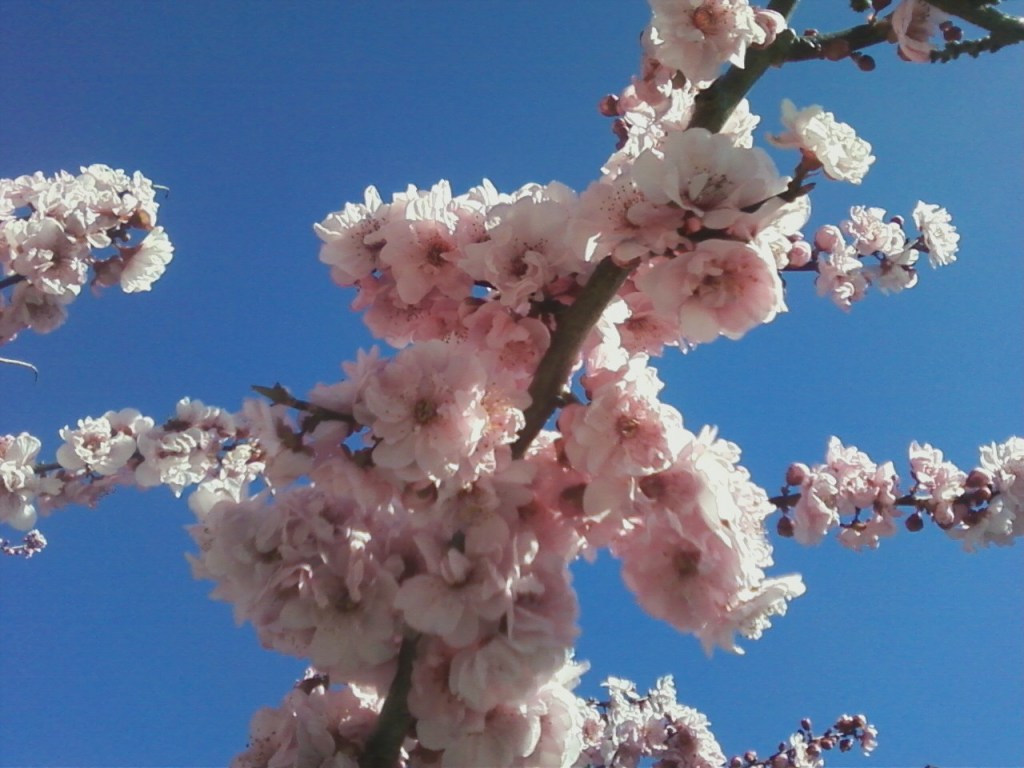
Spring bloom is spectacular prior to foliation.

There are actually several different purple leaf plums, Prunus cerasifera, to provide colorful white or pink bloom sometime between the middle of winter and the middle of spring, followed by colorful bronzy or purplish foliage through summer. Some also provide good fruit, which can unfortunately be messy if it is not harvested. Most stay quite compact, less than twenty feet tall and broad, so are proportionate to small garden spaces. ‘Hollywood’ is the largest, but rarely gets more than thirty feet tall, and not quite as broad. Prunus X cistena does not get much more than six feet tall and broad.

Because each cultivar has a distinct personality, it is important to match trees when adding or replacing trees in a grove. The fruitful ‘Atropurpurea’ has single white flowers in spring, followed by bronzy red new growth that turns purplish in summer and reddish brown in autumn. ‘Krauter Vesuvius’ has single pale pink flowers and the darkest foliage, but lacks fruit. ‘Thundercloud’ has similar or paler flowers, lighter or more bronzy foliage, and sometimes produces tangy red fruit about an inch wide. Prunus X blireiana (illustrated) fades to bronzy green by summer, but has handsome branch structure and double pink flowers that are slightly fragrant. Unlike plums that are grown for larger and more abundant fruit, purple leaf plums do not need much pruning.

Summer Squash

Zucchini are the most familiar squash.

Zucchini is the most familiar variety of summer squash, Cucurbita pepo. It is not the only one, though. Several are varieties of Cucurbita moschata. These species are so variable that they seem to be many more than two. Some varieties are winter squash, which also develop through summer, but ripen for winter. Their fruits are plumper but less numerous.

Some summer squash can grow to be very big also. They can likewise remain intact into winter. However, they are best if harvested while small and tender. Frequent harvest that prevents squash from maturing diverts resources to more squash. Some summer squash can almost be too productive. Production should continue until foliage withers with frost.

Yellow crookneck is probably the second most popular summer squash. It can be almost as productive as zucchini. Pattypan squash has firmer texture, which is an advantage for stews and freezing. All summer squash enjoy organically rich soil and frequent irrigation. Their coarsely foliated vines can get almost aggressively vigorous with summer warmth. Seed from mature squash fruits is typically very variable. Only seed from reliable sources is consistent.

Purple Leaf Plum

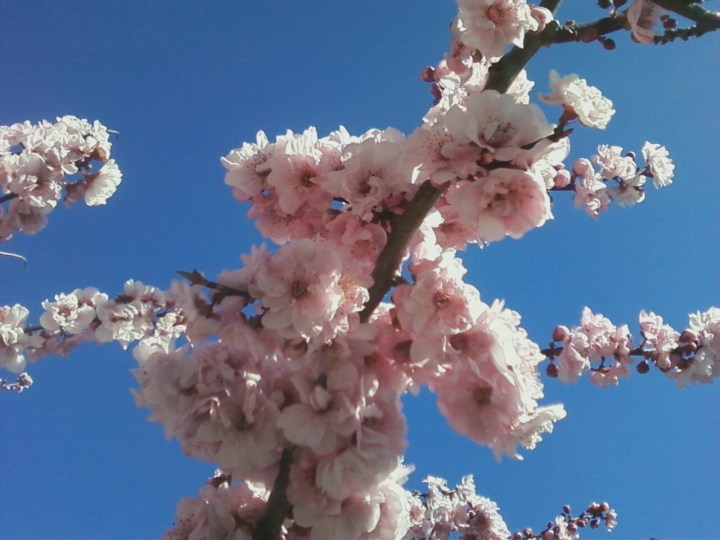
Purple leaf plum bloom is more colorful than its purplish foliage.

There are actually several different purple leaf plums, Prunus cerasifera, to provide colorful white or pink bloom sometime between the middle of winter and the middle of spring, followed by colorful bronzy or purplish foliage through summer. Some also provide good fruit, which can unfortunately be messy if it is not harvested. Most stay quite compact, less than twenty feet tall and broad, so are proportionate to small garden spaces. ‘Hollywood’ is the largest, but rarely gets more than thirty feet tall, and not quite as broad. Prunus X cistena does not get much more than six feet tall and broad.

Because each cultivar has a distinct personality, it is important to match trees when adding or replacing trees in a grove. The fruitful ‘Atropurpurea’ has single white flowers in spring, followed by bronzy red new growth that turns purplish in summer and reddish brown in autumn. ‘Krauter Vesuvius’ has single pale pink flowers and the darkest foliage, but lacks fruit. ‘Thundercloud’ has similar or paler flowers, lighter or more bronzy foliage, and sometimes produces tangy red fruit about an inch wide. Prunus X blireiana (illustrated) fades to bronzy green by summer, but has handsome branch structure and double pink flowers that are slightly fragrant. Unlike plums that are grown for larger and more abundant fruit, purple leaf plums do not need much pruning.

Stock

Stylishly colorful stock is alluringly fragrant.

Marigold is a warm season annual that gets more popular later than earlier in its season. It is prominent for autumn but does not last for long into winter. Stock, Matthiola incana, is a cool season annual for the opposite extreme of the year. It is popular for late winter and spring but may not perform well into summer warmth. It is unreliable as a perennial here.

Stock bloom can be white, or rich shades or pastels of purple, red, pink, yellow or cream. Most bloom is double, but some is single. Floral fragrance is alluringly rich and complex. It resembles that of carnation, but is notably stronger. The narrow leaves are oblong with pastel grayish green color. Removal of deteriorating bloom promotes subsequent bloom.

Garden varieties of stock are quite different from florist varieties. For home gardens, most popular stock is relatively compact, and blooms freely. Florist stock is taller, and tends to bloom abundantly but at about the same time. In home gardens, florist stock may require staking if it grows as tall as three feet. Home garden stock may grow no taller than a foot.

‘Minneola’ Tangelo

‘Minneola’ tangelo fruit is slightly tart like a grapefruit, but richly flavored like a Mandarin orange.

Of all the citrus that ripen about now in winter and early spring, oranges, lemons, limes, grapefruits and mandarin oranges (or mandarins or tangerines) are the most familiar. (A tangerine is merely a mandarin that was developed in the Americas.) Kumquats, blood oranges, sour oranges, citrons and many of the odd citrus hybrids that are less common are becoming more popular as their fruit becomes more available in markets, and their trees become available in nurseries. Except for the very popular ‘Meyer’ lemon, which is actually a hybrid of an orange and a lemon, the most popular citrus hybrid is likely the ‘Minneola’ tangelo, which is a hybrid of a grapefruit and a mandarin orange. Other tangelos remain somewhat rare.

Like all citrus, ‘Minneola’ tangelo has appealingly glossy evergreen foliage and fragrant flowers. They can be grown in containers if their roots are dug, pruned and planted again every five years or so. They like regular watering, good drainage and mulch. Aphids, mites or scale can become problematic. Suckers from below the graft should be rubbed off as they appear. (The graft union can be identified by the change in bark texture and color on the main trunk just a few inches above the roots.)

‘Minneola’ tangelo trees get a bit larger than mandarin orange trees, but not as large or quite as full as grapefruit trees. The bright reddish orange fruit has all the flavor of mandarin oranges, and is just as easy to peel, but unlike the majority of mandarin oranges, has few seeds, and can be left on the tree through spring. The fruit is a bit smaller than that of ‘Valencia’ orange, and has a distended bump where the stem is attached. Flavor develops best in warmer parts of the garden, particularly after warm summers.

Canna

Cannas are as foliar as floral.

Not many summery bulbs provide as much immediate gratification as Canna. They grow very fast as soon as the weather begins to warm at the end of winter. They could become a bit too invasively vigorous for some situations. Canna are almost too easy to propagate by division. They probably perform better with annual thinning, preferably while dormant.

Dormant canna rhizomes are now available from nurseries. Potted specimens should be available a bit later. Canna, though, might be as available from friends or neighbors who grow too many. They crave frequent irrigation, and can inhabit riparian situations such as ponds. Although they are not too discriminating about soil, the prefer organically rich soil.

Canna foliage is about as lush and striking as its bloom. It can be green, various shades of bronze or variegated with white, yellow or bronze. Flowers can be thin and ribbony, or big and billowy. Floral color is various hues of yellow, orange, red, pink, or rarely creamy white. Flowers are commonly spotty or blotchy. Some canna grow higher than eight feet. Dwarf cultivars bloom splendidly without growing taller than two feet.

Pork & Beans

If it appears to be related to burrow’s tail, it is because pork & beans is the same genus.

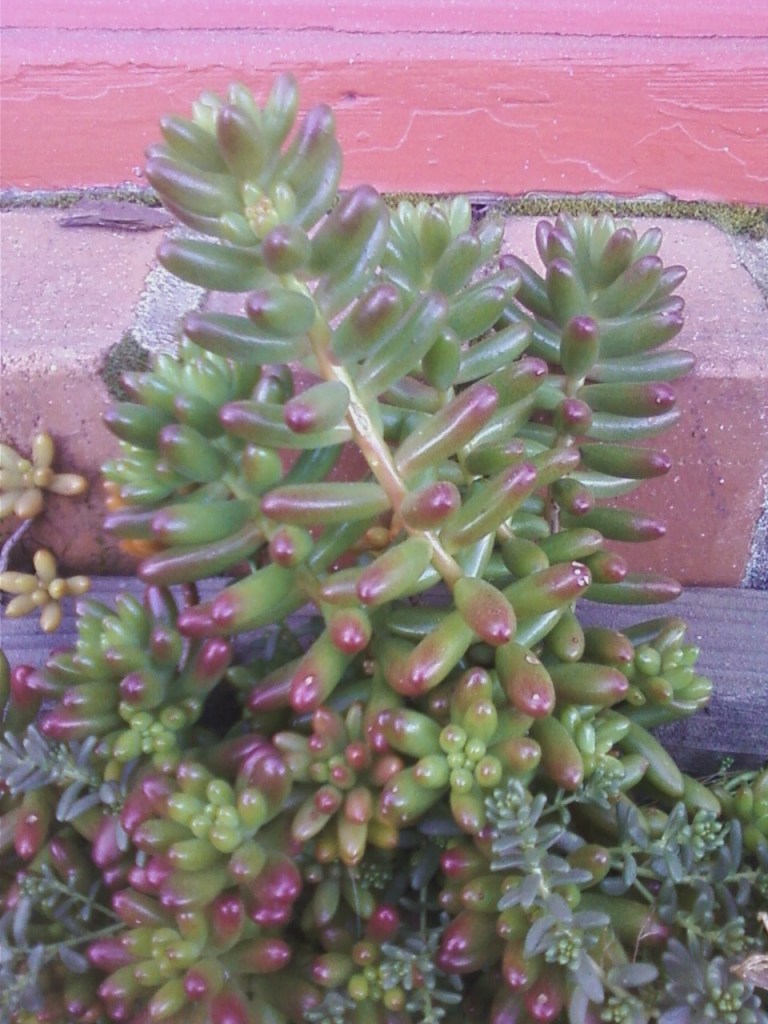
The tender succulent foliage of pork and beans, Sedum rubrotinctum, is as squishy as it appears to be, so is safest where it will not be disturbed. Although it sprawls around without getting much deeper than six inches, it does not fill in reliably enough to be a real ground cover over a large area anyway. It can instead add color and texture in small doses between larger plants or stones. It is a nice addition to urns of mixed perennials, rock gardens and dish gardens. It propagates very easily from stem cuttings or even leaves that break off, so can be tucked into gaps in stone walls.

The plump three quarter inch long leaves resemble jelly beans more than pork and beans, since they are green where shaded. More exposed foliage is more bronzy red or brown, especially at the tips. Small clusters of tiny yellowish flowers are held above the foliage on reddish brown stems in spring.

California Bay

California bay is not culinary bay.

Grecian bay is, as its name suggests, endemic to Greece and the Mediterranean region. California bay, Umbellularia californica, is native to California and southwestern Oregon. The two are very different. Although California bay can be useful for culinary application, it is twice as pungent. For replacing Grecian bay in recipes, half as much should suffice.

California bay also grows much larger and more irregularly than Grecian bay. With good sun exposure, it grows more than forty feet tall. Where it competes for sunlight in forests, it can grow a hundred feet tall. Domestic trees typically develop on single vertical trunks. Wild trees might develop several leaning trunks. Foliar canopies are densely evergreen.

California bay is uncommon within urban home gardens because it is so big and messy. It is more likely to inhabit rural gardens either by self sowing or by being there first. Some old trees that grew from stumps of older trees can develop basal decay. Stumps might be difficult to kill. Foliar and floral detritus inhibits smaller vegetation and seed germination. Some abhor the foliar aroma.

Narcissus

Daffodil are a type of Narcissus.

If their bulbs were planted when they became available as summer evolved into autumn, Tazetta Narcissus and their hybrids should begin to bloom about now, a bit prior to related daffodil and jonquil Narcissus. In cooler winter climates, bloom must wait until early spring. The most popular variety, ‘Paper White’ blooms with about five or six small clear white flowers clustered on top of foot tall stems surrounded by vertical and somewhat rubbery, narrow leaves. Other varieties have white or yellow outer petals, known as the ‘perianth’, or orange or white centers, known as the ‘cup’. All are good cut flowers that are quite fragrant.

Because it is best to leave narcissus foliage to yellow and abscise (shed) naturally after bloom and as weather gets warmer, ground covers that are deep enough to conceal their deteriorating foliage are practical companions. (For example, deteriorating narcissus foliage can be stuffed under healthy English ivy, where it can be hidden without being removed.) Ground cover also keeps the soil from being bare during summer and autumn dormancy.

Mature clumps of narcissus bulbs only need to be dug and divided if they become so crowded that they do not bloom as much as they should. They are easiest to dig immediately after foliage dies back and lies on the ground, when they are dormant but still easy to find. Dug bulbs should then be stored in a cool dry place until it is time to plant them late in summer. Bulbs should be planted about five inches deep and about five to eight inches apart, with good sun exposure. The largest bulbs with multiple buds (known as ‘noses’) bloom most abundantly.

If they are happy in their location, narcissus easily naturalize, even if they do not get divided occasionally. They get most of the water they need from rain, since they are mostly dormant before dry weather in summer. Gophers and deer do not bother them.