Santa Cruz II

Begonia boliviensis ‘Santa Cruz’

Begonia boliviensis ‘Santa Cruz’ is significantly bigger than it was when I wrote about it three months ago. If I had known that it would have performed so well, I would have groomed it for better form. It grew upright at first. I just let it do so because I wanted to make a cutting from the tip when it got pruned back. However, because it leaned over and branched as it should, it did not get pruned back. It could have developed a better and lower form if I had tended to it better, but I am too pleased with it now to complain that it is a bit more upright than it should be. I do not mind that I did not get a cutting from the primary stem that I did not cut back because there are now many more stems that I can get cuttings from, simply be grooming out a small bit of superfluous growth from within. I could get many more than I want if I were to actually prune this specimen back for winter. It is getting to be too exemplary to cut back for winter, though. Nor do I want to leave it out to get frosted, as I might do with other begonias. The horticulturist who procured it will shelter it from frost, and perhaps groom it a bit after winter, but otherwise try to retain as much of this growth as possible for a head start next spring. I am curious to see what it does. Will it shed most of this growth as it resumes growth from below next spring; or will it grow from near the tips of where it stopped growing this year? I did not expect to be so impressed by this modern cultivar of Begonia.
Six on Saturday: Away Again

It is a long story. To be brief, Rhody and I are again far away from work and home, near Phoenix in Arizona, without time to write.

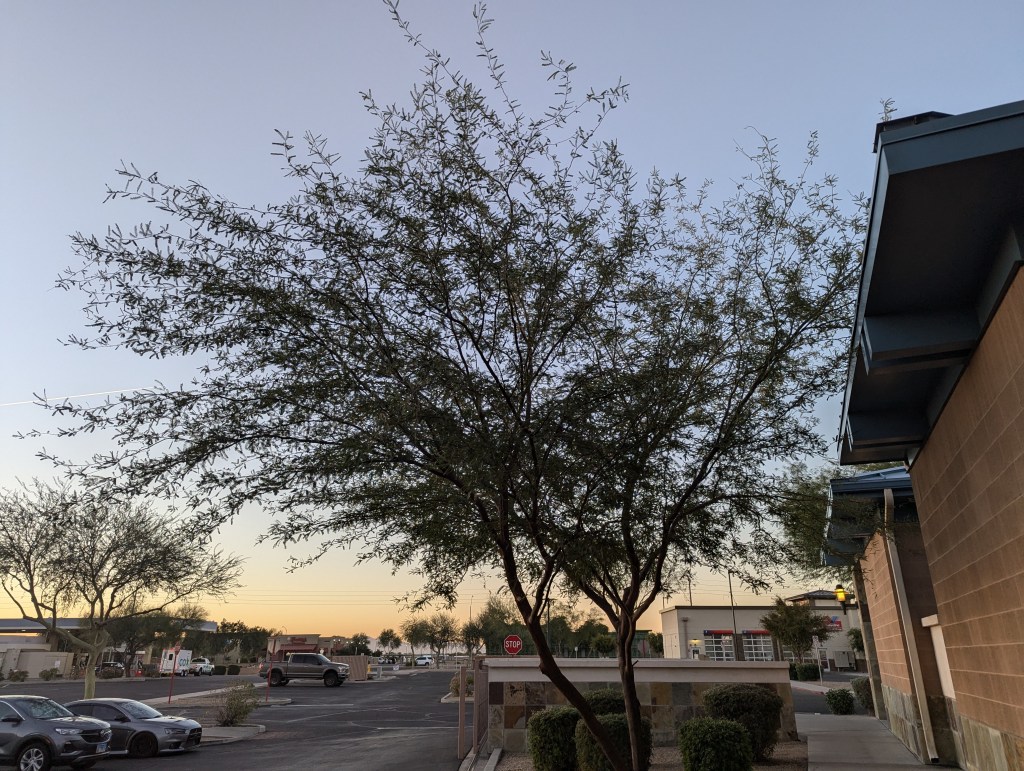
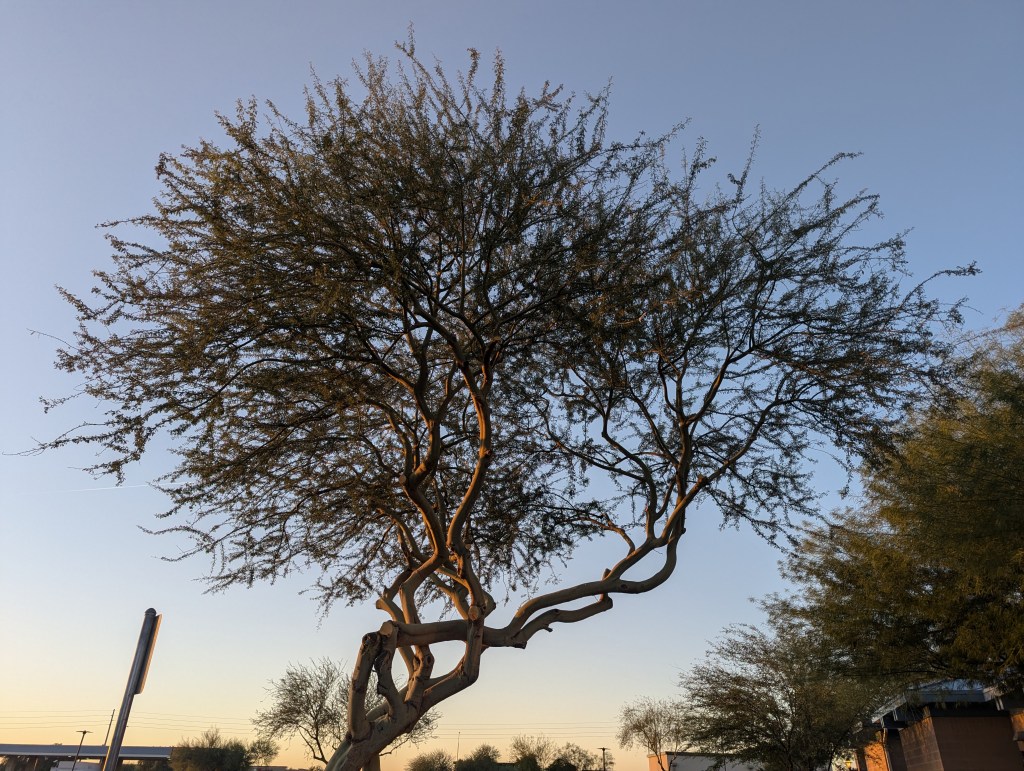
1. Prosopis velutina, velvet mesquite is supposedly the most common mesquite here and is also native. It develops sculptural form, but only light shade, which seems to me to be substandard for such a warm climate. Perhaps it is common because it is undemanding.

2. Parkinsonia florida, blue palo verde is also native like velvet mesquite, but is only one of the two most common palo verdes here. Foothill palo verde is the other. Both develop sculptural form and light shade, also like velvet mesquite, and are a bit more sculptural.

3. Lantana montevidensis, trailing lantana is the same common type that I occasionally work with at home, but seems to be happier and more colorful here, even while shorn as these weirdly compact globs, and humiliatingly deprived of its naturally sprawling form.

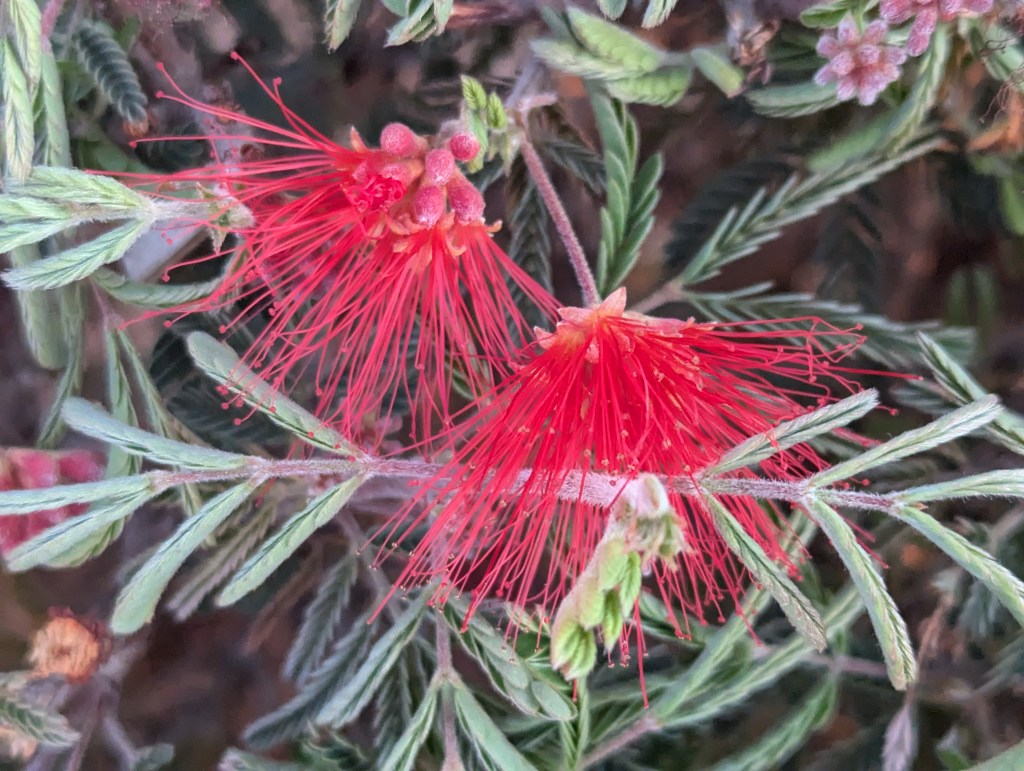
4. Calliandra californica, Baja fairy duster seems to be more prevalent here than it is in California. Of course, Baja California is a very big and very diverse region to the south of the State of California that I am familiar with. I suspect that this is a hybrid or a cultivar.

5. Leucophyllum frutescens, Texas sage, like so much of the flowering shrubbery here, is shorn too abusively to bloom as well as it likely should. Its silvery gray foliar color is also compromised. I can not even guess what its natural form or branch structure should be.

6. Rhody is so tolerant of my interest in unfamiliar vegetation. His only interaction with it involves just ‘claiming’ it. I absconded with a handful of seed pods and three seedlings of velvet mesquite, and a seedlings of Baja fairy duster (which will get a different name).

This is the link for Six on Saturday, for anyone else who would like to participate: https://thepropagatorblog.wordpress.com/2017/09/18/six-on-saturday-a-participant-guide/

Elderberry

Blue elderberry is native here.

Although almost never planted intentionally, elderberries occasionally appear in strange places, wherever their seeds get dropped by the birds or rodents who eat their berries. The blue elderberry, Sambucus mexicana / caerulea, is native and most common between California, British Columbia and the Rockies. The American elderberry, Sambucus canadensis, is more common elsewhere, and also appears in the west where it had historically been imported for berry production. Some modern cultivars (cultivated varieties) with gold, bronze, or lacy foliage are actually related to European elderberries.

Except for compact cultivars, elderberries grow rampantly to about fifteen feet tall and wide. Aggressive pruning in winter keeps them looking fuller and more densely foliated. Overgrown plants can be rejuvenated by getting cut to the ground. The big leaves are divided into seven leaflets that are two to six inches long. Blue elderberry foliage is softly serrate and a bit more variable, with five to nine leaflets that may be as short as one inch.

Wide flat trusses of pale white flowers that bloom in late spring or early summer produce small but potentially abundant and richly flavored berries. Blue elderberries are dark blue dusted with white powder on trusses to about six inches wide. American elderberries are darker and more purplish on trusses that can be wider than eight inches. (Red elderberries are toxic!)

Chinese Elm

Chinese elm is sculptural and textural.

Dutch elm disease became a serious problem for American elms in the 1930s. However, it did not reach California until half a century or so later. Chinese elm, Ulmus parvifolia, is not very susceptible to the disease, but is a vector. In other words, it can survive infection to share it with other species of elm. Consequently, it became unavailable by the 1980s.

Some mature specimens of formerly common Chinese elm still inhabit older landscapes. Younger specimens in newer landscapes are mostly ‘Drake’ Chinese elm. They are a bit more upright, with more symmetrical form. More importantly, they are not vectors of Dutch elm disease. Other cultivars that are also resistant are rarely available at local nurseries.

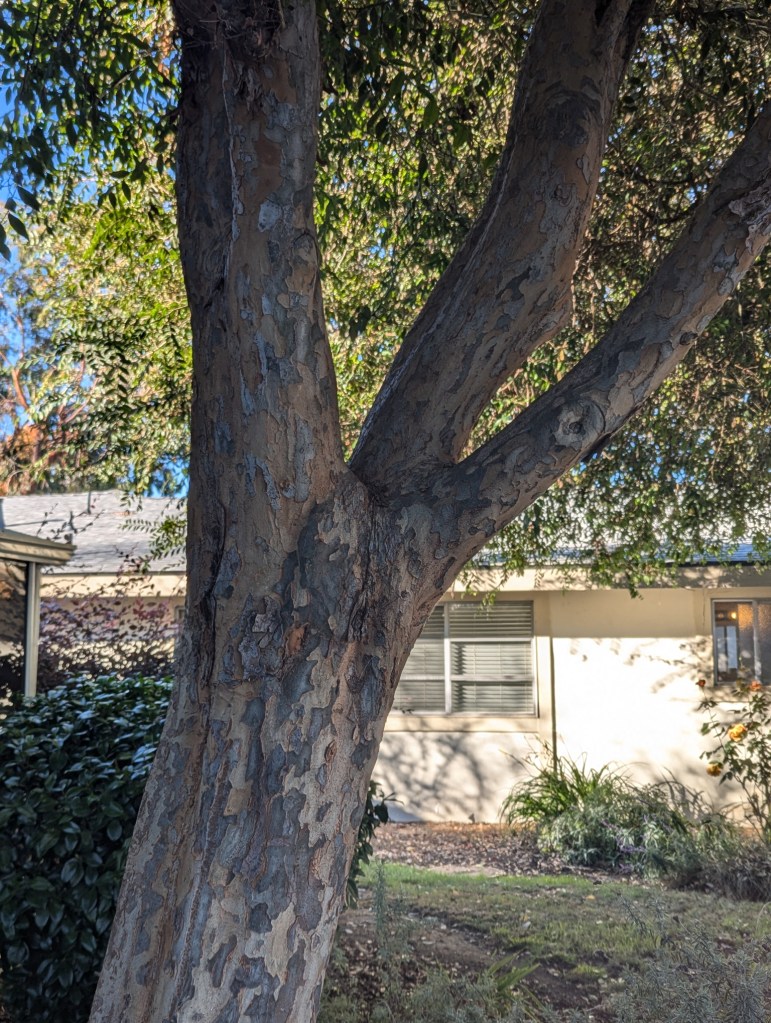
Classic and formerly common Chinese elm can eventually grow more than fifty feet high. Some can grow thirty feet wide to shade an entire urban front lawn. Some cultivars might grow nearly as high, but are generally not quite as broad. Their blotchy gray and tan bark adorns curvaceous limbs. Their small deciduous leaves are not very colorful for autumn. They can be copious, messy and quite tedious to rake.

Sweet William

Sweet William can grow as a short term perennial.

Because they do not like warm weather through summer much, sweet William, Dianthus barbatus, is appreciated more as a cool season annual from autumn into winter and even into spring. They can also be planted early in spring for color before summer warmth. They can sometimes survive as perennials in sheltered areas, particularly if mixed and hidden amongst other perennials and annuals. Deadheading (removal of deteriorating flowers) prolongs bloom.

New plants are easy to propagate from division, cuttings or layering of tired older plants. (Layering involves rooting prostrate stems by burying them slightly and them separating them when they have developed roots.) By the time the old plants become too deteriorated to salvage, the new cuttings or layers should be ready to replace them. New plants like to start out in rich and well drained soil, but not watered too much since they can be susceptible to rust and fusarium wilt.  

The white, pink, rosy pink, red, somewhat purplish or bicolored half inch wide flowers form rather flat dense trusses on top of short stems. Minute but abundant green bracts fill the spaces between the individual flowers. The rich green leaves below are about an inch to two and a half inches long. Mature plants of the more common varieties are typically less than a foot tall and wide. More compact and larger varieties are available as seed.

Blue Atlas Cedar

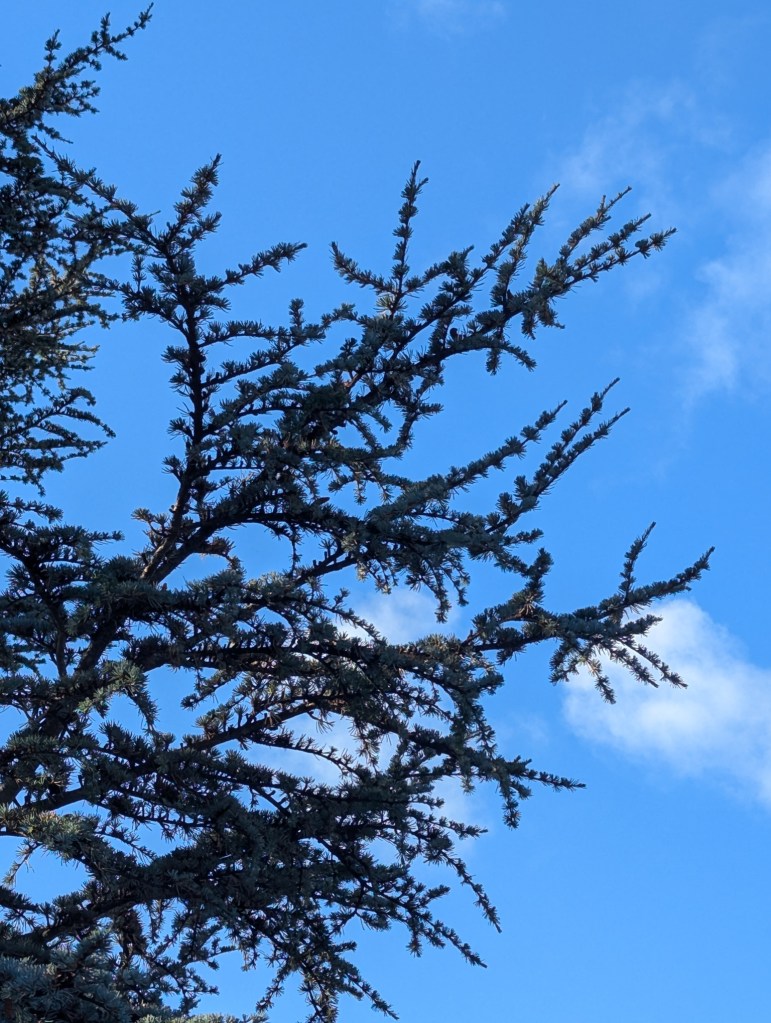
Blue Atlas cedar creates distinctive silhouettes.

No other coniferous tree develops such distinctively irregular form. Very few exhibit such distinctively steely grayish blue foliar color. Blue Atlas cedar, Cedrus atlantica ‘Glauca’ is no simple shade tree. It is a striking trophy tree that is worthy of prominent display within grand landscapes. It is ideal for traffic circles, without other trees to obscure its boldness.

Blue Atlas cedar is also sufficiently resilient for traffic circles and other difficult situations. Arid warmth, even if enhanced by pavement, roofs or walls, should be no problem. Once established, blue Atlas cedar does not crave much irrigation. It should be able to survive with none. Excessively frequent or copious irrigation is more likely to become a problem.

Blue Atlas cedar can grow a hundred feet tall in the wild within its native range. It should not grow much more than half as tall with good exposure within landscapes. Trunks may slowly grow to almost six feet wide. Canopies can eventually grow wider than thirty feet. ‘Glauca Pendula’ is weeping blue Atlas cedar, which is smaller but even more exquisite. ‘Aurea’ with gold tips, is very rare.

Zinnia

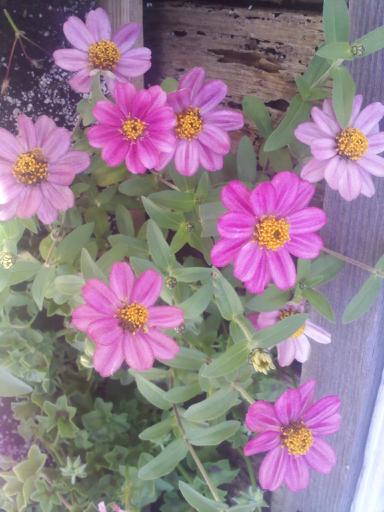
Zinnia look like small dahlia, but are annual.

The longer and cooler nights of autumn will soon finish the season for zinnias. (Most, but not all of the common zinnias are of the species Zinnia elegans.) They are really at their best while the weather is warm through summer and the beginning of autumn. As the garden warms up at the end of next spring, new seedlings can be planted, or zinnia seed can be sown. They like rich soil and regular watering, but are susceptible to mildew in humid spots. Sunny areas with good air circulation are best.

Like related chrysanthemums, zinnias are quite variable. Although the simpler forms remain more popular; double, cactus flowered and crested forms are also available.  Flowers can be less than an inch wide to more than five inches wide. Their color range includes white, yellow, orange, salmon, pink, red, rose, purple, lavender and even green. The narrowly oval leaves can get to about four inches long. Compact types stay about a foot tall and wide. Large types get twice as wide and more than three times as tall. 

Vine Maple

Vine maple works like Japanese maple.

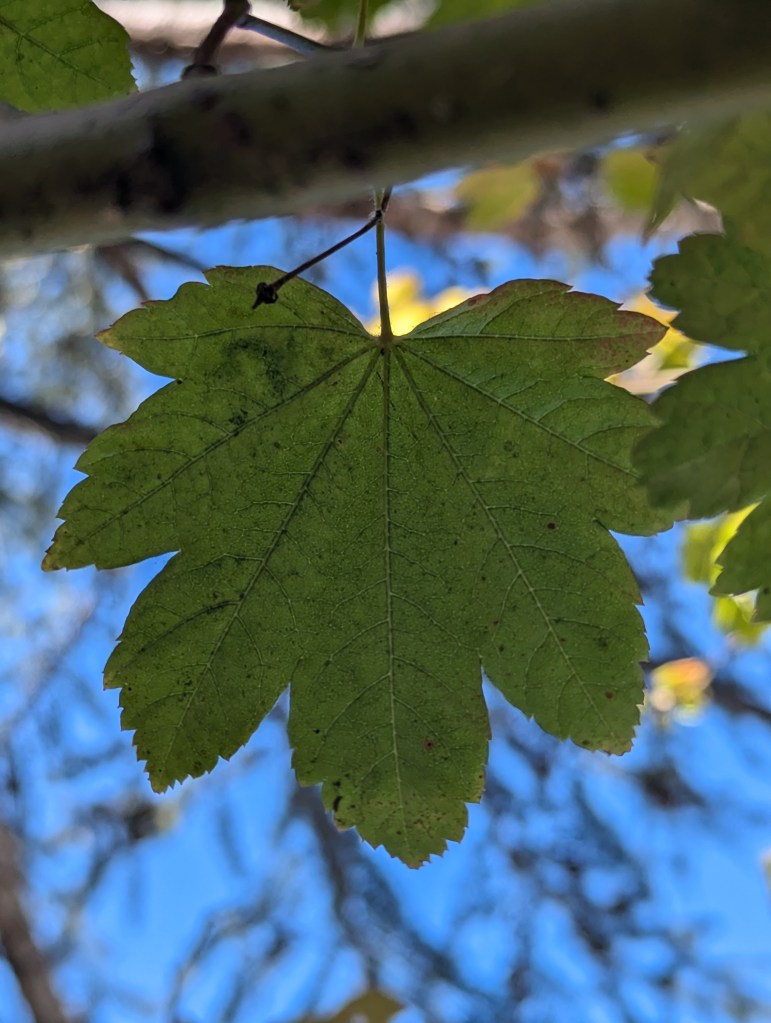
Japanese maples became so popular for their novelty that they are no longer novel. The diversity of their many cultivars is their primary appeal now. Vine maple, Acer circinatum, lacks such diversity, but is actually more novel. It is native from Mendocino County to the southwestern corner of British Columbia. Yet, it is very rarely available at nurseries here.

Vine maple has not been in cultivation for nearly as long as Japanese maple has. This is why its diversity is limited to not much more than a dozen cultivars. Its cultivars are even rarer than the simple species. Only a few ever become available, and almost exclusively by online purchase. Consequently, with very few exceptions, they are initially very small.

Vine maple grows somewhat like Japanese maple, typically with a few sculptural trunks. With regular pruning, it can stay as short as ten feet. It rarely grows more than twenty feet tall. The lobes of its palmate leaves are wider than those of Japanese maple. Leaves are only about three inches long and wide. Foliage develops bright orange color for autumn.

Periwinkle

Periwinkle is both pretty and a weed.

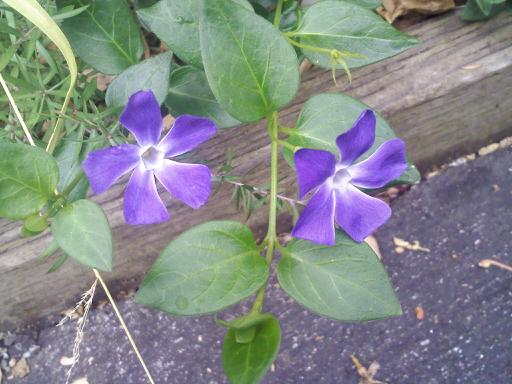
Conflict would likely erupt from any discourse between the city mouse and the country mouse regarding the topic of periwinkle, Vinca major. In rural areas, periwinkle can aggressively invade any area that stays even slightly damp through summer; and it is nearly impossible to eradicate. In urban areas, periwinkle can be a useful and appealing ground cover for difficult situations. It clings to steep embankments, and ventures into shade that is too dark for other ground covers.

Periwinkle can mound up to more than a foot and a half deep with wiry stems and rich green leaves about two and a half inches long. It looks neater and stays lower if shorn or mown down just before new growth develops at the end of winter. Two inch wide sky blue periwinkle flowers bloom mostly as new growth develops through spring, and can bloom sporadically through the end of autumn. ‘Variegata’, with wide white leaf margins, brightens up urns or planters of mixed ferns, and also looks good cascading from planters of mixed annuals or perennials. 

Ranunculus

Ranunculus blooms several months from now.

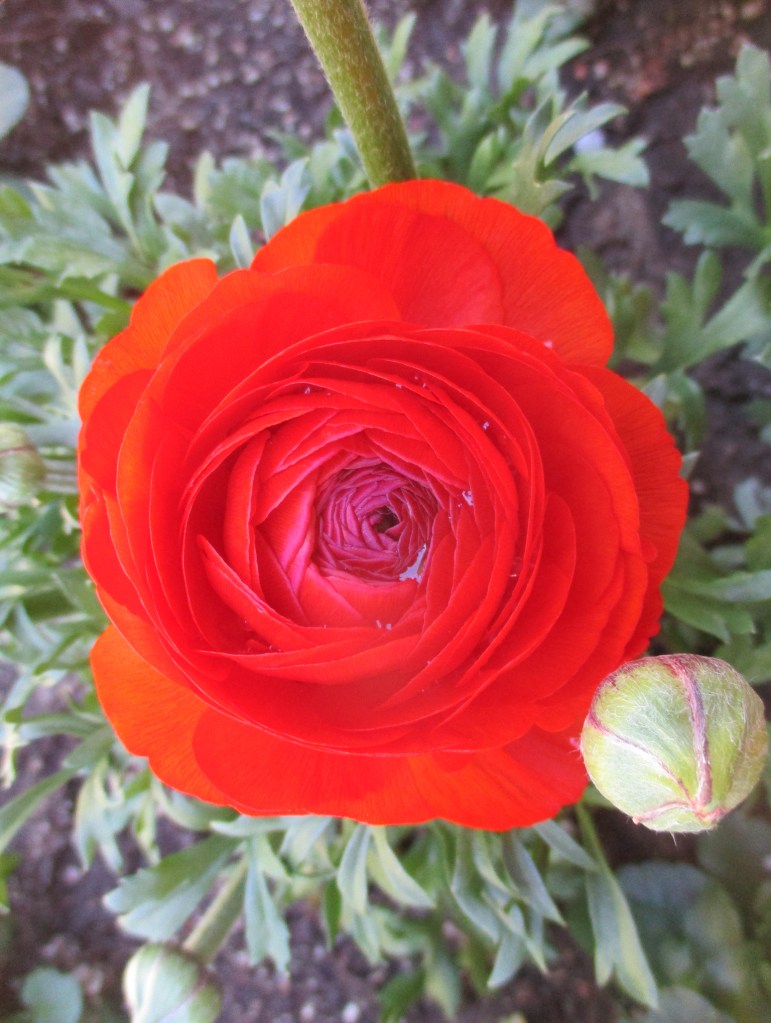
The shriveled and dried tuberous roots of Ranunculus are not much to brag about. They look more like dehydrated mini calamari than dormant and viable spring bulbs. Yet, they somehow bloom as soon as the weather warms enough after winter. Although they need no vernalization, they need time to grow. Bulbs should be into their garden by December.

Alternatively, small budding plants will be available from nurseries after winter. They are too big for cell packs, so are mostly in four inch pots. Larger one gallon plants often have shabby foliage. Although popular as annuals, Ranunculus can be reliably perennial like other bulbs. They are less susceptible to rot if dug and stored while dormant for summer.

Ranunculus bloom is white, yellow, orange, red, pink or purple. The plump flowers have many papery and densely set petals, like small peonies. They typically stand less than a foot high, and may be only half a foot high. Their finely textured basal foliage stays even lower. It resembles parsley, but is a bit more substantial. It shrivels during warm weather.