Myrtle

Myrtle is more foliar than floral.

Old landscapes of the Victorian Era may still include myrtle, Myrtus communis. It is quite a survivor. It had been popular for centuries because of its resiliency. It is very conducive to the sort of formal hedging that was popular during that time. As formal hedges became old fashioned, so did myrtle. Yet, it is still more sustainable than more popular shrubbery.

Besides, myrtle is not limited to refined shorn hedges. It can just as efficiently become an unshorn and informal hedge or screen. It can grow as tall as fifteen feet, but rarely grows higher than first floor eaves. Without pruning, it typically grows about half as wide as it is high. Selective pruning rather than shearing limits its size without ruining its natural form.

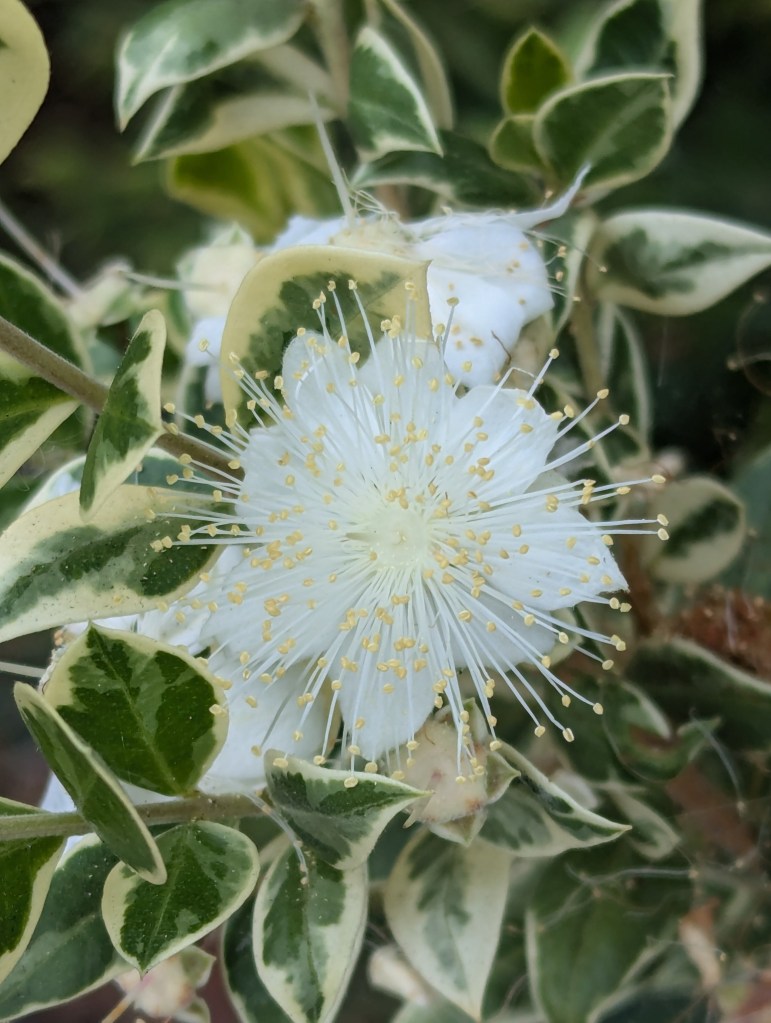
Myrtle foliage is densely evergreen and pungently aromatic. Individual leaves are merely an inch or two long. Small white flowers with prominent stamens may not be very showy. Small and darkly bluish black berries are sparse. ‘Compacta’ grows only about three feet high and wide. ‘Compacta Variegata’ is slightly more compact and variegated with white.

Garden Verbena

Garden verbena sort of resembles lantana, with more variety of color.

When I first saw ‘Peaches ‘N Cream’ garden verbena, Verbena X hybrida, that was trendy in the early 1990’s, I thought that the variable shades of pale pink and nearly white of its flowers were too dull. Then I saw the flashy bright red, purple, blue and fluorescent pink of other modern varieties at the time, and gained a new appreciation for the more subdued color range, including white and more ‘normal’ pink. The flower color range may not be very extensive, but it is diverse.

Even though it is commonly grown as an annual, garden verbena is actually a short term perennial. It is a traditional component of mixed flower urns and planter boxes, but does not necessarily need to be replaced along with other annuals. Like English ivy and ferns that are so often planted with annuals, garden verbena can be salvaged, at least for a few seasons, as annuals come and go. It looks good in hanging pots or large urns where its slightly cascading form can be appreciated. In good soil, garden verbena can become a colorful small scale ground cover.

Mature plants do not get much more than six inches deep or two feet wide. Their coarsely dentate leaves are about two inches long. Their flat, two inch wide trusses of small flowers bloom mostly in summer. Hard pruning at the end of winter helps restore plants in spring, and keeps plants healthy longer. Mildew can become a problem in humid areas, particularly if air circulation is inhibited by crowded foliage.

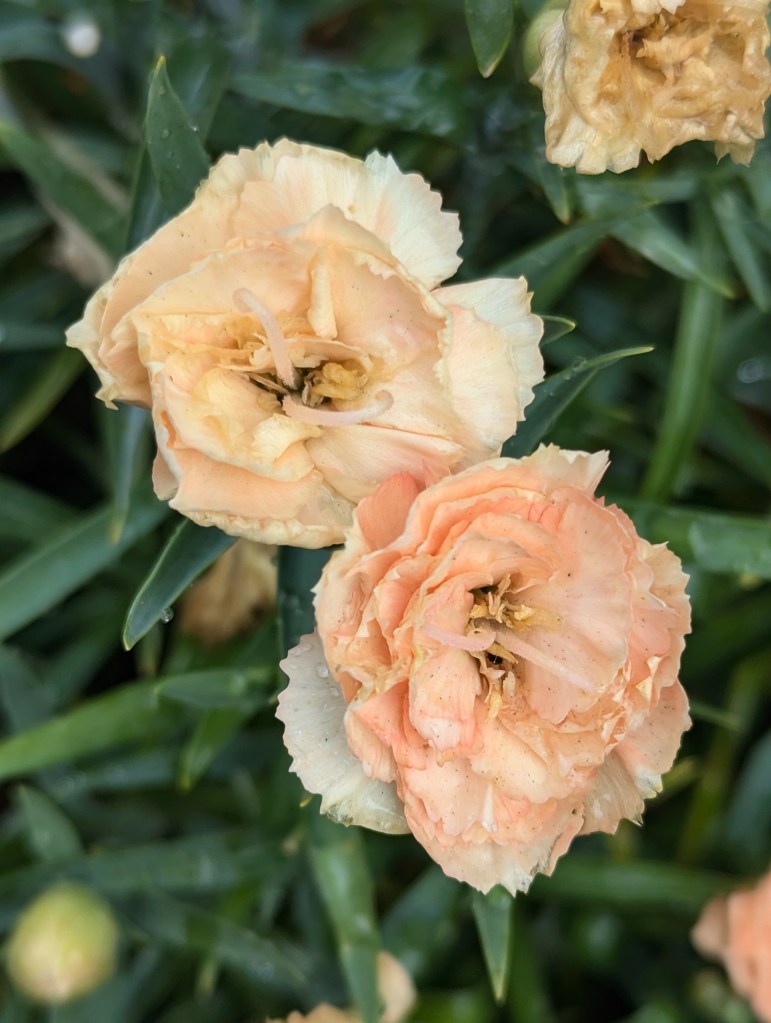
Border Carnation

Border carnations stay short and compact.

Florist carnation, Dianthus caryophyllus, is not originally as colorful as it seems. It can be red, pink, pastel yellow, pastel orange or nearly purple. Most for the floriculture industries begin as white though. White carnations are conducive to dying with any color that might be in demand. They are therefore more versatile than those with a different natural color.

Furthermore, their natural floral color range is not as natural as it seems. It is the result of extensive breeding of several species. Consequently, several popular types of carnation lack species designation. This includes a few compact cultivars that are more popular as annuals than cut flowers. Within locally mild climates, they can be short term perennials.

Border carnations grow only a few inches tall and less than a foot wide. Eventually, very old specimens may grow more than a foot tall. Such big specimens are very rare though. Border carnation foliage is glaucous bluish gray. The short and very narrow leaves are in opposing pairs. Flowers are less than two inches wide, with delightfully spicy fragrance of clove.

Poor Man’s Rhododendron

Poor man’s rhododendrons is less colorful but more perennial than the more popular busy Lizzie Impatiens walleriana.

The nursery industry is so innately unsatisfactorily lucrative, that to us nurserymen, a ‘poor man’s rhododendron’ is any rhododendron that we grow. To everyone else, it is Imaptiens sodenii, a tender perennial that gets to six feet tall and wide or even larger on plump, softly succulent stems. It succumbs to even mild frost in winter, but regenerates rapidly by summer. It prefers partial shade, and can roast if too exposed to direct sunlight on warm days. Too much shade is rarely a problem.

The two inch wide flowers are typically very pale shades of pink, lavender or slightly blushed white. At least one modern variety has brighter white flowers with reddish pink centers. Bloom continues as long as weather is warm. The seed capsules are not much to look at, but explode to disperse their seeds when disturbed. The soft, rich green leaves are about three to six inches long.

Saint John’s Wort

Saint John’s wort is a survivor.

Saint John’s wort is the common name of a few species of Hypericum. Hypericum beanii sometimes gets the distinction of Bean’s Saint John’s wort. That sounds more like carob, Ceratonia siliqua, though. Carob is the locust bean that sustained Saint John the Baptist in the desert. Mr. Bean was actually a respected botanist of the Royal Botanical Garden.

This Saint John’s wort is not as invasive as naturalized sorts, but is as resilient. Although rarely available from nurseries, it survives in old and neglected landscapes. Established specimens need no irrigation, but perform better with it. This species is likely rare merely because of its resemblance to invasive sorts. It propagates quite efficiently from cuttings.

Hypericum beanii is a shrubby species, unlike more familiar ground cover types. It grows about two or three feet tall and wide. Its bright yellow flowers are about two inches wide, and bloom through summer. Foliage is deciduous where winter is cooler. Here, it is likely to linger until spring foliage replaces it. Partial shade is tolerable, but might inhibit bloom.

Ice Plant

Other types of ice plant bloom with different colors.

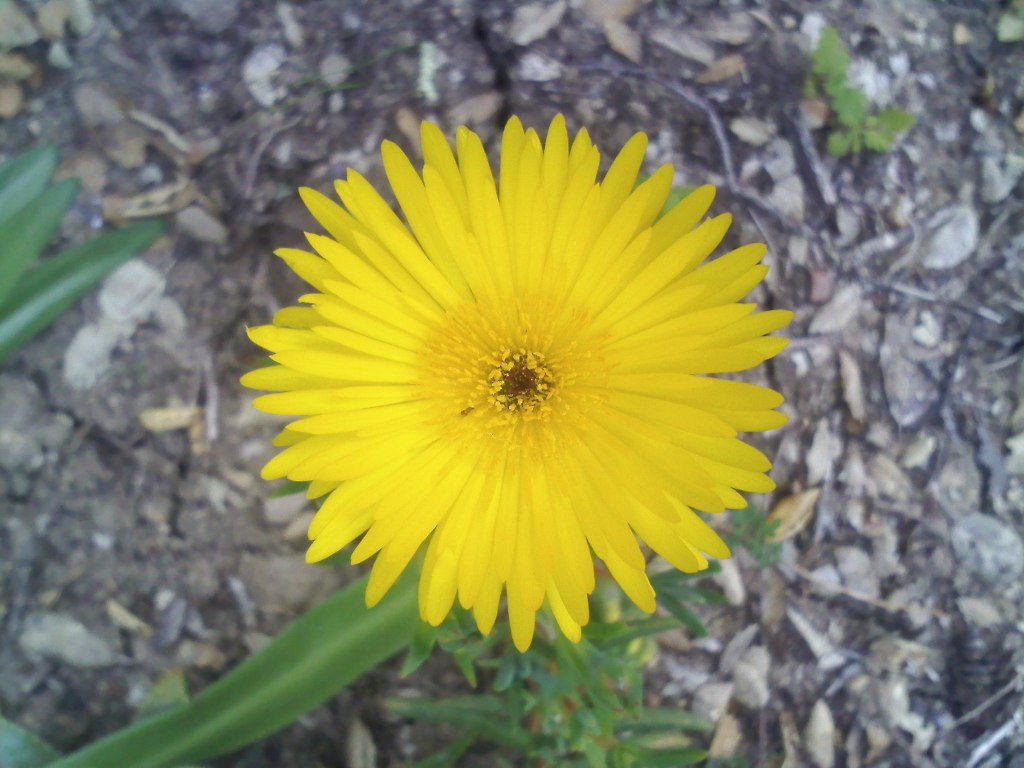
The bright orange, inch and a half wide flowers of Lampranthus aurantiacus, a type of ice plant, should bloom between winter and spring, but a few are brightening my garden right now. This bright yellow flower in the picture is that of the variety ‘Glaucus’, which I grew from a cutting last year. My single low mounding plant is about a foot wide now and will eventually spread to about two feet wide, and can get about a foot deep. Stems can root where they lay, forming new plants that will spread farther. To accelerate the spread, more plants are very easy to propagate from small cuttings. Lampranthus aurantiacus has narrow, inch long leaves, and a relatively shrubby basal branch structure.

Tropical Hibiscus

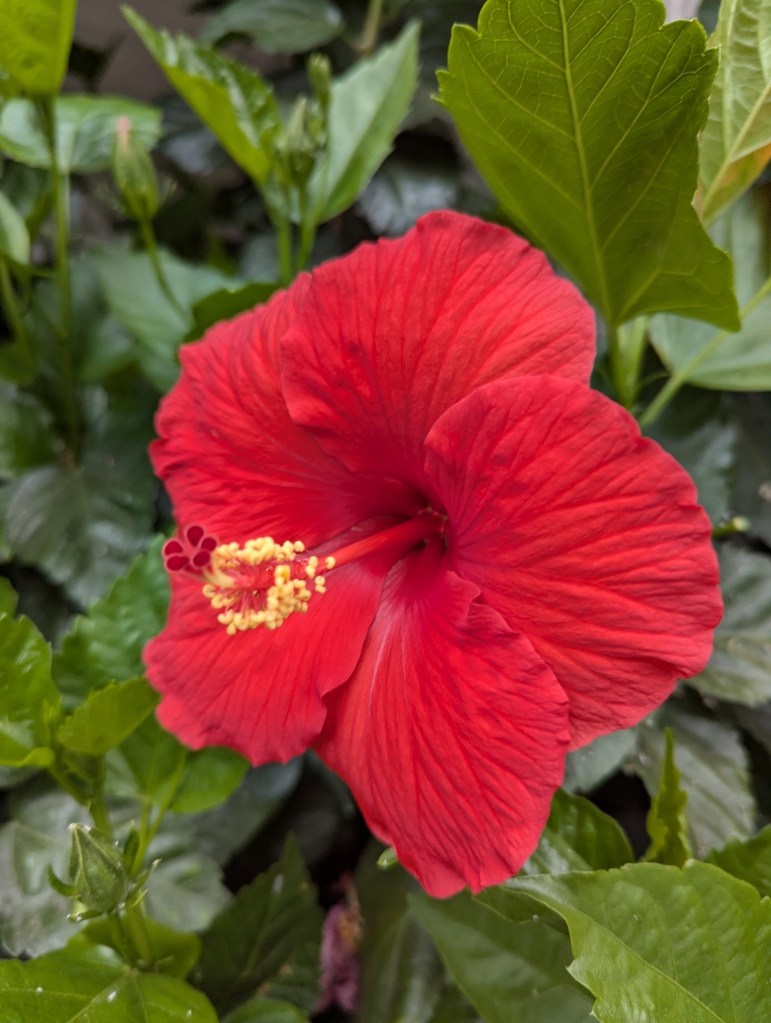
Hibiscus floral structure is notably unusual.

Hummingbirds and butterflies are quite fond of tropical hibiscus, Hibiscus rosa-sinensis. They are attracted to the bright yellow, orange, red, pink or white color of its bloom. They stay for the syrupy nectar that they find deep within the flowers. Tropical hibiscus attracts pollinators rather efficiently, but almost never generates seed. Most cultivars are hybrids.

Tropical hibiscus flowers are not overly profuse, but are about three or four inches broad. Fancy hybrids that bloom with broader flowers are not as vigorous as more typical sorts. Most cultivars bloom with somewhat ruffled single flowers. Some bloom with more ruffled double flowers. Both types of flowers have five garishly flaring petals. None are fragrant.

Tropical hibiscus grows as evergreen shrubbery about six to a bit more than ten feet tall. Pruning to remove congestion of inner growth promotes healthier outer growth. Besides, whitefly and scale insects often proliferate on crowded foliage. Leaves are mostly two to five inches long and two to three inches wide. Bloom continues from summer to autumn, mostly with warmth.

Hollyhock

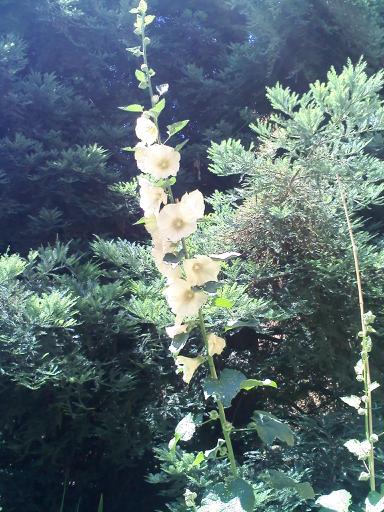
Hollyhock was more popular within Victorian gardens.

Old fashioned hollyhock, Alcea rosea, can be a bit too imposing for small gardens, since their spire like flower stalks can get taller than eight feet. Modern varieties are more proportionate, standing about five or six feet tall. Some are only about two and a half feet tall. Many modern varieties also have fluffier semi-double or double flowers. Those with smaller flowers have denser flower set than old varieties (Flowers are closer together on the stem.).

The three to five inch wide flowers bloom through summer in shades of pink, red, purple, pale yellow, pale orange and white. Removal of spent flower stalks may promote shorter autumn blooms, but also prevents self sowing. Seed can be sown at the end of summer for blooms next year. The coarsely textured and variably lobed basal foliage does not get much wider than two feet. Snails and rust can be problematic.

Smokebush

Smokebush bloom is not particularly flowery.

Mundane floral color and a lack of floral fragrance are no problems. Smokebush, Cotinus coggygria, compensates. Its uninteresting bloom reveals strikingly fluffy floral trusses for summer. These trusses eventually deteriorate to reveal exquisitely vibrant foliar color for autumn. This foliar color eventually deteriorates to reveal sculptural trunk form for winter.

Foliar color through spring and summer is likely the most striking attribute of smokebush. Most are boldly rich purplish bronze. Some are strikingly vivid yellowish chartreuse. The two extremes contrast splendidly. Old fashioned olive drab is now rare. Foliar color does not fade much. However, it suddenly transitions to fiery orange and red color for autumn.

Old fashioned olive drab smokebush can grow a bit more than fifteen feet high and wide. Because it does not grow fast, only old specimens are so large. Most bronze cultivars do not get much higher than first floor eaves here. Chartreuse cultivars are likely to stay a bit shorter. Healthy young specimens might get wobbly if their canopies outgrow their roots. Aggressive pruning improves form and stability, and can also enhance foliar color.

Godetia

All but one species of Clarkia are native somewhere in California.

Like California poppy, sky lupine and various other native wildflowers, godetia, Clarkia amoena, seems to prefer its own space. However, it is somewhat more adaptable than some other natives are to regular irrigation and coexisting with exotic (non-native) wildflowers that are not too overpowering. It is a common component in wildflower mixes, and is more likely than most to naturalize after the other wildflowers have died out. 

It is best to sow godetia seed in autumn, directly where the flowers are wanted, so that the seed get watered in by rain and begin to grow through winter and early spring. Bloom begins later in spring or early summer. In areas that do not get watered regularly, occasional watering prolongs bloom. Fertilizer can actually interfere with bloom though. As bloom finishes, deteriorating plants should be left to disperse seed for the following year.

The two inch wide flowers are typically pink or purplish with red blotches or veining. Some are very pale pink or nearly white with deeper pink blotches at their centers. Most godetia are only about a foot or two tall. ‘Dwarf Gem’ stays less than a foot tall. Taller types get nearly three feet tall. The lanky stems are adorned with narrow light bluish green leaves that are about half an inch to one and a half inches long.