North & South

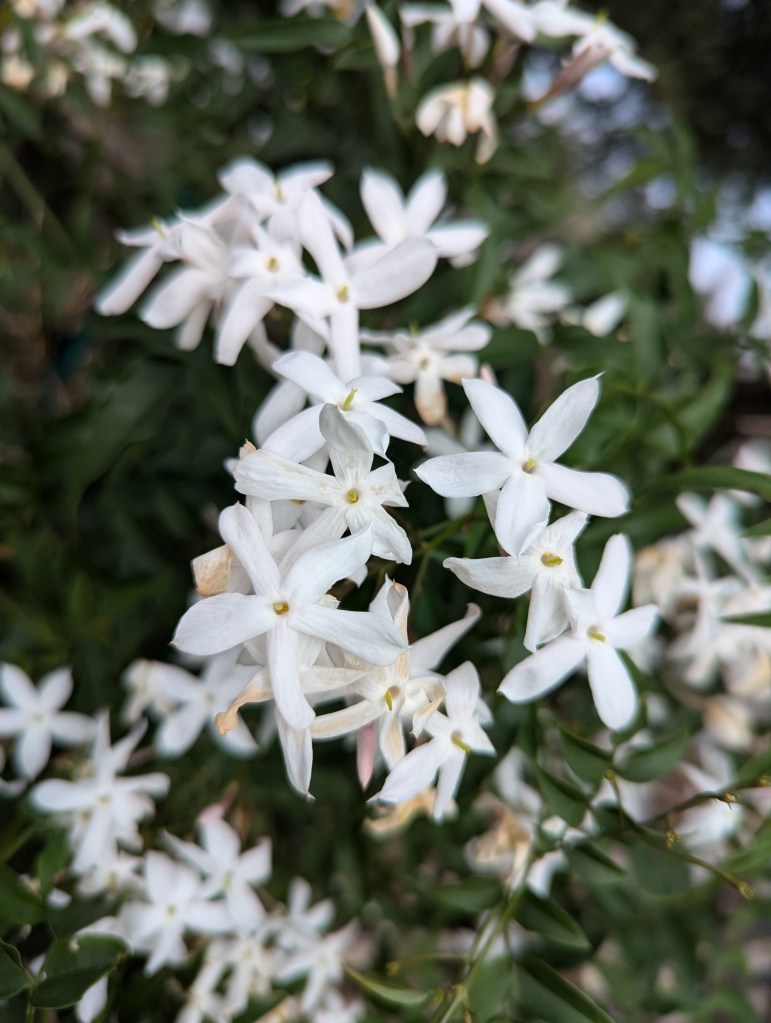
pink jasmine, Jasminum polyanthum

Brent and I studied horticulture through the second half of the 1980s at California Polytechnic State University at San Luis Obispo, which is known more simply as Cal Poly. San Luis Obispo is exactly halfway between where each of us came from. He came from the region west of Los Angeles, two hundred miles to the southeast, which is considered to be south by the standards of California. I came from the region west of San Jose, two hundred miles to the northwest, which is considered to be north by the standards of California. He considered San Luis Obispo to be within Northern California. I considered it to be within Southern California. Consequently, when either of us encountered a species with which we lacked prior experience, we assumed it to be regionally popular within the respectively unfamiliar half of California. Such assumptions were accurate for some species. For example, Brent was as fascinated with redwoods as I was with desert fan palms. He knew that redwoods are more popular here than in Southern California, and eventually went to experience them growing wild within their native range near Santa Cruz. I knew that desert fan palms are more popular in Southern California than here, and eventually went to experience them growing wild within their native range near Palm Springs. Pink jasmine, Jasminum polyanthum, was an odd one. Because Brent had never encountered it before, he assumed that it had been popular in Northern California. Because I had never encountered it before, I assumed that it had been popular in Southern California. In actuality, it only became commonly available throughout California at about the time that we encountered it, so had previously been popular neither here nor there. Nonetheless, to Brent, it is still as northern as it is southern to me.
Perennial Pea

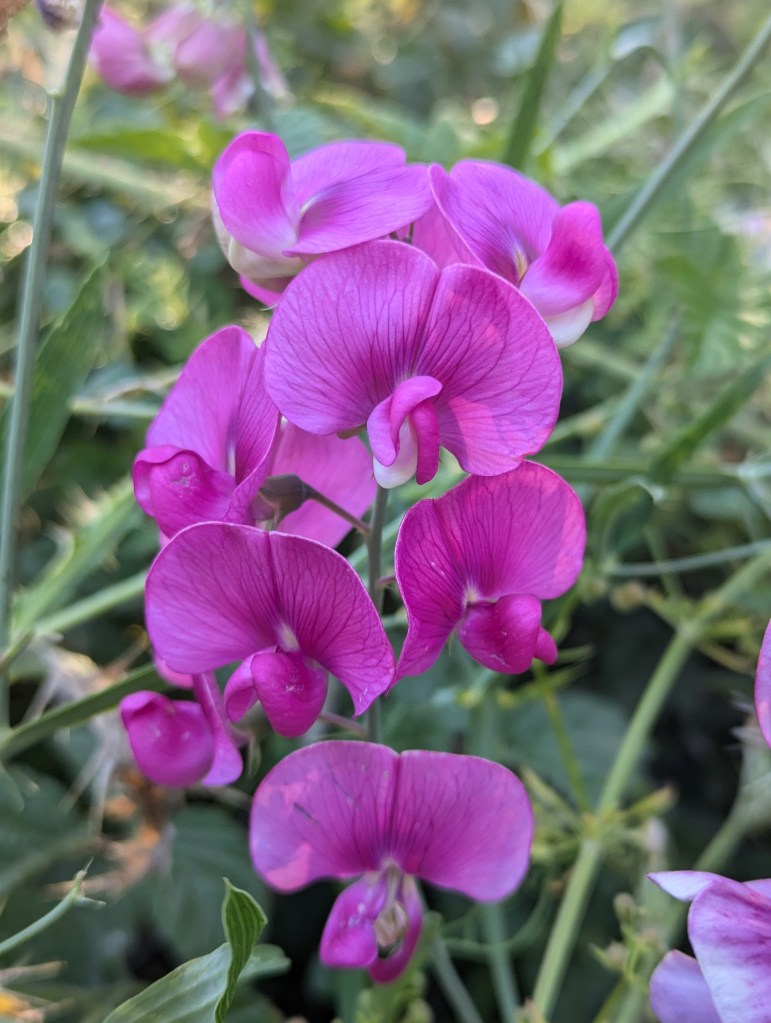
Perennial pea is a naturalized wildflower.

Now that the weather is getting hot, perennial pea, Lathyrus latifolius, is finishing bloom. It needs warmth to bloom, so can begin between the middle or end of spring. However, it shrivels in heat, so can finish between the beginning and middle of summer. Sometimes, it can bloom for almost three months. Sometimes, it finishes almost as soon as it starts.

Perennial pea is more popular as a naturalized wildflower than within home gardens. Its seed is rarely available from nurseries. Young seedlings might not grow very big initially. Mature specimens can vigorously climb and creep more than seven feet in any direction. Their fibrous perennial roots are very difficult to kill. Propagation by root division is easy.

Almost all perennial pea blooms with an abundance of bright pinkish magenta flowers. A rare few bloom with slightly striated light pink flowers. A bit fewer bloom with bright white flowers. Bloom resembles that of annual sweet pea, but is less frilly and lacks fragrance. Slightly bluish foliage and stems have a soft texture, and recover slowly from disruptions. Any parts can be toxic if ingested.

What Is This IV?!

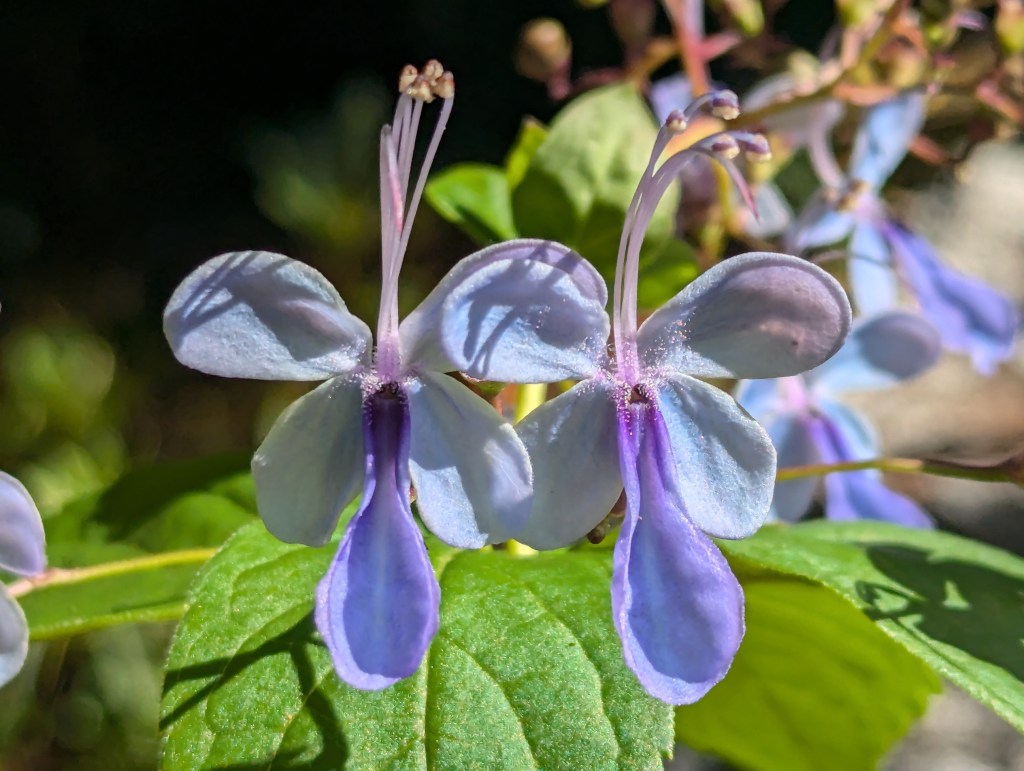
Rotheca myricoides / Clerodendrum myricoides ?

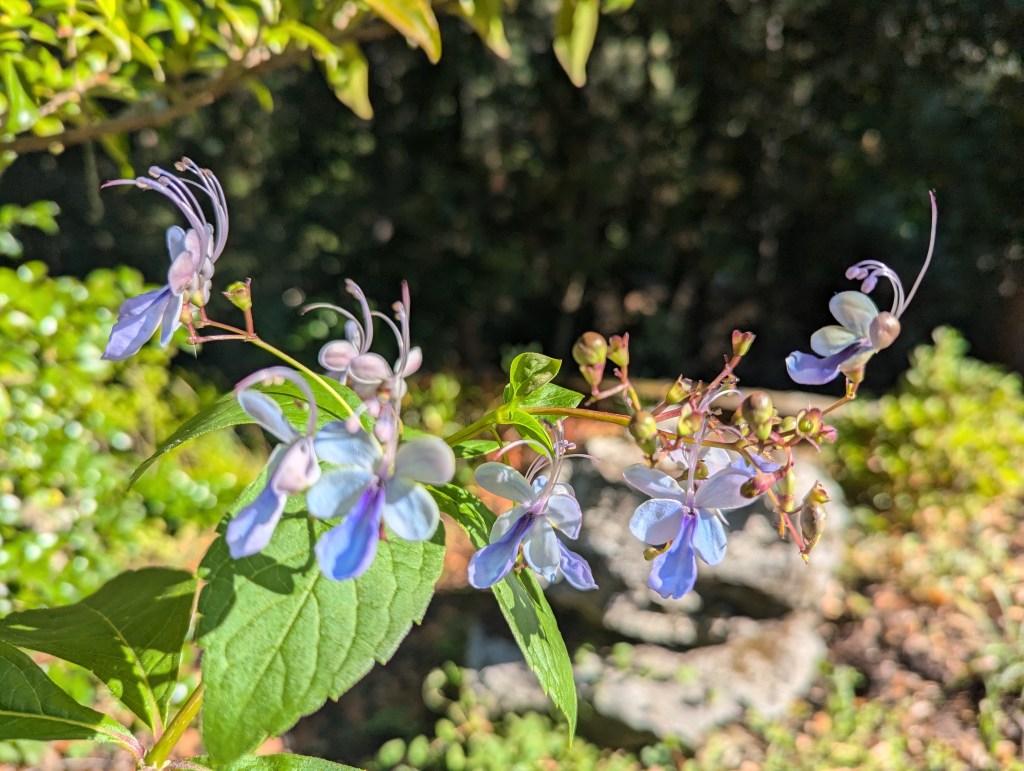
It is not a species of ivy. ‘IV’ is merely its Roman numeric designation as the fourth species that I am unable to identify since I started assigning numeric designations to them. So then, what is it? I suspect that it is likely Rotheca myricoides, which is alternatively known as Clerodendrum myricoides. ‘Ugandense’ is a cultivar name that, in typical modern tradition of botanic nomenclature that violates the simple standards of botanic nomenclature, now seems to be an acceptable species name in conjunction with either genus name. Its common names include butterfly flower, blue butterfly plant and blue butterfly bush, although the latter sounds more like a cultivar of Buddleia. I have not actually confirmed its identity, and I have no idea how it got into one of our landscapes. It grew under the carcass of a Brunfelsia pauciflora, yesterday, today and tomorrow, which did not survive my meager attempt to salvage it from compost. I can only assume that it arrived, most likely as an ungerminated seed, with the now deceased yesterday, today and tomorrow. It initially grew quickly with only two straight canes about four feet tall. I would have pulled it as a weed, but was intrigued by it. It did not grow much this year, but instead took time to branch, and is now taking time to bloom with these few intricate flowers on top. I am now pleased that I did not pull it as a weed. If it really is butterfly flower, it can get a bit taller than it already is. So, because it grew in front of an exemplary sasanqua camellia, I will likely relocate it to a more appropriate situation during its winter dormancy. I am fond enough of its sky blue flowers to propagate a few more copies of it.

The delicate pastel blue flowers are prettier up close.

Shore Juniper

Shore juniper is a ground cover that can cascade splendidly.

Like so many other junipers, the old fashioned shore juniper, Juniperus conferta, is recovering from decades of a bad reputation. Through the 1950’s and 60’s, junipers had been so overly common and were so commonly planted where space was insufficient for their mature size that just about anyone who enjoys gardening now likely knows how irritating prickly juniper foliage can be, or how to remove overgrown junipers. I prefer to blame the icky tam junipers for this.

Now that they are actually regaining popularity, junipers seem to be commanding more respect; perhaps with the exception of tam junipers, which are just as useless now as they ever were. Junipers that grow into small trees are getting planted where they can be appreciated for their sculptural forms. Shrubby junipers are being employed as informal barriers where they do not need to be pruned for confinement. The shore juniper, like other low growing or creeping junipers, is a practical ground cover. Mature shore junipers spread about six feet wide without getting deeper than a foot. The finely textured bluish green foliage is actually a bit more bristly than it first appears, with small pine needle shaped leaves. The soft berries are lighter grayish blue to purplish black. ‘Emerald Sea’ has greener foliage that seems to be a bit more lax. ‘Blue Pacific’ has denser and more bluish foliage.  

Sawara Cypress

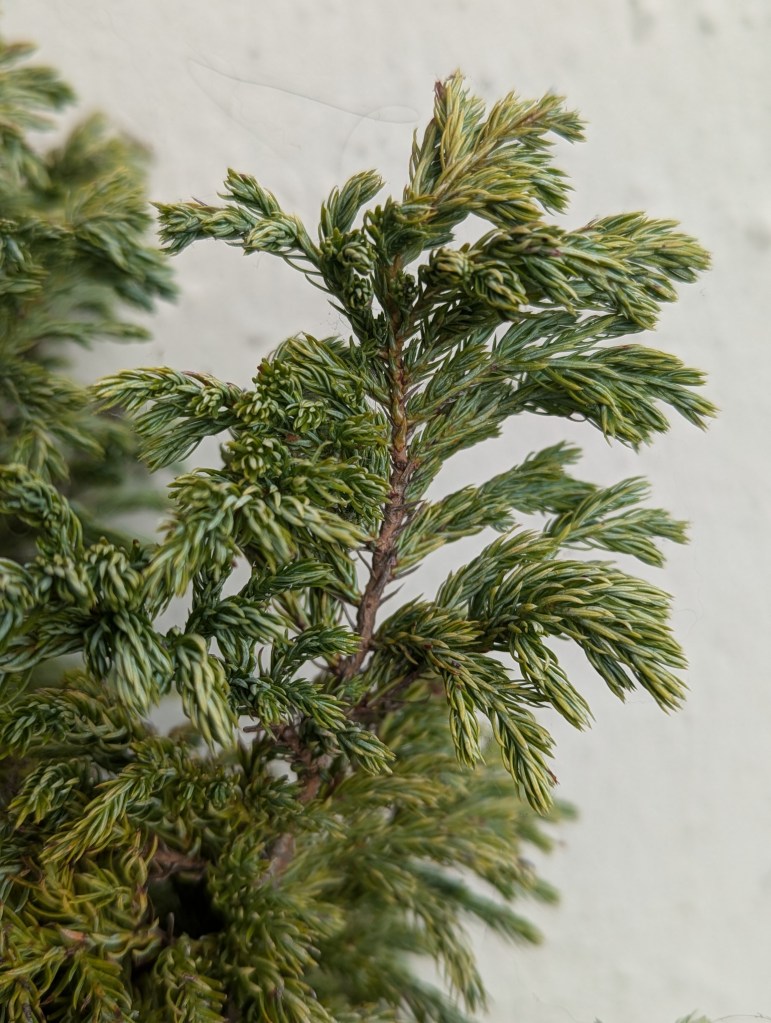
Sawara cypress cultivars are relatively compact.

It is difficult to imagine Sawara cypress, Chamaecyparis pisifera, as a timber tree. Within its native range in Japan, it can grow as tall as one hundred and fifty feet. Its trunk can be six feet wide. It is no surprise that it grows slowly though. Its more familiar types rarely grow taller than ground floor eaves. Only the oldest and biggest are nearly thirty feet tall.

Sawara cypress cultivars are uncommon, and some are rare. Among them, ‘Boulevard’ is less uncommon. It has feathery bluish foliage, and can grow eight feet tall. Supposedly, it can eventually grow nearly three times as tall. ‘Filifera Aurea’ has bright yellowish foliage on limber cord like stems. It supposedly gets taller, but it is typically lower and mounding.

Although its cultivars are more diverse, Sawara cypress resembles compact arborvitaes. Its densely evergreen foliage has a similarly soft texture. Its bark is similarly ruddy with a similarly fibrous texture. Individual scale leaves are less than a sixteenth of an inch long. Sawara cypress classifies as the false cypress because it is not of the genus Cupressus.

Thrift

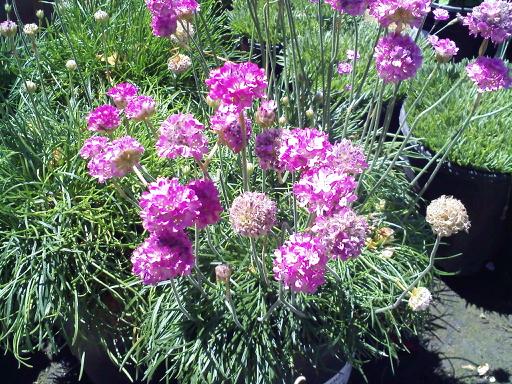
Thrift performs well in coastal climates.

When I see common thrift, Armeria maritima, in nurseries now, I wonder what such a diminutive perennial would be useful for. Their densely compact mounds of narrow evergreen leaves rarely get more than four inches deep, and take their time spreading to less than a foot wide. Then I remember how thrift visually softened the straight edges of my father’s brick patio and retaining walls, and fit so nicely into the tight spots. If allowed to do so, thrift creeps slowly over edges of pavement and stepping stones, but is not too eager to overwhelm them.

If it eventually gets overgrown, thrift is easily cut back to the edge of pavement at the end of winter, and will green over its raw edge by spring. The bits and pieces that are left over from cutting back the edges can be plugged back into other areas and will eventually develop roots if initially watered regularly. Once established, thrift stays healthier if allowed to dry somewhat between watering. Bald spots that may naturally come and go as mature plants die out in the center and then regenerate fill in faster if outer edges get cut back.

The dense round clusters of tiny flowers stand above the foliage on bare stems about four to eight inches high. The flowers are almost always bright pink, but are sometimes white or reddish pink. Bloom is most profuse in spring and may continue sporadically all year. 

Little Leaf Sage

Little leaf sage has little flowers.

Its common name is both simple and descriptive. Little leaf sage is a literal translation of its botanical name, Salvia microphylla. However, several of its most popular cultivars are actually hybrids with other species. Also, they are more popularly but inaccurately known as Salvia greggii. Most lack their species name between their genus and cultivar names.

Little leaf sage is a small and generally evergreen shrubby perennial. Mature specimens are about three or perhaps four feet tall. They are a bit wider, and some can slowly widen by dispersing little rhizomes. Their little leaves are less than an inch long and delightfully aromatic when disturbed. Where winters are cooler, frost might initiate partial defoliation.

Bloom is most abundant for late spring or early summer, and again for autumn. Sporadic bloom can continue throughout most of the year. A few flowers may even bloom through winter. Floral color ranges through red, white and pink, as well as peachy and rosy pink. Coppicing old growth at the end of winter promotes replacement with new basal growth.

Clematis

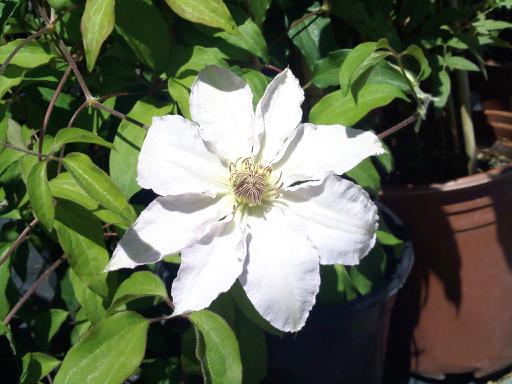
Clematis like warm air but cool soil.

Like the big bark of a little terrier, the big and boldly colored flowers of large-flowered hybrid clematis seem to be more than their delicate vines should be able to produce. Almost all of the many modern varieties bloom with flowers that are at least three inches wide; and some have slightly ruffled double flowers. Their rich, deep, and sometimes two toned shades of red, blue, purple or pink, as well as white seem too opulent for their simple wiry stems that may climb to only six feet or so. The dark green compound leaves grab harmlessly onto light trellises, stakes or lattice.
Although the foliage and flowers want sunny exposure, clematis roots do not like warm soil, so appreciate generous mulching.  Some people like to give them a wide rock to disperse their roots under, or plant them next to large pots that sit directly on the soil. I planted mine on the north side of the northwestern corner of the house where the soil was always shaded, and allowed it to climb around the corner onto an iron banister on the west side.

Clematis want to be watered and fertilized regularly, and well drained organically rich soil. They should be pruned rather aggressively in winter while they seem to be dead, but are really just dormant.

Nasturtium

Feral nasturtium is yellow or orange.

Most consider nasturtium, Tropaeolum majus, to be a warm season annual. Some might consider it to be a cool season annual. A few press its tender stems into moist soil to root and continue growth as a perennial. Plants that bloom for summer can disperse seed for winter bloom. Plants that bloom for winter can likewise disperse seed for summer bloom.

Because they replace themselves so readily, they may seem to be perennial. In actuality, plants from one season, whether warm or cool, may not last long in the next. Seed might be sneaky about spreading. Trailing nasturtiums might naturalize in riparian ecosystems. Nasturtium seedlings are available in cell packs, but do not grow as vigorously as seed.

Nasturtium bloom is diverse shades and tints of yellow, orange and red. Varieties bloom with particular colors within that range, although few are true to type. Their feral progeny bloom only bright orange and bright yellow. Their tender growth does not get much more than one or two feet deep. Trailing varieties can climb as high as first floor eaves though. Nasturtium leaves are almost circular like those of water lilies.

White Sage

White sage is so aromatic that it may be be objectionable to some.

‘White’ is not often associated with ‘sage’, since so many sages are known for the rich shades of purple, blue and red of their flowers. Others have lavender, pale blue, pink, yellow or ‘almost’ orange flowers. Compared to these, the whorls of small, slightly blushed white flowers of white sage, Salvia apiana, are relatively unremarkable, even though they are held as high as a foot and a half above the shrubby foliage on elegantly slender flower spikes.

However, the evergreen silvery foliage of white sage is quite remarkable both visually and aromatically. It is so aromatic that some people may actually find it to be objectionable. Those who initially grow white sage as an herb or for use as incense later realize that it also becomes a prominent ornamental, particularly with dark green foliage, like junipers or arborvitaes, to contrast with its strikingly silvery color. Mature plants get taller and wider than three feet, with simple three inch long leaves. After spring bloom, flower spikes can be shorn off to promote fuller foliar density. I prefer to prune stems back more aggressively to promote more aromatic vigorous vegetative (non-blooming) growth. These vegetative stems become less aromatic as they too eventually bloom.