Sticks on Fire

Sticks on fire is a more colorful version of pencil tree.

The old fashioned pencil tree, with leafless, succulent stems is a strikingly strange plant already. In mild climates of coastal Southern California, it can get quite large, nearly ten feet broad and twice as high. Sticks on Fire, Euphorbia tirucalli ‘Sticks on Fire’, stays less than half as large, but is even weirder because the stems are so oddly colored.

The inconspicuous leaves drop almost as soon as they develop, leaving distended fleshy stems that are either reddish or yellowish orange. Stems fade to softer yellow through summer, and then turn red in winter. Size and growth rate are limited by a lack of chlorophyll. Although related to poinsettia, the flowers of sticks on fire are not significant.

Sticks on fire prefers full sun exposure and warmth, but unfortunately needs protection from frost during winter. It can be happy under an eave on a south or west facing wall, or in a large tub that can be moved to shelter during winter. Plants in tubs are a bit more sensitive to rot if watered too frequently. The sap of sticks on fire is very caustic to skin and can be dangerous if it gets in the eyes.

Daffodil

Daffodil will bloom months from now.

They may seem to be unseasonable now. Their flowers will not bloom until early spring. It is getting to be about time to install their dormant bulbs, though. Daffodil and all related Narcissus enjoy chilling under damp soil through winter. In fact, established bulbs bloom better after unusually chilly winters. Plump bulbs of some types are conducive to forcing.

The names for daffodil and Narcissus seem to be interchangeable. Narcissus is actually the Latin name of daffodil. It mostly applies to those with smaller but more abundant and fragrant flowers. Most with bigger but fewer and scentless flowers are daffodil. Narcissus are mostly white, but may be yellow. Daffodil are mostly yellow, but may be white or pink.

Some of the fancy varieties of daffodil bloom with billowy double flowers with two colors. Simpler Narcissus are more likely to naturalize though. Taller varieties of both can bloom nearly a foot and a half high. Their narrow and bluish green leaves stay somewhat lower. Foliage deteriorates after bloom, but lingers to sustain new bulbs until summery warmth.

King Palm

King palm prefers frostless climates of Southern California.

Where it grows wild in rain forests of eastern Australia, the piccabeen or bangalow palm, Archontophoenix cunninghamiana, is a strikingly elegant tree that gets to about fifty feet tall on a clean, slender trunk. The six to ten foot long feather fronds (pinnate leaves) form a light but distinctive canopy about ten to fifteen feet broad. Smooth green petioles (leaf stalks) encase the upper few feet of crownshaft, eventually peeling away cleanly to reveal the smooth trunk as it grows below. A juvenile king palm does not bloom, but eventually flaunts adulthood with softly pendulous ‘graduation’ tassels of profuse but tiny purple tinged white flowers.

Locally, this palm is known more commonly as the king palm, and does best as a large houseplant or where it is protected from frost. Outdoors, it seem to be happiest close to the San Francisco Bay where it is somewhat insulated by all the water, but can unfortunately get smacked about by the wind there. A mature tree is somewhat more tolerant to frost than a young tree is, but can be damaged or even killed if it gets cold enough.

King palm fortunately does well in the partial shade of larger adjacent trees or buildings that might shelter it from frost. However, it can not be pruned down for clearance from higher trees, ceilings or any other overhead obstruction (including utility cables), so should be planted where it has plenty of room to grow vertically, or where no one will mind it getting removed when it gets too tall after many years.

Unlike most other palms, king palm does not transplant easily when mature. It has no problem getting planted from a pot to a larger tub or planter, or into the ground. Once in the ground though, it is there to stay.

Lantana

Lantana exudes a pungent foliar aroma.

Bloom continues as long as warm weather continues. Within warm exposures within the mildest of climates, it does not stop for long. Within cooler climates, Lantana camara may already be decelerating its bloom. Although remarkably resilient to arid warmth, it can be vulnerable to frost farther inland. Once established, lantana does not require much water.

Umbels of several tiny tubular flowers are about an inch and half wide. Individual flowers bloom progressively inward from the edges of their umbels. They are typically yellow, but then fade to orange, red or pink. Blooms therefore develop yellow centers within orange, red or pink edges. One cultivar is uniformly bright yellow. Another fades to creamy white.

Old fashioned lantana can eventually grow six feet tall. Congested old specimens might respond favorably to coppicing after winter. After coppicing, new growth can grow six feet high within its first season. Modern cultivars are generally shorter and relatively compact, and a few sprawl. Their very slightly raspy foliage is pungently aromatic when disturbed.

Canary Island Date Palm

Canary Island date palm is the boldest of the common palms here.

The biggest and boldest of the common palms is the Canary Island date palm, Phoenix canariensis, which can get more than sixty feet tall and nearly forty feet wide, with a full canopy of gracefully arching deep green fronds. A young tree actually spends the first many years as a shrubby plant while the base of the trunk develops. Fronds get longer and spread broader every year until the trunk gets big enough to elongate. Vertical growth then accelerates somewhat, but the canopy gets no broader.

Most trees are female, eventually producing ornately orange but messy clusters of inedible dates. Male trees eventually get a bit taller, but are not quite as graceful and bloom with unimpressive dusty tan flowers.

Old deteriorating fronds need to be pruned away close to the trunk. Petiole bases of the most recently removed fronds are often carved into ‘pineapples’ to leave a bit of support directly below the canopy. Removed fronds leave a distinctive pattern on the trunk.

Japanese Garden Juniper

Japanese garden juniper stays relatively low.

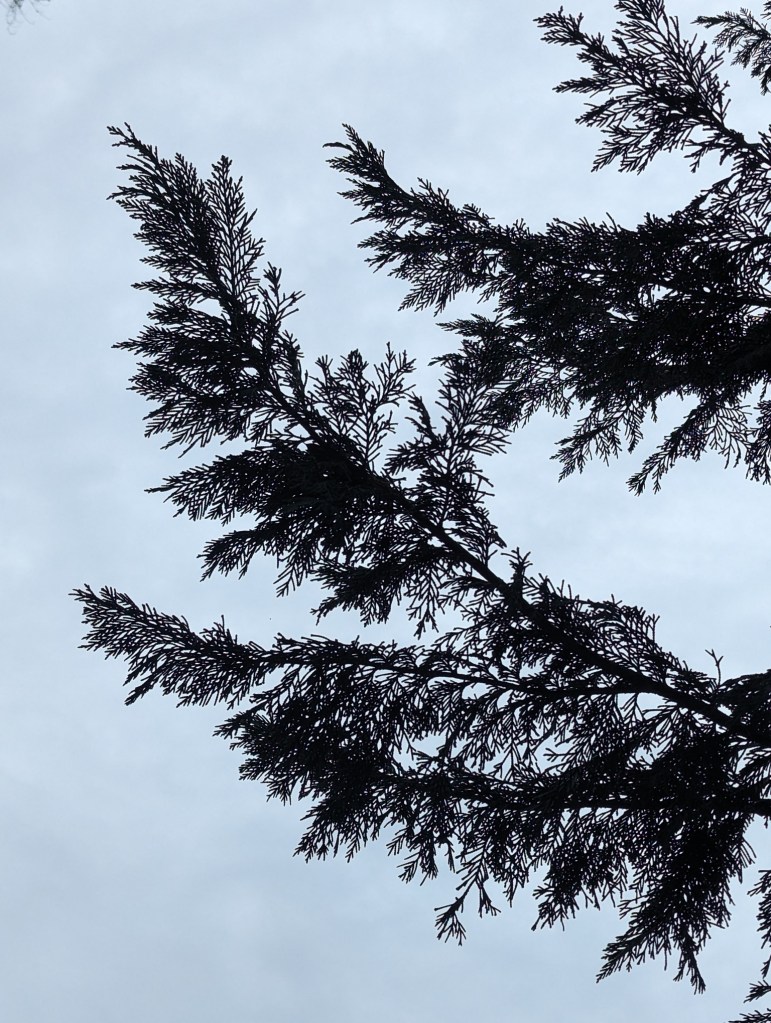
With adequate time, this prostrate juniper slowly evolves from ground cover to shrubbery. Japanese garden juniper, Juniperus procumbens, can sprawl more than ten feet. Without obstruction, it might do so without getting higher than a foot. It grows higher as it depletes space to expand, or reaches its maximum width. It may eventually grow a few feet deep.

The evergreen foliage of Japanese garden juniper is elegantly grayish or bluish green. It contrasts splendidly with deep green junipers or other rich green foliage. The tiny leaves display a visually fine texture, but are actually rigid and prickly. New stems are short and somewhat pointy until they widen with new foliage. Foliar density excludes most weeds.

Like most junipers, Japanese garden juniper is challenging to prune. Because foliage is so dense, it does not extend far below its outer surface. Consequently, there is not much growth to prune back to. Exposed inner stems are unlikely to foliate efficiently. Shearing, although effective, temporarily compromises natural form. Frequent light pruning is best. ‘Nana’ is the more compact cultivar.

What Is This?! II – Hibbertia scandens (sequel from last Saturday)

Hibbertia scandens, Guinea flower

Obviously, it is not cup of gold vine, Carolina jessamine, yellow jasmine, yellow trumpet vine, yellow orchid vine, yellow black eyed Susan vine or any of the vines with yellow flowers that Google suggested as its identity. It is more than obviously not lotus, which incidentally blooms with orange flowers rather than yellow, but was somehow, according to Google, a candidate for vines with yellow flowers. It is amazing what can and can not be found on Google.

Brent recognized this vine just like I did, but also like me, could not remember its identity. We had not seen much of it in many years, but could remember that it was somewhat common in coastal regions while we were in school during the late 1980s. It lived at a doughnut shop that we sometimes went to in Morro Bay, and seemed to smell as if a tom cat had marked his territory on it. I can remember it within old gardens of Carmel and Monterey, as well as Santa Cruz, where I found these cuttings. I also remember encountering it while inspecting median landscapes of some of the major roads of Morgan Hill in the late 2000s, and that it did not perform as well within the somewhat inland climate there. Brent observed that specimens in Santa Monica and Beverly Hills seemed to express the same preference for the more coastal climate of Santa Monica.

Now that I got it, I have no idea of what to do with it. I suppose that, without mentioning the faint but potentially slightly objectionable floral fragrance, I can convince neighbors that they want it in their gardens. Some of our landscapes are big enough for it to be pretty at a distance. At least I know what it is, Guinea flower, Hibbertia scandens.

Pecan

It is ‘PEEkan, not ‘piKAHN’!

Texas selected a distinctive state tree; the pecan, Carya illinoensis. It is happy in the south and middle mid-west, where naturally grows about seventy feet tall. It can get almost as large here, so is best in big spaces. Summers are a bit too mild for reliable nut production in autumn, but single trees can sometimes make plenty. Two different trees (to pollinate each other) can actually be quite productive, although not quite as well flavored as in warmer climates. The pinnately compound leaves have about eleven individual leaflets that are about five or six inches long. Shade is not too dark.

Oleander

Most oleander blooms with single flowers.

Since their development, freeways had been prettier with oleander, Nerium oleander. No other comparably resilient and undemanding shrubbery is as colorful. Harsh exposure of medians and interchanges was no problem. Oleander became less common through the 1990s only because of oleander scorch. Big contiguous colonies were most susceptible.

Oleander is as resilient as it has always been. It is less susceptible to oleander scorch if remote from other specimens. It performs best if it can grow wild without pruning. Pruning is not actually harmful, but can disrupt bloom. Frequent shearing eliminates most bloom. However, with pruning to remove lower growth, big shrubs can become nice small trees.

Bloom is white, pink or red. Pink ranges through bright cherry pink to pastel peachy pink. Pale yellow remains quite rare. Single flowers are most common. Double flowers are not rare though. A few cultivars provide mildly fragrant bloom, but also generate seed. Large oleander can grow as tall as fifteen feet. Dwarf cultivars may stay shorter than three feet. Oleander leaves resemble those of native bay laurel. All parts of oleander are notoriously poisonous.

Mexican Fan Palm

Mexican fan palm is the most familiar palm of California.

It does not take long for Mexican fan palm, Washingtonia robusta, to get too big for most of the spaces it so often self sows its abundant seed into. The attractive lush foliage looks innocent enough, although the long petioles (leaf stalks) have nasty teeth. As trees get tall enough to get out of the way, they also get too big to manage, eventually reaching a hundred feet tall on elegantly curving trunks. No matter how tall they get though, their canopies always stay about eight feet wide. The problem is that the maintenance of such tall and aggressive trees can be costly.

Beards of old leaves can be allowed to accumulate on the trunks, but are combustible and can get infested with rats. Old leaves are more often pruned off, leaving a distinctive pattern of petiole bases. Old leaves can alternatively be ‘shaven’ to expose elegant bare trunks.