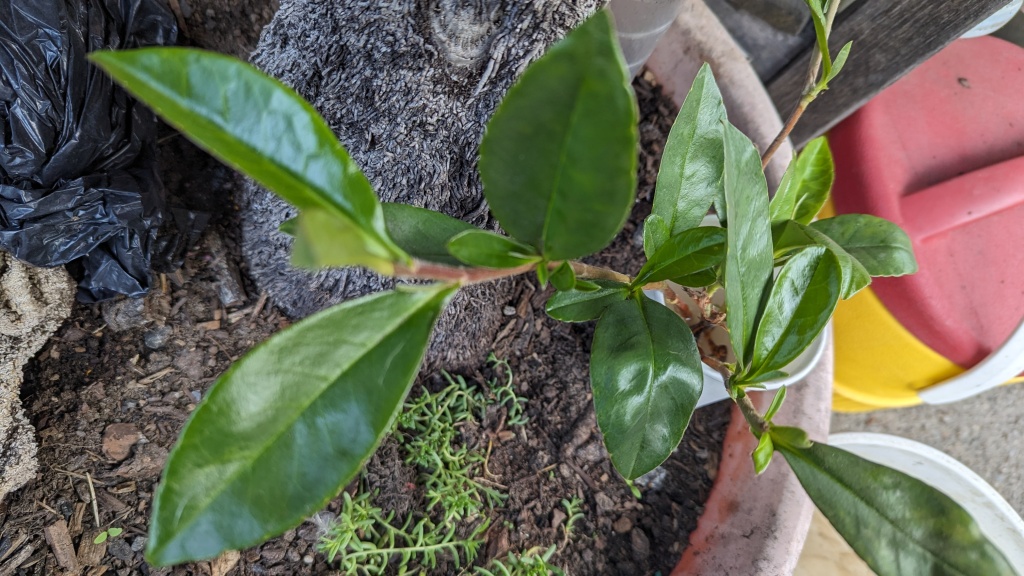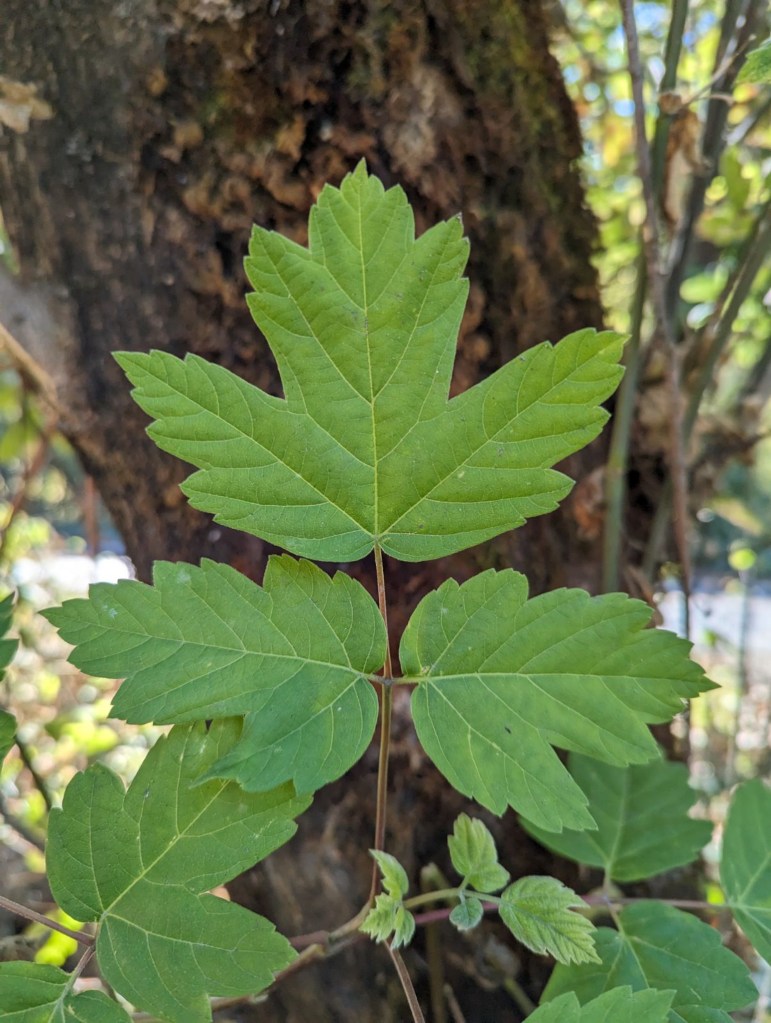
The botanical name of Norway maple, Acer platanoides, means ‘maple like a sycamore’. It resembles Platanus X acerifolia, which means ‘sycamore with maple foliage’. Platanus X acerifolia is London plane (‘sycamore’), which serves similar purposes. Norway maple lacks the irritating foliar tomentum of London plane. It has more aggressive roots though.
Norway maple was likely never a fad, but was common as a street tree during the 1950s. It naturalized as in invasive exotic species in parts of the Pacific Northwest. It is not such a nuisance locally. Most domestic trees are sterile or almost sterile cultivars. If their roots were more complaisant, they could have been ideal street trees. Their shade is splendid.
‘Schwedleri’, with bronzed foliage, was likely the most popular cultivar originally. Modern cultivars are darker bronze, golden, variegated or simple green. Their deciduous foliage is not so impressive for autumn though. It turns somewhat brownish yellow. The palmate leaves are about five to nine inches wide. Defoliation is efficient. Refoliation is quite late. Not many Norway maples get more than forty feet tall within the mild climates here.
This picture is from my Six on Saturday post for this morning.
Its name is so minimalistic and blunt in the language of the indigenous people who are most familiar with it. Others might know it as the giant highland banana. It seems to me that most of us who find it to be of interest know it by its botanical name of Musa ingens.
Oem, or giant highland banana, or Musa ingens, is native to the tropical montane forests of New Guinea. Because it is endemic to high elevations, it does not perform so well in the sort of continually hot and humid tropical climates that most other species of banana enjoy. It actually prefers the weather to get somewhat cool at night. Therefore, it is more likely to be happier here than in Southern Florida, Hawaii or coastal San Diego County.
Not many horticultural enthusiasts grow it anyway. Actually, I do not know of anyone else who grows it. I have seen only a few comments online regarding germination of the very rare and expensive seed. Furthermore, no one seems to be successful with germination. This particular species does not generate pups as readily as other species of the genus, and even if it did, there are no established specimens from which to procure such pups.
However, its lack of popularity is less likely a result of its rarity and difficulty to propagate, but more likely because of its massive scale. In the wild, oem can grow to a hundred feet tall! It may be limited to about half as tall within cultivation, and without competition from other tall trees, but that is nonetheless a potential to get fifty feet tall! That may not seem like much relative to other trees, particularly the redwoods that are more than a hundred feet tall, with potential to get three times as tall. The concern is that banana trees are not actually trees. They are merely humongous perennials. Their pseudostems do not grow for very long before they begin to deteriorate and collapse. Pseudostems of smaller sorts may complete the process within two years, but are easily removed afterwards. Fifty foot tall pseudostems take significantly more time to mature and then deteriorate, but are not so easily removed from refined landscapes. Arborists can not climb them to cut them into sections. They require space to fall harmlessly. They are full of water, so are very heavy.
Now, oem lives here. It is merely a single dinky pup, but grows very efficiently. I have no idea of what to do with it. It can likely stay canned through this year, but may need to go into the ground next year. Not only does it need plenty of space, but it does not conform to the styles of any of the landscapes here. Consequently, it might eventually inhabit my home garden, regardless of its awkward appearance. This will likely get very interesting.
This warm season annual is actually a biennial. Cardinal flower, Lobelia cardinalis, may stay relatively short for its first summer. It might bloom four feet high for its second or third summer. By then, pups are easy to divide as new plants to replace the old. Most cardinal flower plants from nurseries are rather mature. They might grow tall for their first summer.
Common cardinal flower has rich cardinal red bloom and bright green foliage. ‘Alba’ has white bloom. ‘Rosea’ has pink bloom. ‘Queen Victoria’ has familiar rich red bloom above deeply bronzed foliage. Individual flowers are only an inch and a half from top to bottom, but are numerous. Basal leaves can be almost six inches long. Upper leaves are shorter.
Cardinal flower enjoys richly organic soil with regular irrigation. It dislikes getting too dry. It appreciates a bit of partial shade as the weather gets warmest after noon. Seed is easy to collect. However, seed from fancy cultivars is not necessarily true to type. Subsequent generations eventually revert to familiar rich cardinal red bloom and bright green foliage.
With the many slender arching trunks, quince, Cydonia oblonga, is more like a large deciduous shrub than a fruit tree. Even old trees are not much more than twenty feet tall and broad. Most of the rare trees that can be found are old, because quince is such an old fashioned fruit. The fruit is still immature and covered with white pubescence (fuzz). By late autumn, it will be remarkably aromatic and resemble golden pears, about four inches long and nearly as wide, and so hard that it should be cooked.
California fan palm is the only palm that is actually native to remote regions of California. However, Mexican fan palm, Washingtonia robusta, is much more common. Technically, its native range is not far away. It had been the most popular of palms prior to the 1990s. It is more adaptable to more populous climates. Also, it naturalizes within some regions.
Mexican fan palms grow vigorously while young. Growth decelerates with maturity. Very old trees can grow very slowly without completely stagnating. Wild specimens may have potential to survive for a few centuries with such slow growth. Cultivation and irrigation of home gardens may limit this potential. Few local specimens are more than a century old.
Mexican fan palms are taller and slimmer than California fan palms. Their trunks lean as prevailing wind blows them. They easily grow fifty feet tall, and eventually get a hundred feet tall. Such tall and leaning trunks can suspend their canopies over adjacent gardens. Their pleated and palmate leaves are about three feet wide, on petioles with nasty teeth.
Most black walnuts were not planted intentionally, but grew from the roots of old English walnut trees.
Although native, most local black walnut trees, Juglans hinsdii, are secondary growth from the rootstock of what were once grafted English walnuts, or descendents of such trees. (English walnut trees are grafted onto black walnut understock.) However, the massive old trees that flank the old Monterey Highway south of San Jose were planted as large shade trees nearly a century ago. They are now about sixty feet tall, with lofty broad canopies. Their foot long leaves are pinnately compound, with about eleven to nineteen slightly dentate leaflets that are about three or four inches long. The hard nuts and thick husks are far too messy for refined gardens.
Mount Shasta very rarely lacks its snow. Its summit is almost always white. Shasta daisy, Leucanthemum X superbum, strives for the same. Bright white bloom starts in spring and continues into autumn. Primary spring bloom is the most profuse. Sporadic bloom lingers between subsequent minor bloom phases. Only cooling autumn weather inhibits bloom.
Shasta daisy is a resilient perennial. It develops dense colonies of tough basal rhizomes to survive winter dormancy. From spring to autumn, upright blooming stems grow almost three feet high. Individual composite flowers are of classic daisy form with cheery yellow centers. They are excellent as cut flowers, with simple green foliage. Leaves are serrate.
Shasta daisy prefers systematic watering, but can survive with less. It tolerates only a bit of partial shade. Removal of floral stems after bloom or cutting should leave no tall stubs. Removal of all upright growth as it deteriorates into winter promotes tidier spring growth. During winter dormancy, Shasta daisy is very easy to propagate by division of rhizomes.
Many relocated mature date palms were recycled from date orchards.
It seems that recycled large date palms, Phoenix dactylifera, became trendy in the past few decades while vast date orchards around Las Vegas were displaced by urban sprawl. They are stately trees with airy but bold rounded canopies between twenty and thirty feet wide. Mature trees are more than fifty feet tall on single trunks. Varieties with multiple trunks are shorter and rare. The ten to twenty foot long leaves are pinnately compound with folded foot long leaflets, and nasty basal spines.
Each date palm tree is either male or female (dioecious). Orchards are almost exclusive to fruiting female trees with only a few male trees grown separately for their pollen, which gets applied manually. Without male pollinators, recycled formerly productive female trees are fruitless, and therefore not messy.
Date palms may have been in cultivation for nine thousand years! The Judean date palm was grown from seed that was lost in storage for two thousand years, which (until recently) was the oldest known viable seed!
Mrs. George Washington never grew Martha Washington geranium, Pelargonium X domesticum. It was hybridized in Europe from south African species after she passed away. Although classified as a hybrid species, it is actually a group of distinct hybrids. Most are related to the same pair of primary ancestors. A few other species mingled in the process though.
The largest cultivars do not get much taller than three feet. Some develop rather irregular form. A few grow upward only to fall over. Minor tip pruning can improve awkward form. Stems are woodier than those of common zonal geranium. Consequently, cuttings do not develop roots as efficiently. Old specimens are less likely to recover from major pruning.
Martha Washington geranium may not bloom quite as profusely as zonal geraniums. The flowers are more spectacular though. Floral color can include purple, lavender, pink, red, burgundy or white. Billowy flowers are bordered or blotched with alternate colors. A few flowers bloom together on rounded umbels. Evergreen foliage is light green and ruffly.
Most big China doll trees were formerly docile houseplants.
It is hard to believe that the original variety of the familiar China doll, Radermachera sinica, that grows so slowly to reach an eight foot high ceiling as a houseplant, can actually grow into a substantial fifty foot tall tree with a three foot wide trunk, where protected from frost. Modern varieties with more billowy foliage take even longer to reach the ceiling, and do not go much higher. The finely textured and very glossy foliage is bipinnately compound, which means that each of the half to two foot long leaves are divided into smaller leaflets, which are also divided into even smaller leaflets that are about an inch or so long. Trusses of tubular white flowers that resemble big catalpa flowers are almost never seen among houseplants or modern varieties, but are quite showy on big old trees.