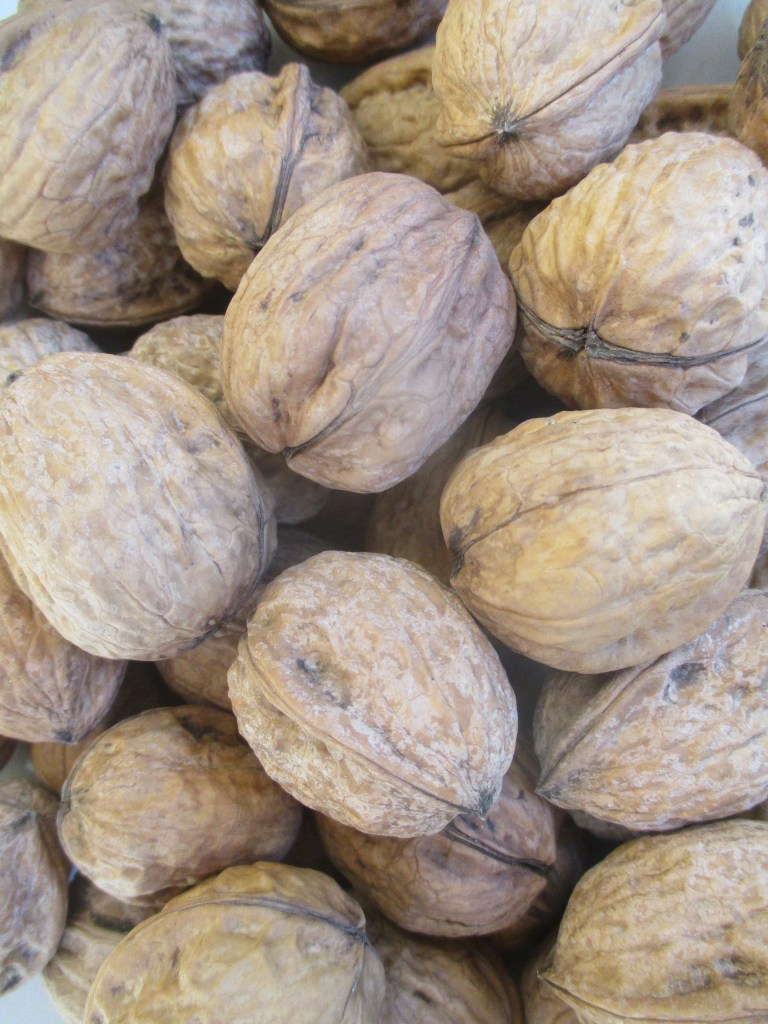
It has been in cultivation for several thousands of years. Throughout that time, it escaped cultivation to naturalize in many regions between the Balkans and the Himalayas. It most likely originated from a much smaller natural range within Persia. An interesting certainty of its dubious original range is that English walnut, Juglans regia, is not actually English.
English walnut likely arrived at Spanish Missions of California prior to 1800. It became a major agricultural commodity of both the Sacramento Valley and the San Joaquin Valley. A few old trees survive within urban areas that were formerly orchards of the Santa Clara Valley. Newer trees are unfortunately rare within home gardens because they get messy.
English walnut trees rarely grow more than forty feet high and wide here. Their abundant foliar, floral and fruit debris is toxic to young plants though, and stains hardscapes. Each type of debris sheds during a different season. Squirrels might claim most or all nuts, but drop shredded hulls. The deciduous and pinnately compound leaves can be a foot long.