Red Ironbark Eucalyptus

The pendulous foliage of red ironbark eucalyptus moves softly in the breeze. The tall, curvy trunks are elegant and sculptural.

The many varied eucalypti never seem to outgrow the bad reputation of the blue gum and red gum eucalypti that get too big, messy and dangerous for urban gardens. Fortunately though, most others do not get nearly as large, and many stay proportionate to urban gardens. Their smaller canopies are neither as messy, nor as structurally unsound. Their adaptability to so many California climates and tolerance of aridity are serious advantages.

Red ironbark eucalyptus, Eucalyptus sideroxylon, is one of the mid-sized eucalypti that can eventually get quite tall, so is probably best where it has room to grow. Pruning for containment in compact gardens is actually quite a bit of work. Their coffee colored and deeply furrowed bark on elegantly sculptural trunks and limbs contrast nicely behind the mint frosting colored and softly pendulous foliage. The lanceolate leaves are about five inches long and three quarters of an inch wide. Flowers are almost always pinkish red, but can be pink or white.
Gladiolus

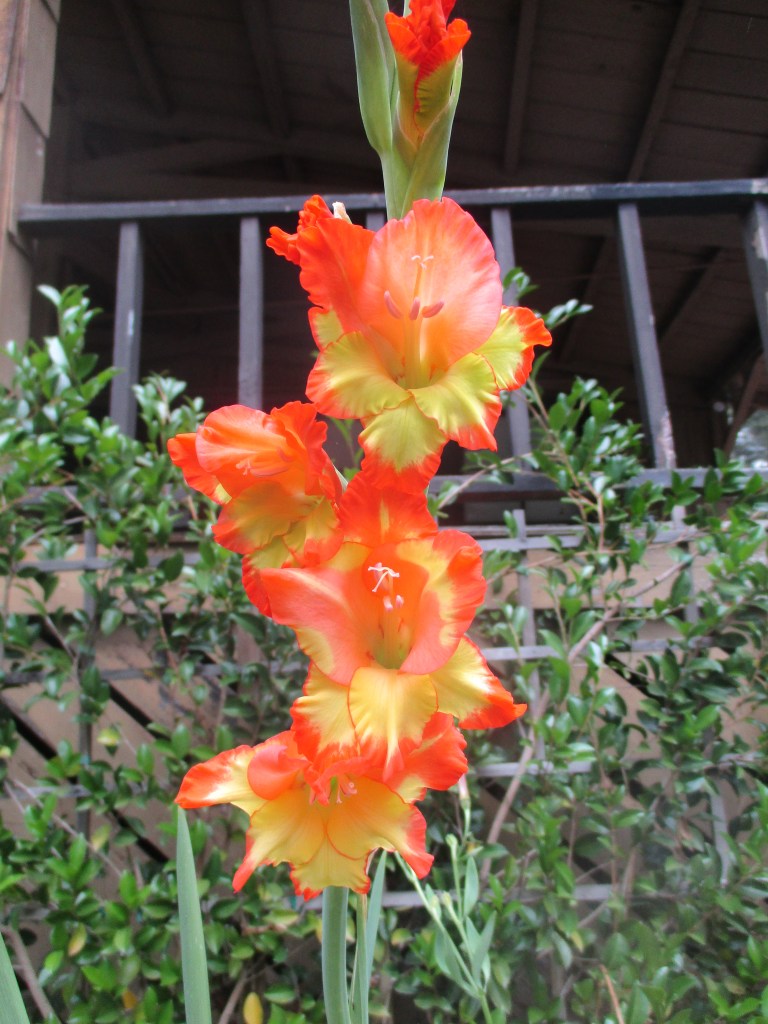
Gladiolus are still just dormant corms.

Although they will not bloom until summer or autumn, gladiolus are in season now. Their corms, which are like bulbs, are now available from nurseries, and are ready for planting. Unlike earlier spring bulbs, they need no chill, and should not generate new foliage until warmer spring weather. Corms prefer to be at least four inches deep, in sunny situations. 

The most popular and common gladiolus, Gladiolus X hortulanus, are hybrids of several species. They bloom more impressively than their simpler parents, but are not as reliably perennial. Most corms bloom for only a single season, although some within each group may bloom for a second season or more. Blooms can get heavy enough to need staking. 

Bloom can be bright or pastel hues of any color except true blue, perhaps combined with another related color. Individual florets are not large, but they share their floral stalks with several similar florets that bloom upward from the bottom. Long and pointed leaves stand upright, flaring only slightly to the left and right. The tallest gladiolus can get six feet high.

Rubber Tree

Big glossy leaves of the familiar rubber tree like a sunny spot in the home, away from sources of heat.

Pruning a rubber tree, Ficus elastica, in the home takes a bit of acrobatics, since any wound immediately bleeds staining white latex. While pruning with one hand, the other hand must catch the latex with a rag. A third hand is needed to catch the bleeding piece of stem that gets pruned away. To make things more complicated, all three hands should avoid the potentially caustic latex. Even if it is harmless to the skin, it is a painful irritant if it gets into the eyes.

Young trees have larger glossy leaves that may be as long as a foot and half as broad, although most are about half as long and broad. Many modern cultivars have variegated or bronzy foliage. Where it gets enough sunlight as a houseplant, rubber tree will eventually need to be pruned for confinement. After all, in the wild, it can get more than a hundred feet tall and almost two hundred feet tall, with trunks more than six feet wide! In the garden, it needs shelter from frost. Aerial roots can develop in humid environments.

Highlight: ‘Meyer’ Lemon

‘Meyer’ lemon is an interesting hybrid.

Of all the cultivars of citrus that are popular for home gardens, the ‘Meyer’ lemon is likely the most popular. However, it is not overly common in markets. That may be an incentive for growing it at home. Technically, it is not totally lemon. It is an odd hybrid of lemon and orange. Hence, its fruit has a distinctly rich flavor, but a bit less acidity than other lemons. 

‘Meyer’ lemon is distinct among citrus trees. It grows more like rigid shrubbery, with a few irregular trunks. Because it naturally develops compact form, it does not require dwarfing understock. Most old trees therefore grew from cuttings on their own roots. Modern trees commonly grow on understock though, so can develop suckers below their graft unions.

‘Meyer’ lemon fruit is abundant during autumn and winter. Minor quantities ripen through spring and summer also. All ‘Meyer’ lemon trees from nurseries nowadays are ‘Improved Meyer’, whether or not their labels say so. Their improvement was selection of stock that lacks a particular tristeza virus that was inherent to the original cultivar prior to the 1940s. 

Poinsettia

After their distinctive and colorful bracts are gone, poinsettias can become handsome foliar houseplants or tall and lanky blooming shrubbery.

The tiny, yellow buds at the center of poinsettia (Euphorbia pulcherrima) blooms are actually the unimpressive flowers. The colorful red, white, pink or rarely pale orange bracts surrounding these flowers are merely colorful leaves. Some varieties have marbled, blotched or spotted bracts. Compact potted plants that are mostly less than two feet tall and broad can get quite lanky and taller than ten feet in the garden. The dark green leaves are about three to five inches long.

Pitahaya

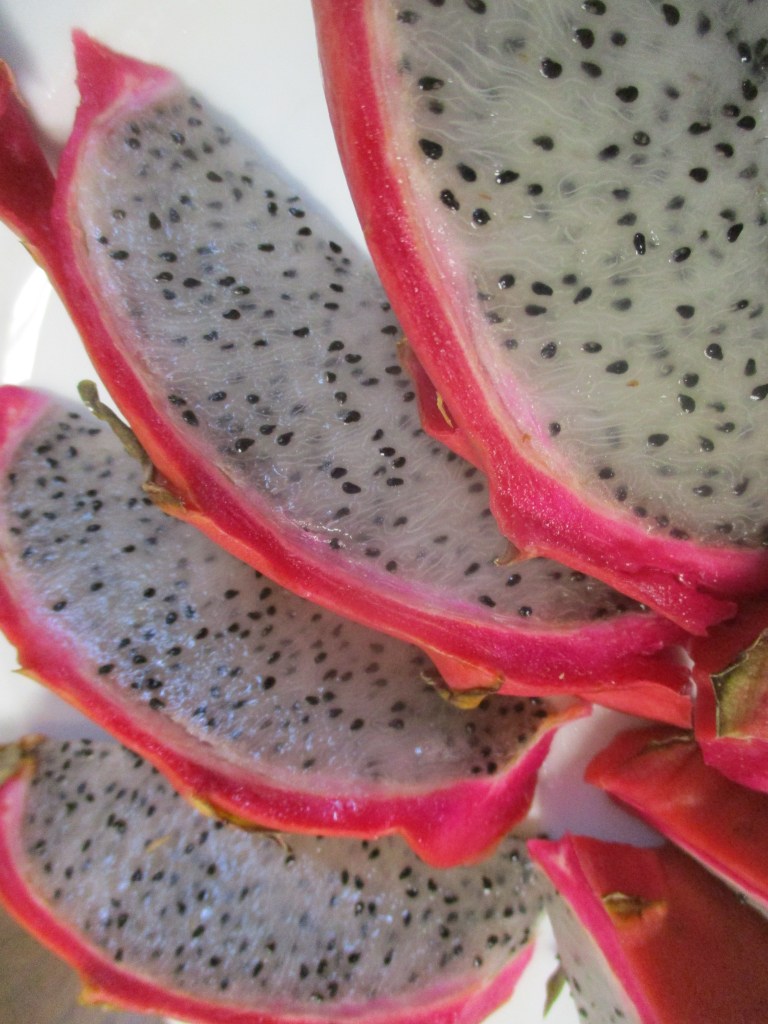
White pitaya looks almost otherworldly.

This weird tropical cactus gets mixed reviews. Pitahaya fruit, or dragon fruit, is abundant in favorable conditions, but develops potentially bland flavor. The green succulent stems may be vigorous, but develop distinctly pendulous form that resembles Sigmund the sea monster. Bloom lasts from summer to autumn, but individual flowers open for just a night. 

Selenicereus undatas is the most popular pitahaya. Its fruit weighs between half a pound and a pound, and has white flesh. Selenicereus costaricensis fruit is similar, but with red flesh, and perhaps slightly more flavor. Selenicereus megalanthus fruit is smaller, thorny and yellow, with white flesh and richer flavor. Home grown fruit is superior to market fruit.

Pitahaya grows very easily from cuttings or pruning scraps. Young stems climb with wiry aerial roots, so need substantial support. Fruiting stems hang downward from the tops of such support. Most modern cultivars need no pollinator. Some old cultivars need another of its same species for pollination. Pitahaya is vulnerable to frost where winters are cool.

English Walnut

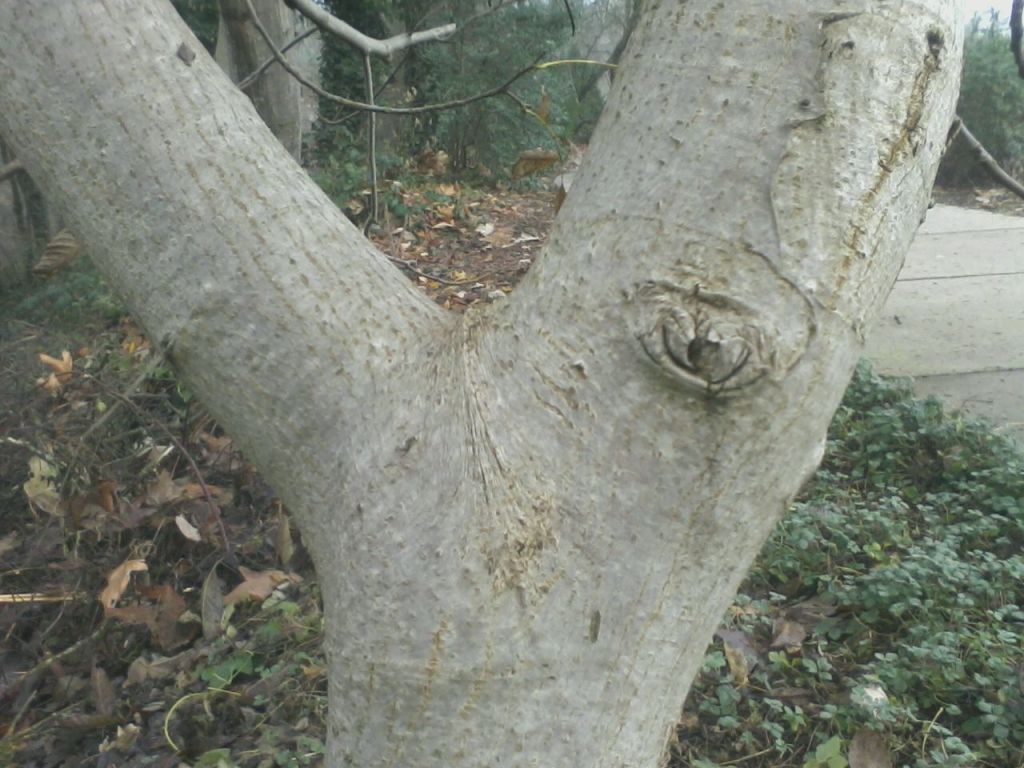
It may take a few years for a walnut tree to grow into a sculptural specimen with striking white limbs.

Like many ‘English’ plants, the English walnut, Juglans regia, is not actually from England. It is Persian, so is quite comfortable here in California. However, the foliar litter and husks contain a natural herbicide that can make nearby seed grown plants and annuals uncomfortable. Planted trees are typically grafted onto native California black walnut understock (roots) that is more resistant to disease, and improves stability.

Mature trees can be as tall as seventy five feet with trunks as wide as five feet, but are almost always significantly smaller, and even proportionate to urban gardens, although notoriously messy with bloom, leaves and nuts. The pinnately compound leaves are generally less than a foot long, with five to nine leaflets that can be between two to six inches long, and about two inches wide. The bark is notably smooth and gray until trees get quite old and furrowed.

Pomegranate

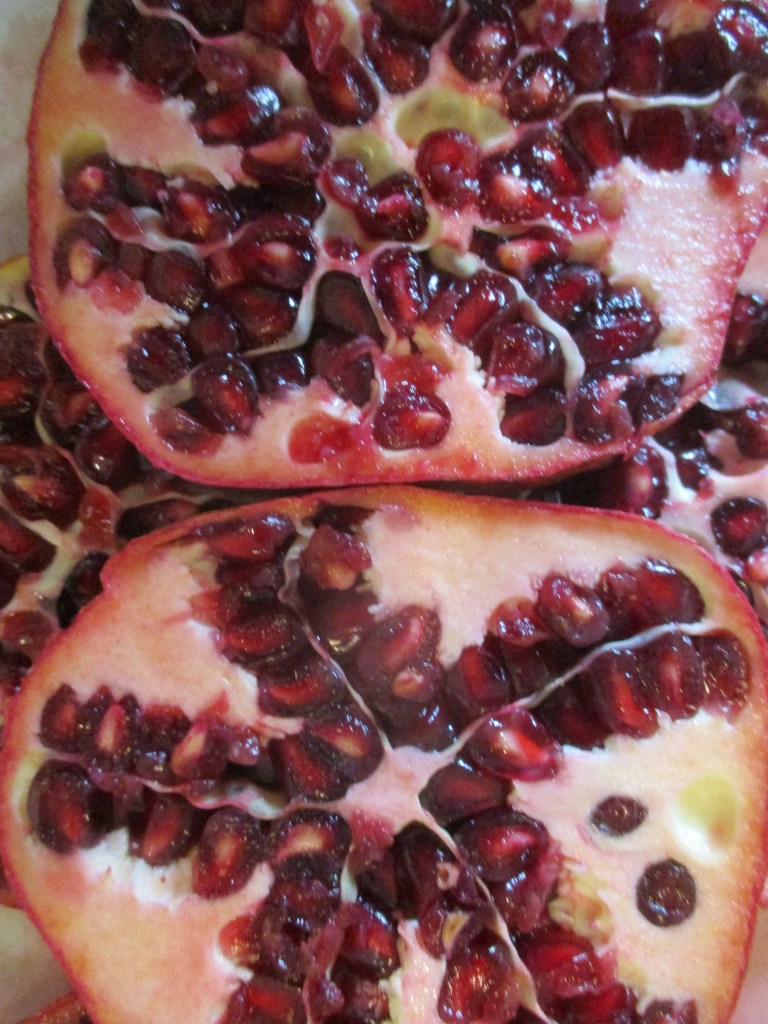
Pomegranates are autumn and winter fruit.

As for fig, date, avocado, grape and olive, the esteemed pomegranate, Punica granatum, has been in cultivation for a very long time. Several thousands of years of domestication have generated countless cultivars. They are now popular in many regions and cultures throughout the World. They produce very well here and in other Mediterranean climates.

Most locally popular pomegranate fruits are brownish red, and about three to four inches wide. Each fruit contains hundreds of seed, which are surrounded by juicy and delicately succulent flesh. They separate easily, like many tiny and tender berries. Most are garnet red. Some cultivars produce fruit with darker purplish, lighter pink or even colorless flesh. 

Without dormant pruning, pomegranate trees can get taller than fifteen feet, and develop dense thicket growth. Fruit is easier to collect from well groomed shorter trees. Individual trees may develop a few trunks, and live for two centuries. Orangish red flowers bloom in spring. Leaves turn yellow prior to defoliation in autumn. Fruit ripens in autumn or winter.

Chinese Evergreen

With such lush foliage, Chinese evergreen is a bold houseplant alone, and is also quite compatible with all other houseplants.

It is no coincidence that Chinese evergreen, Aglaonema, is perhaps the most common tropical plant for interiorscapes. It is quite easy to care for, and available in so many unique personalities. Many have rich deep green foliage. Most are elegantly variegated with white, silvery gray or gold. Leaf shape is quite variable, although most have rather narrow leaves radiating outward from dense rosettes. Leaves can be half a foot to more than a foot long, and a bit more than an inch to almost six inches wide. Mature plants are at least a foot tall and a foot and a half broad.

Indirect sun exposure or partial shade is best. Chinese evergreen likes humidity, so likes to share sheltered enclosed atriums with other lush foliage plants. New plants are easy to propagate by division.

Persimmon

Ripe persimmon is surprisingly sweet.

Most other deciduous fruit trees provide delightfully profuse spring bloom as well as fruit. Persimmon, Diospyros kaki, does not. It compensates though, with brilliant orange foliar color for autumn. Defoliation reveals comparably bright orange ripe fruit. The awkwardly bulky fruit may look silly on lanky limbs of otherwise bare trees, but they sure are yummy! 

Persimmon trees will not require a pollinator to generate an abundance of fruit. However, according to some experts, paired trees of different cultivars produce more abundant fruit of slightly better quality. Abundance is not necessarily an asset though. Unfortunately, all that very perishable fruit ripens at the same time. Fruit is inedible before completely ripe.

Mature persimmon trees can get big enough to become moderate shade trees. If they do, their abundant fruit will be too high to reach, and will generate a horrendous mess when it falls. Although they are handsome trees, they should probably stay relatively short and compact. New trees should be planted while dormant during winter, preferably bare root.