Flowering Crabapple

Flowering crabapple blooms like flowering cherry.

All crabapple trees flower. Almost all subsequently produce fruit. Those designated as ‘flowering’ crabapples exhibit the most spectacular bloom, but generally produce inferior fruit. A few cultivars are nearly fruitless. Crabapples not designated as ‘flowering’ are not as bold in bloom, but generally produce larger fruit of better quality. Their fruit is useful for jelly and other culinary applications.

Almost all crabapple trees here are flowering crabapples. Fruiting crabapples are rare locally. Their fruit is not as popular as it is in other regions. However, flowering crabapples that produce big fruit are increasingly trendy. Their fruits can get as wide as an inch and a half, almost as big as fruits of fruiting crabapples. If not picked or eaten by birds, even typical berry sized fruits are messy.

White, pink or reddish pink bloom is impressively profuse, just prior to spring foliation. In fact, bloom is comparable to that of flowering cherries, and only a bit later. Most flowering crabapples get no taller than fifteen feet. Aggressive annual dormant pruning is not necessary as it is for trees that produce heavy apples. Instead, mature trees appreciate summer structure pruning and thinning.
Daphne

Perhaps fragrance could be more colorful.

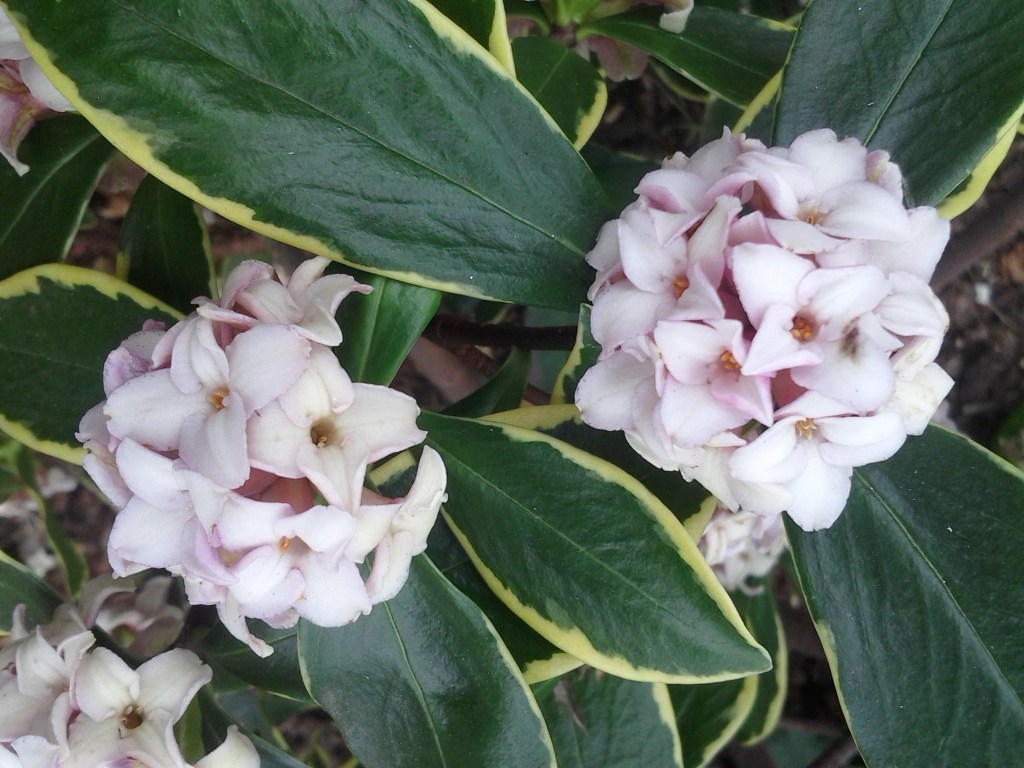
The small trusses of tiny, pale pink flowers of daphne, Daphne odora, really do not need to be too flashy with such powerful fragrance. Actually, the flowers might be considered to be less interesting than the glossy evergreen foliage. The most popular cultivar, ‘Marginata’, has a narrow ivory or pale yellow edge to each leaf. Each leaf is only about two or three inches long. Each domed flower truss is about as big as half of a ping pong ball. Daphne is sometimes grown to compliment and provide fragrance for boldly colorful but fragrantly deficient camellias.

Daphne is unfortunately notorious for being somewhat finicky. It likes rich soil and reasonably regular watering, but quickly rots if soil stays too damp or drains inadequately. The roots are quite sensitive to excavation. Partial shade is no problem. Yet, even the biggest and happiest specimens do not get much more than three feet high and five feet wide, and rarely live more than ten years. Daphne is toxic, and the sap can cause dermatitis.

Norway Maple

Few maples perform as well here.

Japanese maples get all the notoriety. They have such delightful texture and form. Many are proportionate to small spaces, such as atriums. Realistically though, they are overrated and overused. Meanwhile, other maples that work as larger shade trees remain obscure. Norway maple, Acer platanoides, gets broad enough to shade much of an urban garden, but rarely gets to forty feet tall.

Of course, Norway maple has innate limitations. It dislikes arid and harshly warm desert climates. Nor does it like to be too close to the coast. Los Angeles is about as far south as it wants to live. In the Pacific Northwest, it gets much bigger, and develops greedy roots. The non-cultivar species is invasive there. Norway maple defoliates neatly for winter, but then refoliates late in about April.

Almost all local Norway maples are cultivars. ‘Schwedleri’ has richly bronzed foliage. It is rare now, but was a popular street tree in the 1950s. ‘Crimson King’ has richer purplish foliage, but is less vigorous. ‘Drummondii’ displays delightful variegation. The deciduous foliage of Norway maple turns soft brownish yellow or gold for autumn. The palmately lobed leaves may be five inches wide.

Saucer Magnolia

Spring color blooms before winter ends.

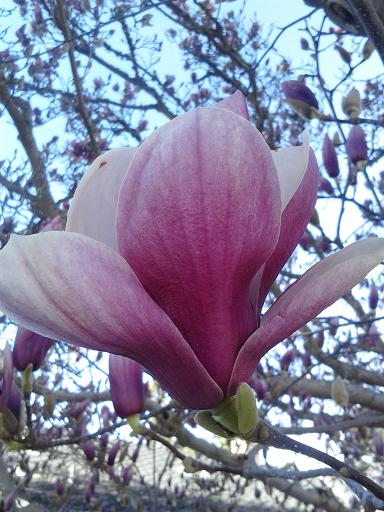
Before the deciduous foliage regenerates, saucer magnolia, Magnolia X soulangeana, is already completely overwhelmed with a profusion of big pastel pink and white flowers. Some of the many cultivars bloom white, paler pink or purplish. Some are more purple than pink. Individual flowers are about six inches wide. Some cultivars bloom with globular flowers that do not open quite so broadly. Others open even wider. The largest flowers can get almost a foot wide. Eventually, fading flowers will be replaced with big and soft lime green leaves. Most saucer magnolia trees are grown with several trunks and low branches to display the bloom more prominently, as well as to display the sculptural branch structure while bare through winter. The flat bark is strikingly light gray.

Dahlia

Dahlias look nothing like this yet.

There is nothing simple about dahlia. Some are short bedding plants that behave as annuals. Tree dahlias develop big and lanky canes that can get as high as ground floor eaves, only to replace them during the next summer. The most popular dahlias are lushly foliated perennials with striking and extraordinarily colorful bloom. Most are taller than bedding dahlias, but less than six feet tall.

Dahlias can bloom just about any color except blue. However, most purple dahlias tend to be rather reddish or pinkish. Green dahlias are rare, and tend to be rather yellowish. Floral form is wildly variable! So is floral size. Some dahlia flowers get no wider than two inches. Larger sorts get about ten inches wide, so must be staked. Dahlias might be as variable as related chrysanthemums.

Dormant dahlia tubers can go into the garden as early as late autumn here. Most start in winter though, to be less susceptible to rot while waiting for spring. After blooming through summer, dahlia growth succumbs to frost late in autumn. Division of crowded dormant tubers every few years promotes healthier spring regeneration. There is no need to dig and store tubers through winter here.

Camellia japonica

Camellia bloom before the flowers or early spring.

After centuries of breeding, there are more than two thousand cultivars of Camellia japonica! Additionally, there are more than a thousand cultivars of both Camellia sasanqua, with smaller but more profuse flowers, and comparably rare Camellia reticulata, with fewer but garishly big flowers. This does not even include the more than a hundred other specie of camellia found in the wild throughout East Asia.

It is obviously difficult to generalize about so many different personalities. Actually though, the glossy and slightly serrate leaves of almost all Camellia japonica are surprisingly similar. Also, most grow into rounded shrubs that are happy to stay below first floor eaves. Only a few grow into small trees, and only after many years. All prefer rich soil and regular watering.

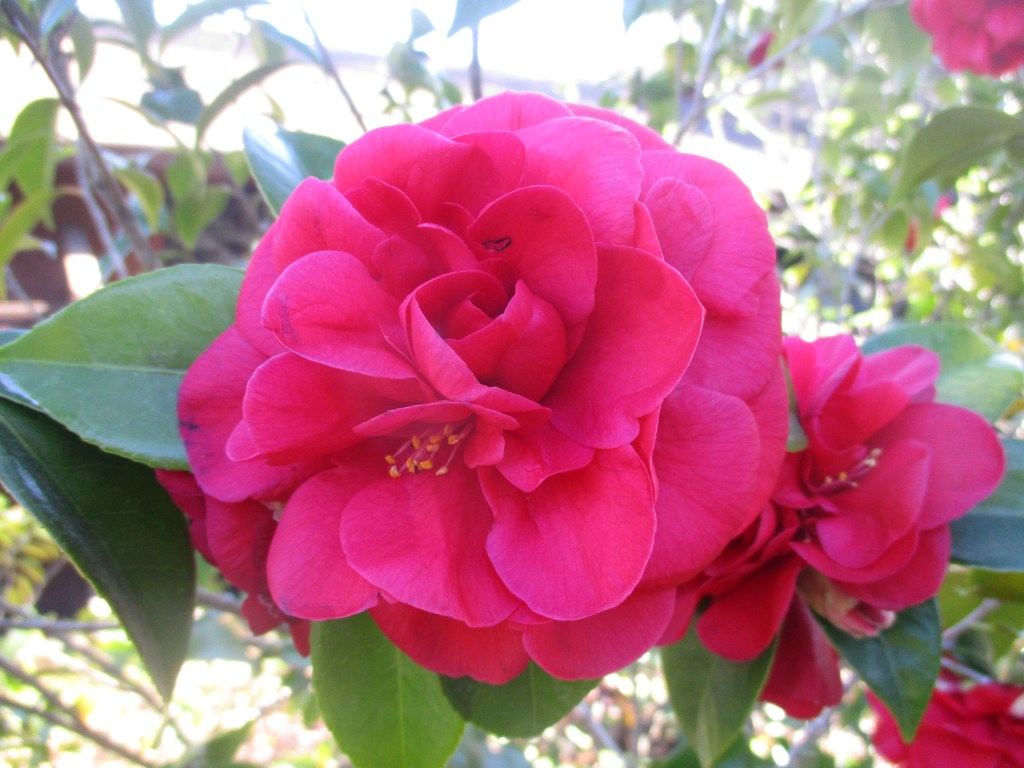
The flowers that bloom late in winter are the most distinguishing characteristics of the many cultivars. The largest can get more than four inches wide. Flower form is remarkably variable (and can be described as single, semi-double, double, formal double, paeony, anemone or rose). Many have prominent yellow stamens. Color ranges from pure white to red, with every shade of pink in between. Picoteed, striped and blotched flowers are not uncommon.

Cecile Brunner Rose

Cecile Brunner rose is elegantly simple.

Few modern rose cultivars are as tolerant of neglect as Cecile Brunner rose. Furthermore, few recover as efficiently from renovation after many years of neglect. Old overgrown thicket growth that might be unsightly while bare through winter can be spectacular in bloom. Alternatively, it does not mind aggressive pruning, even if only stumps remain. It easily regenerates with fresh new canes.

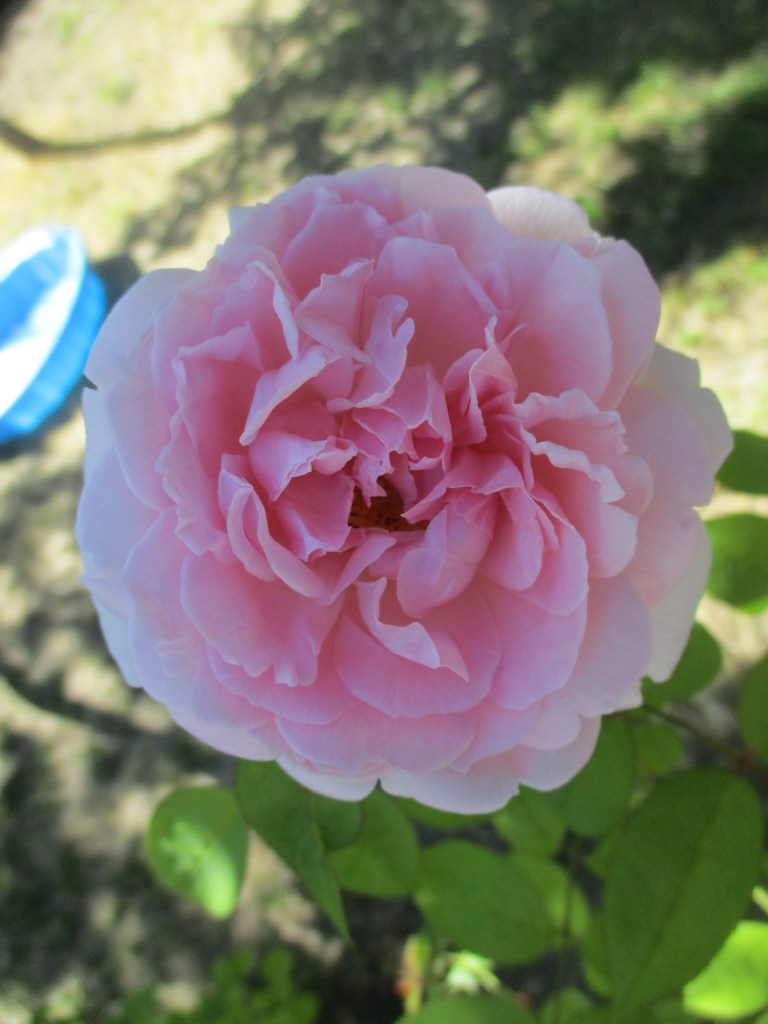
Bloom is nicely profuse early in summer. The individual fluffy pink flowers are not much more than two inches wide, but are rarely alone. They develop in big and possibly billowy clusters. The faint fragrance is easy to ignore, but appealing to some. After primary bloom, subsequent bloom is sporadic. Green stems are less prickly than stems of most other roses. Foliage is rather light green.

Shrubs are vigorous but compact. They may not get much taller than two feet. Most stay less than four feet tall. However, there are actually a few cultivars that are known as ‘Cecile Brunner’. Those that are most familiar are climbing types that can easily get higher than twenty feet. Their bloom is sparse after profuse early summer bloom. Some might bloom rather profusely again for autumn.

English Boxwood

English boxwood is a classic formal hedge.

Good old fashioned boxwood hedges really look silly if just a single missing plant get replaced with a different cultivar (cultivated variety) or specie. Most of the older boxwood hedges are the traditional, but somewhat yellowish Japanese boxwood. Most middle aged hedges are a relatively newer cultivar that is a bit greener. Modern boxwood hedges are more likely a cultivar of English boxwood, Buxus sempervirens.

English boxwood resembles Japanese boxwood, but has slightly narrower leaves that produce a slightly more objectionable aroma when shorn or otherwise disturbed. These opposite (paired) glossy leaves are only about a quarter to half an inch wide and about twice as long. The color is slightly darker with a more ‘olive’ tone. Wild English boxwood in Europe can grow as small trees. Most garden varieties are fortunately much shorter and more compact, which is why they are so popularly shorn into small formal hedges. They also do well as topiary. ‘Aureo Variegata’ is variegated with nicely contrasting cream colored leaf margins.

Grapefruit

Grapefruit originated as an unlikely hybrid.

Citrus have been in cultivation for centuries. Most breeding and selection was intentional. Even the strange breeding of orange and lemon for the familiar ‘Meyer’ lemon was deliberate. Grapefruit, Citrus X paradisi, is a peculiar one though. Its parents were unknown when it mysteriously appeared in Barbados in about 1750. It is now known to be a hybrid of orange and pomelo, both exotic.

The original grapefruits were ‘white’ grapefruits, with tart and pale yellowish flesh. ‘Pink’ grapefruits, with milder flavor, and blushed flesh, appeared a century and a half later, in about 1906. Those with rich pink flesh are known as ‘red’ grapefruits. Some mildly flavored modern white grapefruits are hybrids of grapefruit and pomelo. Such breeding makes them 75% pomelo and 25% orange.

Both modern and traditional white grapefruit trees are more vigorous than pink and red grapefruit trees. Dwarf white grapefruit trees grow slowly, but might eventually get more than fifteen feet tall. Standard trees can get as big as shade trees. They are too productive for home gardens. Pink and red grapefruit trees rarely get taller than eight feet. Grapefruit foliage is evergreen and lustrous.

Manzanita

Shrubby manzanitas develop sculptural stems with shiny cinnamon brown bark.

There are more than a hundred specie of Manzanita, Arctostaphylos spp., that range in size and form from creeping ground covers to small trees that can get almost twenty feet tall. (They are more commonly known by their cultivar names than by their specie names.) Arctostaphylos ‘Emerald Carpet’ is as the name implies a nice low groundcover for dry slopes. Arctostaphylos ‘Doctor Hurd’ is a shrubby small tree that is often pruned to expose strikingly sculptural trunks that are as smooth and rich brown as a chestnut.

Abundant trusses of tiny ‘urn’ shaped flowers bloom about now. Almost all are pale white. A few are pale pink. The subsequent red berries typically get eaten by birds before anyone else sees them. The evergreen foliage is quite dense. Individual leaves are rather small and disproportionately thick.

Manzanita should be planted while small, because larger plants are more susceptible to rot. New plants want to be watered to prevent desiccation until they disperse their roots. If planted in autumn, they get enough water from rain through winter (typically), so that they only want occasional watering through the following spring and summer. Once established, they do not want much water at all, and can be damaged by fertilizer. The happiest plants are satisfied with what they get from rain after they get established.