Firethorn

Overwintering birds can not miss firethorn.

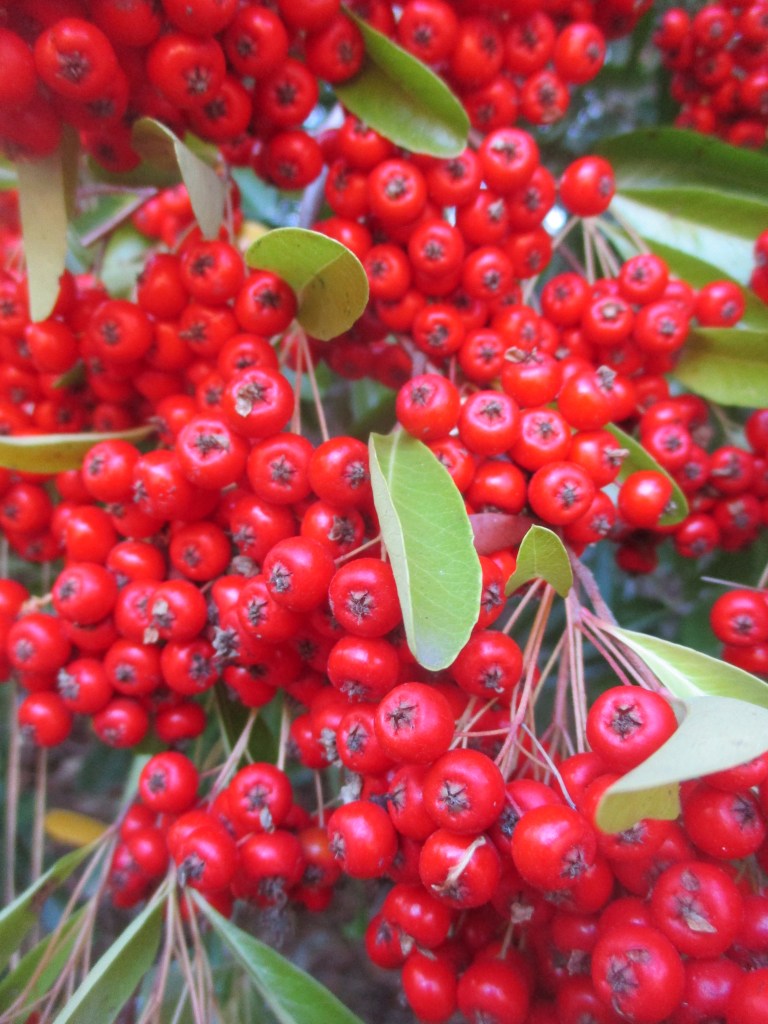
The most abundant bright red berries of autumn are those of firethorn, Pyracantha coccinea. They resemble English hawthorn, cotoneaster and toyon berries, but are shinier and more abundant. Their weight causes their limbs to sag. Most are either rich deep red, or brighter slightly orangy red. Orange berries are uncommon locally. Cultivars with yellow berries are less vigorous and rare.

Berry production may seem to be more variable than it actually is. Healthy plants typically produce a profusion of berries. They only seem to be more profuse if they ripen late, after migratory birds fly south. Such birds are voracious with early berries. Overwintering birds are less numerous, and consume berries slower. Regardless, few berries last long enough to deteriorate and get messy.

Firethorn is thorny enough to function as an impenetrable hedge. However, it is unpleasant to prune with all those thorns. Also, pruning without removing the stems that bloom and produce berries takes effort. Upright cultivars can get higher than downstairs eaves. Some cultivars get only a few feet tall as they sprawl over the ground. Even without berries, the evergreen foliage is appealing.
English Yew

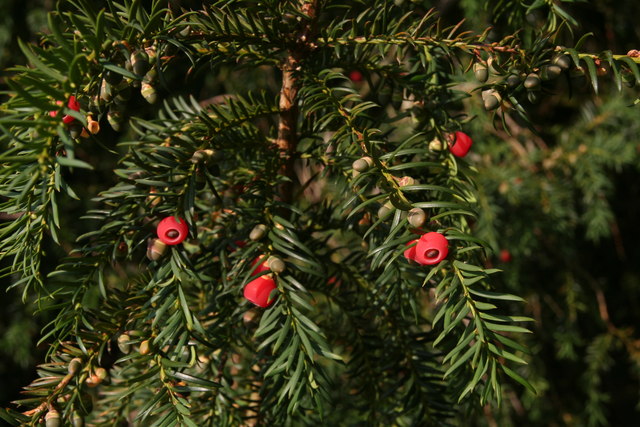
English yew has inhabited landscapes and gardens for centuries. (This is not my picture.)

It is difficult to know how big any of the various cultivars of English yew,Taxus baccata, will eventually get, and how long they will take to get that big. Most can get almost as tall as thirty feet. Some can get nearly twice as tall. However, they can take more than a century or several centuries to do so. Old specimens around Europe are significantly older than two thousand years. Slow growth is an advantage for formal hedges that get shorn only annually. English yew prefers regular watering. Partial shade is not a problem.

Irish yew is actually a cultivar of English yew with densely upright growth. The various golden yews have yellowish foliage. Otherwise, most English yews have finely textured dark green foliage on angular stems that resemble those of redwood. Individual leaves are very narrow, and only about half and inch to an inch long. The peeling dark brown bark resembles that of large junipers, but not quite as shaggy. English yew is toxic.

Pink Iceplant

Pink bloom is merely a bonus.

Lavender pink bloom in spring or early summer can be profuse in sunny situations. Individual flowers are like small daisies with yellow centers. They stay closed through most of the morning, then open by about noon. If the weather is conducive, they can be slightly fragrant. However, the evergreen foliage of pink iceplant, Oscularia deltoides, might be even more appealing than the bloom.

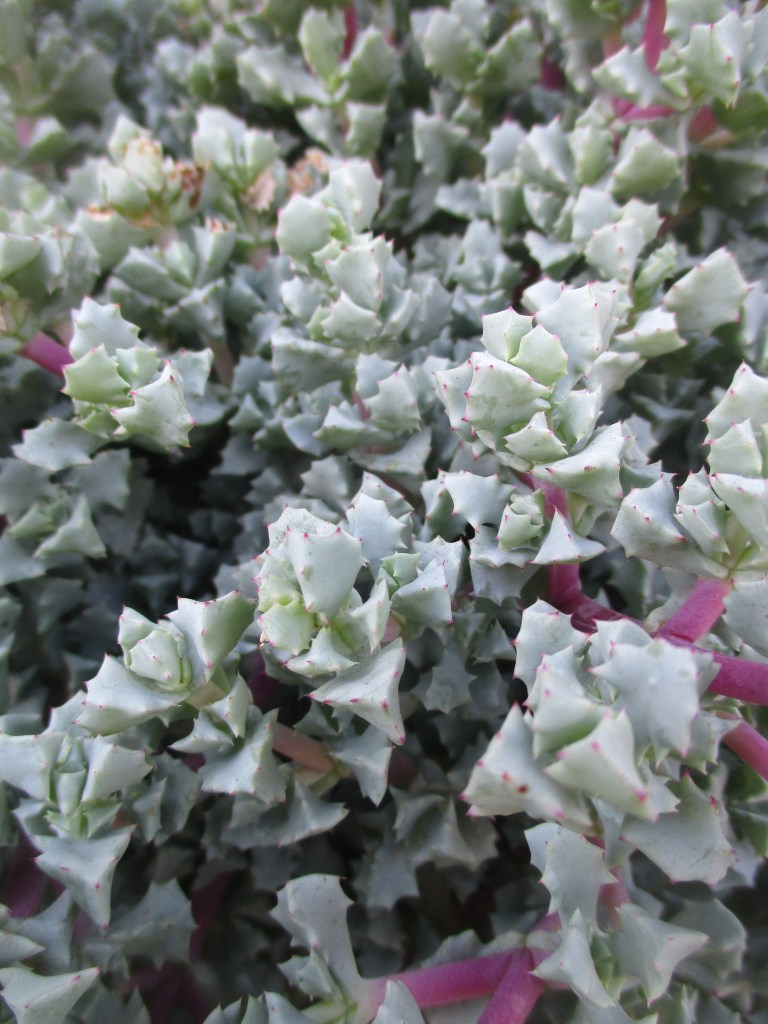
The plumply succulent leaves are a delightfully bluish hue of gray. With two sides and a flat upper surface, these leaves are triangular in cross section. Blunt foliar teeth provide a distinctive texture. Foliage is so dense that the relatively thin stems within are barely visible. Stems can blush with pink or purple. Bloom is better, and foliage is denser, with good exposure and occasional watering.

Mature growth gets at least half a foot deep, and can eventually get a foot deep. It slowly spreads about two or three feet wide. With age, outer stems develop roots where they lay on the soil, and spread even farther. New plants grow very easily from cutting. Pink iceplant cascades nicely from pots or over stone. It contrasts handsomely with richer or darker colors of other foliage or bloom.

Burro’s Tail

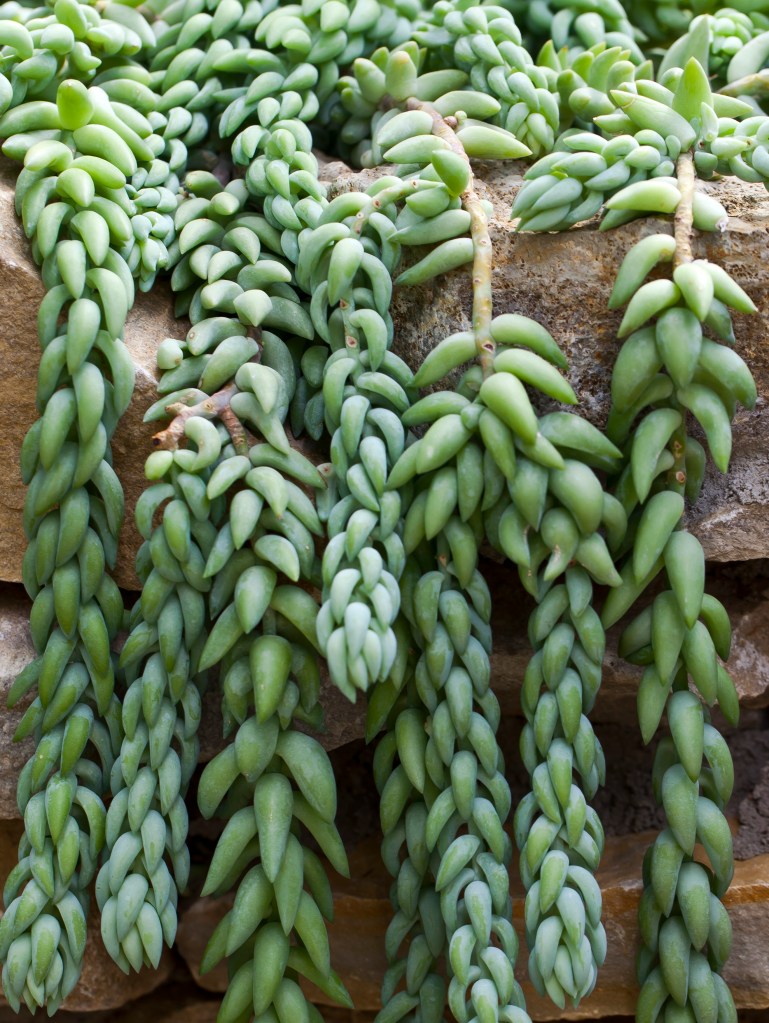
My pictures are missing, so I found this one online without copyright protection. It demonstrates the cascading habit of burro’s tail.

Back when big spider plants or Boston ferns suspended in fancy beaded macrame were all the rage through the 1970’s, burrow’s tail, Sedum morganianum, was an unusual but also trendy succulent perennial for sunny spots in the home or sheltered and slightly shaded spots in the garden. The refined foliar texture and light bluish green color contrasted nicely with the big and deep green leaves of comparably trendy philodendrons. The thin stems are too limber to stand up, but cascade excellently. Plants in the garden that get pruned back while dormant in winter can easily get two feet long through summer. Without pruning, big plants can get longer than six feet. Pruning scraps and even the small but plump leaves can be rooted and grown into new plants. It is impossible to prune or even move burro’s tail without dislodging some of the leaves anyway. Watering should be regular but not excessive, but then minimal for plants in the garden through winter.

Arizona Cypress

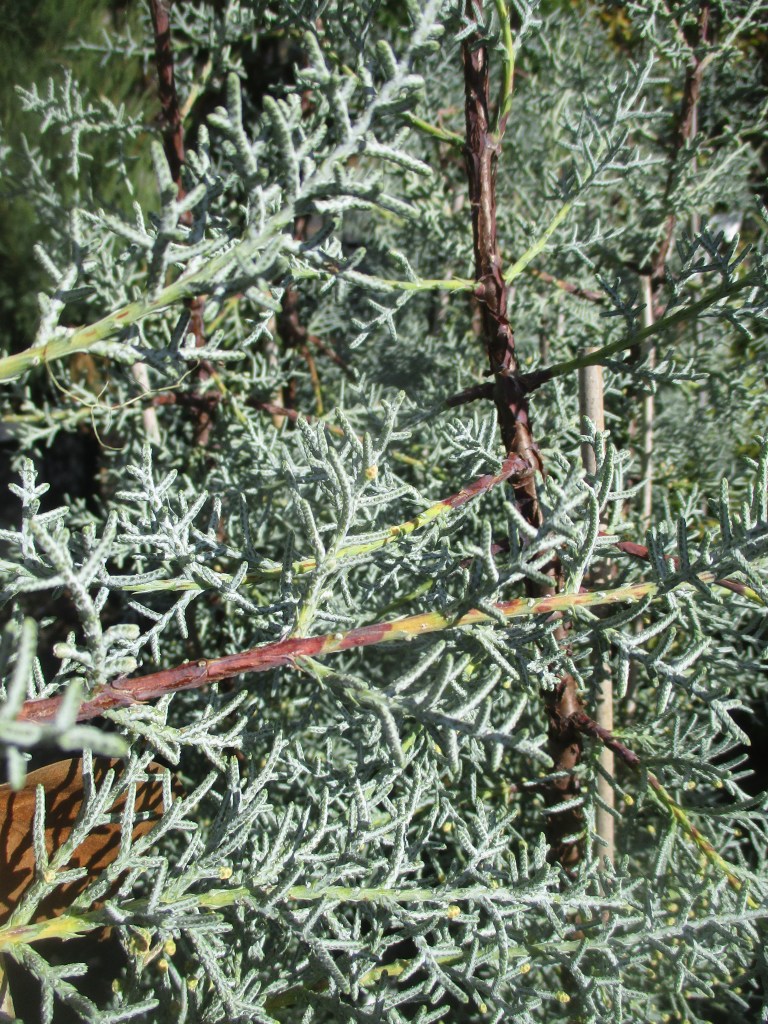
Arizona cypress can be strikingly blue.

If Hetz blue juniper grew as a tree, it might look something like Arizona cypress, Cupressus arizonica. The evergreen foliage of modern cultivars is almost as blue as blue spruce. Older trees that grew from seed (not cloned) can exhibit significant genetic variability, and are more grayish green than blue. Some are stout and shrubby. Taller specimens might exhibit sculpturally irregular form.

In the wild, Arizona cypress is even more variable, with as many as five distinct varieties. Some varieties are sometimes classified as separate species. Shorter types may get no taller than a two story house. Taller types get twice as tall, and as wide as thirty feet. Trunks can get two feet wide. Smooth Arizona cypress has patches of distinctively flaking bark over shiny chestnut brown bark.

Arizona cypress are best where they can develop their natural form. They prefer no more than minor pruning of awkward stems. Although, none seem to mind grooming to eliminate dead or aging stems. Modern cultivars are more conducive to minor pruning than older trees. Some cultivars supposedly make nicely dense shorn hedges. Furthermore, shearing enhances the blue foliar color.

Angel Wing Begonia

This is not the common Angel Wing begonia. I just found it online, in the pictures that are not protected by copyright. I could not find my picture. Storage has been a problem.

The simple pink or sometimes red or white flowers of angel wing begonia are not as flashy as those of other begonias, and are not abundant enough to provide much color. During warm weather, they are merely a minor bonus to the striking foliage. As the name implies, the big and angularly lobed leaves are shaped like wings of angels. Upper surfaces are glossy and dark green with irregular silvery spots. Undersides are even glossier and reddish bronze. With support, the lanky cane stems can get more than twelve feet tall. However, because older tall canes produce runty foliage, they are often pruned out to promote more vigorous and lushly foliated young canes.

Because they are sensitive to frost, and also because they are ideal houseplants, angel wing begonias are typically grown in containers. They like rather regular but not excessive watering, and rich potting soil. Abundant sunlight enhances foliar color; but harsh exposure roasts foliage. Partial shade is not a problem.

Curve Leaf Yucca

Curve leaf yucca can be variegated.

Some perennials are too easy to grow. Curve leaf yucca, Yucca recurvifolia (or Yucca gloriosa ‘Tristis’), is remarkably resilient. It migrates slowly but surely. If it becomes obtrusive, it is difficult to contain and remove. Removal of foliar rosettes above does nothing to slow the roots below. The roots merely produce new foliage. Of course that can be a distinct advantage for harsh conditions.

The striking foliar form resembles that of other species of Yucca, except that it reliably arches softly downward. Foliage is not as soft as it seems though. Each leaf terminates with a sharp spine. Sharp edges can cause wicked paper cuts. Foliar color is bluish gray. Although, variegated cultivars are increasingly popular. Old plants can develop trunks that slowly grow more than six feet tall.

Tall and elegant spikes of relatively small creamy white flowers stand grandly above the evergreen foliage in late spring or summer. Bloom is best with warm and sunny exposure, and lasts a long time. Viable seed is rare. Propagation by division of some of the many pups is simple though. Popular variegated cultivars exhibit more docile growth with fewer pups, but bloom less abundantly.

Statice

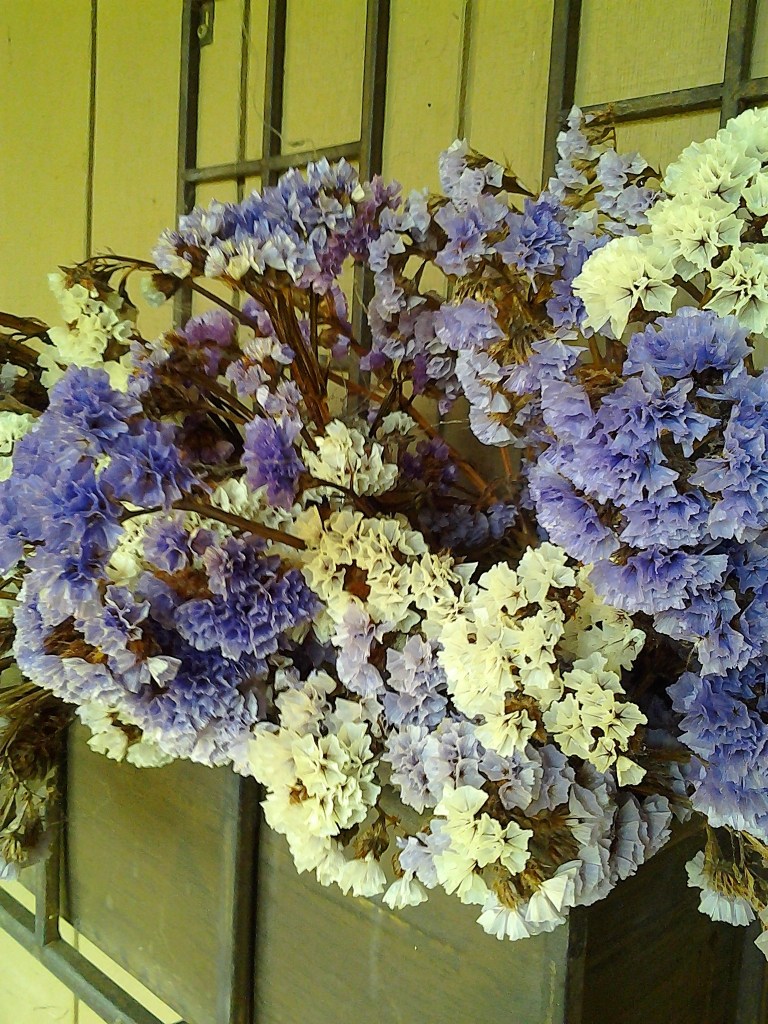
Statice is so popular as a cut flower that it should be more popular than it is in home gardens.

The papery flowers of annual statice, Limonium sinuatum, are so popular as seemingly synthetic dried flowers that many garden enthusiasts are surprised to find that they are happy to bloom naturally in home gardens. The clear shades of blue, purple, pink, orange, yellow and white seem to be dyed. The one or two foot tall flower stems are outfitted with odd papery ‘wings’ that make the stems seem wider than they actually are. Deeply lobed basal foliage forms shallow rosettes. Mature plants are about one or two feet tall, and a foot or so wide. Bloom begins late in summer, and continues into autumn. Good sun exposure and good drainage are preferred. Seed can be sown directly, or young plants can be added to the garden early in spring.

Freeman Maple

Freeman maple colors with minimal chill.

It is a hybrid. It is naturally occurring. Yet, most cultivars (garden varieties) resulted from intentional hybridization and selection. It is not as strange as it seems. Freeman maple, Acer X freemanii, is a naturally occurring hybrid of silver maple and red maple. It grows wild where the natural ranges of the parents overlap. From their example, breeders learned to selectively breed the cultivars.

These cultivars combine the fast growth rate of silver maple with the structural integrity of red maple. None get to be as imposing as the silver maple. Some get to be about forty feet tall and wide, which is a bit bigger than red maple gets in local climates. Foliage is lacy like that of silver maple, but more substantial, like that of red maple. It develops brilliant orange and red color for autumn.

Freeman maple, although locally uncommon, is one of the more practical maples here. Like silver maple, it does not require much chill in winter. Like red maple, it develops a symmetrical canopy with reasonably high branches. Roots should be complaisant with concrete. Because it is a hybrid, it is mostly sterile. It does not produce enough seed to be invasive in more conducive climates.

Coral Bells

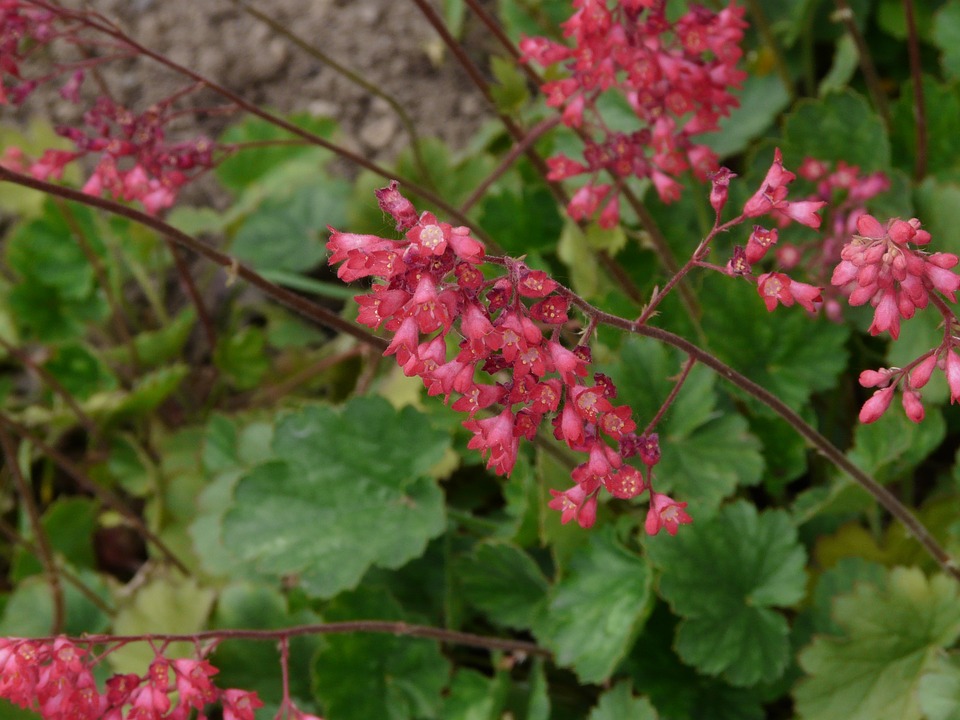
Coral bells can bloom again in autumn. (This is not my picture.)

From Santa Barbara to Vancouver, and also in central Idaho, the humble native coral bells, Heuchera micrantha, is not much to look at, with compact rosettes of relatively small and bronzy rounded leaves with weird tomentum (hairs). In spring and early summer, and sometimes again in autumn, sparse trusses of minute brick red flowers hover about a foot above on wiry and slightly fuzzy stems. Old plants that get bare in the middle can be divided into several small plants in spring or autumn.

Modern cultivars are considerably more interesting, with more substantial foliage in various shades of green, gold, tan, brown, bronze and purplish bronze. The larger and variably lobed leaves can be two inches wide or slightly wider. The flowers stand as much as two feet high, but lack color. Most are pale greenish white. ‘Palace Purple’ has deep bronze or almost purplish foliage. ‘Ruffles’ has deeply lobed and ruffled green leaves. Unlike undemanding wild plants that can grow in cracks in exposed stone, modern cultivars like rich soil. Harsh exposure can scorch foliage, so a bit of partial shade is preferred.

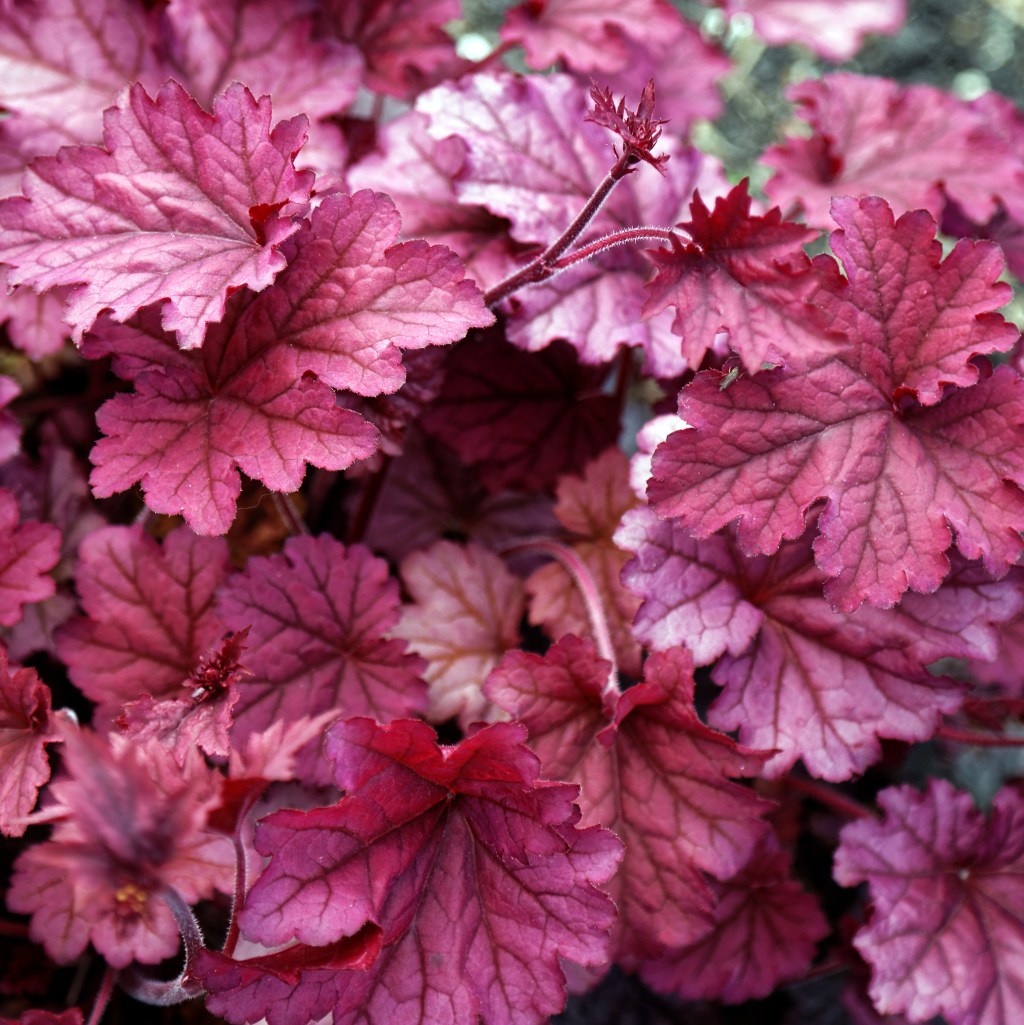
Most coral bells are grown more for their colorful and low foliage than for their bloom. (Both pictures here were obtained online. I can not find my pictures.)