Catalpa

Catalpa bloom may be too high to see.

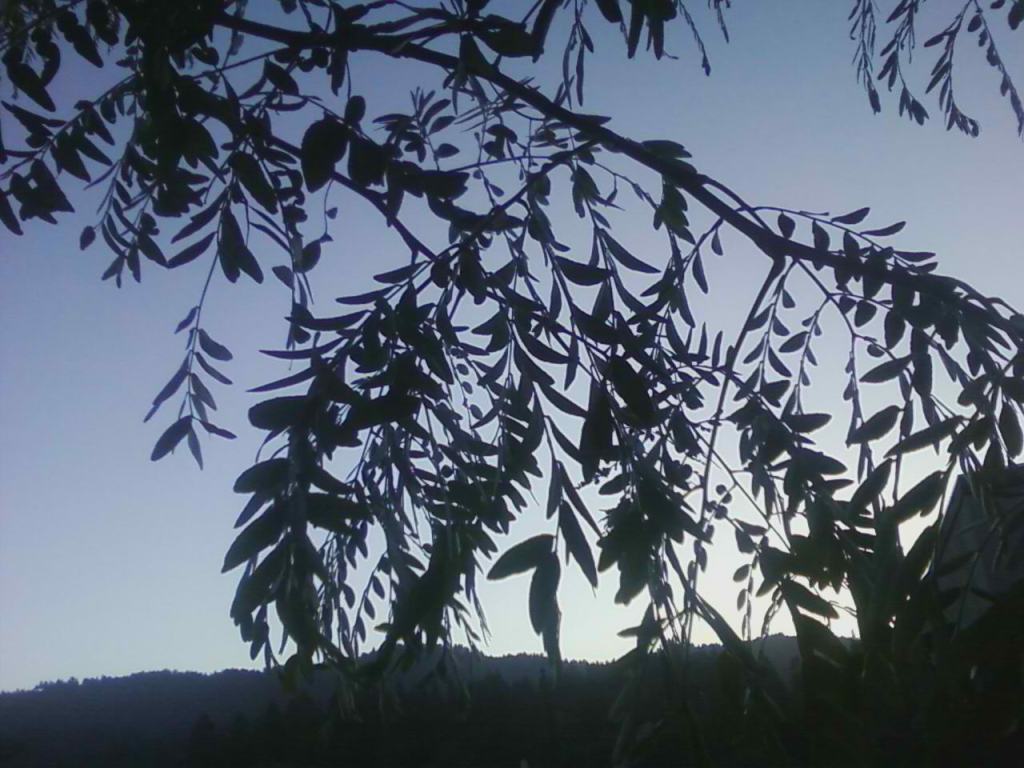
Those who know trees mostly agree that the more traditional catalpa, Catalpa speciosa, from the Midwest is the best catalpa, with soft leaves between half and a full foot long. In late spring or early summer, impressive upright trusses suspend an abundance of bright white, tubular flowers with yellow or tan stripes and spots at their centers. Individual flowers are as wide as two inches. Mature trees can be taller than forty feet and nearly as broad.

From the Southeast, Catalpa bignonioides, is a bit more proportionate to urban gardens though, since it only gets about seventy five percent as large, with leaves that are not much more than half as long. The flowers are also smaller, and not quite as bright white, but are more abundant than those of Catalpa speciosa are. The stripes and spots at their centers are slightly more colorful purplish brown and darker yellow.

Both catalpas can be messy as their flowers fall after bloom.  Fortunately, the big leaves are easy to rake when they fall in autumn. Long seed capsules that look like big beans linger on bare trees through winter.

Catalpa speciosa is almost never seen in modern landscapes, and not exactly common even in older Victorian landscapes around downtown San Jose. A few remarkable specimens remain as street trees in older neighborhoods of Oakland, Burlingame and Palo Alto. Most young trees were not planted, but instead grew from seed from older trees that are now gone.

Catalpa bignonioides is actually quite rare locally. A few old but healthy specimens can be seen around downtown Felton, with a few younger trees that grew from seed around the edges of town. Trees in Golden Gate Park in San Francisco are not as happy because of cool and breezy summers and mild winters.

Plum

Plums are now ripening for summer.

Prunes are not merely dried plums. They are European fruits which, although very edible fresh, are also popular for drying. Their significant sugar content inhibits mold during the drying process. Plums, Prunus domestica, are of the same species, but are of Japanese origin. They are quite popular fresh, but are more likely to mold than dry like prunes can.

Besides their lower sugar content, plums are a bit bigger and rounder than most prunes. Prunes are ‘freestone’, so their flesh separates from their seeds when ripe. Old fashioned plums are ‘clingstone’, so their flesh adheres to their seeds when ripe. The most popular plums are maroon or purple. Others are red, yellow, orange, green, blue or almost black.

Almost all plum trees within home gardens are semi dwarf. Although they do not grow as big as orchard trees, they can grow twenty feet tall. They require specialized aggressive dormant pruning during winter. Otherwise, they become shabbily overgrown with most of their fruit out of reach. Their prolific and bright white bloom is spectacular for early spring.

Giant Reed

Giant reed is a horrid weed within many ecosystems.

The earliest infestations of giant reed, Arundo donax, that clogged tributaries of the San Joaquin and Sacramento Rivers supposedly grew from pieces used as packing materiel for cargo from China. It was simply dumped into the rivers as cargo was unloaded in port cities like Stockton and Sacramento. How it got to China from its native range in the Mediterranean is unclear.

Because it is so aggressive and invasive, giant reed is almost never found in nurseries. In many rural areas, particularly near waterways, it is listed on the ‘DO NOT PLANT’ list. However, giant reed can sometimes be found in old landscapes where it was planted before it became so unpopular. It can also grow from seed in unexpected places.

Once established, giant reed can be difficult to eradicate or even divide. It spreads by thick rhizomes that resemble the stolons of bamboo, but not quite as tough. It is often mistaken for bamboo. Where it gets enough water, it can get nearly thirty feet tall, with leaves about two feet long.

Where it can be contained and will not become an invasive weed by seeding into surrounding areas, giant reed can provide bold foliage that blows softly in the breeze. ‘Versicolor’ (or ‘Variegata’) has pale yellow or white variegation, and does not get much more than half as tall as the more common green (unvariegated) giant reed. Incidentally, the canes of giant reed are used to make reeds for musical instruments.

Angel’s Trumpet

Angel’s trumpet impresses with huge flowers.

Lineage can be difficult to identify. Most popular cultivars of angel’s trumpet, Brugmansia are hybrids. Many are hybrids of hybrids. Almost all are consequently identifiable by only their genus and cultivar names. They usually lack species names. Their original species were likely native from Venezuela to Chile or southern Brazil. No one knows definitively.

Angel’s trumpet is a big bushy perennial. Its trunks may be as substantial and persistent as those of small trees. Most popular cultivars can grow higher than eight feet. A few rare cultivars should grow larger. Leaves are about six inches long and half as wide, or larger on vigorous stems. Some cultivars have slightly tomentous foliage. A few are variegated.

Bloom is sporadic while the weather is warm, and can be profuse in phases. Flowers are commonly longer than six inches and wider than three. Most are very pendulous. Double flowers are quite frilly. The floral color range includes pastel hues of yellow, orange, pink and white. Several cultivars are nicely fragrant. All parts of angel’s trumpet are toxic.

Lavender Cotton

Neither lavender nor cotton, but a member of the Compositae Family.

The name is somewhat of a mystery. It is related to neither lavender nor cotton, but Santolina chamaecyparissus is known as lavender cotton nonetheless. The small, silvery gray leaves have a finely wrinkly texture, and are remarkably aromatic, like lavender. Though, the small and round bright yellow flowers look like daisies with the outer petals plucked off.

Unlike lavender and most other similar evergreen semiherbaceous shrubs, lavender cotton is adaptable to shearing, and is actually a classic component of traditional ‘knot gardens’, usually with another species of Santolina with green foliage to provide contrasting color. (Knot gardens feature small hedges with various foliar colors shorn into geometric and sometimes intricate patterns.) If regularly shorn, it is appreciated for its strikingly gray evergreen foliage, since it will not bloom.

Unshorn plants get about two feet tall and a bit broader, and will eventually need seasonal light shearing to remove fading flowers after bloom. Annual pruning at the end of winter keeps plants compact and neat without depriving them of their bloom. They otherwise eventually get bald in the middle and sloppy around the edges. (Some of us know about that.)

Good warm exposure and well drained soil is best. After their first year, lavender cotton does not need much water.

Chilean Rhubarb

Chilean rhubarb is a grand perennial.

Only riparian and aquatic vegetation tolerates sustained soil saturation. Chilean rhubarb, Gunnera tinctoria, almost qualifies as such. It enjoys such generous irrigation that it may perform well on a bank of a pond or stream. However, it should be sufficiently high on its bank to avoid constant saturation. Otherwise, it can rot, likely during its winter dormancy.

Chilean rhubarb is a spectacular foliar plants. Its humongous lobed leaves may grow six feet wide and eight feet tall. Although they succumb to mild frost, they regenerate quickly from rhizomes for spring. Leaves and petioles have a rather raspy texture, with small soft spines. Odd conical floral spikes that bloom about now might grow nearly three feet high.

Although not related to real rhubarb, Chilean rhubarb is as edible as its name implies. Its big petioles only need peeling to remove the raspy exteriors. Locally, Chilean rhubarb is more of a striking ornamental perennial. It is as appropriate to woodsy gardens as it is to sleek modern gardens. The absence of its bold foliage for winter is the main disincentive for its usage.

Sawara False Cypress

Sawara false cypress cultivars do not develop into real trees.

Just like other types of false cypress, the Sawara false cypress, Chamaecyparis pisifera, naturally gets much larger than its many cultivars that are sometime grown in gardens for their colorful and interestingly textured foliage. Although not large trees, they can get nearly thirty feet tall in wild groves in Japan. Most garden varieties stay less than ten feet tall, and some stay much shorter.

‘Cyano-Viridis’ (‘Boulevard’), with feathery blue green foliage, is one of the more popular cultivars. It grows slowly to more than six feet tall and broad. ‘Filifera’ has very different foliage, with tightly fitting scale leaves on limber cord shaped branches. It stays a bit shorter but can get a bit broader. ‘Mops’ is similar to ‘Filifera’, but stays about a foot and a half tall and broad. ‘Filifera Aurea’ and ‘Golden Mops’ are just like ‘Filfera’ and ‘Mops’, but with yellow foliage.

Reflected glare or harsh exposures can burn foliage. Full sun is not a problem, unless enhanced by glare from surrounding pavement or lightly colored walls. Partial shade is not a problem either, but compromises foliar color, particularly yellow.

Shearing or major pruning deprives false cypress of their naturally appealing forms and textures. They should therefore get plenty of space for their mature size, and get trimmed lightly for shape only when necessary.

Mint

Mint is very easy to propagate.

Propagation is not a problem for mint, Mentha spicata. It grows very easily from cuttings, even in water. Alternatively, it grows efficiently from division of its dense network of basal stolons. A more likely problem is its potential invasiveness. It spreads everywhere it finds water, even into other vegetation. Therefore, it is more popular in pots than in the ground.

Mint is as popular for its herbal or culinary application as for its aesthetic appeal. Various cultivars and hybrids provide various flavors and aromas of mint. It is handsome alone in pots, or can mingle nicely with annuals, perennials or herbs. It is a traditional component of mixed window boxes. With containment it can be a splendid small scale ground cover.

Mature growth is generally less than a foot high. It can sprawl almost three feet high onto low shrubbery, though. Occasional shearing, particularly after winter, maintains tidier and lower growth. Paired evergreen leaves are about two inches long, with serrated margins. Slender floral spikes of tiny white or pink flowers may get slightly shabby during summer if not shorn.

Silver Mountain Gum

Silver mountain gum needs no irrigation once established.

The bulky trunk and limbs, and shaggy bark of silver mountain gum, Eucalyptus pulverulenta, seem like they should be associated with a more imposing tree. Mature specimens are rarely more than twenty five feet tall. Those that try to get taller often fall over or break apart because they are unable to support their own weight, particularly if watered too generously. Aggressive pruning in spring and summer limits size, and also promotes an abundance of silvery juvenile foliage, which is popular as cut foliage.

Juvenile leaves are round and sessile (without petioles or stalks), and arranged in strict four-ranked formation. (Each pair of opposite leaves alternates with similar but perpendicular pairs.) Adult foliage is almost lanceolate (lance shaped) and not quite as silvery. Small, white, staminate flowers (without obvious petals) bloom between leaves from autumn through winter. Young stems have peeling bark.

Like almost all eucalypti, silver mountain gum gets established most efficiently and grows best if planted while small. They are actually best grown from seed, which can sometimes be obtained online. The next best option, which is actually least common, is #1 (1 gallon) trees. #5 (5 gallon) trees are typically the smallest trees available. Larger trees are likely to have problems dispersing their roots. Once established, silver mountain gum needs no fertilizer or watering.

Deodar Cedar

Deodar cedar develops casual conical form.

“Cedar” is a common name of a few species of a few genera that are not actually cedars. Western red cedar is an arborvitae. Eastern red cedar is a juniper. Deodar cedar, Cedrus deodara, happens to be one of only three real cedars. Atlas cedar and cedar of Lebanon are the other two. Cultivars of Atlas cedar are uncommon. Cedar of Lebanon is very rare.

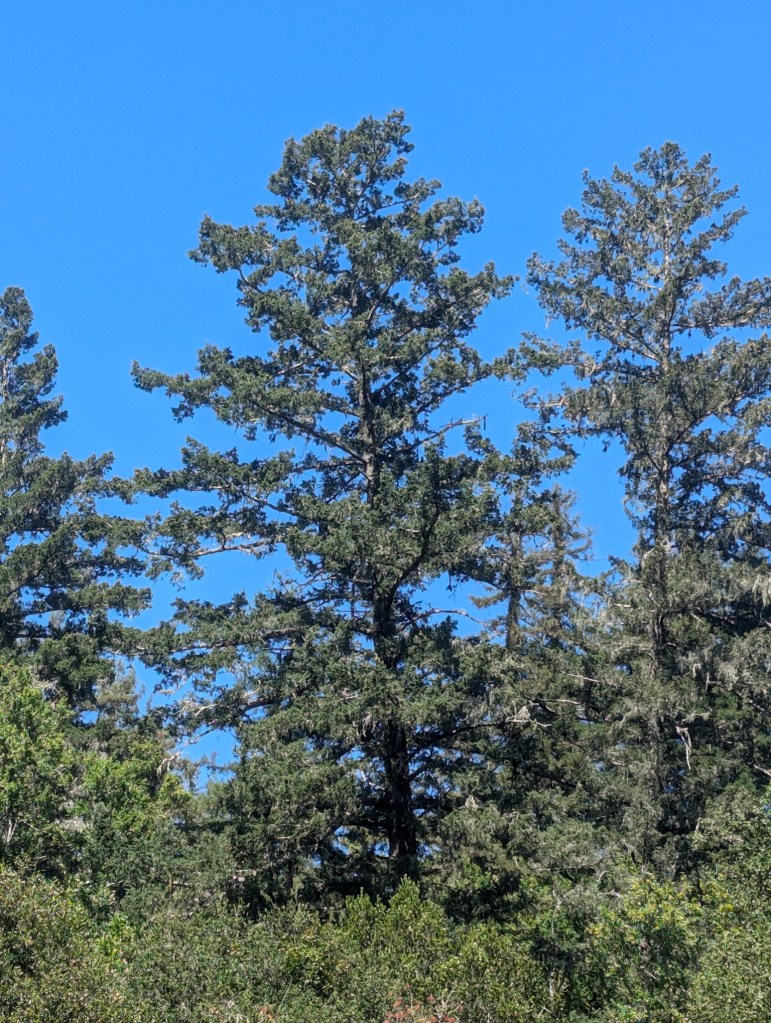
Although too big for compact gardens, deodar cedar is one of the more popular conifers. It performs splendidly within local climates and soils, as if it is right at home. Mature trees can survive without irrigation. Roots are generally complaisant, and disperse too deeply to displace pavement. However, deodar cedar can grow fifty feet tall and thirty feet wide.

Deodar cedar mostly develop casually conical form. Some develop multiple trunks or big limbs that eventually curve upward like trunks. Otherwise, limbs tend to droop somewhat at their tips. Glaucous grayish needle leaves are about an inch or two long. Most occur in terminal clusters of short spur stems. Some develop singly on elongated vigorous stems. Foliar debris has an herbicidal effect on the ground below.