Silver Mountain Gum

Silver mountain gum needs no irrigation once established.

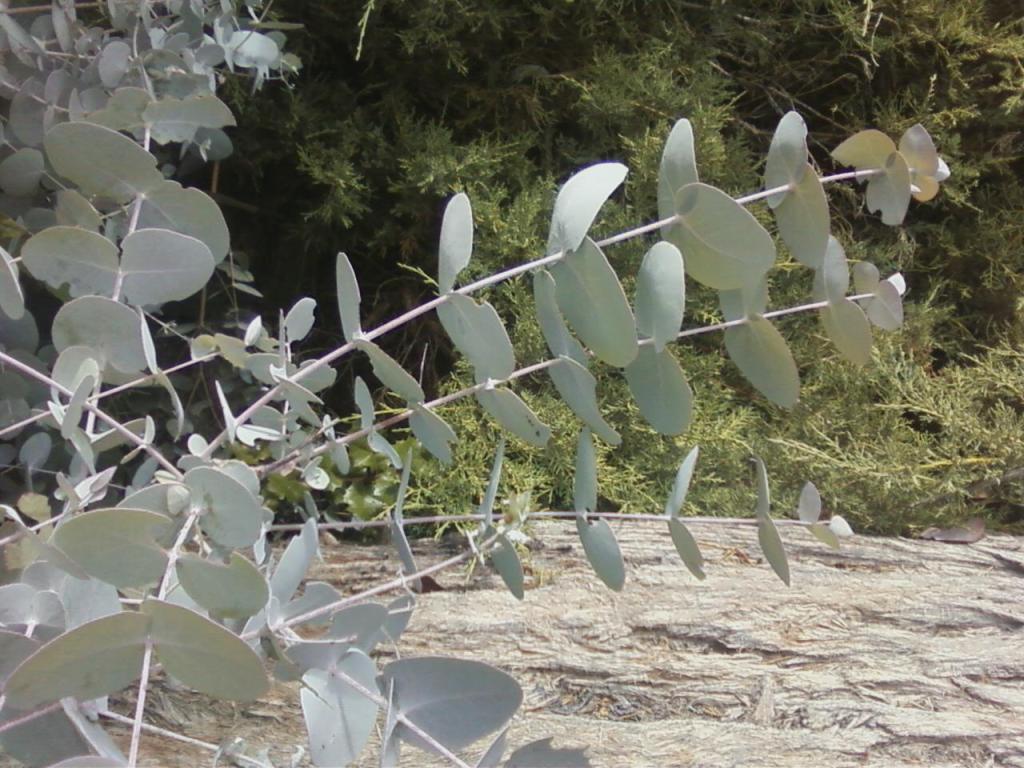
The bulky trunk and limbs, and shaggy bark of silver mountain gum, Eucalyptus pulverulenta, seem like they should be associated with a more imposing tree. Mature specimens are rarely more than twenty five feet tall. Those that try to get taller often fall over or break apart because they are unable to support their own weight, particularly if watered too generously. Aggressive pruning in spring and summer limits size, and also promotes an abundance of silvery juvenile foliage, which is popular as cut foliage.

Juvenile leaves are round and sessile (without petioles or stalks), and arranged in strict four-ranked formation. (Each pair of opposite leaves alternates with similar but perpendicular pairs.) Adult foliage is almost lanceolate (lance shaped) and not quite as silvery. Small, white, staminate flowers (without obvious petals) bloom between leaves from autumn through winter. Young stems have peeling bark.

Like almost all eucalypti, silver mountain gum gets established most efficiently and grows best if planted while small. They are actually best grown from seed, which can sometimes be obtained online. The next best option, which is actually least common, is #1 (1 gallon) trees. #5 (5 gallon) trees are typically the smallest trees available. Larger trees are likely to have problems dispersing their roots. Once established, silver mountain gum needs no fertilizer or watering.

Deodar Cedar

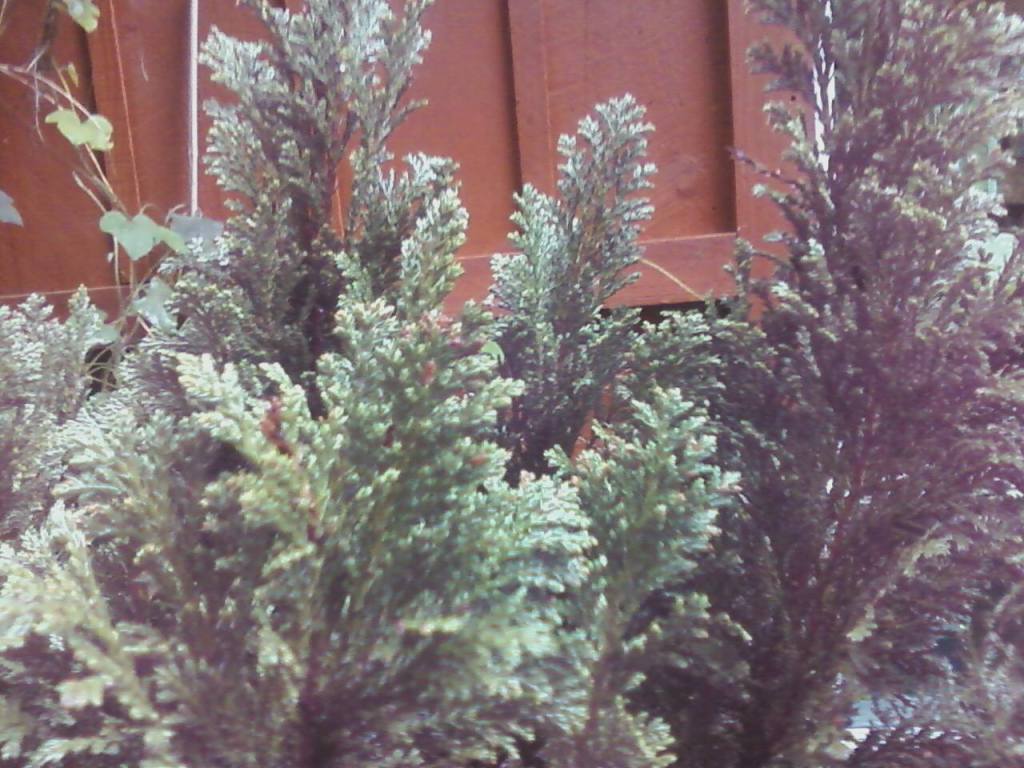
Deodar cedar develops casual conical form.

“Cedar” is a common name of a few species of a few genera that are not actually cedars. Western red cedar is an arborvitae. Eastern red cedar is a juniper. Deodar cedar, Cedrus deodara, happens to be one of only three real cedars. Atlas cedar and cedar of Lebanon are the other two. Cultivars of Atlas cedar are uncommon. Cedar of Lebanon is very rare.

Although too big for compact gardens, deodar cedar is one of the more popular conifers. It performs splendidly within local climates and soils, as if it is right at home. Mature trees can survive without irrigation. Roots are generally complaisant, and disperse too deeply to displace pavement. However, deodar cedar can grow fifty feet tall and thirty feet wide.

Deodar cedar mostly develop casually conical form. Some develop multiple trunks or big limbs that eventually curve upward like trunks. Otherwise, limbs tend to droop somewhat at their tips. Glaucous grayish needle leaves are about an inch or two long. Most occur in terminal clusters of short spur stems. Some develop singly on elongated vigorous stems. Foliar debris has an herbicidal effect on the ground below.

Port Orford Cedar

Cultivars are much more compact than the simple species.

Fifty foot tall Port Orford cedar trees, Chamaecyparis lawsoniana, like those that get harvested for timber from their native range on the south coast of Oregon and the northwest corner of California are almost never found in refined gardens. Their remarkably diverse garden varieties mostly stay less than half as tall, as dense, compact trees or large shrubbery that resembles arborvitaes. Many have bluish or greyish foliage. Some have gold foliage. Finely textured needle-like juvenile foliage that is so prominent among young plants continues to appear sporadically with scale-like adult growth as plants mature. The small round cones are not prominent. Like related arborvitae, Port Orford cedar tolerates a bit of shade.

Lemon Bottlebrush

Lemon bottlebrush is popular among hummingbirds.

Like oleander and junipers, lemon bottlebrush, Callistemon citrinus, has become passe. It was a victim of its own practicality. It was so popular that it became overly common. Yet it is just as practical now as it was then. It is resilient enough to survive within medians of freeways with minimal irrigation. In less exposed situations, it might require no irrigation.

As a small tree, lemon bottlebrush can grow more than fifteen feet tall. With pruning from below, some grow about twenty feet tall with sculptural trunks. Their canopies eventually become messy though, and require aggressive pruning. Most lemon bottlebrush grow as big flowering shrubbery or high hedges. Shearing can compromise bloom if too frequent.

Bright red bloom should be most abundant for summer, but may be sporadic at any time. It is very popular with pollinators, including hummingbirds. Many small staminate flowers bloom in compact cylindrical trusses, like bottlebrushes. Each truss is about two or three inches long and nearly as wide. The aromatic and evergreen leaves are almost as long. Dark brown bark is handsomely shaggy and furrowed.

Pincushion Flower

Pincushion blooms in pastel blue, lavender pink or white.

The oddly protruding stamens of pincushion flower, Scabiosa columbaria, are ideal for bees collecting pollen. To us, they resemble pins stuck into the somewhat flat surface of the composite (daisy like) flowers. To bees, they are a flea market (or bee market) of pollen. Bees easily stroll the two inch wide flowers to peruse the merchandise on display. 

The pale lavender, blue, pink or white flowers on limber stems are good cut flowers. The grayish foliage is deeply lobed and nicely textured. Mature plants can be two feet tall and broad. Bloom begins by summer and continued until frost if fading flowers get plucked. Although perennial in mild climates, pincushion flower is more often grown as an annual.

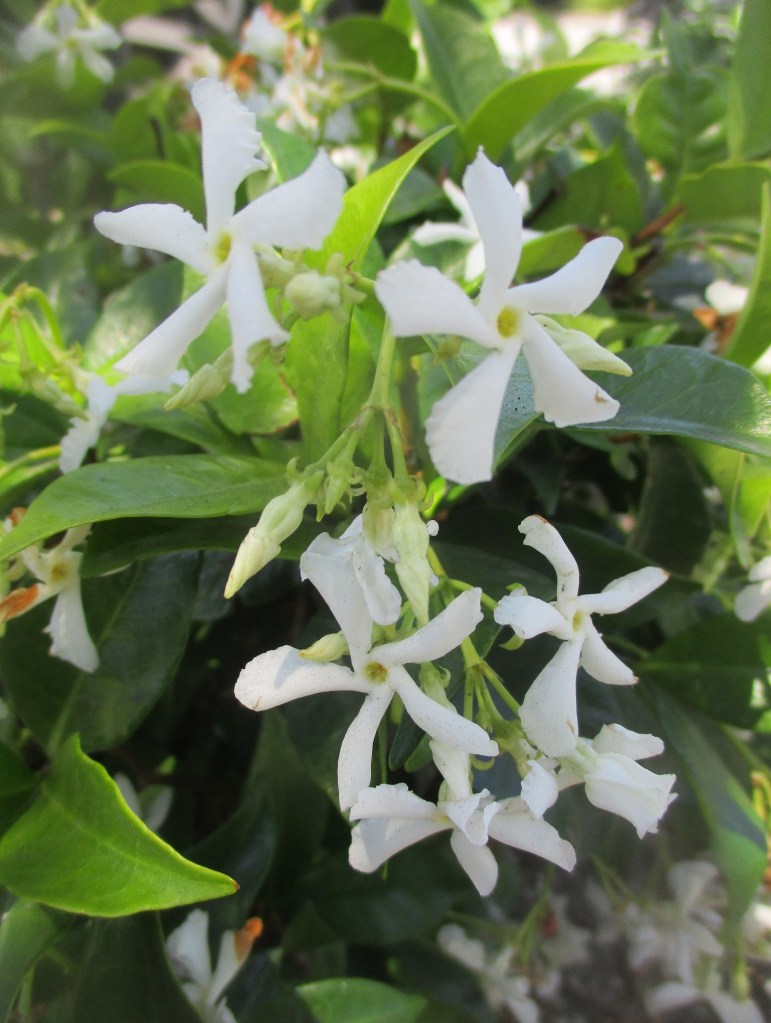
Star Jasmine

This jasmine is quite a star.

It is certainly a star within many gardens, but it is technically not a jasmine. Star jasmine, Trachelospermum jasminoides, is actually closely related to Plumeria. Its floral fragrance can be comparably rich with copious bloom, but is distinctly vanillish. Bloom is abundant for late spring and early summer. Sporadic bloom can start early and continue to autumn.

Without bloom, the distinctly glossy foliage is handsome alone. Individual leaves are not much longer than two inches, and not much wider than one. Their deep green foliar color and lustrous sheen almost seem artificial. Pruning or any disturbance of foliage or stems releases caustic and toxic sap. Twining vines ascend by wrapping around their supports.

Star jasmine can get two feet deep as a ground cover without support. It requires pruning to prevent it from overwhelming shrubbery or climbing into trees. It also requires frequent pruning around its edges. As a climbing vine, it grows fast to ten feet high, and can grow much higher a bit slower. It can become a neatly shorn faux hedge on a chain link fence.

Mock Orange

Official State Flower of Idaho

Meriwether Lewis of the Lewis and Clark Expedition encountered the western native mock orange, Philadelphus lewisii, in 1806, and gave it his own name. It inhabits an extensive range that reaches from the northern Sierra Nevada to southern British Columbia to western Montana, but is somewhat sporadic within its natural range. It is the state flower of Idaho, and is commonly planted in state, national and even some county parks within its range and throughout the rest of California.

Partial shade is not a problem for mock orange, but full sun exposure promotes more abundant bloom. The simple, strikingly white flowers that bloom in spring are less than two inches wide with only four petals. However, their remarkably rich orange fragrance is unexpectedly powerful. The two inch long, forest green, deciduous leaves on arching limber stems are a nice backdrop. ‘Goose Creek’ has double flowers.

Because regular pruning or shearing of outer growth inhibits bloom and compromises natural form, mock orange is best where it has plenty of space to grow wild, or at least where the upper canopy can spread out naturally if the lower canopy gets pruned away to form a small tree with multiple trunks.  After bloom, older deteriorating stems can be pruned out, to favor newer stems emerging from the base. Overgrown plants can be cut to the ground in winter, and will regenerate over the following summer to bloom in the second spring. Mature mock orange gets nearly ten feet tall and broad.

Hosta

Hosta exhibits a lushly woodsy style.

Even for some understory species, shade can inhibit bloom. For Hosta, that would not be much of a problem. Its late summer bloom is merely an added bonus to its lushly colorful foliage. Actually, the foliage is more appealing without its tall floral spikes. Such bloom is prettier in a vase anyway. The hanging white or lavender flowers are an inch or two long.

Where summer weather is cooler, some Hosta can grow three feet tall and twice as wide. Locally, only a few of the largest cultivars can grow as wide as three feet during summer. Then, they defoliate by winter. Most have broadly rounded leaves, but a few have narrow or wavy leaves. Many have paler green, yellow or white variegation, or glaucous foliage.

Hosta is uncommon here, probably because it may be somewhat demanding. It requires very regular watering to avoid desiccation. It craves organically rich soil or potting media. Fertilizer can enhance lushness, but can burn foliage if just slightly excessive. Slugs and snails can ruin foliage. However, Hosta are understory plants that tolerate a bit of shade.

Atemisia ‘Powis Castle’

Artemisia ‘Powis Castle’ is more foliar than floral.

The pleasantly aromatic and lacy silvery gray foliage of Artemisia ‘Powis Castle’ can either mix well with pink, lavender or light blue flowers, or contrast against bright red or orange. The dark angular leaves of bronze New Zealand flax or bronze cannas are striking against its low and softly mounding form, which stays less than two feet tall and not much more than twice as wide. Contrary to how Artemisia ‘Powis Castle’ enhances the color of other flowers and foliage, its own flowers are not much to look at, if they get noticed at all.

Foliage is fluffiest if mature plants get pruned down at the end of winter. New plants can be propagated by division in spring or autumn. As plants get established, good drainage becomes more important than frequent watering.

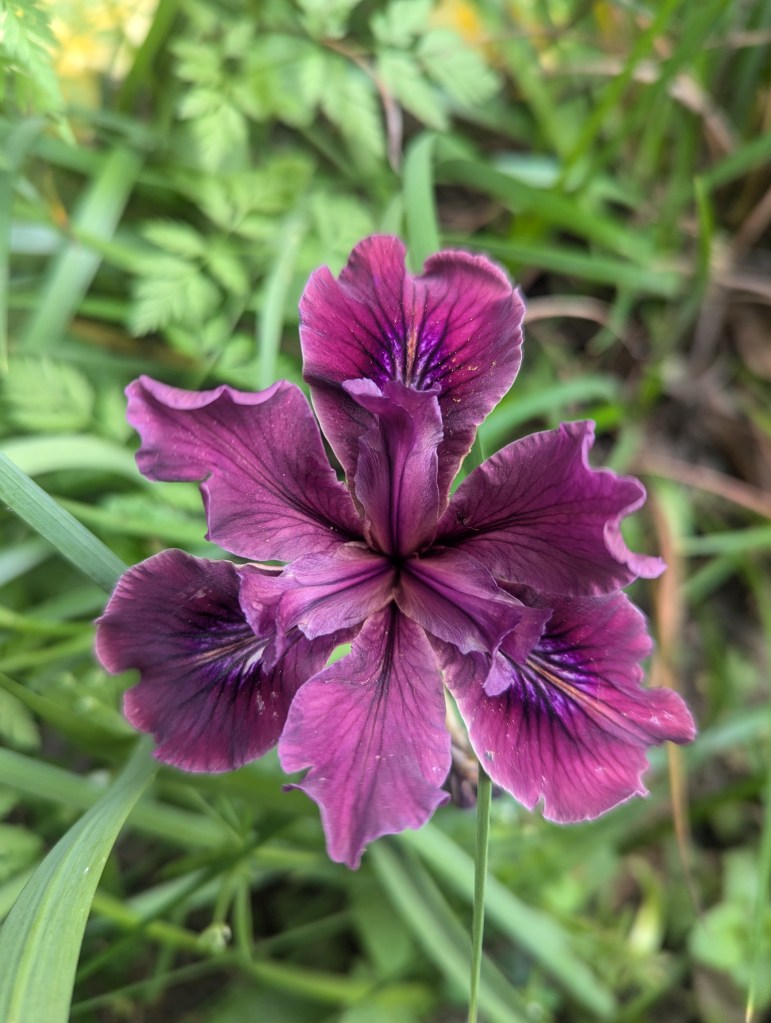
Pacific Coast Hybrid Iris

Hybridization has produced unnaturally rich color.

Several species of iris are native to the West Coast of North America. Iris douglasiana is probably the most colorful species. Hybridization with the others improved its floral color range and other characteristics. Several of such hybrid cultivars collectively became the Pacific Coast hybrid iris. However, the various cultivars developed from various ancestry.

Most Pacific Coast hybrid iris are finishing their bloom about now. Some bloomed earlier, at the end of last winter. Their flowers can be various shades of blue, purple, red, orange, yellow or white. This includes lavender, burgundy, rust, rose, coral, gold or creamy white. Only green colors lack. Brown pods of sterile seed are visually unappealing after bloom.

Flowers are about three or four inches wide and stand about a foot tall. Individual flowers do not last long, but bloom in succession for quite a while. Grassy and dark green foliage develops low mounds that stay lower than bloom. Propagation is simple by division from large foliar mounds during autumn. Generous watering can cause rot and patchy growth.