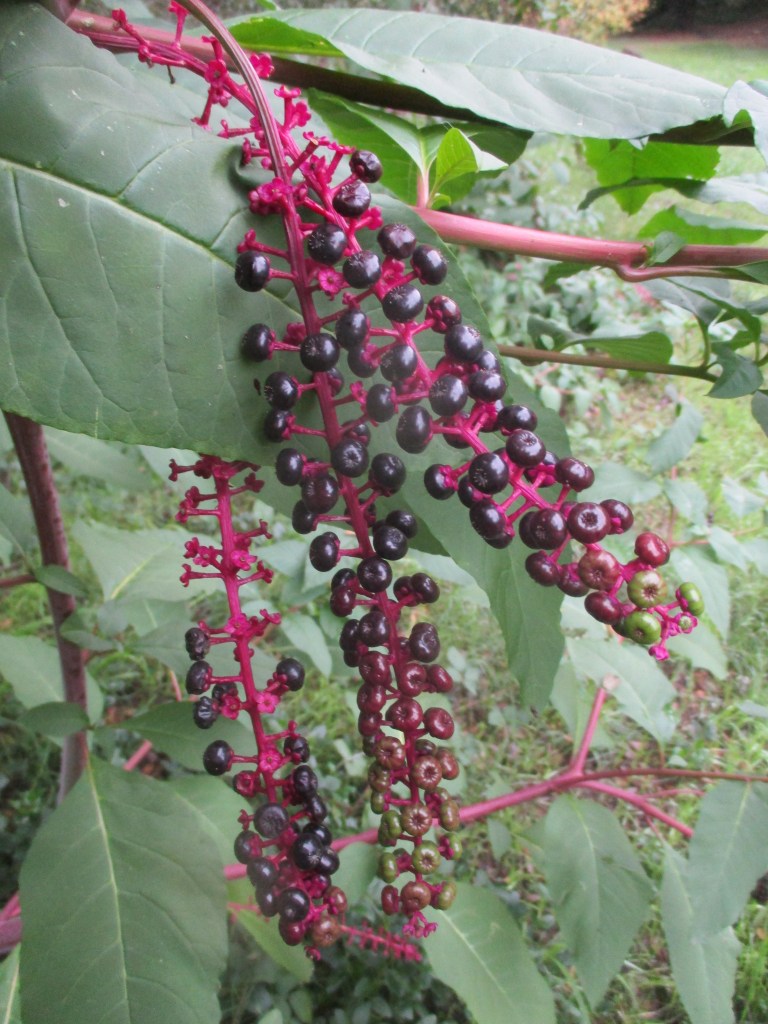
Phytolacca americana is known by several names; pokeweed, pokeberry, pokebush, pokeroot, poke sallet, and simply, poke. I have no idea what poke is, but it is obviously famously associated with this species, which I know instead as inkberry. That is a more sensible name to me, since I made ink from the famously toxic berries. However, within its native range, a species of holly is also known as inkberry.
The ink is initially an obnoxiously bright magenta, but fades to a light brown. Those who prefer the bright magenta color can preserve it somehow. I prefer the faded brown. Because the ink is caustic, it should be used only with disposable quills. Inkberry is also used for dying fabric, either magenta or brown.
Weirdly, inkberry is both extremely poisonous and also edible. Tender young vegetative shoots can be collected as they begin to emerge after winter. They can be boiled and drained a few times to eliminate toxins that might have developed within them by that time. Such growth becomes more toxic as it matures. A few shoots must be left to grow through summer and autumn to sustain tuberous roots below, so that new shoots can grow for the following season. This sustaining growth gets quite large, after providing only a minor volume of edible shoots. In other words, inkberry is a large perennial that needs plenty of space but provides only a small amount of potentially edible but possibly toxic greens. There are plenty of safer and more efficient greens and vegetables to grow in the garden.
Inkberry has become a somewhat invasive exotic species here. We prefer to remove it from public landscapes because its poisonous but pretty berries might be tempting to those who are unfamiliar with it. They certainly look like they would be tasty.


 Tony Tomeo