Sacred Datura

Native sacred datura is extremely toxic.

Georgia O’Keeffe made jimson weed flowers famous. Within the context of her paintings, they seem to be angel’s trumpet flowers. Californians know its species as sacred datura, Datura wrightii. It is as native here as where Georgia O’Keeffe observed and painted it in New Mexico. For refined gardens, though, it is rare. It lives almost exclusively in the wild.

There are a few reasons for this. Sacred datura is a sloppily sprawling perennial that can quickly grow eight feet wide. It is not reliably perennial though. It might perform for only a single season, and then suddenly die. The spectacular flowers close through the middle of the day. Seed capsules are annoyingly bristly. Worst of all, sacred datura is very toxic.

Otherwise, sacred datura is as appealing as Georgia O’Keeffe depicted it to be. Its grand flowers resemble those of angel’s trumpet. They stay open longer during cool and damp weather. Foliar color is creamy white, perhaps with a slight lavender blush. Fragrance is mild only because bloom is so close to the ground. Big specimens can get three feet tall. The foliage has a velvety texture.
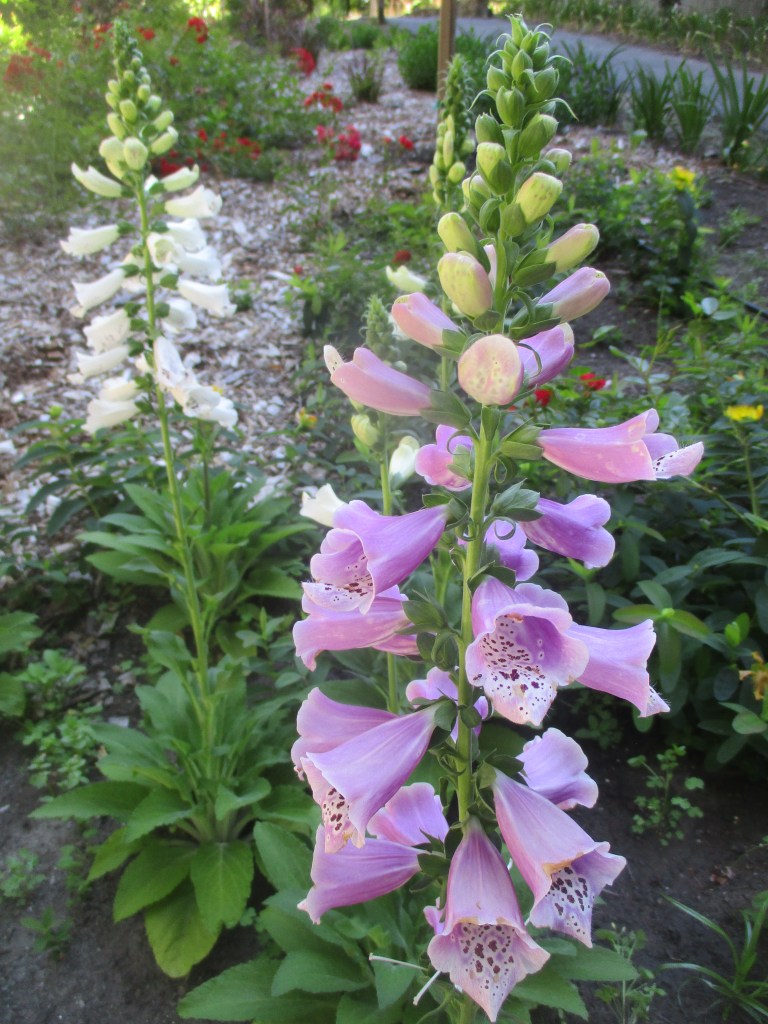
Foxglove

Foxglove is the source of digitalis.

It is no coincidence that its generic name seems more pharmaceutical than horticultural. After all, the cardiac medication digitalis is an extract of foxglove, Digitalis purpurea. The plant is unfortunately very toxic. Because it naturalizes in several regions, it can be more hazardous than standardized medications. It can migrate undetected into home gardens.

Otherwise, foxglove is a delightful warm season annual with a rustic or woodsy style. It is actually a biennial that generates basal foliar rosettes during its first season, and blooms during its second season. Although technically monocarpic (so should die after bloom), it can produce a few short pups to bloom later. Seedlings can appear in random situations.

Plants from nurseries grew during a previous season, so are ready to bloom immediately for early summer. Their seedlings may grow through later summer and autumn, so might bloom for the following summer. Floral stalks generally stand between three and six feet tall. The tubular and somewhat pendant flowers are mostly pinkish purple, pink or white. A few modern varieties bloom yellow or apricot.

Be Careful With Toxic Plants

Toxic plants can be quite appealing.

Plants are so much more intelligent than they get credit for. Many use color, fragrance and flavorful nectar to get insects and animals to disperse their pollen for them. Some provide fruit for animals that inadvertently take and disperse their seeds. Others use barbs or sticky substances to attach their seeds to unknowing animals that take them away. Plants have all sorts of techniques for exploiting those who are more animated than they are. After all, immobility has certain disadvantages.

Because plants can not get away from the animals and insects that eat them, many have developed techniques for being unappealing. Plants that live in deserts where edible foliage is relatively scarce are famous for their nasty thorns and spines, like those of cacti and agave. Hellebore and poinsettia have caustic sap that make them unpalatable. The naturally aromatic foliage of many edible herbs, like rosemary and lavender, is actually intended to repel grazing animals with sensitive noses.

Some plants unfortunately rely on toxicity for protection. Many plants are only partially toxic. For example, apples are intended to be eaten safely by animals that disperse the seeds within, but their seeds are toxic enough to avoid getting eaten by rodents after dispersal. Potato, tomato, rhubarb, asparagus and elderberry plants all produce edible fruits or vegetables, but also have poisonous parts. Some edible fruits and vegetables, like grapes and onions, are edible to humans, but toxic to dogs.

Foxglove, angels’ trumpet, morning glory, yew, rhododendron, azalea, oleander and castor bean are some of the more notably toxic plants often found in home gardens. Wisteria, holly and ivy produce toxic seeds and fruits. Dieffenbachia is a popular but very toxic houseplant. Although mostly safe, toxic plants can be a problem where young children might put things into their mouths, or where puppies are in that chewing phase.

Some Edible Plants Start Out Toxic

41126thumb
Pokeweed is both edible and toxic.

Early American settlers from Europe had a lot to learn about the plants of North America. After their first harsh winter without much food, many were eager to eat the first fresh greens of spring, which was sometimes the very poisonous jimson weed. Those who were not lethally poisoned right away might have hallucinated and told their friends that they could fly, and consequently got burned as witches.

It should be no wonder that some early Americans were hesitant to try tomatoes, which are related to jimson weed. Potatoes are also related, and their fruit, foliage and stems actually are toxic. Pokeweed (unrelated) was probably riskier, since the same young shoots that can be cooked as greens become toxic as they mature. Their poisonous berries, which were used as ink back then, look delicious.

There were other potentially dangerous edibles brought from Europe and other places as well. Rhubarb, which makes such great pies, is petioles (leaf stalks) for toxic leaves. Both American and European elderberries are slightly toxic before getting cooked into jelly or pie. Elderberry juice must be cooked and then given yeast to make wine. Figs and mulberries can be eaten right off their trees, but their sap is caustic enough to be irritating to the skin.

The seeds of apples, pears, peaches, nectarines and apricots can be toxic if too many are eaten. They are not a problem only because they are not eaten. However, apricot kernels can be roasted and eaten like almonds because the cooking process denatures the toxins. Separating the small kernels from the hard shells is much more work than it is for almonds, but they supposedly have great flavor.

Just like for apricot kernels, pokeweed and elderberries, the heat of cooking makes taro edible. The foliage can be eaten as stewed greens. The big and starchy corms (bulb-like stems) are something like potatoes. All parts of taro are toxic while raw. There are actually a few toxic plants that are edible once cooked. For a few others, it is important to know what parts are edible, and what parts are toxic.