Horridculture – Bad Pollarding

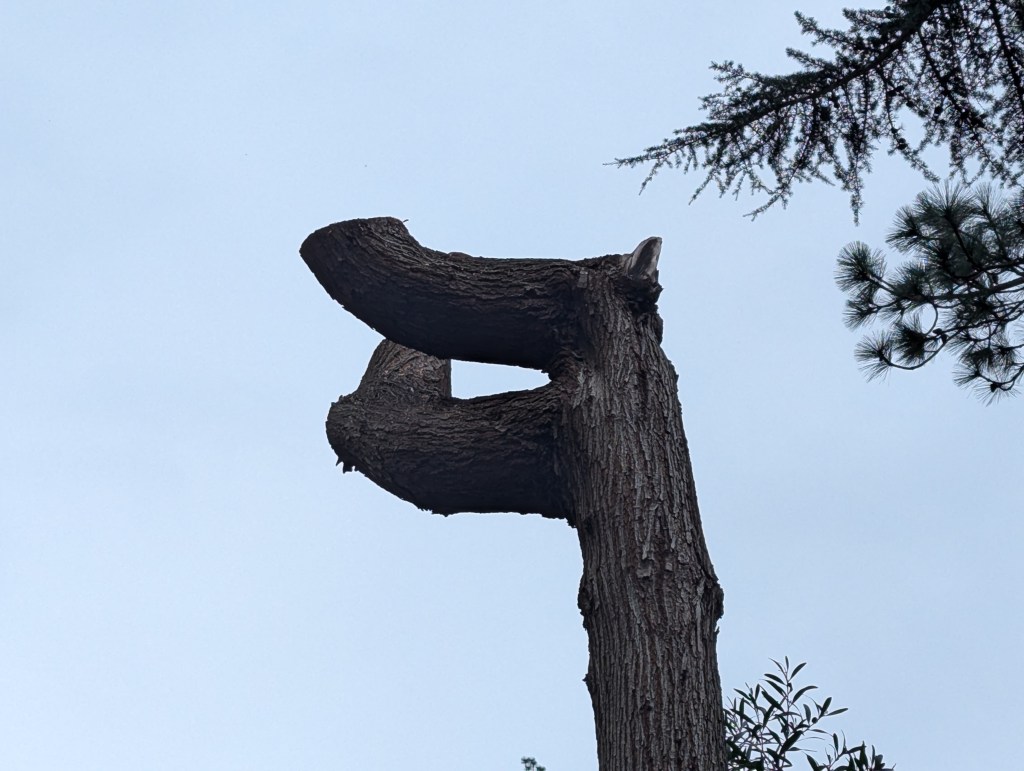
Actually, this does not even qualify as pollarding. It looks as if this tree, which was one of a few similarly damaged Acacia melanoxylon, black acacia trees, was in the process of being removed when the crew who was removing it left for the day. It would not have been so bad if they had returned to remove it and the others completely. They did not. This was the finished product. It and the others were almost twenty feet tall in this condition. They were about twice as tall prior. This sort of hack job is what gives pollarding a very bad reputation. It also demonstrates why proper pollarding should not be so vilified that arborists do not learn how to do it. Very obviously, this is not proper. Because they could not be salvaged, all of these trees were cut down a few days after I got this picture.

Pollarding can be done for a variety of reasons, and has been done for centuries in various cultures. It is still respected technique in many or most cultures. It stimulates vigorous growth that can be fodder for some types of livestock, including silkworms who consume the vigorous foliage of pollarded white mulberry trees. It can prevent some trees from producing troublesome pollen or fruit, such as old orchard olive trees that were retained as homes and their respective gardens were constructed around them. It can enhance autumn foliar color for some types of deciduous trees, such as the old Schwedler maples that were formerly common as street trees in San Jose. It stimulates growth of vigorous cane stems that are useful for basketry, fences, trellises or kindling. Locally though, it is considered to be as egregious as the technique pictured above, which is why no one here learns about it.

Coppiced Vegetation Regenerates With Vigor

Coppicing can alleviate congested basal growth.

Winter dormancy has advantages. It facilitates acquisition and establishment of bare root stock, and winter dormant pruning. Coppicing and pollarding are the most severe sorts of winter dormant pruning. Although initially ugly, coppiced and pollarded vegetation mostly grow vigorously later. Most species bloom and fruit better. All species foliate more lushly.

There is certainly nothing wrong with proper coppicing and pollarding. Both are common beyond America, particularly within Europe. However, both are very unfortunately vilified as disfigurement here. Not many arborists know how to perform such techniques, or may not admit to it. Yet, some coppiced vegetation is covertly popular in some home gardens.

Coppicing and pollarding are genuinely extreme and harsh techniques. Coppicing is the removal of almost all growth that is above the surface of the ground. For some shrubbery or trees, short stumps may remain. Coppiced vegetation is therefore not much to look at. Pollarding is similar, but retains primary trunks and limbs. Pollarded trees seem hideous.

Hideousness is subjective, though. By European standards, pollarding is an acceptable horticultural technique. European arborists know how to perform it properly during winter dormancy. They do so neatly, without stubs or torn bark, and direct growth as necessary. Coppiced vegetation is not as hideous because not much of it remains to see afterwards.

Because of its vilification, coppicing became more tolerable with different classifications. “Cutting back” perennials, such as African iris, lion’s tail and canna, is the same process. So is cutting back carpet roses or honeysuckle to the ground. The alternate classification is more acceptable. It is just as effective for removal of thicket or deteriorating old growth.

Also, coppiced vegetation regenerates more vigorously for spring than it may otherwise. Elderberries prefer selective grooming, but coppiced plants produce bigger fruit clusters. English Laurel, osmanthus, photinia and red twig dogwood respond nicely to coppicing. However, coral bark Japanese maple is grafted, so is likely to lose its scion if cut too low down.

Fruitless Mulberry

Fruitless mulberry is conducive to pollarding.

Even though silk never became a major commodity in North America, it indirectly made an impression on American gardening. The tree that was developed to most efficiently feed silkworms is now among the most popular of shade trees. The fruitless mulberry, Morus alba, wastes no resources producing fruit while providing only abundant foliage, which is the only sustenance for silkworms.

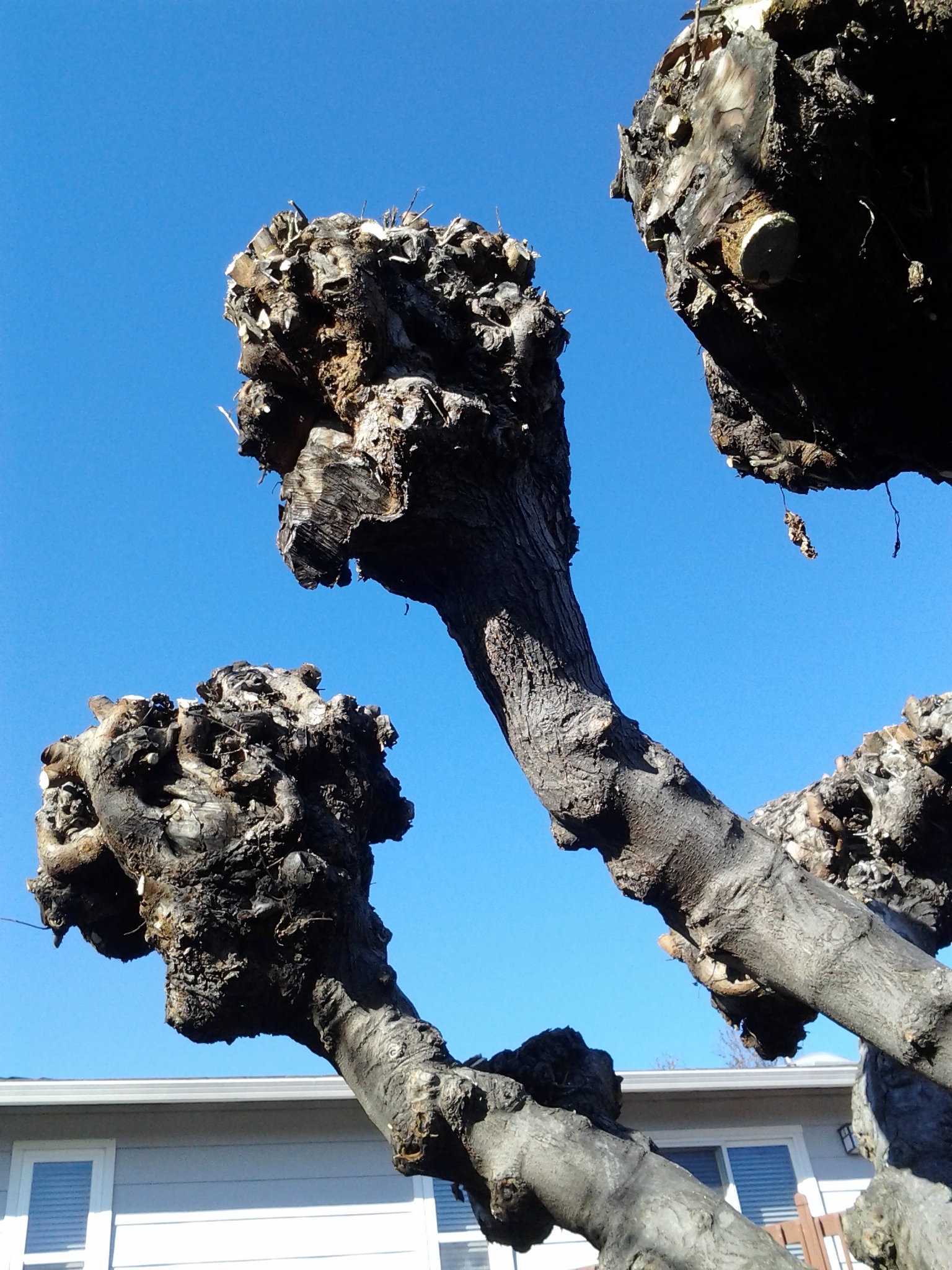
Young trees grow at a good rate to nearly thirty feet tall, and can eventually reach fifty feet. They are often pollarded (pruned severely back to the same burly ‘knuckles’ every winter), which causes them to regenerate stems at an alarming rate during summer. Shoots from mature pollarded knuckles have no problem reaching fifteen feet in all directions! Mulberries incidentally have the distinction of the fastest motion known to the plant kingdom, because they launch their pollen at more than half the speed of sound!

The serrate leaves are quite variable. Those of vigorous young shoots of pollarded trees are mostly about six inches long with rounded wide lobes, but can be nearly a foot long! They turn bright yellow and typically fall neatly from the tree within a limited time in autumn, facilitating raking. Leaves on slower growing stems of lightly pruned mature trees are mostly unlobed and less than six inches long. They begin to fall earlier in autumn and linger over a longer time, sometimes with slightly subdued autumn color.

Coppice To Renovate Overgrown Shrubbery

Coppicing stimulates vigorous new basal growth.

Pollarding is extreme pruning. It removes all but the most substantial of limbs and trunks. Coppicing is even more extreme. It leaves only stumps above ground. Both are common and respected arboricultural techniques outside America. However, they are vilified here. Actually, very few arborists here know how to pollard and coppice properly, or admit to it.

There are many valid reasons to pollard or coppice trees or big shrubs. Both techniques stimulate vigorous growth. Lush foliage of such growth is useful as fodder, particularly for silkworms. Elongated stems of such growth are useful for basketry and kindling. Species that bloom on older stems can not produce pollen or messy fruit after annual procedures.

Although silkworms, basketry and such are unimportant within an average home garden, proper pollarding or coppicing enhances vigor. This enhances the bloom of species that bloom on new stems. Vigorous growth of pollarded crape myrtle is atypically resistant to mildew, and also blooms zealously. Coppice pruning eliminates unsightly thicket growth.

Pollarding is generally useful for trees and large shrubs that retain primary trunks. Only a few of the many species that inhabit home gardens are conducive to it. Since secondary growth is initially structurally deficient, it will most likely need subsequent pruning during subsequent winters. Some vigorous pollarded trees are dependent on annual pollarding.

Coppicing is generally useful for large and vigorous shrubbery, and perhaps a few types of trees. Coppiced shrubbery is not as reliant on subsequent pruning as pollarded trees. They either benefit from pruning as they grow anyway, or do not get too heavy to support their weight. Both coppice and pollard pruning can happen only during winter dormancy.

Realistically, the majority of plants in home gardens are conducive to neither coppice nor pollard pruning. Cypress hedges die if cut back to stumps. Grafted plants, even if pruned above their graft unions, are likely to regenerate from their understock. However, some of the most popular hedge plants, such as privet, holly, photinia, osmanthus, English laurel and bottlebrush regenerate splendidly.

Pollarding Pruning Techniques Remain Controversial

Pollarding is pruning to the extreme.

Olive orchards formerly inhabited some of the regions that became urban in California. A few orchard trees remained within urban gardens of the homes that encroached on them. Unfortunately, for those who did not utilize the abundant olives, these trees were horridly messy. Many decades ago, pollarding eliminated the mess without eliminating the trees.

Pollarding is extreme pruning that eliminates all but the main trunk and a few main limbs. It deprives olive trees of their ability to bloom, by eliminating stems of a previous season that would otherwise bloom during the next season. Fruit can not develop without bloom. For other trees that bloom only on older stems, pollarding eliminates bothersome pollen.

Pollarding has several other practical applications. It confines trees that would otherwise get too big for their respective situations. It enhances foliar color and texture for trees that display colorful foliage through summer, such as Schwedler and Princeton Gold maples. Red twig dogwood generates more colorful twigs, and more abundantly, after pollarding.

For agricultural purposes, pollarding generates lush vegetative growth of white mulberry to sustain silkworms, or other vegetation for livestock. It similarly generates long and thin willow stems for basketry. Various eucalypti rely on pollarding to produce juvenile foliage that is colorful and healthy enough for floral design, or aromatic enough for essential oils. 

Nowadays, pollarding is unfortunately passe and even vilified. Consequently, almost no arborists learn about it. Because it is technically disfiguring and potentially unsightly, it is undesirable for many situations. Annual repetition is needed to prevent bloom or fruiting. Otherwise, restorative pruning or more extreme pollarding eventually become necessary. 

For pollarding, proper technique is imperative. Such severe pruning must happen during winter dormancy. It would it be too stressful during vascular activity. Besides, bark would be very susceptible to scald if so suddenly exposed during warmer and sunnier weather. Pruning cuts must be very neat, and back to any old pollard cuts, without stubs to inhibit healing.

Coppicing And Pollarding Annoy Arborists

Pollarding is a long term commitment.

Coppicing and pollarding are the most extreme of pruning techniques. They may also be among the oldest in some cultures. Yet, arborists are correct to condemn both as improper. Coppicing is the complete removal of all stems and trunks back to a stump. Pollarding is the removal of all stems back to main stems and trunks. Both procedures happen in winter, annually or every few years.

Both coppicing and pollarding stimulate vigorous and prolific cane growth during the next season. Lush foliage of such growth is useful as fodder. Foliage of pollarded mulberry is the primary food of silk worms. Canes are good kindling for the following winter. Thin canes of various species are useful for basketry. New foliage of pollarded eucalypti is useful for both essential oils and floristry.

Of course, few rely on modern urban gardens for fodder, kindling, eucalyptus oil, or basketry material.

Arborists disapprove of coppicing and pollarding because both techniques ruin trees. Many of such trees are too structurally compromised to support the weight of secondary growth after the first year. Consequently, they rely on annual coppicing or pollarding. Some trees will support their weight for a few years. Strangely though, many properly coppiced or pollarded trees live for centuries.

Coppiced trees generate from stumps of cut down trees. Ideally, they begin young. Grafted trees are less cooperative. They are likely to generate suckers below their graft unions. Pollarded trees get to develop their main trunks and limbs prior to their first pollarding procedure. The locations of the first pollarding cuts is very important. Subsequent pruning will be back to the same locations.

Distended ‘knuckles’ develop after repeated coppicing or pollarding back to the original pruning sites. Pruning must be flush to these knuckles. Stubs interfere with healing. Annual pruning leaves smaller wounds than less frequent pruning. Secondary growth should be able to overgrow wounds efficiently. Cutting below knuckles leaves wounds that may be too big to heal before they decay.

Pollarding And Coppicing Appall Arborists

00212thumb
Pollarding is disturbingly severe but effective.

Very few arborists in America condone the extreme pruning techniques known as pollarding and coppicing. Both techniques essentially ruin trees, and deprive them of their natural form. Affected trees likely require such procedures to be repeated every few years or annually. Otherwise, they are likely to succumb to resulting structural deficiency. Restoration of such trees is rarely practical.

Pollarding is severe pruning to remove all except the main trunk and a few or perhaps several main limbs. Coppicing is even more severe, and leaves only a stump. Both are done while subjects are dormant through winter. Most or all new growth that develops is spring is concentrated around pruning wounds of the previous winter. Some coppiced stumps generate growth from the roots.

If pollarded or coppiced annually, all growth that developed during the previous season gets pruned cleanly away to where it grew from since the previous procedure. Distended ‘knuckles’ develop at the ends of pollarded limbs or coppiced stumps as the pruning is repeated for a few years. ‘English’ pollarding leaves a well oriented stub of any desired length to slowly elongate each knuckle.

Pruning wounds should be as flush to each knuckle as possible, without intrusive stubble. The many small pruning wounds left on each distended knuckle will compartmentalize (heal) efficiently as new growth develops during the following season. Pruning below a knuckle might seem to be more practical, but leaves a single but big wound that could decay before it gets compartmentalized.

Delaying pruning for a few years creates bigger wounds, and allows innately structurally compromised stems to get heavy.

Pollarding and coppicing were developed a long time ago to produce kindling, fence stakes, cane for basketry, and fodder for livestock, as well as silkworms. Nowadays, it is done to contain big trees, enhance the size and color of leaves, produce juvenile foliage, produce colorful twiggy growth, or prevent unwanted bloom or fruit. Not many trees are conducive to such severe techniques.

Bad Pollard


P90831KJust about any other arborist will insist that any pollard is a bad pollard. I am not any other arborist. I have no issue with pollarding certain trees properly.

Pollarding is severe pruning that removes all growth that developed since the last pollarding procedure, leaving only a main trunk and a few main limbs. It is done while trees are dormant in winter, and must be repeated either annually or at least every few years, before the resulting growth develops into major limbs. Pruning must be very thorough and neat, leaving no stubs.

Most new growth develops from where older growth had been pruned away during the previous winter, with only a few adventitious stems possibly developing on the main limbs or trunks. Distended ‘knuckles’ develop where this growth repeatedly gets pruned away and regenerates. All subsequent pollard pruning must be done only on the outside of these knuckles, not below.

It may seem easier to cut entire knuckles off with fewer big cuts rather than cutting all the secondary growth off with so many more cuts. However, as new growth develops, the many small cuts on the distended knuckles will be compartmentalized (healed over) much more efficiently than fewer but larger wounds. Wounds that compartmentalize too slowly stay open to decay.

Once pollarded, a tree will always need to be pollarded, or at lease pruned regularly to compensate for compromised structural integrity. Secondary growth is innately vigorous and heavy, but weakly attached to the main limbs.

Pollarding is done to produce an abundance of lush foliage, to produce an abundance of twiggy growth, or to deprive a tree of bloom. Pollarded mulberry trees provide lush foliage to feed silkworms. Pollarded willow trees provide many uniform limber canes for basketry. Pollarded privets are unable to bloom and bother those who are allergic to their objectionably fine pollen.

Well, enough about pollarding.

I pollarded a blue gum, Eucalyptus globulus, for the second time earlier this year. It was done dangerously late in the season, and at the same time that the roots of the tree were brutally damaged by relocation. (It is a canned tree that rooted into the ground.) The tree has no branches, but only a single ridiculously bare trunk with a silly new knuckle on top. Oh, the shame!

As you can see, the unfortunate tree has not grown much since then. It is now getting to be September, so the tree will not be growing much through autumn. As much as I would prefer to pollard this tree annually, I will likely not pollard it this winter, but instead let it grow for another year before pollarding it again. The blue juvenile foliage is exquisitely aromatic, but scarce.

For this picture, I could have moved the tree away from the fence that it is tied to for support, but the barbed wire somehow seems appropriate.

Six on Saturday: Oh, The Shame!


Not my shame of course; but that of the trees in the pictures below.

Do not try this at home. I only did it because I am a horticulturist and arborist; and I happen to be one of the last arborists in America who condones coppicing and pollarding, which are depicted here.

Coppicing is cutting trees or shrubbery down to the ground annually, or at least regularly every few years or so. Some coppiced trees form basal burls or lignotubers. Some just form thicket growth that replaces itself after getting coppiced back to the ground.

Pollarding is similar to coppicing, but rather than cutting all growth back to a stump or stumps at ground level, it involves pruning all growth back to the same distended knuckles at the ends of a few main limbs annually, or at least regularly every few years or so. It is done in such a manner that the pruning wounds are compartmentalized by the new growth of the following year. Knuckles can be elongated by leaving single short stubs.

There are a few reasons for coppicing and pollarding. Some subjects develop an abundance of appealingly lush foliage. Some develop an abundance of appealing or useful twiggy growth. Coppiced red twig dogwoods are much twiggier and more colorful while bare in winter. Pollarded or coppiced willows produce an abundance of canes for basketry. White mulberries are pollarded to provide an abundance of lush foliage to feed silkworms.

I coppiced a Eucalyptus globulus ‘Compacta’ and pollarded a Eucalyptus globulus for two main reasons. Both are such problematic trees that I do not want to plant either into the ground, so must keep them contained. Also, I want the remarkably aromatic juvenile foliage that develops in response to coppicing and pollarding.

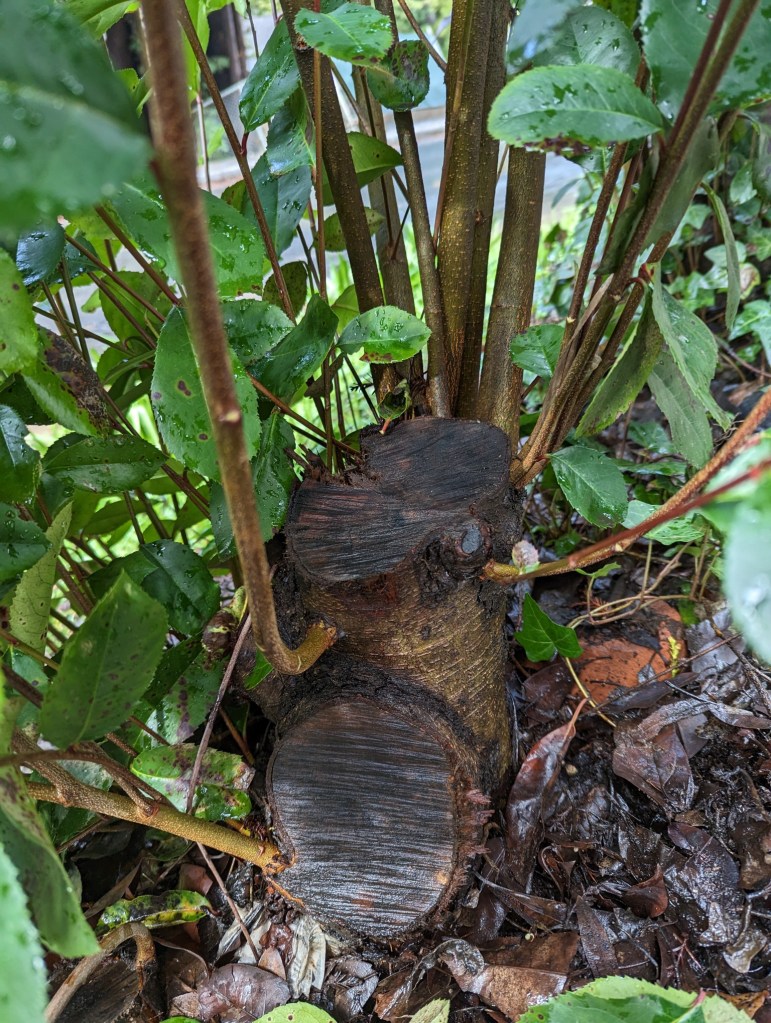
1. Eucalyptus globulus ‘Compacta’ coppiced stump. It is not such a great example of a coppiced stump, since the tree did not grow enough two years ago to get coppiced last year. Consequently, the few main trunks that were just recently coppiced are already starting to form their own separate lignotubers on top of the original, which is now rotting below. Soon enough, they will fuse to form a single lignotuber, concealing the evidence.P90601

2. Eucalyptus globulus ‘Compacta’ before getting coppiced. It is quite small for a specimen that was not coppiced last year.P90601+

3. Eucalyptus globulus ‘Compacta’ after getting coppiced. Rhody is not impressed.P90601++

4. Eucalyptus cinerea in need of pollarding. This tree grew too big too fast to survive any longer in the relatively small #15 (15 gallon) can. Fortunately, in just a few days, it will instead get installed into a landscape where it can disperse roots and mature into a normal unpollarded tree. After a few years, it might get pollarded anyway, just to produce silvery juvenile foliage withing reach of the ground, but that is not a concern just yet.P90601+++

5. Eucalyptus globulus pollarded knuckle. This is only the second pollarding procedure for this subject. The first procedure involved lopping the lanky single trunk off right here where the knuckle is now. The multiple limbs that developed were just recently lopped off, leaving this distended knuckle to repeat the process, hopefully annually.P90601++++
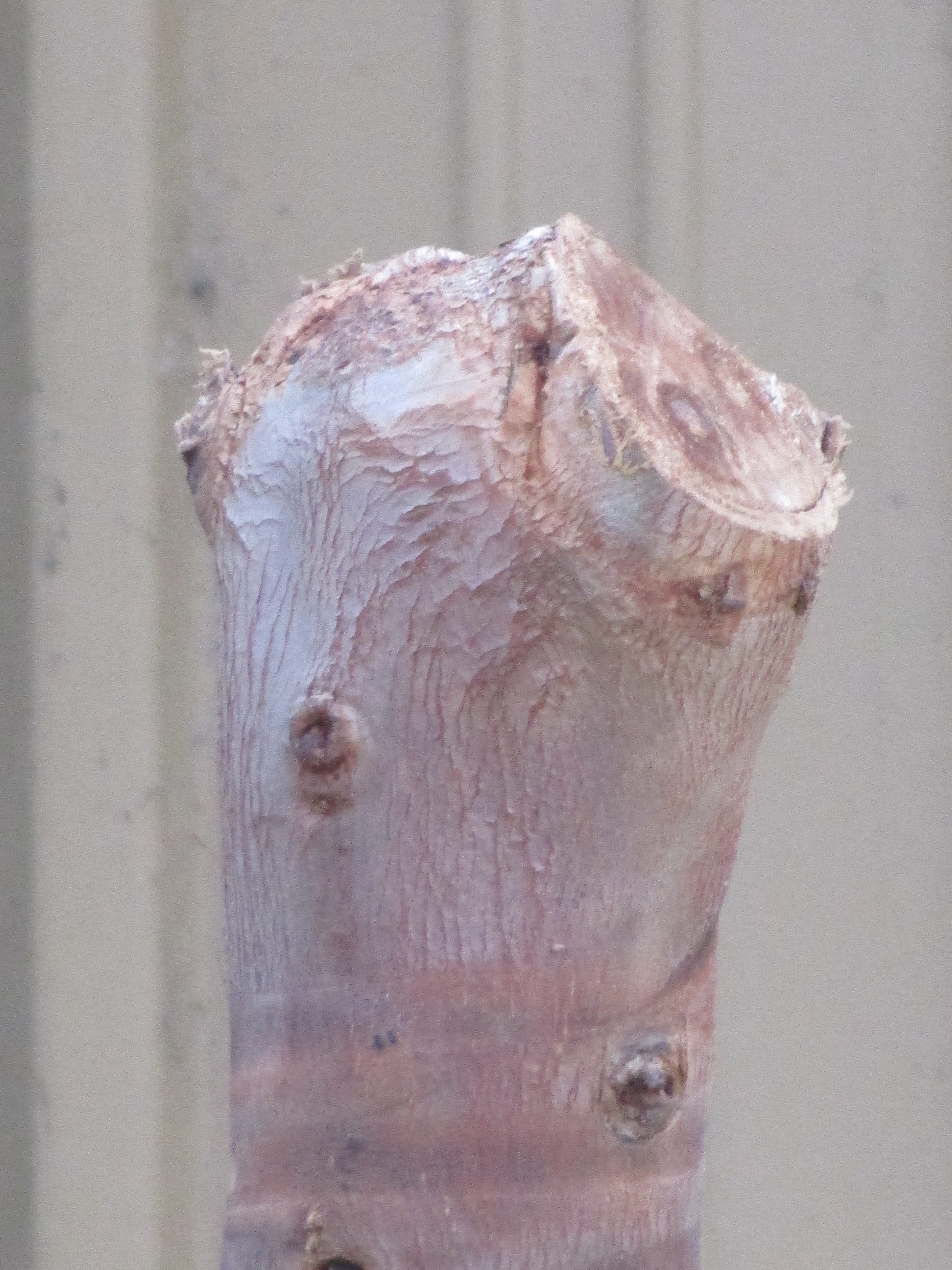
6. Eucalyptus globulus pollarded trunk. This is why Eucalyptus globulus should not get pollarded! They look ridiculous if deprived of their naturally elegant form. They do not look much more dignified with multiple pollarded limbs. Oh, the shame!P90601+++++

This is the link for Six on Saturday, for anyone else who would like to participate:

https://thepropagatorblog.wordpress.com/2017/09/18/six-on-saturday-a-participant-guide/
Horridculture – Bad Pollarding And Coppicing

P90508Pollarding and coppicing are proper pruning techniques. If you think you are an arborist who believes otherwise, do not waste my time arguing about it. More than likely, you are neither as educated nor as experienced as I am with such matters, or you work exclusively with trees for which such procedures would be very inappropriate.
Well, yes, pollarding and coppicing are very inappropriate for the vast majority of trees and shrubs out there. Furthermore, even for those trees and shrubs that they are appropriate for, such procedures are very rarely done properly here in California. Most attempts at pollarding and coppicing are really horrid!
Take these blue elderberries and mock oranges for examples. They were mutilated last summer to improve the view of the historic Felton Covered Bridge. It sort of accomplished that objective, although the improved view of the Bridge was then cluttered with the disfigured and mostly bare trunks and limbs of the brutalized shrubbery below. Because they were chopped back too late in summer to grow much, they stayed that way until now.
So it is spring, and the shrubbery is growing from the tops of the mutilated but tall trunks and limbs, right back to obstructing the view of the Bridge. They will likely get chopped when they get to be too overwhelming, which again, will be in late summer, repeating the process. It would be better to just remove the shrubbery not only because it would be less work, but also because the shrubbery is so unsightly when it gets chopped!
OR; the shrubbery could get coppiced. Both blue elderberry and mock orange respond favorably to the procedure. If coppiced, or in other words, if pruned back to the ground annually each winter, they could regenerate fresh new growth each spring, but not get big enough to crowd the view of the Bridge by the following winter, when they get coppiced again. The elderberry would not bloom or fruit; but that is not important here anyway.
Coppicing takes advantage of the natural dormancy and regenerative processes of the plants. Starting over fresh each spring and growing uninterrupted through summer is more natural for them than trying to recover from getting brutalized while they are actively growing in summer. Since they start the process at ground level, they have room to grow without interruption. If cut back only as much as necessary, they have no room to grow.