For urban areas, the first rain of the season is typically icky. It mixes with all the crud and filth that has accumulated since the last rinsing rain of the previous spring. Damp roads smell like a mix of automotive fluids and wet tires. Asphalt roofs smell like tar. Even urban trees can initially smell like damp dust. It takes a while and a bit of rain for the crud and filth to rinse away.
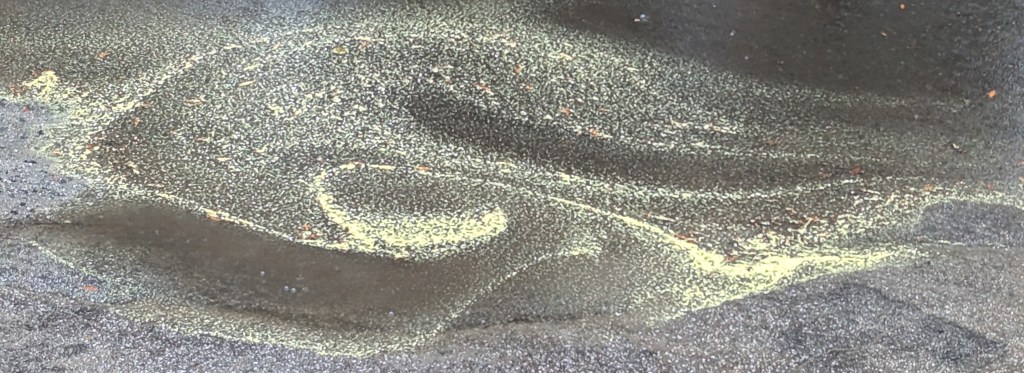
This is the second rain of the season, and in a less than urban area. It does not smell objectionable, and is not notably cruddy. However, it still flows with an abundance of pollen that had not rinsed away already. Perhaps this pollen accumulated just since the previous rain, although not much has been blooming visibly at this time of year. It is impossible to say even what species dispersed so much pollen. Nonetheless, here it is, floating in the first few puddles to accumulate. Yuck!
It is no wonder that pollen is as effective at pollination as it is. It is impressively abundant and permeating. It is also no wonder that it is such a pervasive problem for those who are allergic to it.
Wild flowers are generally worse for allergies than more colorful flowers within home gardens.
Have you ever wondered why it is sometimes difficult to know which flowers cause the worst allergies at any particular time? It is for the same reason that it can be difficult to find the flowers that produce the most fragrance. They simply do not need flashy colors to attract pollinators. Fragrant flowers instead use fragrance to attract pollinators. Flowers that are the worst for allergies simply put less effort into attracting pollinators, since they prefer to get their pollen delivered by wind. Yes, wind; it is one hundred percent natural and absolutely free.
Pollen than is designed to be dispersed by wind seems to perform just as well without it, by floating through the air, which is like ‘diet wind’. Unlike the pollen of big colorful flowers that is heavy and sticky in order to adhere to pollinators, pollen that is designed to be dispersed by wind (or diet wind) is extremely finely textured and abundant. Since it is not so directly and efficiently delivered between flowers, it gets everywhere and into everything, with the hopes that some of it, if even just a few particles, will reach the flowers that it wants to pollinate.
Pollen that primarily relies on wind for dispersion is like all those millions of bulk mailing fliers that get mailed out to everyone so that one or two or perhaps a few might reach someone who might actually be interested in getting one. Pollen from big flashy flowers are more like fancy Christmas cards that we send directly to friends, family and neighbors, but would be too expensive to send to millions of uninterested people. The problem is that like so much junk mail that clogs mailboxes, wind dispersed pollen is too abundant, which makes it a serious problem for those who are allergic to it. There is no escape when it fills the air.
The many wind pollinated plants that bloom in secret are the worst for pollen production. Unremarkable flowers of pines, cypress and cedars are among the worst. Acacias and eucalyptus are nearly as bad; but at least some have colorful bloom. Although hedged privets are not often able to bloom (because their flower structures get shorn off), privets that are allowed to grow into trees produce wicked pollen, even at a young age. Wild grasses may not seem like they would be much of a threat in urban landscapes, but their pollen travels for many miles to find victims.
Unfortunately, there is no way to control all the plants that produce objectionable pollen. We can only contend with those in our own gardens and be aware of what else is out there in the neighborhood.

 Tony Tomeo