Pollinator

A pollinator is a vector of pollen, besides wind. Most are insects. Some are animals. Their only qualification is that they collect and deliver pollen between flowers. Almost all are unaware that they do it as they visit flowers for nectar, which the flowers produce to attract pollinators. Bees, which are probably the most common pollinators, visit flowers to collect pollen with which to make their honey, and pollinate in the process.

So, what about the flowers that provide pollen for pollination, particularly for dioecious species such as hollies, date palms and kiwi vines? (Dioecious plants are either male or female.) ‘Bing’ cherry is not dioecious, but is not self pollinating either, so needs another cultivar of sweet cherry for cross pollination. Such a cultivar is known as a pollinator.

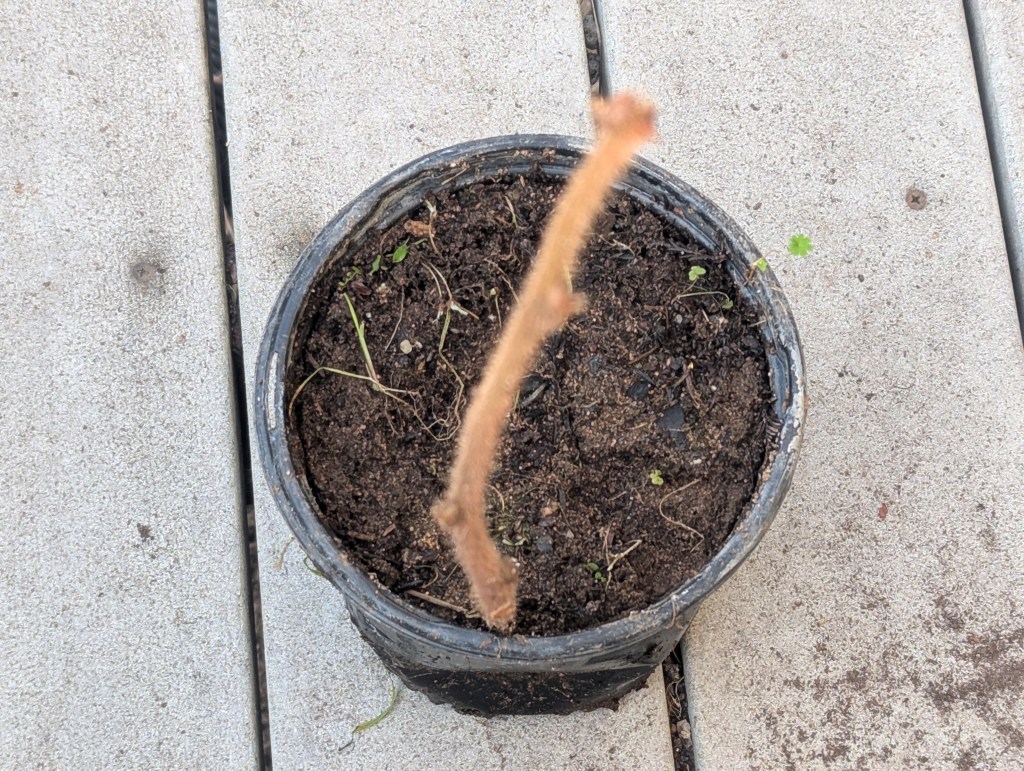
My female kiwi vine just recently acquired a male pollinator. It does not look like much yet, but will grow up to bloom with male flowers to provide pollen for the female flowers of the vemale vine. Because kiwi vines are dioecious, the female vine would be fruitless without pollination from the male vine. Perhaps the male pollinator will need a pollinator to deliver its pollen to the female vine.

Hummingbirds Enjoy Home Gardens Also

Hummingbirds are very fond of sages.

Floral color communicates to pollinators. Pollination is, after all, the priority of all flowers. Those that rely on pollinators more than breezes for pollination must therefore advertise. They effectively customize their bloom for preferable pollinators. Some incorporate floral fragrance if necessary. Most preferable pollinators are insects. Some are hummingbirds.

Seven species of hummingbird inhabit California. Some are always here. Some migrate south for winter. A few are only here while they migrate between farther south and farther north. All eat only small insects and floral nectar. Blooms which rely on hummingbirds for pollination are happy to provide. They have a mutually beneficial symbiotic relationship.

Many plant species have customized their bloom for pollination by hummingbirds. Many of these flowers are elongated, tubular and curved to fit the long beaks of hummingbirds. Most, although not all, are bright and rich colors that hummingbirds prefer. Bright red and orange are probably their favorite colors. Floral fragrances are more for other pollinators.

Many who enjoy gardening enjoy hummingbirds within their gardens. Hummingbirds are as colorful as some small flowers, but are much more dynamic. They enjoy hummingbird feeders and birdbaths or simple saucers of water. They also appreciate the various sorts of flowers that appeal specifically to them. Such flowers can appeal to everyone anyway.

Hummingbirds enjoy too many flowers to list. Those that customize their blooms for them will be expecting them. Many that customize their blooms for other pollinators can attract them anyway. Zinnia, coneflower and most composite flowers are ideal for pollination by bees. Many of their bright floral colors that attract bees entice hummingbirds incidentally.

Columbine and nasturtium are more customized for hummingbirds. Penstemon, foxglove and various trumpet vines accommodate a range of pollinators. Honeysuckle, lupine and sages do too, but seem to fit thin hummingbird beaks best. Bright floral color of hibiscus, fuchsia, canna and bottlebrush are impossible to ignore. Indiscriminate taste is an asset.

Flowers Have An Agenda

Flowers are only as colorful or fragrant as they are to attract pollinators.

When the garden is full of bloom, we do not like to think that flowers have an agenda. All their colors and fragrances seem to be displayed merely for our benefit. Who really wants to know that procreation is their real priority; that all their efforts are merely to get pollinated to make seed for the next generation?

Because flowers are not mobile like animals and insects are, they need to rely on wind or pollinators to deliver their pollen to other flowers. Flowers that are more reliant on wind for pollination are not much to look, since they do not need to advertise. The wind needs no incentive to blow. Wind pollinated flowers are instead abundant and productive, to disperse as much of their light pollen as possible.

Flowers that need pollinators need to advertise. They offer all sorts of attractive colors, fragrances, nectar and pollen to attract their particular preferred pollinators. For example, those that exploit the services of hummingbirds appeal to their discriminating taste with sweet nectar in tubular flowers that are mostly in colors that hummingbirds like, orange or red.

All the variety among flowers is designed for the variety of pollinators that they employ. Flowers that rely on nocturnal moths are large and pale, often with infrared patterns (that people do not see) to be visible in moonlight to moths drawn to their sweet fragrance. The offensive fragrances and textures of fly pollinated flowers are delightful to flies. Many flowers appeal to multiple pollinators.

Bees are of course the busiest of pollinators, as they collect nectar and pollen to make honey. They visit any flower they encounter, but prefer those that make abundant and dense pollen that they can carry away. They are very fond of the many different fruit trees; such as apple, pear, apricot, cherry, plum and all their relatives, as well as citrus. They also dig eucalyptus, wild lilac (ceanothus), hebe, firethorn, bottlebrush, honeysuckle and roses.

The difficulty for bees is finding a constant supply of flowers. As apple and pear trees finish blooming, bees want to start visiting other flowers. Bees like a variety of just about any of the annual flowers, particularly pincushion flower, cornflower, snapdragon, foxglove, sunflowers, poppies and lupines. With a good mix, something should always be blooming. Bees are also very fond of catmint, ajuga, thyme, rosemary, penstemon, lavenders and the many salvias and sages.

Those who want to attract bees to the garden should therefore plan for a good mixture of flowers that bees like, so that there is always something to keep the bees happy. Many of their favorite flowers that may not seem very colorful to us use ultraviolet patters that are quite flashy to bees. The choices are not always so obvious.

However, those who do not like bees or are allergic to bee stings, should avoid an abundance of flowers that will attract them. Unfortunately, there are no flowers or plants to repel bees. Also, the coniferous (cone bearing) evergreens and many other wind pollinated plants that are less attractive to bees produce abundant light pollen that is so problematic for allergies.

Elderberry Glut

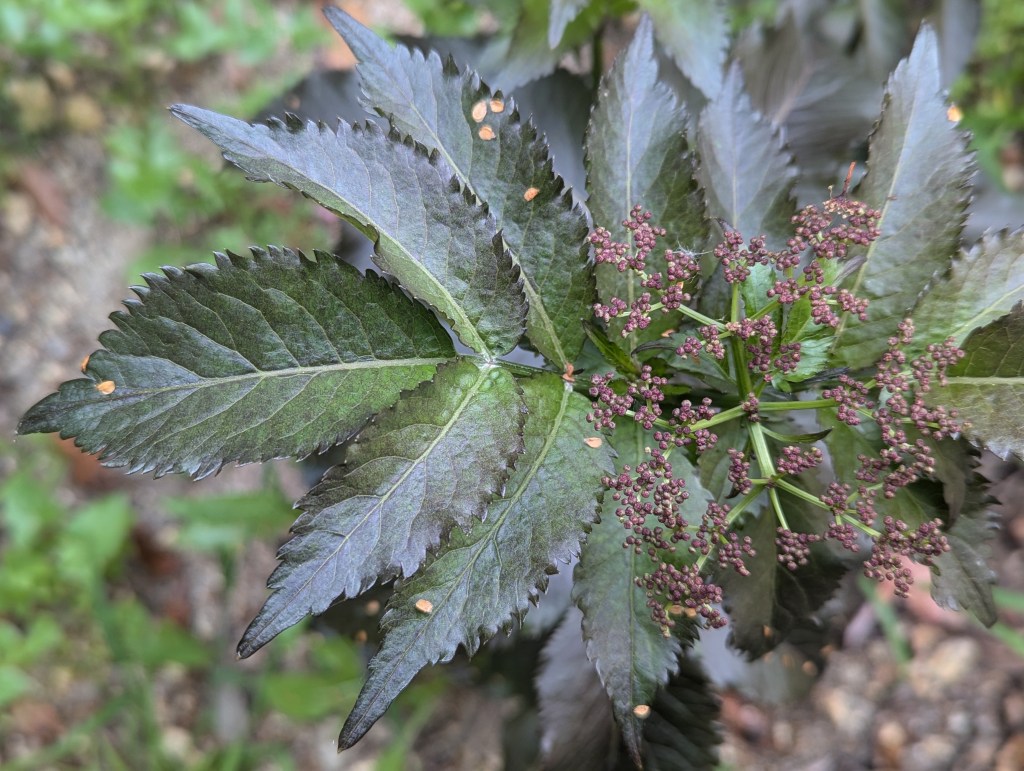
‘Black Tower’ European black elderberry is not very black yet.

Perhaps my explanation of the elderberry glut here was a bit brief last Saturday. Allow me to explain.

Sambucus caerulea, blue elderberry is native and grows wild here, so was innately the first on the scene.

Sambucus nigra ‘Black Lace’ European black elderberry arrived next. I do not know who procured it or why, but it was left here in a can before my time. I put it into a landscape just to get it out of the storage nursery. In other words, I was none too keen on it, so I just wanted to make it go away. Instead, because it was so popular with those who saw it in the landscape, I learned to appreciate it. Then, I figured that it would be even more appealing if it produces berries for birds, so I sought a mate for it.

Sambucus nigra ‘Madonna’ European black elderberry was almost the perfect mate. I would have preferred ‘Albomarginata’, but did not want to pay for it. ‘Madonna’ in a #1 can was available for only a few dollars because it looked so shabby two winters ago.

Sambucus racemosa, red elderberry was a gift from Tangly Cottage Gardening shortly afterward. They were a group of four seedlings, so needed no mate for pollination. Although they are supposedly native here, I had never seen them before, but want to grow them.

Sambucus nigra ‘Albomarginata’, ‘Atropurpurea’ and ‘Black Tower’ European black elderberry, and Sambucus racemosa ‘Lemony Lace’ red elderberry unexpectedly became available for a few dollars each just last winter because, like ‘Madonna’ European black elderberry two years prior, they were shabby while dormant. Without a plan, I procured all of them. ‘Lemony Lace’ red elderberry, the only red elderberry of the four, could be pollinated by the red elderberries that already came from Tangly Cottage Gardening. As I mentioned, ‘Albomarginata’ was the cultivar that I would have preferred to ‘Madonna’ that I procured earlier.

Sambucus canadensis ‘Nova’ and ‘York’ American black elderberry were the last acquisitions at the end of bare root season last winter. They are for fruit production in my home garden.

I would have been pleased with only ‘Black Lace’ and one other pollinator cultivar for it within the landscapes at work. For my home garden, I wanted only blue elderberry, red elderberry and American black elderberry. I would have preferred wild American black elderberry, but can not complain about the cultivars that I got. Collectively, we got much more than we bargained for.

Mars & Venus

It is much too early to distinguish gender of these carob seedlings.

Phoenix dactylifera, common date palm supposedly became more popular than Phoenix canariensis, Canary Island date palm during the 1990s for two primary reasons. Firstly, it is less susceptible to pink rot that was killing so many Canary Island date palms at that time, and continues to do so. Secondly, mature specimens became so readily available as their orchards were being displaced by urban development, particularly around Las Vegas and Palm Springs. Of course, fruiting date palms would have been too messy for the urban landscapes that they were recycled into. So, to prevent such mess, only female trees were recycled for such landscapes. Without their male pollinators, they are fruitless. Female trees are generally shorter, more lushly foliated, and therefore more appropriate to refined landscapes anyway. Besides, all but between one and five percent of trees in date orchards are female. Male trees were not completely wasted though. Although not as lush, they are taller and statelier, so were recycled to landscape remote desert highway interchanges, where their pollen does not reach female date palms that now inhabit more urban landscapes. It all works out well, although contrary to the original purpose of the date palms involved. It would seem silly to separate genders of most familiar dioecious species, such as kiwifruits and hollies. However, only female carob trees are available from nurseries nowadays because they would be messy with pollination, and also because male floral fragrance is horrid! Male carob trees are only available for agricultural purposes, or grow as feral males from seed. The problem that I will eventually encounter with my carob trees is that I grew them from seed, and will not know what their genders are until they are a few years old. I want a female specimen in a specific location, and a male pollinator in another specific location. I think that I will put three seedlings in each location, select one that matures to be the preferred gender for its particular location, and eliminate the other two. Alternatively, I could allow two genders to grow together in such a manner than the male grafts to the female to become a branch that I could prune to be a small but necessary portion of the collective canopy. Of course, there is a possibility that all within each group of three could be the wrong gender. I will not know until a few years from now.

Yucca whipplei Seed

Yucca whipplei seed is likely more rare in cultivation than in the wild.

Yucca whipplei, which is now known as Hesperoyucca whipplei, should not be so difficult to procure. It is the most common species of the genus within the next few hundred miles south of here, and was quite common in the hills around San Luis Obispo, where Brent and I studied horticulture at California Polytechnic State University (Cal Poly). I should have taken pups from wild specimens within the region, but I know of no one with wild specimens within their gardens. I can only see them from a distance, and, although within view, they are far enough away to necessitate quite a hike to get to. I never bothered to procure pups from specimens that I encounter directly in the Santa Monica Mountains north of Beverly Hills because they might be a different variety, or related to such a variety. Contrary to dramatic bloom, seed of the species is supposedly rare because the larvae of its very specialized pollinating moth devour almost all of the seed that develops from successful pollination. (The moth pollinates a flower only to provide seed for its larvae to eat.) Seed should be even more rare here because the specialized pollinating moth has no business so far from the natural range of its sustaining species. Somehow, a specimen that bloomed at work produced these few seed capsules. Someone else besides the specialized pollinating moth apparently took interest in its bloom. Although I have no idea what variety of Yucca whipplei the particular specimen is, I am pleased with the seed, and will try to grow them if they are viable when their capsules dry. (I hope that removal from their deteriorating stalk does not compromise their development.) Furthermore, I will get at least one pup from the original parent now that it will generate a litter after its monocarpic bloom. It is likely the variety that I want and am most familiar with anyway, because that particular variety happens to be the most common. Of course, I will procure a pup from a wild specimen within the region of San Luis Obispo if I ever get the opportunity to do so, just in case it is any different from what is growing and now blooming here.

Six on Saturday: More About This Later

Brevity is not always easy with Six on Saturday. I might elaborate on some of these later. There is no common theme. These are merely six random pictures from last week.

1. Sambucus nigra ‘Black Lace’ European black elderberry got ‘Madonna’ as a pollinator only this year. ‘Madonna’ will not bloom until next year. ‘Black Lace’ makes a few berries anyway. I hope that they are prettier when more abundant. I can elaborate about it later.

2. Amaryllis belladonna, naked lady is demonstrating is preference for sunny exposure. This row of bulbs extends from left to right across this picture, but blooms only half way, with no transition to where bulbs are too shaded to bloom. I can elaborate about it later.

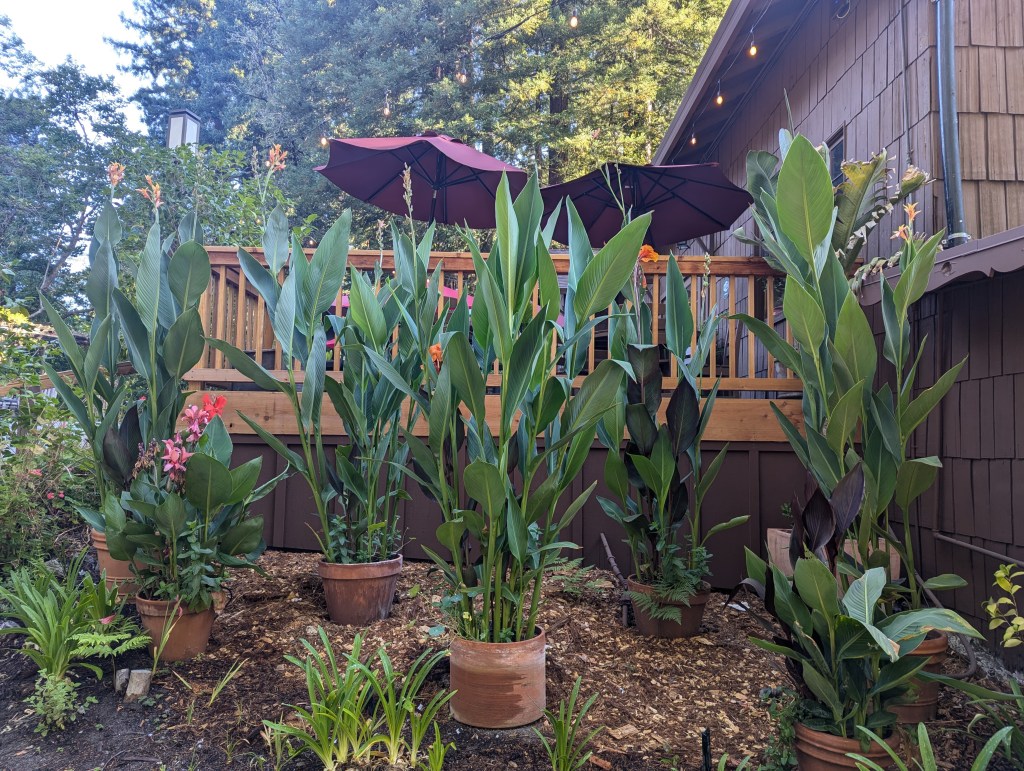
3. Canna musifolia, canna, which has been very fun to grow, was a gift from a neighbor, but not practical for our landscapes. These, with a few fancier cultivars, were potted here temporarily until a new landscape develops this autumn. They earn many compliments.

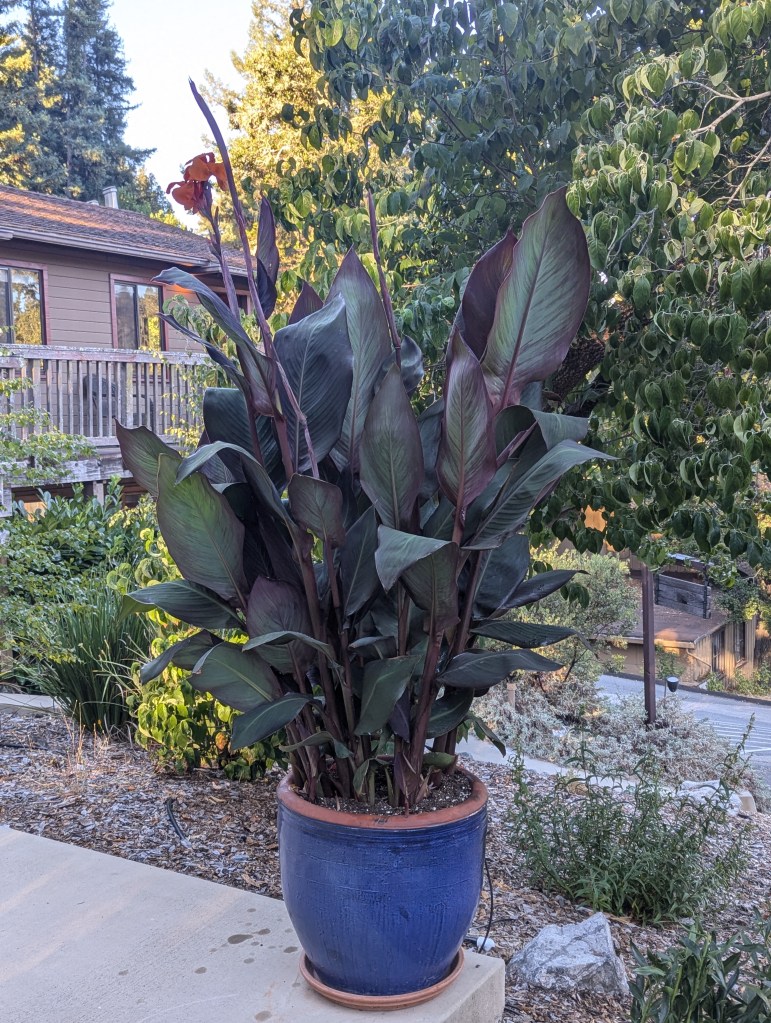
4. Canna X generalis ‘Inferno’ canna arrived with Canna musifolia. I think that it looks like ‘Wyoming’. Without a plan, we put this specimen into this ugly cobalt blue pot from a very dead Ficus benjamina houseplant that someone left for us, and now it looks RAD!

5. Hymenocallis festalis, Peruvian daffodil had been in the nursery for too long when we finally put all ten into three landscapes shortly before bloom. It is supposedly as reliably perennial as some of the more reliable types of Crinum. If so, it should be more popular.

6. Dahlia ‘Tabasco’ dahlia was purchased as a bedding dahlia, which implied that it is as disposable as annuals. However, this is its third season. It was originally red with orange stripes. Then, it was yellow with orange blotches. Now, it is this delightfully simpler red.

This is the link for Six on Saturday, for anyone else who would like to participate: https://thepropagatorblog.wordpress.com/2017/09/18/six-on-saturday-a-participant-guide/

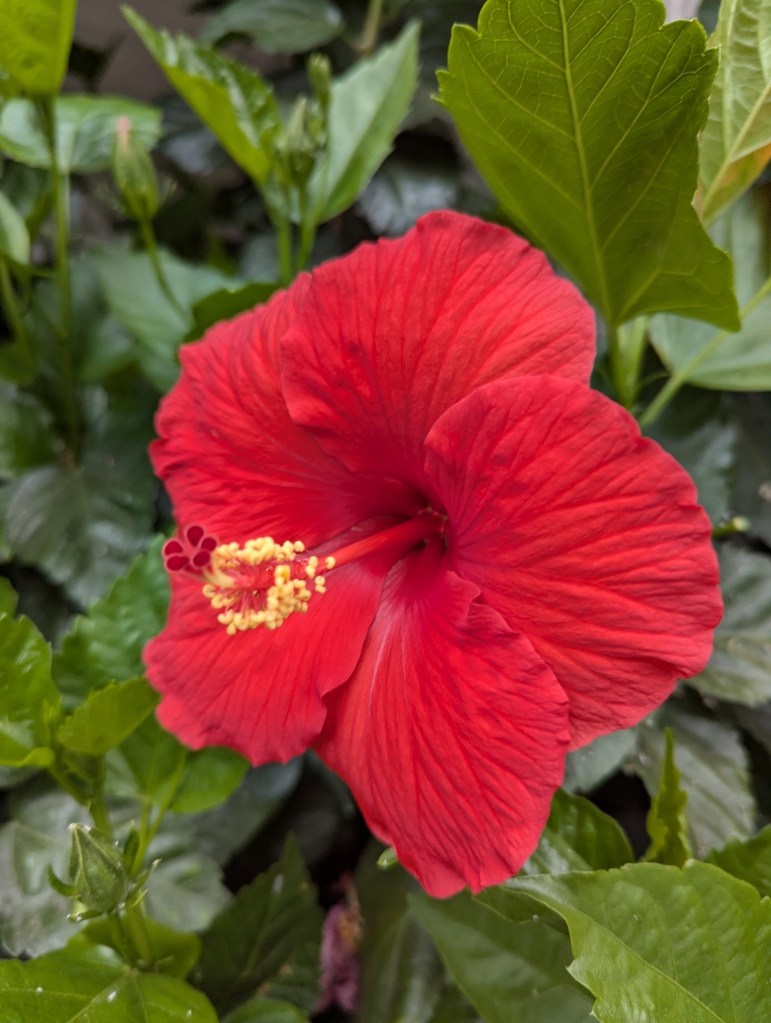
Tropical Hibiscus

Hibiscus floral structure is notably unusual.

Hummingbirds and butterflies are quite fond of tropical hibiscus, Hibiscus rosa-sinensis. They are attracted to the bright yellow, orange, red, pink or white color of its bloom. They stay for the syrupy nectar that they find deep within the flowers. Tropical hibiscus attracts pollinators rather efficiently, but almost never generates seed. Most cultivars are hybrids.

Tropical hibiscus flowers are not overly profuse, but are about three or four inches broad. Fancy hybrids that bloom with broader flowers are not as vigorous as more typical sorts. Most cultivars bloom with somewhat ruffled single flowers. Some bloom with more ruffled double flowers. Both types of flowers have five garishly flaring petals. None are fragrant.

Tropical hibiscus grows as evergreen shrubbery about six to a bit more than ten feet tall. Pruning to remove congestion of inner growth promotes healthier outer growth. Besides, whitefly and scale insects often proliferate on crowded foliage. Leaves are mostly two to five inches long and two to three inches wide. Bloom continues from summer to autumn, mostly with warmth.

Pollinators Are As Busy As Bees

Flower breeding is not for pollinators.

Flowers bloom for pollination. It is that simple. Most rely on wind to disperse their pollen. They are more abundant than colorful or fragrant. More prominently colorful and fragrant flowers rely on pollinators. Their color and fragrance attract preferred pollinators, such as insects, birds or bats. Such flowers sustain their pollinators with nectar or surplus pollen.

More than pollinators appreciate their diligence. Almost everyone who enjoys gardening enjoys floral color and fragrance. Cultivation of naturally appealing bloom began several thousand years ago. Selection and breeding most likely began relatively soon afterward. Ultimately, during relatively modern history, hybridization began getting too complicated.

Pollinators were not a priority during such processes. Because most ornamental flowers produce no usable fruit, pollinators are unimportant. Because of extensive hybridization, many ornamental flowers are sterile anyway. Floral color, fragrance and various tangible attributes are more important. Modern bloom appeals more to people than to pollinators.

A few modern flowers now confound their original pollinators. Some types of insects can die of exhaustion while trying to ascertain them. These insects may recognize floral color or fragrance but not strange floral structure. A few modern flowers are too frilly for access. Some attract pollinators without providing enough nectar or extra pollen to sustain them.

Several exotic flowers with less or no breeding distract pollinators with their abundance. Lemon bottlebrush blooms very abundantly and is still common within some landscapes. Blue gum eucalyptus is naturalized in parts of California. Both attract monarch butterflies that native species rely on. Native ceanothus must instead rely more on other pollinators.

Furthermore, a few pollinators actually disrupt native ecosystems. Honey bees, although very important to local agriculture, are not native. They arrived in San Jose in 1853, from where they dispersed throughout the West. It is now impossible to assess their influence. Even seemingly beneficial influence is unnatural and therefore ecologically detrimental.

Undoing of Fragrance

Extensive breeding can compromise floral fragrance.

As I enjoy good friends and cheap coffee out on the deck, I am also savoring the sweet fragrance of the abundant white bloom of the black locust off in the distance. I know that black locust is a noxious weed that invades riparian environments; but they smell so good on such pleasantly warm spring days. Modern varieties are certainly better behaved and more colorful with their pink to purplish flowers, but their fragrance does not compare so well.

Earlier here on the deck, one of my friends and I discussed how modern Buicks are much safer than old classic Buicks are, but are not quite as elegant and stylish. It made me think of how decades ago, modern roses were developed for flower size, form, color and stem length, but in the process, were deprived of, among other qualities, their fragrance. Perhaps I would have been more attentive to my friend if the coffee were as potent as the fragrance of the black locust.

Modern varieties of many classic flowers are less fragrant than their ancestors were. This is because decades (and centuries) ago, fragrance generally had not been prioritized in breeding as much as were other physical characteristics, such as flower size, form, color and so on. The plants that were consequently used for breeding typically had the most visually appealing flowers, but lacked fragrance. Such disparity is actually quite natural among plants with variable flowers.

For example, most bearded iris that naturally have the biggest, fanciest and most brightly colored flowers are also the least fragrant. Their progeny that have become the modern varieties are just as flashy, and also, just as deficient of fragrance. Conversely, the relatively small and simple pale purple flowers of my favorite ‘Grandma Sheppard’ bearded iris are remarkably fragrant.

To the iris, this is all quite sensible. Their fragrance is not designed to impress us, but is merely intended to attract pollinators. If they are fragrant enough to entice the insects that bring them pollen, they do not need to waste any more effort on visual appeal. Without fragrance though, they can alternatively use color (including infrared and ultraviolet) to direct insect traffic where they need it to go in order to accomplish pollination. Almost all of the many varieties of iris prefer to specialize in one or the other; either fragrance or visual characteristics, but not both.

So many of the old classics seem to have lost some or most of their fragrance as they have ‘improved’ over the years because visual appeal has been prioritized more than fragrance. Besides flowering locusts, roses and iris, some types of honeysuckle, mock orange, sweet pea, violet, hyacinth, lily and even narcissus are less fragrant than their ancestors were. However, traditional as well as modern fragrant roses and iris seem to be gaining popularity. Fortunately, gardenia, lilac, wisteria, stock and the fragrant types of angel’s trumpet and jasmine are probably as potent as they have ever been because they have not been tampered with as much.