 There is so much more to gardening than mere horticulture. There is so much more to horticulture than mere plant life. Plants get eaten by insects and animals, and also take advantage of insects and animals for pollination and dispersion of seed. Some of us who enjoy gardening also like to attract some types of animals and insects to our gardens because they are nice to have around.
The birds and the bees, as well as butterflies, squirrels, lizards, snakes and other small animals add color, motion and vibrancy to the garden. Destructive animals like gophers, rats and deer, and cumbersomely big animals like moose and bears, are not so popular. Mosquitoes and flies are the sorts of insects that we would like to repel with aromatic herbs. Some but not all are welcome.
‘Pollinator’ flowers have become a fad recently, not only to attract bees, but also to provide them with more of what some believe they are lacking out in the wild. There is certainly nothing wrong with attracting bees. Those who are enslaved in honey production are best! Children learn as much about nature from bees as from other wildlife. The soft hum of big herds of bees is quite nice.
Beyond that, we should think outside the box of our home gardens. The unnatural disruption of local ecology can not be repaired by throwing more unnatural resources at it. Honeybees who were imported to make honey are not native, but displaced and interbred with natives enough to interfere with their natural pollinating behavior, as well as their resistance and susceptibility to disease.
Almost all plants in urban as well as agricultural areas were imported too. They were perpetuated until they dominated the localized ecosystems. There is now much more flora in places like the Los Angeles Basin and the Santa Clara Valley than there has ever been before! There is no shortage of bloom for bees. In fact, there is an overabundance of bloom potentially distracting bees from pollinating native specie who need them. Invasive exotic eucalypti might enjoy their popularity at the expense of California poppy.
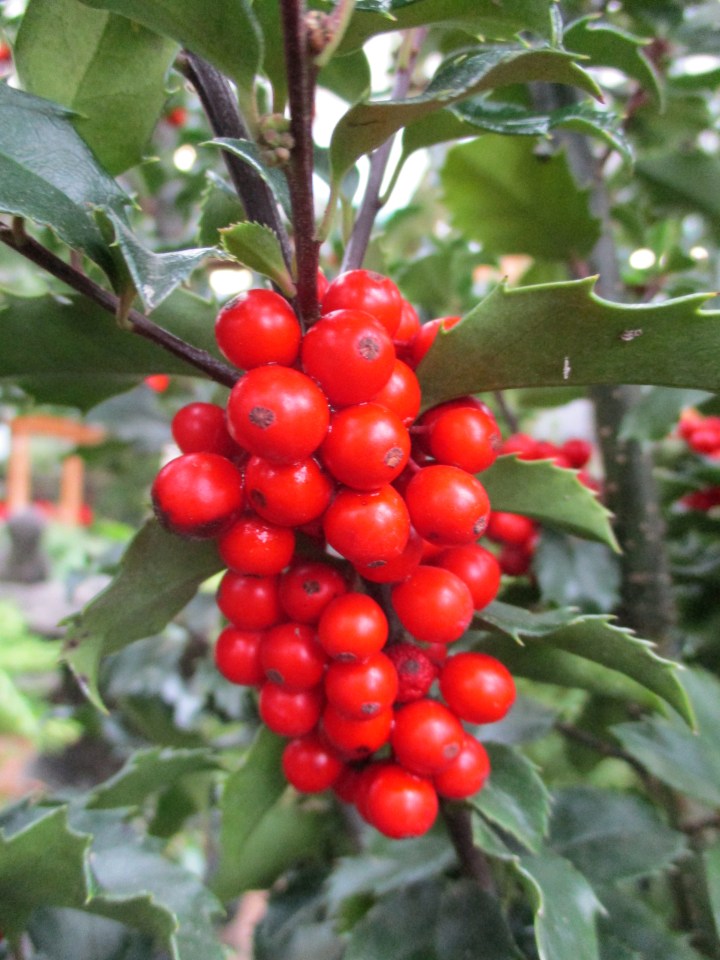
 It is about time that someone reintroduced this technique! Blue Princess holly is now available together in the same pot as its male pollinator, Blue Prince holly (Ilex x meserveae ‘Blue Princess’ and ‘Blue Prince’). With careful pruning to prevent one from crowding out the other, both can coexist and provide profuse, bright red berries every winter, indefinitely. As the plants grow, their main trunks will eventually graft together.
 There are some things about plants that we might be better off not knowing about. For instance, their idea of sex is even weirder than that of humans! Generally, flowers of ‘monoecious’ plants have male parts and female parts that do what they must to produce seed, which is often contained in some sort of fruit structure. Some plants can pollinate themselves. Ick! Others require separate but compatible pollinators.
 Before you send me a comment about it, I am already aware that this is a very bad picture. It was taken with my primitive telephone because it was convenient at the time. This tired looking butterfly might not have waited for me to get the camera. It passed away, seemingly peacefully, right there on the hood of the old Chevrolet. It did not seem to be injured in any way. It probably simply expired like butterflies do after breeding. It is a natural process that the butterfly did not seem to be too distressed about. It gets no obituary because I am not qualified to write one. We are not sufficiently acquainted. I do not even know the specie of this butterfly.
