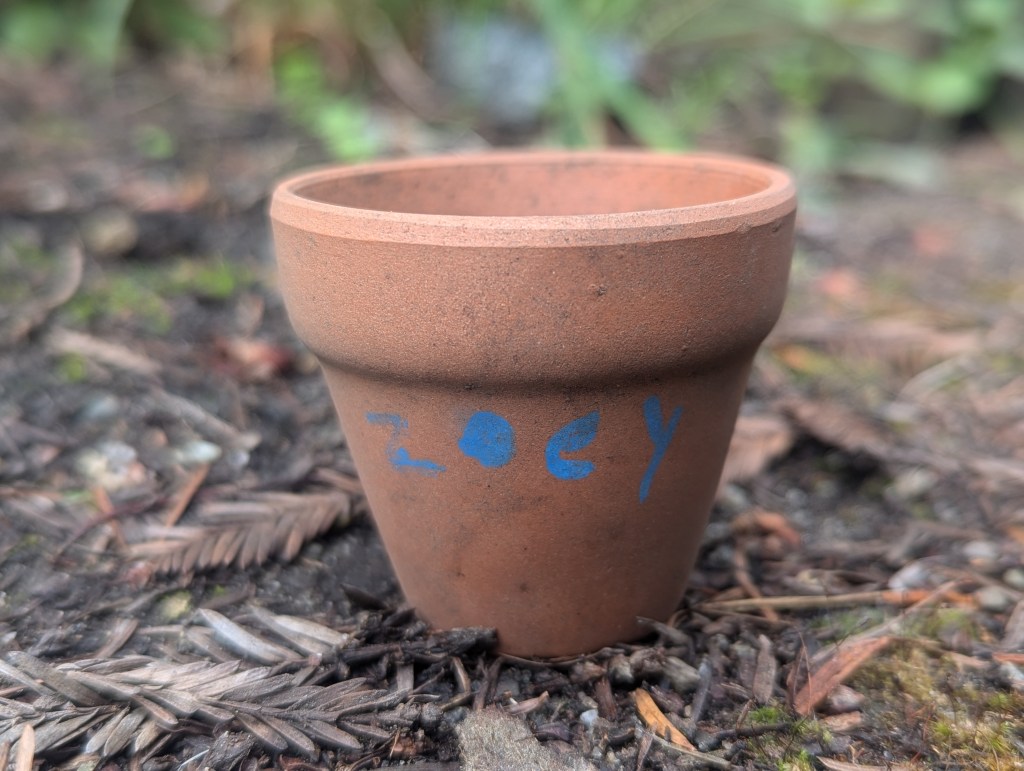
Working within landscapes is obviously very different from working on the farm. Actually, there are too many differences to mention. One difference is people. There are only a few on the farm, spread out over many acres. Conversely, the landscapes that I work in are designed for use and enjoyment by countless people who attend events there. I can rarely get away from all of them. Although it can be fun, it can also be challenging, and often interesting. On rare occasion, I find artifacts that make me wonder about whomever left them. This tiny terracotta pot with “Zoey” painted on it, for example, was found in a small landscape outside of a bookstore, quite a distance from the facility a which young children typically engage in such crafts. I hate to think that Zoey misplaced it there. I sort of hope that it was intentionally left there, perhaps containing a tiny plant that Zoey hoped a gardener would find and add to the landscapes. If so, I found it too late and empty. Zoey does not need to know that. Hopefully, if she returns, she finds something that she believes to be her plant growing happily in our landscapes.
These containers are almost completely obscured by their contents.
Container gardening is one of those trends that I could do without in my own garden. Even though I know that it is actually very practical for several reasons, I prefer to grow as much as I can directly in the ground because I do not want to take care of contained plants. However, even with only minimal potted plants around my garden, the steep embankment above my driveway has reminded me of one of the many reasons why people like to grow plants in large or hanging pots, elevated planters or window boxes. There are just so many plants that look so good cascading out of containers.
The lily-of-the-Nile that I planted on top of part of the embankment to hold the soil together actually look really cool leaning over the top edge, and would look just as good in large planters. The smaller ‘Peter Pan’ lily-of-the-Nile is more proportionate to smaller urns. Since these do not hang over the edges too far, they look even better mixed with more pendulous plants like trailing rosemary, verbena, ivy geranium and dwarf periwinkle. Upright plants like fuchsia and smaller types of New Zealand flax in the middle of mixed plants add good contrasting form. Dracaenas (Cordyline spp.) were traditional vertical accent plants of Victorian gardening.
Low planters and pots, as well as many hanging pots, are very often best outfitted with traditional cascading annuals like lobelia, sweet alyssum, petunia, portulaca and my favorite, nasturtium. Even if annuals that do not cascade are the central features of mixed planters, cascading plants around the edges really maximize the show by spreading even more flower color over the exteriors of the containers. Colorful perennials like fibrous begonias, busy Lizzie, campanula, fleabane, scaevola and dusty miller may not cascade as well as the annuals, but add width, and probably cascade adequately for ‘artfully’ designed pots that are too appealing to obscure completely.
In sheltered lanais and porches, spider plant, burro tail and wandering Jew are classic solitary perennials for hanging pots. What orchid cactus lacks in form and foliage, it makes up for with bold flowers.
The largest pots and planters can benefit from simple ground covers like shore juniper and English ivy, perhaps dressed up with flowering annuals. Gazanias can provide their own flowers, so can instead be dressed up with the colorful and textural foliage of blue fescue or another grassy perennial. Asparagus densilforus has such bold texture and form alone that it does not necessarily need the color of annuals.
The class of 1985 epitomized the ‘Decade of Decadence’ with the raddest of styles in the wildest of colors. My generation is perhaps more familiar than any other with the pursuit of senseless fads and trends. Now that it is about a quarter of a century later, many of us continue such indulgences in our gardens.
Container gardening has become a fad that, despite its practicality for all sorts of applications, has become so common that it actually makes gardening more work than it should be. Modern homes are built with expansive porches and walkways that are designed to accommodate large urns and other planters, instead of more modest and proportionate porches and walkways that leave more space for planting things in the ground around them. Runoff from the planters stains pavement and rots decking. Besides, all the clutter of planters looks like a garage sale.
For balconies, roof gardens or wherever exposed soil is otherwise unavailable, container gardening may be the only option. Containers also help with plants that need to be moved to sheltered spots during frost. However, few plants are as happy in containers as they would be in the ground. Contrary to popular belief, it is better to amend inferior soil in the ground than to grow plants in potting soil within pots.
Where pots or other containers are necessary, they should either be shaded, or otherwise insulated from the heat of the sun. The black vinyl cans that plants arrive from the nursery in are not only unappealing, but can get warm enough in the sun to roast roots. Yet, they are both obscured and shaded simply by getting placed within slightly larger urns or planters.
Other thin plastic pots can transfer heat like black vinyl, but tend to be cooler because they are most often lighter colors that absorb less heat from sunlight. Thicker materials, such as terracotta, are better insulated. Roots prefer the porosity of unglazed pots, although some glazed pots can stay cooler. Plants within containers are often able to provide their own shade by cascading out over the edges, or spreading out above.
Yet, more substantial plants that provide more substantial shade still need to be complaisant to confinement. Plants that need to disperse their roots will never be comfortable in containers. Neither will plants that are not conducive to pruning, but want to grow into large shrubs or trees.
Ornate pots and planters can be as decorative as the plants within them, and provide extra accommodation for more plants.
Like so many fads too often are, container gardening is overrated, and is actually contrary to the currently most faddish of fads; sustainability. Plants in containers need more regular watering than those that can disperse their roots more extensively into the ground. Those that are so indulged also want fertilizer to be applied more regularly, but are more likely to be damaged if fertilized too generously. Because confinement is stressful, plants in containers are innately more susceptible to disease and pests. Some plants need more pruning for confinement.
Then there are the problems with the containers. If exposed to sunlight, thin plastic containers get warm enough to cook roots within. Pots that do not drain adequately or that sit in their own drainage basins can stay saturated enough to kill roots. Water in drainage basins allows mosquitoes to proliferate. Seepage from large pots can rot decks and stain pavement. Self watering containers work nicely for houseplants (if used properly!), but lack drainage, so can not be used out where they are exposed to rain.
The advantages to container gardening are actually quite limited. Containers are obviously needed for houseplants, and where exposed soil is not available, like on balconies. They are also convenient for plants that want better soil than they can get in the garden, especially if the rest of the garden is responsibly landscaped with sustainably undemanding plants that do not require soil amendment or regular watering. Frost sensitive plants can be moved easily to sheltered locations if contained. Flashy plants like orchids and tuberous begonias that get displayed prominently while blooming can be concealed while not so impressive.
Of course there are many pendulous plants like Boston fern, spider plant, string or pearls and burro’s tail that really are at their best in hanging pots. It is also hard to deny that there are all sorts of artsy containers, like colorfully glazed pots and sculptural concrete urns, which are appealing enough to justify growing plants in them, even if just to show off the fun containers. Bonsai requires containers, but that is another big topic!
What ever happened to those poinsettias and cyclamen from last Christmas?
Chrysanthemums, hydrangeas, azaleas, callas, kalanchoes and miniature roses can not really be as happy as they seem to be while in full bloom at the florist counter. Then there are all the seasonal blooming plants like Easter lilies and poinsettias. Wrapped in undraining mylar, often with ribbons and bows, they are actually quite humiliated.
All are forced to bloom in artificial greenhouse environments that are nothing like the home environments that they ultimately go to. As they finish bloom, most get retired directly to the garden where many are unable to adapt quickly and efficiently enough to survive for long. Many do not make it that far, but get sent to the compost or the trash by those who prefer to not prolong their agony.
These potted plants (which are actually known as ‘pot plants’ in the horticultural industries) are not like houseplants, since they are not actually expected to survive for long in the home. They are only expected to perform for a limited time while in bloom.
Adapting to the home environment is not the difficult part. Most potted plants can manage that for a while, but eventually want more sunlight. Hydrangeas, roses, Easter lilies and other deciduous plants also eventually want a cool winter for their dormancy. The problem is adapting to exposure to the sunlight and weather that these plants crave. Foliage can get scorched, frozen or desiccated.
As unsightly as plants can be during transition, most can eventually replace their greenhouse foliage with foliage that is adapted to their new environment in the garden if transitioned slowly and carefully. Large ‘forced’ flowers will eventually be shed or can be pruned off as they deteriorate. The more sensitive types of plants should be moved to a sheltered spot on a porch or in partial shade for a few months before being moved to more exposed spots. Once in the garden, they will want regular watering until their roots disperse.
Deciduous plants and bulbs can stay in the sheltered spot until they defoliate for winter. If put into their permanent location while dormant and bare, their new foliage that emerges in spring will be adapted to the new exposure.
Aloes, Christmas cactus and various other succulents are considerably more resilient and adaptable than the more common potted plants. Both rosemary and small olive trees that have become trendy during the past many years can likewise be adaptable if not kept in the home too long. Olive trees can stay potted indefinitely if pruned regularly, or can go into the garden where there is room to grow. Christmas trees are just as adaptable, but do not want to stay potted for long. Sadly though, most get much too big for home gardens.
Most potted plants would prefer to be in the ground, . . . if possible.
Potted plants can be a problem any time of the year. Some want more water than get. Most get too much water or do not drain adequately. Large plants get constricted roots if pots are too small. The roots of some plants get cooked in exposed pots that collect too much heat from sunlight. Besides, too many pots just seem to be in the way in otherwise useful spaces on decks, patios and anywhere else trendsetting landscape designers want to put them.
Now that the weather is getting cool and rainy, potted plants are not as active as they were during warm weather. Many are dormant. Although few demand the attention that they got during warmer weather, plants still need to be tended to appropriately through autumn and winter.
Cool season annuals, which are also known as ‘winter’ annuals, should get groomed as long as they are performing in the garden, just like warm season annuals get groomed through summer. Deteriorating flowers should be plucked from pansy, viola, primrose, Iceland poppy, calendula, dianthus, stock, chrysanthemum and cyclamen because they can mildew and spread mildew to developing flowers and foliage. Unplucked cyclamen and calendula can develop seed which diverts resources from bloom.
Pots that are out in exposed areas will not need to be watered while they get enough water from rain. The problem is that many that do not drain adequately can get too much water from rain and stay saturated. Dormant and defoliated plants do not need much moisture at all. Even evergreen plants do not need as much as they do while active during warm weather, because cool and humid weather inhibits evapotranspiration (evaporation from foliar surfaces).
Potted plants under eaves also need less water while the weather is cool and humid, but need to be watered nonetheless because they are sheltered from rain. Plants in hanging pots typically drain and dry more efficiently, so probably want a bit more water. Even a few sheltered small plants in the ground may occasionally want to be watered during rainy weather if they do not extend enough roots where they can get moisture from rain beyond the sheltered area. Sheltered plants are actually the most likely to be neglected because watering does not seem so important when it is raining.
Ornate pots and planters can be as decorative as the plants within them, and provide extra accommodation for more plants.
Like so many fads too often are, container gardening is overrated, and is actually contrary to the currently most faddish of fads; sustainability. Plants in containers need more regular watering than those that can disperse their roots more extensively into the ground. Those that are so indulged also want fertilizer to be applied more regularly, but are more likely to be damaged if fertilized too generously. Because confinement is stressful, plants in containers are innately more susceptible to disease and pests. Some plants need more pruning for confinement.
Then there are the problems with the containers. If exposed to sunlight, thin plastic containers get warm enough to cook roots within. Pots that do not drain adequately or that sit in their own drainage basins can stay saturated enough to kill roots. Water in drainage basins allows mosquitoes to proliferate. Seepage from large pots can rot decks and stain pavement. Self watering containers work nicely for houseplants (if used properly!), but lack drainage, so can not be used out where they are exposed to rain.
The advantages to container gardening are actually quite limited. Containers are obviously needed for houseplants, and where exposed soil is not available, like on balconies. They are also convenient for plants that want better soil than they can get in the garden, especially if the rest of the garden is responsibly landscaped with sustainably undemanding plants that do not require soil amendment or regular watering. Frost sensitive plants can be moved easily to sheltered locations if contained. Flashy plants like orchids and tuberous begonias that get displayed prominently while blooming can be concealed while not so impressive.
Of course there are many pendulous plants like Boston fern, spider plant, string or pearls and burro’s tail that really are at their best in hanging pots. It is also hard to deny that there are all sorts of artsy containers, like colorfully glazed pots and sculptural concrete urns, which are appealing enough to justify growing plants in them, even if just to show off the fun containers. Bonsai requires containers, but that is another big topic!
Roots are innately mysterious. They consume much of the resources that plants require. They stabilize the stems above them. Few plants can survive without them. Yet, roots are very secretive about their work. Almost all are invisibly subterranean. Consequently, they get minimal consideration. A lack of consideration is a root cause of many root problems.
Every plant species has distinct environmental preferences. Some plants require full sun exposure. Others tolerate or prefer partial shade. Some are more discerning than others. Similarly, plants that naturally disperse their roots extensively dislike confinement of their root systems. Small plants and some riparian plants are more adaptable to confinement.
Annual bedding plants and many small perennials perform well within pots, planters and small spaces because they do not need to disperse their roots extensively. Some woody plants with fibrous root systems, such as azalea, boxwood and andromeda, can adapt to confinement also. Occasional pruning can keep them proportionate to their root volumes.
Most of the popular succulents perform remarkably well in confinement. Some types that disperse their roots extensively if necessary will adapt to confinement by dispersing their roots only as far as they must. If they get all they need within a pot, they need not go any farther. However, succulents that are endemic to dry desert regions are not as adaptable.
Desert plants can survive warm and dry summers because they disperse their roots very extensively. They can not do so within the confinement of pots and planters. This should not be a problem that systematic irrigation can not compensate for. Unfortunately though, these same plants are too susceptible to rot if their roots are damp during warm weather.
So, some plants that are the most resilient in the ground are the least resilient in pots. Of course, this is not an absolute rule. Yuccas from tropical and temperate climates perform well either in the ground or in pots. Those from desert climates are likely to rot in pots. In general, drought tolerance and container gardening are two fads that are not compatible.
Container gardening is overrated. The endemic soil here is not so bad that nothing will grow in it. What is now suburban gardens was formerly famously productive farmland! Soil amendments make the soil more comfortable to plants with more discriminating taste. Plants that are too discriminating are probably not worth accommodating. With few exceptions, planters are unnecessary.
Plants naturally want to disperse their roots into the soil. Drought tolerant plants disperse their roots even more extensively. That is how they find enough moisture to be drought tolerant. If deprived of such root dispersion, they are always reliant on watering. Plants prefer the insulation of soil too. Many types of planters can get uncomfortably cool in winter, and uncomfortably warm in summer.
Besides, planters clutter landscapes, and occupy space on hardscapes. Decks rot. Patios stain.
The main advantage of planters is their portability. Plants that are sensitive to frost can move to shelter before the weather gets too cool. Plants that are spectacular only while blooming can move for more prominent display during bloom. For those who have not settled into a permanent home, plants in planters are able to relocate. Planters on patios or decks can move about like furniture.
Houseplants obviously grow in planters because not many houses contain enough soil for them to live in. Houseplants can move about just like planters in the garden. That is helpful for those that need a better exposure for winter than they enjoy for the summer. Some might like to go into the garden during mild weather, or for a rinse in light rain. Cascading plants can hang from the ceiling.
Planters can effectively confine invasive plants as well. Montbretia is so invasive that some people will not grow it without containment. (Deadheading to prevent seed dispersion is important too.) Horseradish often grows in tubs for confinement, as well as to facilitate harvest. It is easier to dump the potting media from a planter, and separate the roots out, than to dig roots from the ground.
Potted plants do not have much soil volume to work with.
Potted plants can be a problem any time of the year. Some want more water than get. Most get too much water or do not drain adequately. Large plants get constricted roots if pots are too small. The roots of some plants get cooked in exposed pots that collect too much heat from sunlight. Besides, too many pots just seem to be in the way in otherwise useful spaces on decks, patios and anywhere else trendsetting landscape designers want to put them.
Now that the weather is getting cool and rainy, potted plants are not as active as they were during warm weather. Many are dormant. Although few demand the attention that they got during warmer weather, plants still need to be tended to appropriately through autumn and winter.
Cool season annuals, which are also known as ‘winter’ annuals, should get groomed as long as they are performing in the garden, just like warm season annuals get groomed through summer. Deteriorating flowers should be plucked from pansy, viola, primrose, Iceland poppy, calendula, dianthus, stock, chrysanthemum and cyclamen because they can mildew and spread mildew to developing flowers and foliage. Unplucked cyclamen and calendula can develop seed which diverts resources from bloom.
Pots that are out in exposed areas will not need to be watered while they get enough water from rain. The problem is that many that do not drain adequately can get too much water from rain and stay saturated. Dormant and defoliated plants do not need much moisture at all. Even evergreen plants do not need as much as they do while active during warm weather, because cool and humid weather inhibits evapotranspiration (evaporation from foliar surfaces).
Potted plants under eaves also need less water while the weather is cool and humid, but need to be watered nonetheless because they are sheltered from rain. Plants in hanging pots typically drain and dry more efficiently, so probably want a bit more water. Even a few sheltered small plants in the ground may occasionally want to be watered during rainy weather if they do not extend enough roots where they can get moisture from rain beyond the sheltered area. Sheltered plants are actually the most likely to be neglected because watering does not seem so important when it is raining.



 Tony Tomeo