Six on Saturday: Pots

Pots are a bit more common within our landscapes than they should be, but they can be justified.

1. Philodendron selloum ‘Lickety Split’ split-leaf philodendron grew efficiently enough to obscure its pretty green pot within a few months, but does not seem to grow much now. It seems to merely replace old foliage with new foliage. The stems do not elongate much.
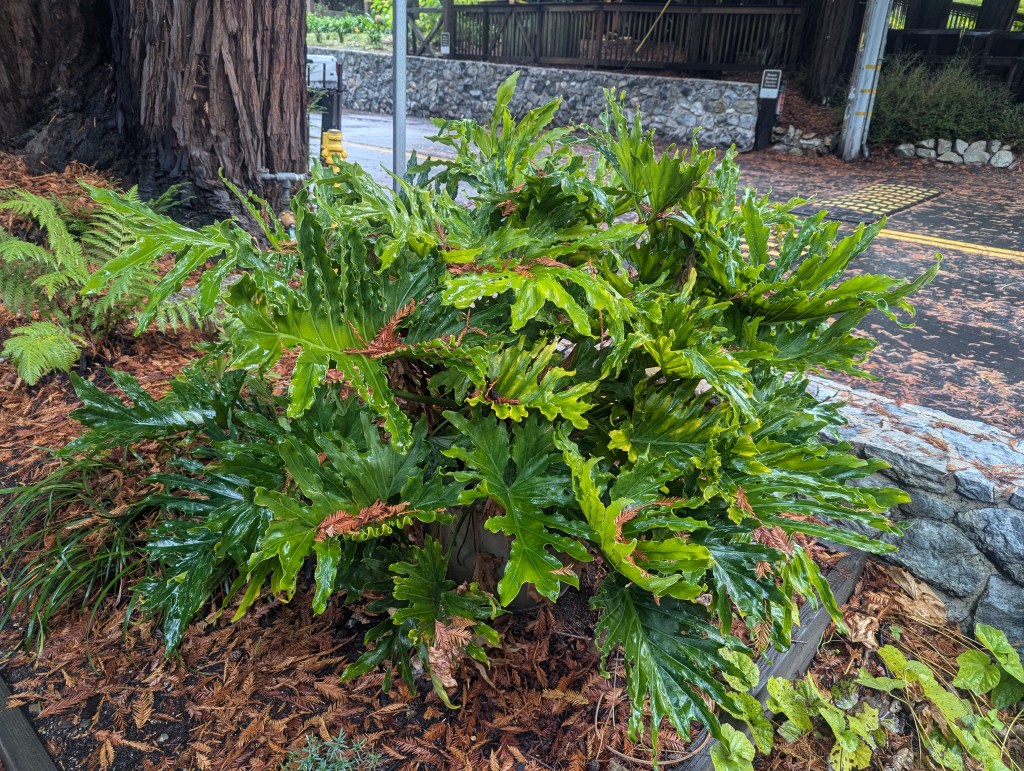
2. Dianella caerulea, blueberry lily is named Sigmund because it looks like a shabby sea monster. It is in a large terracotta pot that it now completely obscures. It visually softens the blunt end of a low stone retaining wall that separates a few stone steps from a ramp.
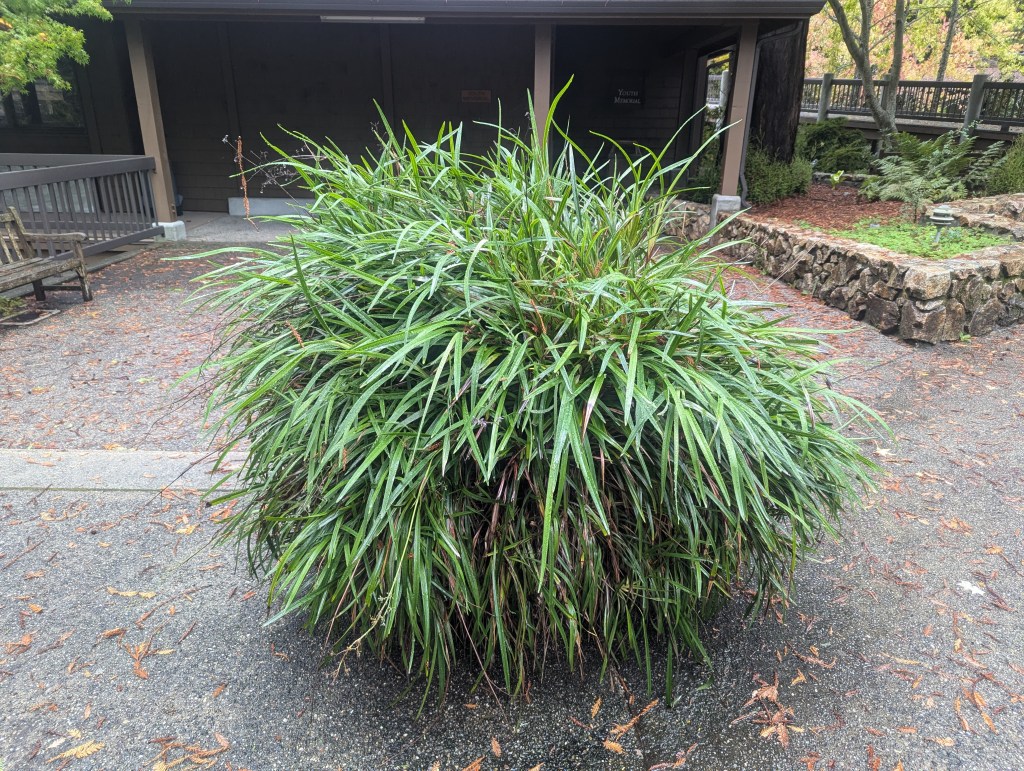
3. Cymbidium, orchid with a few small bits of Vinca minor ‘Alba Variegata’, small white variegated periwinkle are in a cheap plastic urn, with Sigmund in the background to the left. I know neither the species nor the cultivar of the orchid, but it blooms white nicely.
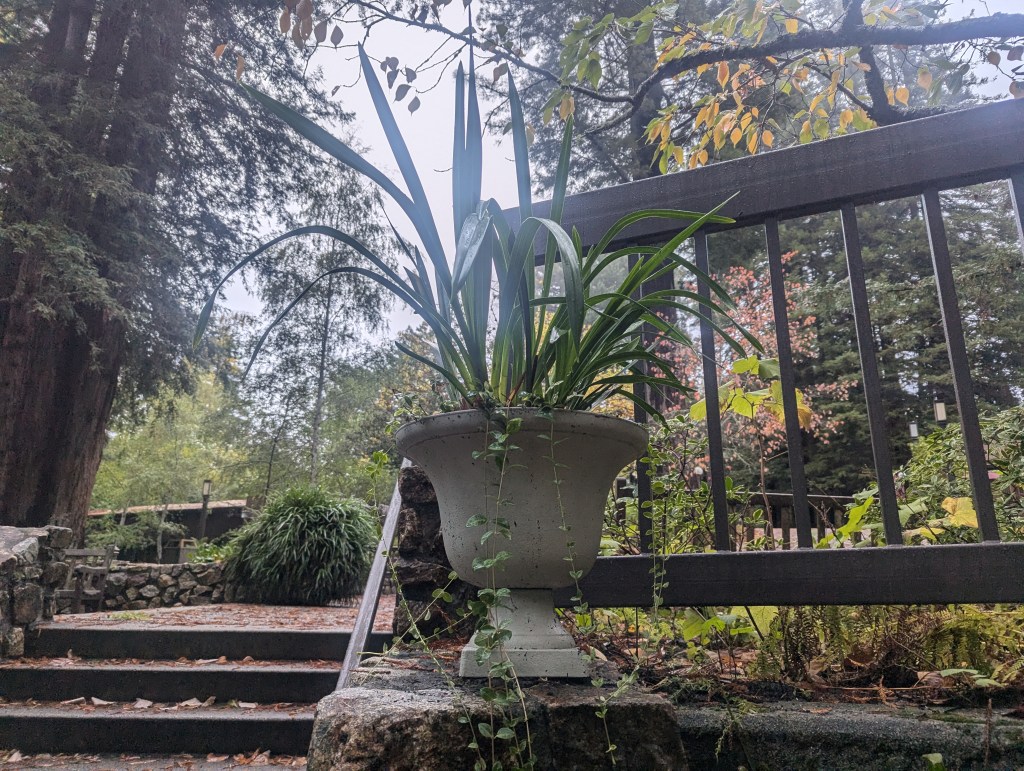
4. Alocasia odora, taro, or whatever species this is, has grown quite nicely to obscure its pot, just like the split-leaf philodendron and Sigmund. It was taken from a vacated home with an Australian tree fern two years ago. Sadly, the old home will soon be demolished.
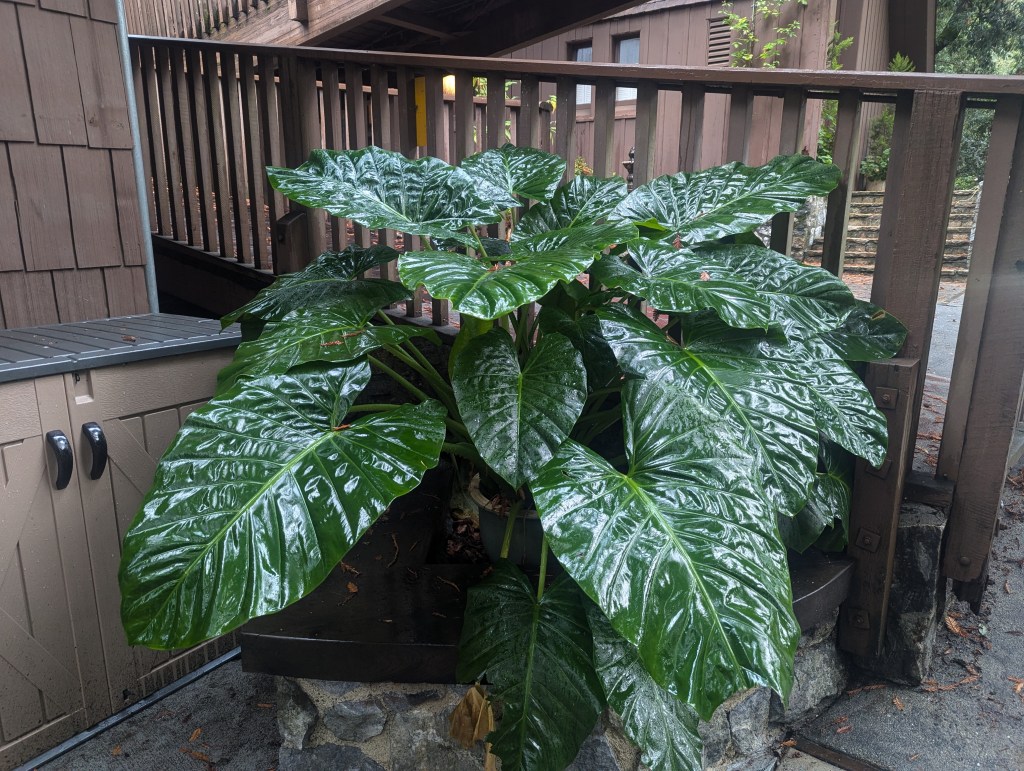
5. Brugmansia, angel’s trumpet really is getting to be redundant, but is also really quite pretty. Like the orchid, both its species and cultivar are unknown. I grew it from a scrap from a green waste pile in East San Jose. Its big terracotta urn was a gift a few years ago.
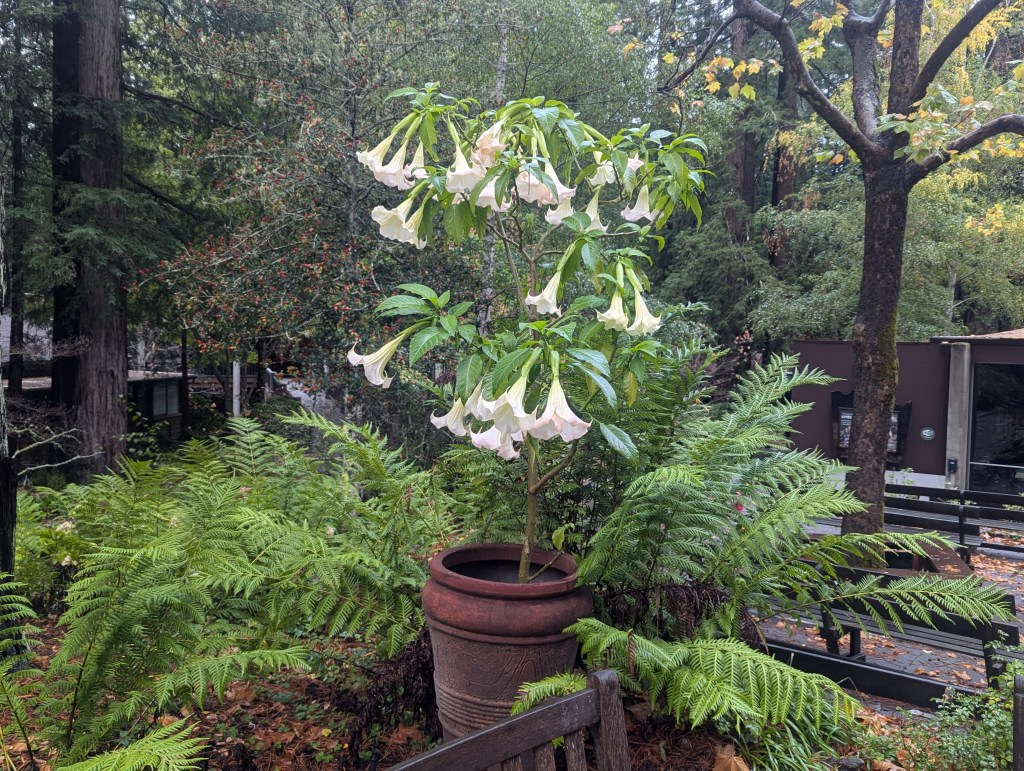
6. Eucalyptus globulus ‘Compacta’, dwarf blue gum is certainly not a typical houseplant. Yet, here it is within an antique coffee shoppe lounge at work. We do not know how long it can survive here without direct sunlight, but will eventually find out. It is quite grand.
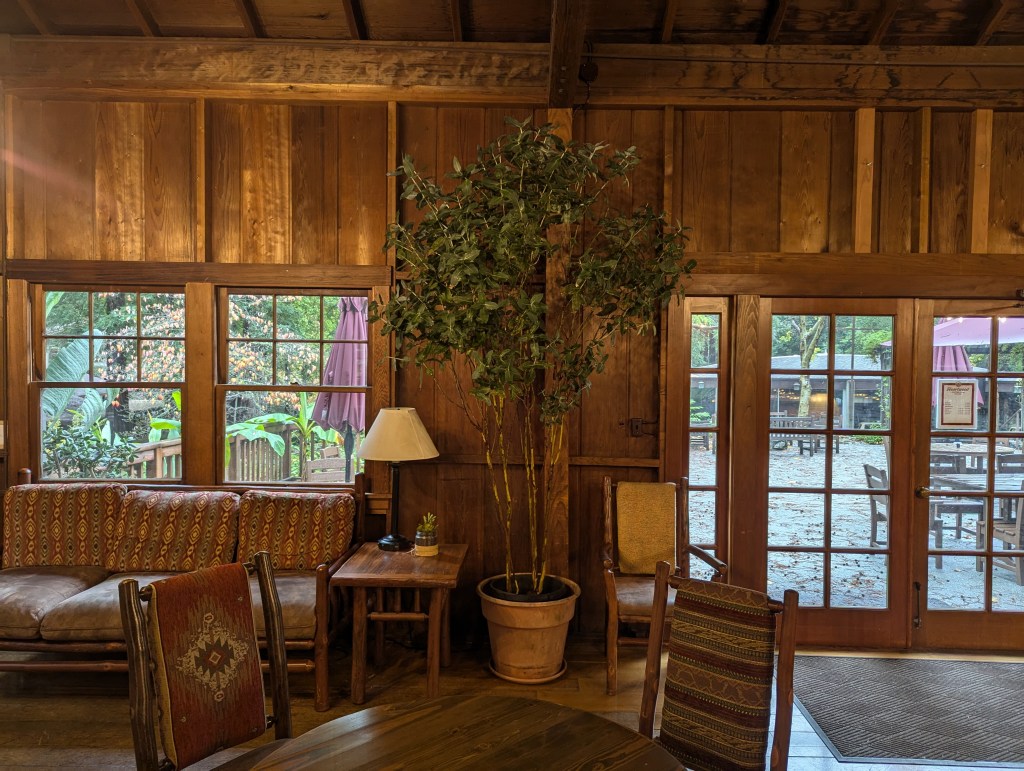
This is the link for Six on Saturday, for anyone else who would like to participate: https://thepropagatorblog.wordpress.com/2017/09/18/six-on-saturday-a-participant-guide/
Six on Saturday: Construction Site

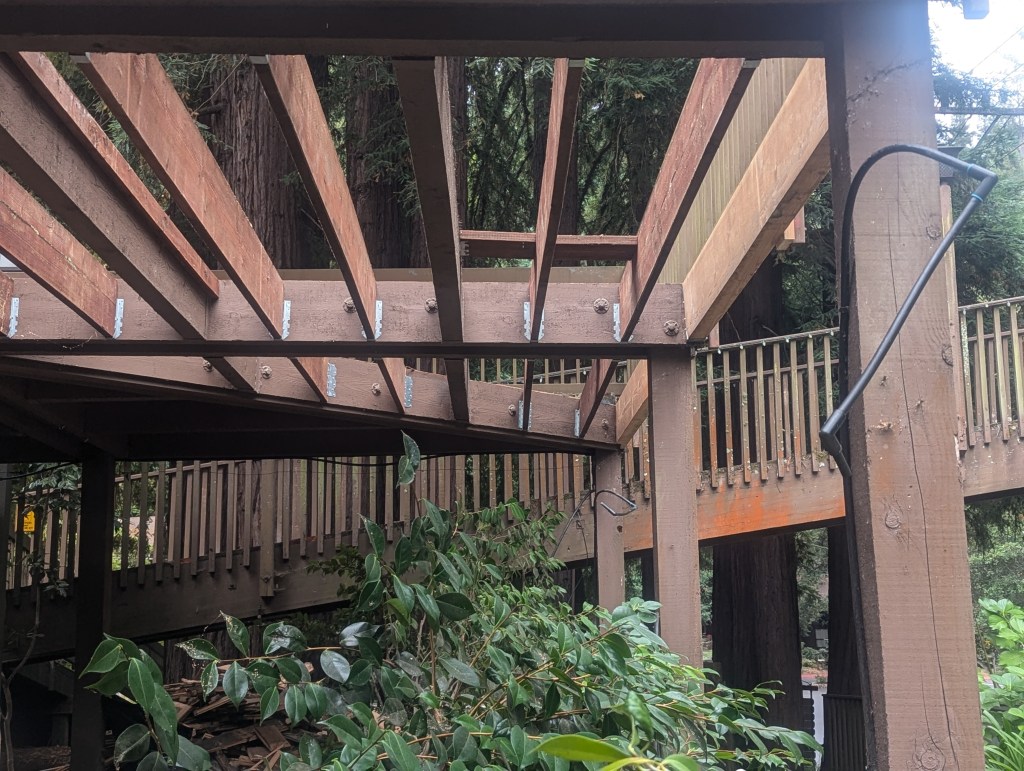
An old deck at work is presently being replaced. Potted cannas that resided on it needed to be moved. Camellias below it are in the way, but safe for now. It is quite a big project.

1. Camellia japonica, camellia under the old deck are temporarily getting more sunlight than they are accustomed to. There are about eight. This will not last long, though, until the new deck replaces the old. The disheveled irrigation tubing was for pots on the deck.

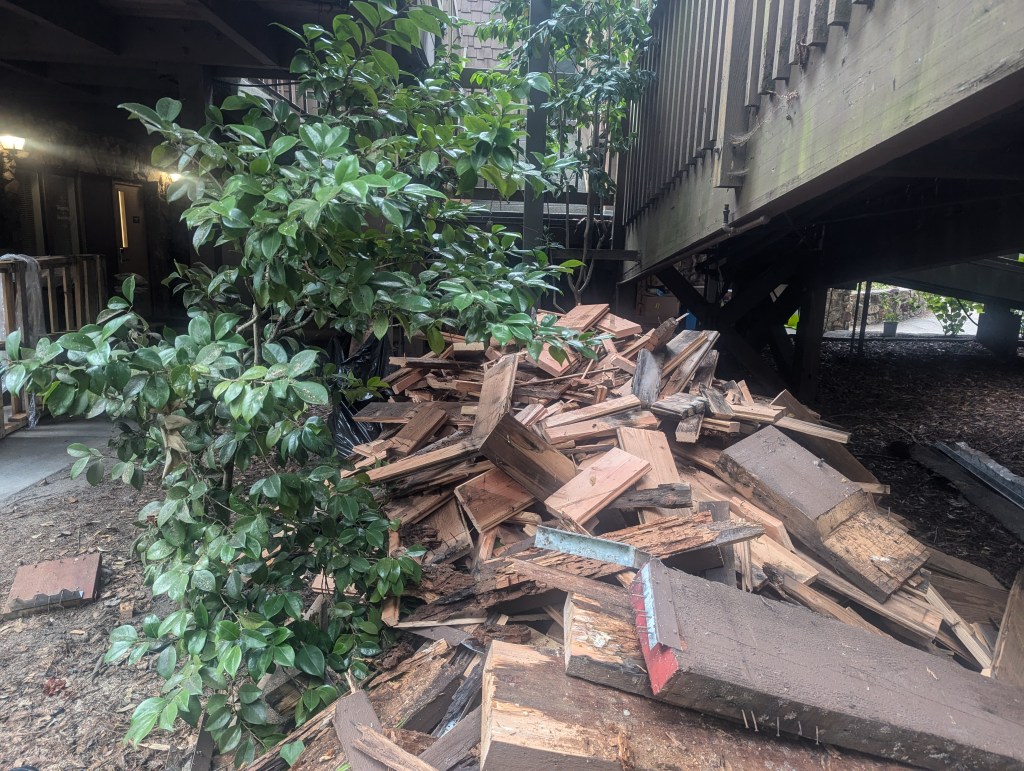
2. Camellia japonica, camellia at the far end of this row is somehow undamaged by this accumulation of debris from the dismantled deck above. I am impressed. Some extent of damage is expected from such a project, particularly with so many camellias in the way.

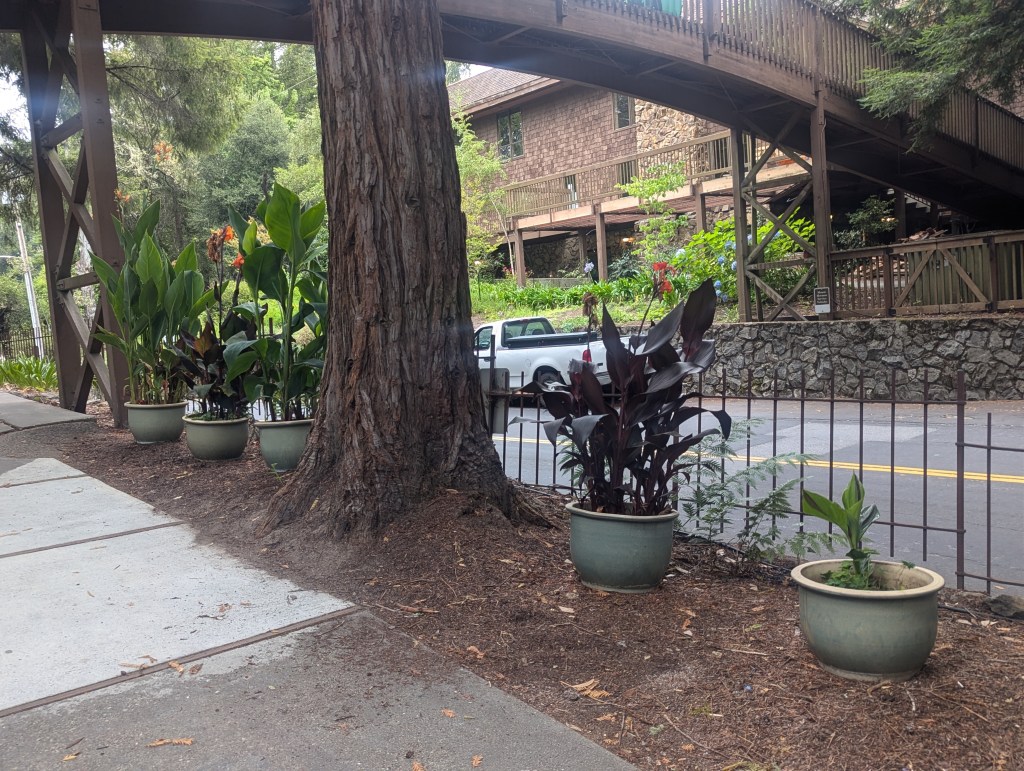
3. Canna indica, canna was looking good on the deck across the road in the background. Not only were they removed, but because of a realistic concern that they promote decay, they will not return to the new deck. For now, they were straightened into position here.

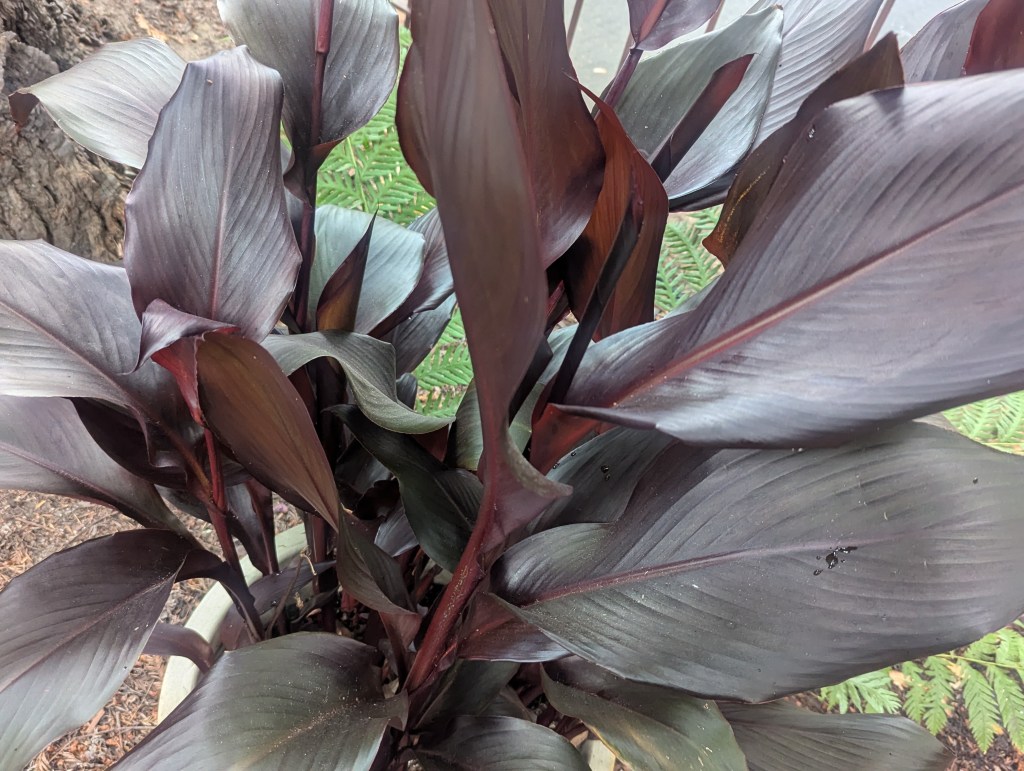
4. Canna indica ‘Australia’ canna is probably the boldest of the five even without bloom. The others are ‘Wyoming’, ‘Cleopatra’, ‘Stuttgart’ with an unidentified cultivar with large red bloom, and ‘Inferno’ with a notably tall but unidentified cultivar of Canna musifolia.

5. Phoenix roebelenii, pygmy date palm paired on another area of the deck will also need to be removed prior to a second phase of reconstruction. Unfortunately, I do not know if these big old pots can be moved intact. Both are deteriorated, fractured, and very heavy.

6. Pelargonium X hortorum, zonal geranium should also be removed, but from another situation. They were originally installed to hold posts for the signs that are now attached to the fence behind them. Now they just get bashed by parking cars. One is already gone.

This is the link for Six on Saturday, for anyone else who would like to participate: https://thepropagatorblog.wordpress.com/2017/09/18/six-on-saturday-a-participant-guide/
Archaeology

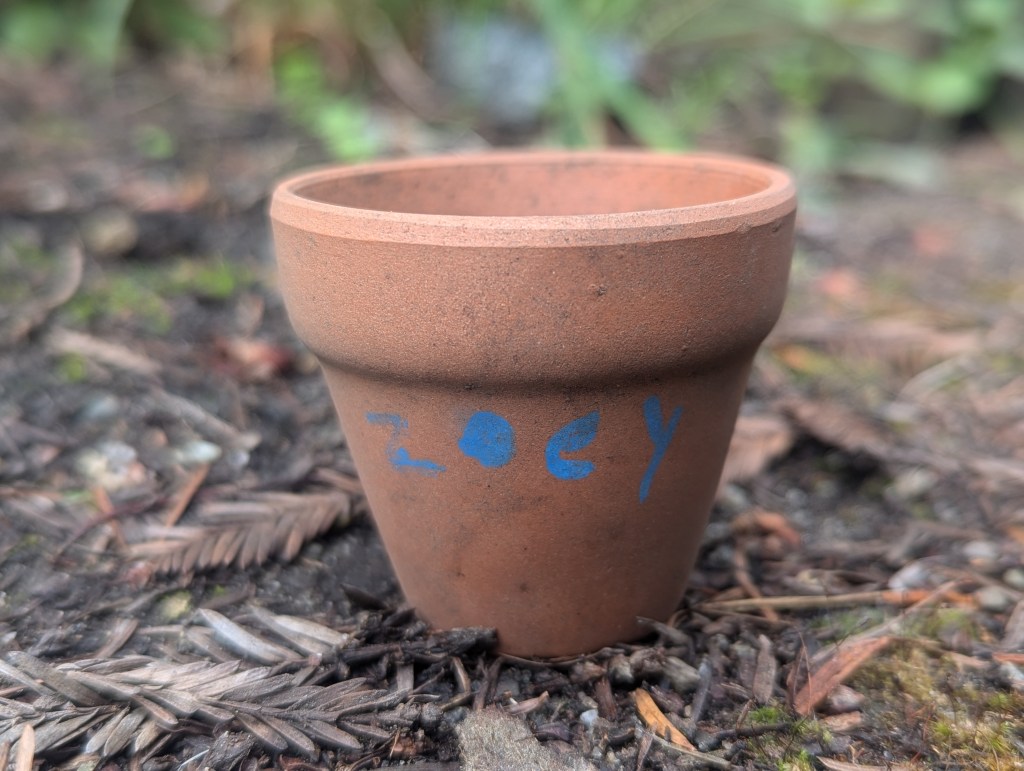
Working within landscapes is obviously very different from working on the farm. Actually, there are too many differences to mention. One difference is people. There are only a few on the farm, spread out over many acres. Conversely, the landscapes that I work in are designed for use and enjoyment by countless people who attend events there. I can rarely get away from all of them. Although it can be fun, it can also be challenging, and often interesting. On rare occasion, I find artifacts that make me wonder about whomever left them. This tiny terracotta pot with “Zoey” painted on it, for example, was found in a small landscape outside of a bookstore, quite a distance from the facility a which young children typically engage in such crafts. I hate to think that Zoey misplaced it there. I sort of hope that it was intentionally left there, perhaps containing a tiny plant that Zoey hoped a gardener would find and add to the landscapes. If so, I found it too late and empty. Zoey does not need to know that. Hopefully, if she returns, she finds something that she believes to be her plant growing happily in our landscapes.

Pork & Beans

If it appears to be related to burrow’s tail, it is because pork & beans is the same genus.

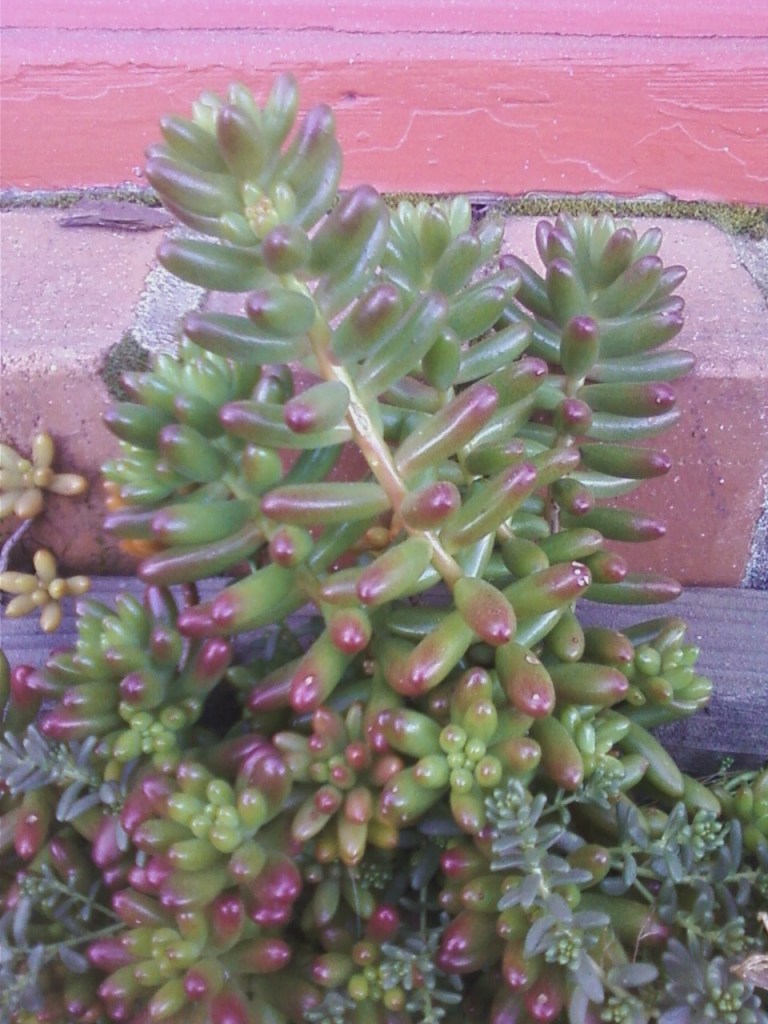
The tender succulent foliage of pork and beans, Sedum rubrotinctum, is as squishy as it appears to be, so is safest where it will not be disturbed. Although it sprawls around without getting much deeper than six inches, it does not fill in reliably enough to be a real ground cover over a large area anyway. It can instead add color and texture in small doses between larger plants or stones. It is a nice addition to urns of mixed perennials, rock gardens and dish gardens. It propagates very easily from stem cuttings or even leaves that break off, so can be tucked into gaps in stone walls.

The plump three quarter inch long leaves resemble jelly beans more than pork and beans, since they are green where shaded. More exposed foliage is more bronzy red or brown, especially at the tips. Small clusters of tiny yellowish flowers are held above the foliage on reddish brown stems in spring.

The Hedge on the Ledge – Update

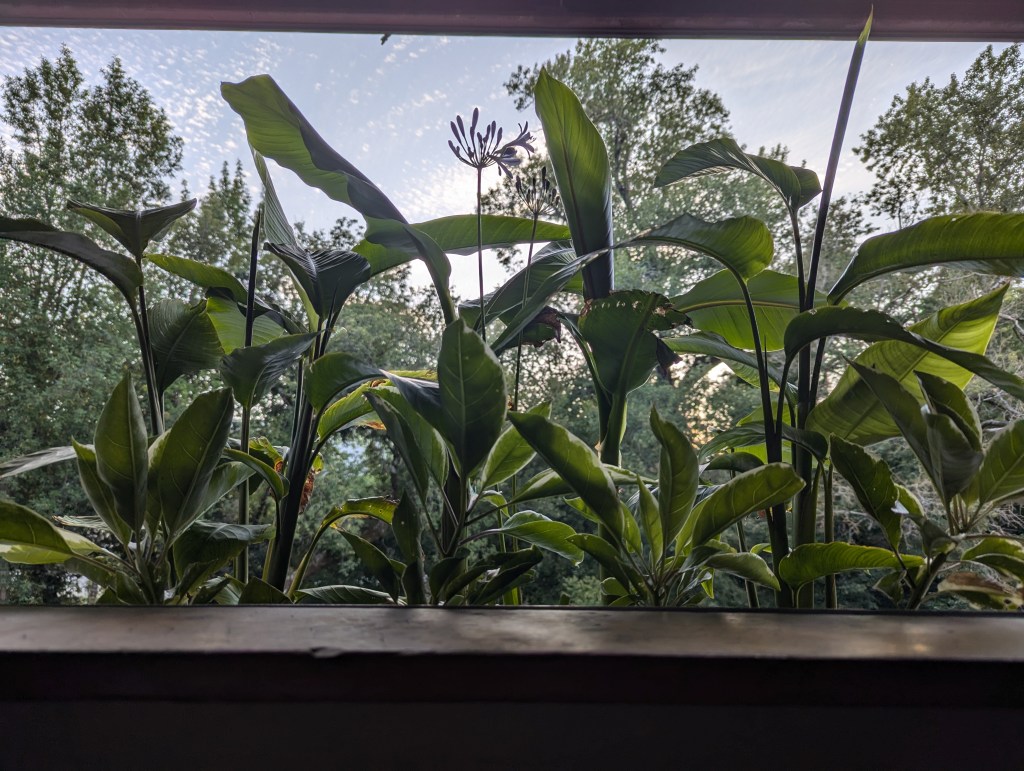
The Hedge on the Ledge continues to develop. Nothing has been added or subtracted from it since its previous update late last July. The vegetation has only grown and been moved about a bit. Perhaps that is an understatement. It has grown more substantially than it should have been allowed to within a situation that it should not actually be in. The only other change is that the pair of parakeet flower pups and the pair of banana pups switched places. It is so overgrown that it obstructs sunlight that would otherwise brighten the associated window. That was not so bad during warm weather of summer. It might not be so desirable as weather cools for autumn. Besides, all of this overgrown vegetation should relinquish its space to smaller vegetation that can benefit from the sheltered position and associated but presently unused heating mat through winter. After all, shelter from minor frost and access to electricity for a heating mat were the original justifications for the installation of this silly shelf below only the half of its window that opens. If I had known that it would still be here, I might have constructed it as a window box instead of an exposed shelf, so that the black vinyl cans and their faded old labels would not be so prominently visible. Eight #1 cans fit neatly onto the shelf, with three 4″ pots nestled into the spaces between them. An elastic strap holds them firmly in place so that they do not get blown off. The vegetation includes:

4 – #1 Solandra maxima ‘Variegata’ cup of gold vine – back row closest to window

2 – #1 Musa acuminata ‘Golden Rhino Horn’ banana – left and right corners of front row

2 – #1 Heliconia psittacorum (unidentified) parakeet flower – middle of front row

2 – 4″ Cucurma longa (unidentified) turmeric – left and right between rows

1 – 4″ Agapanthus africanus ‘Peter Pan’ lily of the Nile – middle between rows

Japanese Aralia

Japanese aralia is both prehistoric and futuristic.

The popularity of Japanese aralia, Fatsia japonica, has spanned more than just a few decades. The big, glossy leaves of this lush foliar plant adorned the home of the Flintstones in Bedrock many thousands of years ago, as well as the office of Mr. Spacely of Spacely Sprockets, where George Jetson works, some time in the future! It is just as happy in most types of soil as it was in the front yard at the Flintstone Residence, and is just as happy in large containers as in Mr. Spacely’s office. As long as it is protected from harsh exposure or reflected glare (like it might get from large lightly colored walls or tinted windows), Japanese aralia does well in full sun, or can be just as happy in the shade of larger trees. 

Although it does not grow too rapidly, Japanese aralia eventually gets nearly eight feet high and wide, and commands a bold presence. Their deeply and symmetrically lobed leaves can get as broad as a foot and a half, on long petioles (stalks). The foliage of ‘Vairegata’ emerges with a yellow border that turns pale white. ‘Moseri’ stays quite compact.

Plants grown for their foliage can be maintained by cutting oldest stems to the ground as they deteriorate, so that newer stems can replace them. Excessive basal watersprouts can be cut or ‘peeled’ off if they get too crowded. Alternatively, lower growth can be pruned away as it develops to elevate the canopy and expose interior stems. However, individual stems do not last indefinitely, and will eventually need to be replaced by any convenient watersprout. The most deteriorated plants can be rejuvenated by getting cut to the ground just before spring.

Billbergia sanderiana

Billbergia sanderiana is like a larger version of Billbergia nutans.

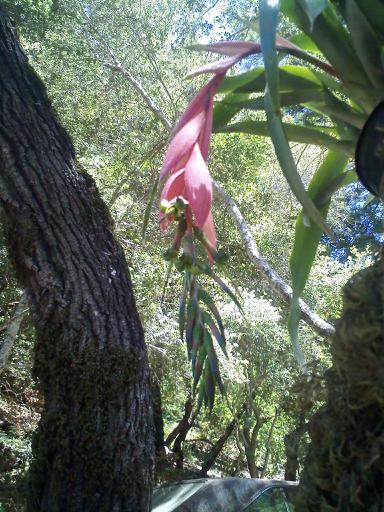
To many of us, Billbergia sanderiana is really just a coarser version of the related and more common queen’s tears bromeliad, Billbergia nutans. The somewhat stiff leaves of the former are substantially wider but are actually shorter than those of the latter, less than a foot long. Billbergia sanderiana foliage has minute teeth for lightly snagging against flannel sleeves, and is sometimes spotted with white. The dense basal rosettes of foliage are always producing pups that can be divided to propagate copies for friends and neighbors.

Their nearly foot long flower spikes look like bunches of perch hanging from jigs on fishing poles. The small weird flowers buds are tipped with almost navy blue, with lime flavored Pez green at the base. These flower buds hang upside down, with their blue tips pointing downward at first. Their petals curl back and upward as they open. The bright pink bracts that wrap the stems that suspend these bunches of flowers puff out as bloom progresses. By the time the lemony yellow pollen laden stamens emerge, the most memorable colors of 1985 are represented.

All specie of Billbergia are naturally epiphytic (grow within the canopies of large trees) so their wiry roots are rather minimal and seem to cling to the inside of their pots while ignoring potting media (potting soil) within. They like to be watered regularly but not excessively while weather is warm, but do not need much at all through the cooler time of year. Their media should be very loose and drain well.

Bromeliads Are . . . Weird.

Tillandsias, to the left and right, as well as Spanish moss, which hangs downward throughout, are types of bromeliads.

After certain botany classes, some of my Cal Poly colleagues and I found it difficult to enjoy eating certain fruits and vegetables like we did previously. Simple things like pineapples, figs, potatoes and Brussels’s sprouts were much less appealing, or even unappealing, once we discovered what they really are. Yet, we also gained a bit more respect for these seemingly weird plants. Even though their adaptations do not always make sense to us, and some adaptations are a bit outdated by a few thousand centuries, or much more, many plants are remarkably adapted to their particular situations within their natural environments.      

Pineapple is still one of my less favorite ‘fruit’. However, the related bromeliads, of the family Bromeliaceae, are fascinating. Almost all are ‘stemless perennials’ with basal rosettes of foliage. (Their ‘stems’ are actually out of sight below their foliage.) Most are epiphytes that live within the canopies of larger trees or on exposed rock formations, sustained by whatever organic matter that happens to fall onto them from above. They are consequently very well adapted to confinement in pots, so can be quite happy as houseplants. A few bromeliads that live in deserts or other comparably harsh environments actually resemble yuccas.

Some people like to water large bromeliads  in the ‘reservoirs’ formed by the densely set leaves at the middles of the foliar rosettes. In the wild, these reservoirs naturally collect rainwater to use during drier weather. Bromeliads can either absorb moisture directly from their reservoirs through their leaves, or they release some of the water between their foliage to their roots below as their leaves lose turgidity (wilt slightly) because of a lack of rainfall or humidity. Either way, bromeliads really know how to conserve and ration water accordingly.

Many bromeliads are appreciated for their unusually colorful and often strangely textured foliage. Many have very interesting or downright strange flowers that mostly stand high above their foliage. The flashiest bromeliads have all of the above ; oddly textured and colorful foliage with interesting flower trusses outfitted with bracts (modified leaves that adorn flowers) that are so colorful that it is difficult to know where the foliage ends and the flowers begin.   

Change of Scenery

I am certainly no landscape designer, but I think that I sort of dig this.

Window boxes annoy me. They were originally developed to contain aromatic herbs that dissuaded mosquitoes from entering small windows, likely before the invention of window screens. They remained popular while window screens were expensive, and to grow culinary herbs where garden space was limited in old European cities. None of that is useful to me. Mosquitoes are not much of a problem here, and if they were, window screens are not expensive. There is plenty of space for herbs in the garden. Furthermore, window boxes eventually rot as a result of the irrigated medium within, and share their rot with the wooden walls that support them.

The small shelf that I suspended below this window was intended for eleven small tissue culture plugs of various cultivars of banana. I wanted to shelter them from minor frost last winter. I intended to remove the shelf after winter. Obviously, I did not.

Without a plan, I moved eleven small specimens of various species from the nursery onto the shelf just to see how their composition could develop. I typically do not like to obscure scenery or obstruct sunlight from windows, but thought I could make an exception for this window. The scenery is not particularly appealing, with a busy roadway nearby. Through summer, a bit of shade from the warm late afternoon sun might be nice.

I did not want the grassy texture or bronzed foliar color of the sugarcane right outside the window. Nor did I want the disorganized texture of any of the gingers. I am rather pleased with how these few other species work though. They are nearly half as high as the window, but as I mentioned, for this window, I do not mind. They look rather jungley.

The eleven small specimens here are in eight #1 cans and three 4″ pots. The three 4″ pots are nestled into the gaps in between two rows of four #1 cans. A pair of young plugs of Cucurma longa, turmeric, in two of the three 4″ pots are not visible to the left and right. Only two blooms of a small specimen of Agapanthus africanus ‘Peter Pan’ lily of the Nile in the middle 4″ pot are visible. Four rooted cuttings of Solandra maxima ‘Variegata’ cup of gold vine are in the closer row of #1 cans. A pair of large specimens of an unidentified cultivar of Heliconia psittacorum, parakeet flower, are to the left and right in the rear row. A pair of pups of Musa acuminata ‘Golden Rhino Horn’ banana are in the middle of the rear row. This is so very inconsistent with my style, but I am getting to like it.

Container Gardening

These containers are almost completely obscured by their contents.

Container gardening is one of those trends that I could do without in my own garden. Even though I know that it is actually very practical for several reasons, I prefer to grow as much as I can directly in the ground because I do not want to take care of contained plants. However, even with only minimal potted plants around my garden, the steep embankment above my driveway has reminded me of one of the many reasons why people like to grow plants in large or hanging pots, elevated planters or window boxes. There are just so many plants that look so good cascading out of containers.

The lily-of-the-Nile that I planted on top of part of the embankment to hold the soil together actually look really cool leaning over the top edge, and would look just as good in large planters. The smaller ‘Peter Pan’ lily-of-the-Nile is more proportionate to smaller urns. Since these do not hang over the edges too far, they look even better mixed with more pendulous plants like trailing rosemary, verbena, ivy geranium and dwarf periwinkle. Upright plants like fuchsia and smaller types of New Zealand flax in the middle of mixed plants add good contrasting form. Dracaenas (Cordyline spp.) were traditional vertical accent plants of Victorian gardening.

Low planters and pots, as well as many hanging pots, are very often best outfitted with traditional cascading annuals like lobelia, sweet alyssum, petunia, portulaca and my favorite, nasturtium. Even if annuals that do not cascade are the central features of mixed planters, cascading plants around the edges really maximize the show by spreading even more flower color over the exteriors of the containers. Colorful perennials like fibrous begonias, busy Lizzie, campanula, fleabane, scaevola and dusty miller may not cascade as well as the annuals, but add width, and probably cascade adequately for ‘artfully’ designed pots that are too appealing to obscure completely.

In sheltered lanais and porches, spider plant, burro tail and wandering Jew are classic solitary perennials for hanging pots. What orchid cactus lacks in form and foliage, it makes up for with bold flowers.

The largest pots and planters can benefit from simple ground covers like shore juniper and English ivy, perhaps dressed up with flowering annuals. Gazanias can provide their own flowers, so can instead be dressed up with the colorful and textural foliage of blue fescue or another grassy perennial. Asparagus densilforus has such bold texture and form alone that it does not necessarily need the color of annuals.