Crassula tetragona is more similar to related jade plant than it appears.
Although the narrow and pointed inch long leaves of Crassula tetragona (which lacks a common name) are not at all similar to the plump rounded leaves of the closely related but much more common jade plant, it is much more similar to jade plant than it appears to be. Both enjoy sunlight but will take a bit of shade. Both can be damaged by extreme exposure (reflected glare and heat), as well as the opposite extreme, frost. Their succulent stems are so easy to root as cuttings, that rather substantial pieces that may need to be pruned off can be stuck into the soil as instant new plants. Even leaves of these and various other specie of Crassula can be rooted as very small cuttings. Besides its distinctive foliage, Crassula tetragona differs from jade plant only because it is limited to about a foot and a half high and wide, and blooms with unremarkable white flowers instead of more prominent flower trusses.
Heaths, which are several species of Erica, derive their name from their natural habitats. They are endemic to shrublands of acidic and seasonally dry soil of inferior quality. Such ecosystems, or heaths, do not sustain many big trees or shrubbery. Species from heaths should be resilient to dry chaparral summers. However, they dislike locally alkaline soils.
This is unfortunately why heaths are quite rare within gardens here. They are popular as blooming potted plants for winter, but become scarce afterward. Within planters of potting media, they may grow and bloom for many years. In the ground though, they are likely to languish without acidifying amendment. They prefer the company of coniferous species.
Heath blooms for winter or very early spring. Heather is a similar relation, but blooms for summer or autumn. Floral color ranges from white to pink to rustic purplish pink. Flowers are dinky but abundant. Comparably dinky evergreen leaves are like soft juniper scales. Almost all available heaths grow less than five feet high. Most grow less than a foot high.
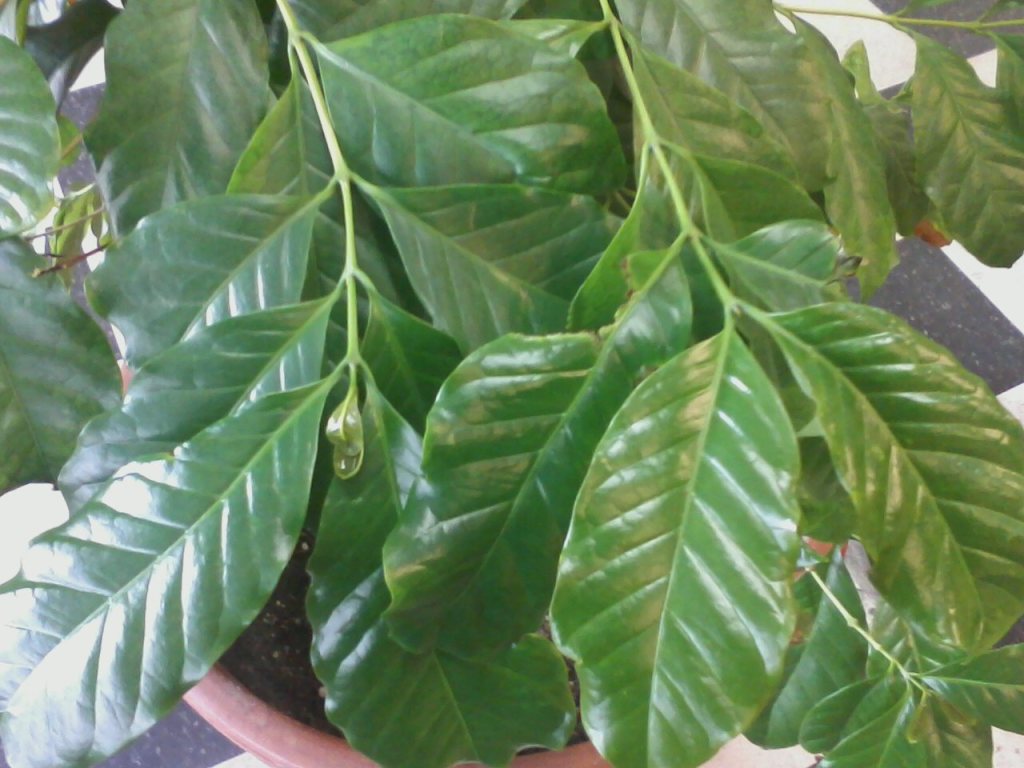
It looks more like a houseplant than the source of coffee.
The White Raven Coffee Shop, the best little pourhouse in Felton, has an interesting but old fashioned houseplant on the counter. This group of four small but rapidly growing coffee trees, Coffea arabica, was a gift from a loyal customer.
Mature plants can get to thirty feet tall in the wild. Fortunately, coffee trees are easy to prune to fit interior spaces. Pruning for confinement is actually better than relocating big plants outside, since they do not like cold weather and are sensitive to frost.
Like various species of Ficus, coffee is appreciated more for lush foliage that happens to grow on a tree that can be trained by pruning to stay out of the way, overhead or in other unused spaces or corners. The simple remarkably glossy leaves are about two and half inches long or a bit longer. The very fragrant small white flowers are almost never seen among well groomed houseplants, and only rarely and sporadically bloom among less frequently pruned larger trees in greenhouses and conservatories.
The half inch wide coffee fruit, which is known as a ‘cherry’, is even more rare than flowers among houseplants because of the scarcity of both pollinators and pollen (from so few flowers). Those fortunate enough to get flowers sometimes pollinate them with tiny paintbrushes or clean make-up brushes to compensate for a lack of insects about the house. The resulting bright red or somewhat purplish cherries barely taste like cherries and only make two coffee ‘beans’ each; not enough to bother roasting and grinding for coffee, but great for bragging rights.
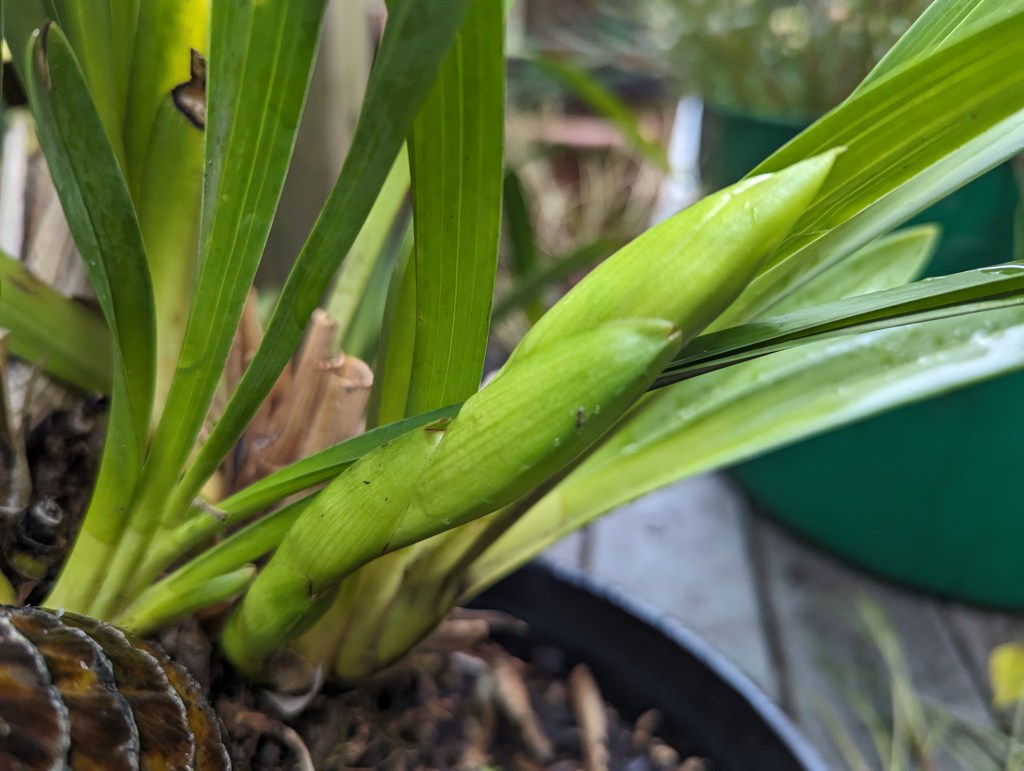
New floral shoots appeared almost immediately after the former bloom finished.
Cymbidium orchids perform quite well here, and seem to be happier with a bit of neglect. Actually, those with a tolerable bit of foliar blemishing or discoloration bloom better than those with exemplarily healthy and vigorous foliage. Those that get everything that they supposedly want, such as coarse chunks of fir bark to disperse their roots into, and regular application of fertilizer, are likely to produce an abundance of healthy foliage with only moderate bloom.
Only two cymbidiums inhabit my garden. I gave all others away many years ago. I acquired one of these two from a neighbor in the early 1990s, and have divided many copies of it since then. It remains potted within a bunch of leafy debris that I raked from my driveway under a massive valley oak many years ago. I suspect that the debris has decomposed to soggy muck at the bottom of the pot, although it remains friable on top, where I only rarely add a bit more leafy debris. I am not so keen on its simple pink bloom, but I continue to grow it because it has been with me for so long.
The other cymbidium was a gift from a colleague here. It originally grew ‘properly’ in a pot of coarse fir bark, but was removed from its pot many years ago, and left to die on top of a pot of potting soil that something else had already died in. It grew unattended there for a few years before coming here. It has bloomed splendidly and annually since its arrival. I want to divide it, but have not managed to do so between bloom phases. Its bloom continues for so long, that by the time it finishes, the next bloom phase is beginning. Fortunately, it is not too overgrown yet.
Candelabra tree is a big and strikingly weird succulent.
The weirdly sculptural succulent stems of candelabra tree, Euphorbia ingens, dark green but devoid of any real foliage, are striking in the right situation. These stems resemble those of unrelated cactus, with longitudinal ridges topped with spines. Although botanically interesting, the minute greenish yellow flowers that bloom in autumn and winter on the ridges of the upper portions of the upper segments are not much to look at. Deep red seed capsules that turn purple as they ripen sometimes develop in milder climates after the flowers are gone, but are almost never seen locally.
Good exposure is preferred. Candelabra tree are better structured and more prominent standing alone away from other larger trees and shrubs. Cool winters and occasional frosts limit their height to not much more than fifteen feet; and unusually cold frost can actually kill big specimens back severely. However, in sheltered areas and milder climates, candelabra tree can get twice as tall. Soil should drain very well and get dry between watering. Regular watering can cause rot, particularly in dense or rich soil.
The main problem with candelabra tree is the remarkably caustic latex sap, which can be dangerous to children, chewing dogs or even those who need to prune the stems. Fortunately, candelabra tree needs very little attention, and only needs to be pruned where the stems get in the way or start to lean against fences or roofs. The caustic sap prevents insect problems.
Annuals are nice, but so are a few more substantial or perennial plants.
Large pots, urns and planter boxes filled with ridiculously colorful blooming annuals are certainly nothing new. However, more small perennials and even a few small shrubs and trees are being planted along with the annuals, and allowed to stay indefinitely as fewer annuals get replaced around them as the seasons change.
These plants only need to be tolerant of confinement, regular watering and the comings and goings of the annuals around them. Upright plants should go in back, behind the lower annuals. Cascading and ground cover type plants should go in front.
Small forms of New Zealand flax and trunkless dracaena palms (Cordyline spp.) add texture, form and motion to large planters, but may eventually get too big if not properly pruned. Larger shoots can be pruned out to allow smaller shoots to take over. Alternatively, overgrown plants can be removed and put out in the landscape when they get too big.
Hollywood and Rocky Mountain junipers have striking form if pruned to show it off, and are easier to contain with selective pruning than reputed. Even without the interesting branch structure of junipers, arborvitaes are appreciated for their similar finely textured foliage and their rich green or yellow color. ‘Blue Rug’ juniper, a grayish ground cover juniper, cascades nicely from large planters.
Large succulents that tolerate water, such as good old fashioned jade plant and various aeoniums, offer bold texture and form in the background. They are easy to prune as they grow, and do not have aggressive roots. Low clumping aloes do the same in front.
Euonymus fortunei, English ivy, various iceplants and other ground cover plants do well cascading over the edges of large planters.
There really is not much limit to the variety of perennials and small shrubs and even trees that play well with others in planters of blooming annuals, and do not mind the confinement and regular watering. Annuals are still the best for flashy floral colors. Yet, the other plants excel in form, texture, foliar color and motion in the breeze.
Wandering Jew, spider plant, various philodendron and jade plant were among the most popular houseplants of the 1970s. They are as easy to propagate as they are to grow, so were popular gifts for friends and neighbors. Jade plant, Crassula ovata, commonly grew too big to stay inside without pruning. It fortunately grows better than the others outdoors.
Jade plant does not grow fast, but can eventually get more than six feet tall, with densely rounded form. The succulent stems of such large specimens get quite plump, but remain rather fragile. The paired evergreen leaves are thickly succulent, and mostly a bit longer than two inches. Clusters of tiny pale pink or white flowers are not especially impressive.
At least one cultivar is variegated with irregular white stripes. Another is somewhat ruddy with relatively compact growth. Others exhibit tubular or curly leaves. Foliage can fade or develop narrow red edges in response to harsh exposure or heat. It is also susceptible to frost damage. Jade plant is mildly toxic, but also potentially appealing to dogs who chew.
Kalanchoe is a popular houseplant here, but grows wild in Madagascar.
The plants grown as houseplants may have serious disadvantages that prevent them from being happy in the garden, but have other advantages that help them survive indoors. They tolerate the lack of direct sunlight, the lack of humidity, the minimal fluctuations of temperature and the confinement to pots that they must endure for a domestic lifestyle. Their main difficulty in the garden is most are from tropical climates, so can not tolerate cold winter weather.
However, even happy houseplants like to get out once in a while. Even though most can not survive the coldest winter weather, the mildest winter weather is actually the best for them to get supervised outings. During clear and warm summer weather, sunlight can easily roast foliage.
Houseplants with glossy tropical foliage occasionally like to be rinsed of dust and whatever residue that they accumulate in the home. (African violets and plants with fuzzy leaves do not want water of their foliage!) Foliage can be rinsed in a shower or with a hose, but are more gently rinsed by very light drizzly rain.
Timing is important. Unusually cold or heavy rain should be avoided. Plants should be brought in before the sun comes out. It is probably best to not leave plants out overnight when it gets colder and they are not likely to be monitored. While the plants are outside, mineral deposits can be scrubbed from the bases of the pots.
The rain needs to fall this time of year anyway, so it may as well go to good use in as many practical ways as possible. It may be a while before it flows into the aquifer and gets pumped out to come back later for use around the home and garden.
So much of the water that gets used around the home has the potential to be used again. With modifications to plumbing and the sorts of soaps and detergents used around the home, used water, politely known as ‘greywater’, can be redirected, collected and distributed to the garden. Water may not be so important in the garden this time of year, but a Greywater Workshop happens to be coming up next week; and advance registration is required.
The Guadalupe River Park Conservancy’s Adult Greywater Workshop (for ages eighteen and up), ‘Greywater Basics: Reusing Household Water in your Landscape’, will be from 9:00 a.m. to noon on February 18th. The Workshop will be at the Guadalupe River Park and Gardens Visitor and Education Center at 438 Coleman Avenue in San Jose. Admission is $15, or $10 for members. More information is available, and reservations can be made, at www.grpg.org or by telephoning 298 7657.
Even if never as overly indulgent in bloom as when new, Kalanchoe blossfeldiana is one of the more sustainable of popular blooming florist plants. Forced bloom remains colorful for quite a while. By the time it deteriorates enough to necessitate grooming, new foliage may already be developing. Sporadic subsequent bloom is more natural in appearance.
Ultimately, Kalanchoe blossfeldiana becomes more of a succulent foliar houseplant that occasionally blooms, rather than a spectacular floral plant. Individual plants may survive for only a few years, but are likely to generate basal pups that grow as new plants during that time. Also, they are very easy to propagate by succulent stem and even leaf cuttings.
Mature Kalanchoe blossfeldiana do not get much more than a foot high and wide. Some may stay half as tall. Their lower leaves can get three inches long, with crenate margins. Minute yellow, orange, red, pink or creamy white flowers bloom for late autumn or winter. Garden plants require shelter from chill through winter and hot sunlight through summer. Most are houseplants that appreciate copious sunlight.
Coffee was more popular as a houseplant decades ago.
The White Raven Coffee Shop, the best little pourhouse in Felton, has an interesting but old fashioned houseplant on the counter. This group of four small but rapidly growing coffee trees, Coffea arabica, was a gift from a loyal customer.
Mature plants can get to thirty feet tall in the wild. Fortunately, coffee trees are easy to prune to fit interior spaces. Pruning for confinement is actually better than relocating big plants outside, since they do not like cold weather and are sensitive to frost.
Like various species of Ficus, coffee is appreciated more for lush foliage that happens to grow on a tree that can be trained by pruning to stay out of the way, overhead or in other unused spaces or corners. The simple remarkably glossy leaves are about two and half inches long or a bit longer. The very fragrant small white flowers are almost never seen among well groomed houseplants, and only rarely and sporadically bloom among less frequently pruned larger trees in greenhouses and conservatories.
The half inch wide coffee fruit, which is known as a ‘cherry’, is even more rare than flowers among houseplants because of the scarcity of both pollinators and pollen (from so few flowers). Those fortunate enough to get flowers sometimes pollinate them with tiny paintbrushes or clean make-up brushes to compensate for a lack of insects about the house. The resulting bright red or somewhat purplish cherries barely taste like cherries and only make two coffee ‘beans’ each; not enough to bother roasting and grinding for coffee, but great for bragging rights.




 Tony Tomeo