Live Christmas Trees Eventually Mature

Most conifers are not so compact.

Christmas trees grow on farms. They are an agricultural commodity. Their unnatural and intensive cultivation is no asset to any associated natural ecosystem. Their harvest does not deprive ecosystems of natural components. Live Christmas trees are at least equally as unnatural. Their cultivation involves more synthetic materials and unnatural irrigation.

There should be no shame associated with the procurement of cut Christmas trees. They are merely cut foliage that is significantly more substantial than that which accompanies cut flowers. Furthermore, live Christmas trees are not an ecologically responsible option. They are merely potted plants that can be difficult to accommodate within home gardens.

That certainly should not invalidate the appeal and potential practicality of live Christmas trees. With proper maintenance, other potted plants, such as houseplants, can grow and perform for many years. Since live Christmas trees are coniferous species that get rather large, they demand more attention. All are not necessarily totally unmanageable though.

Some compact conifers, such as dwarf Alberta spruce and compact cultivars of Colorado blue spruce, can remain within pots for many years. They need either larger pots as they grow, or occasional root trimming if they stay within their same pots for a few years. Their roots outgrow pots as slowly as their canopies grow. They also require diligent watering.

Unfortunately, the most common of decorated live Christmas trees that are available from supermarkets are also the most problematic. Most are either Canary Island pine or Italian stone pine, which grow surprisingly large for such seemingly innocent small evergreens. They very often go into compact gardens, where their bulky roots displace infrastructure, such as pavement and turf grass.

Contrary to popular belief, planting live Christmas trees in the wild after Christmas is not a practical option. Because their roots were confined to pots, they rely on irrigation while they disperse roots into the ground. They can not survive without irrigation after the rainy season. Besides, trees that are not native could be detrimental to the native ecosystems.
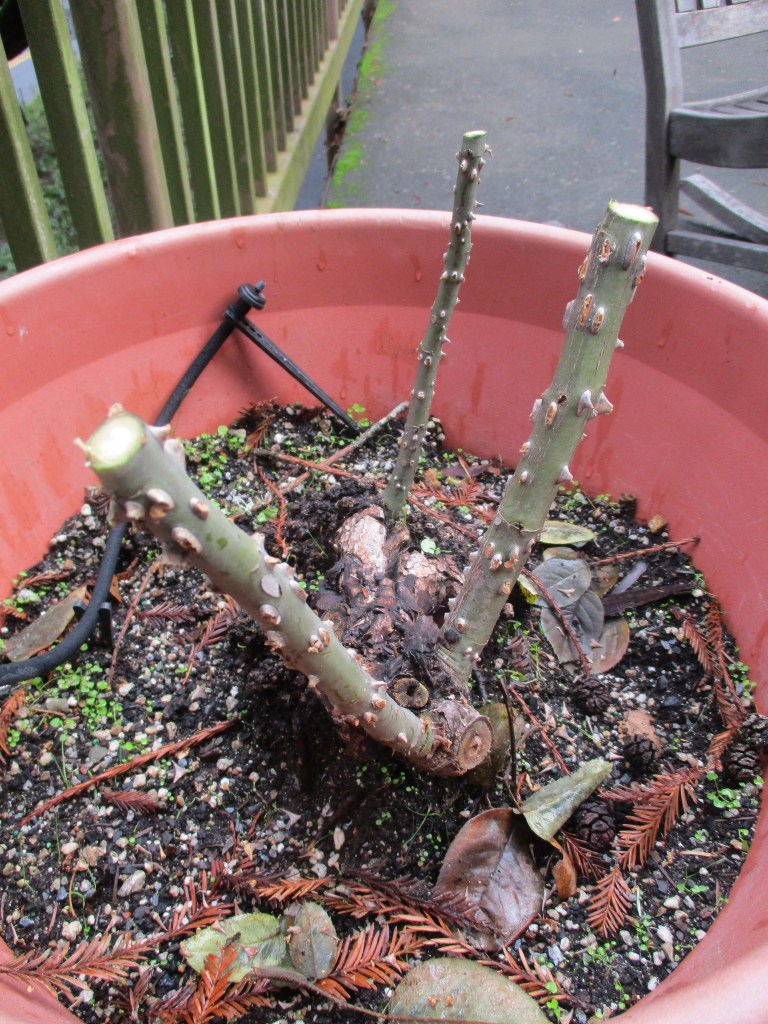
Too much in the garden may be going to pot.

Container gardenin is overrated.

The class of 1985 epitomized the ‘Decade of Decadence’ with the raddest of styles in the wildest of colors. My generation is perhaps more familiar than any other with the pursuit of senseless fads and trends. Now that it is about a quarter of a century later, many of us continue such indulgences in our gardens.

Container gardening has become a fad that, despite its practicality for all sorts of applications, has become so common that it actually makes gardening more work than it should be. Modern homes are built with expansive porches and walkways that are designed to accommodate large urns and other planters, instead of more modest and proportionate porches and walkways that leave more space for planting things in the ground around them. Runoff from the planters stains pavement and rots decking. Besides, all the clutter of planters looks like a garage sale.

For balconies, roof gardens or wherever exposed soil is otherwise unavailable, container gardening may be the only option. Containers also help with plants that need to be moved to sheltered spots during frost. However, few plants are as happy in containers as they would be in the ground. Contrary to popular belief, it is better to amend inferior soil in the ground than to grow plants in potting soil within pots.

Where pots or other containers are necessary, they should either be shaded, or otherwise insulated from the heat of the sun. The black vinyl cans that plants arrive from the nursery in are not only unappealing, but can get warm enough in the sun to roast roots. Yet, they are both obscured and shaded simply by getting placed within slightly larger urns or planters.

Other thin plastic pots can transfer heat like black vinyl, but tend to be cooler because they are most often lighter colors that absorb less heat from sunlight. Thicker materials, such as terracotta, are better insulated. Roots prefer the porosity of unglazed pots, although some glazed pots can stay cooler. Plants within containers are often able to provide their own shade by cascading out over the edges, or spreading out above.

Yet, more substantial plants that provide more substantial shade still need to be complaisant to confinement. Plants that need to disperse their roots will never be comfortable in containers. Neither will plants that are not conducive to pruning, but want to grow into large shrubs or trees.

Anthurium

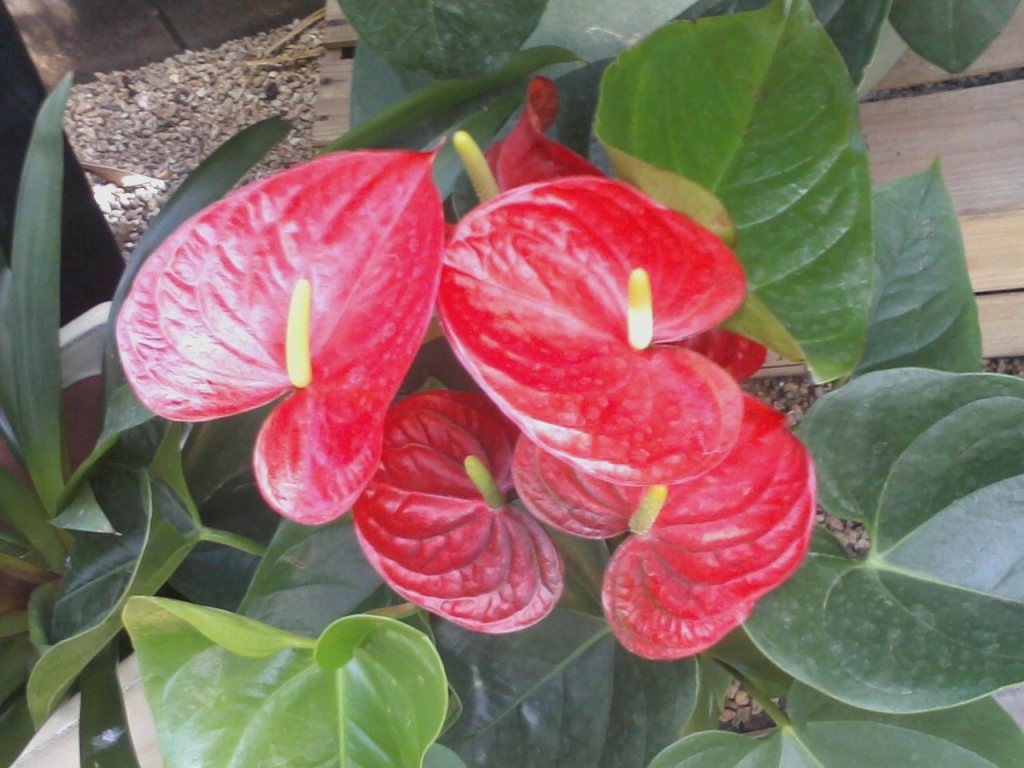
Anthurium seem to be upholstered with vinyl.

The diminutive and indistinguishably dense flowers of Anthurium are surprisingly pathetic relative to the flashiness of the ‘spathe and spadix’ structures that accompany them. The spadix is the generally conical structure that supports and is covered with the flowers. It is most often pale shades of white, yellow or green, but can be pink or purplish. The spathe is the solitary, colorful bract that surrounds the spadix. It is most often white, red or burgundy, but can be orange, pink or pale shades of yellow or green.

There are nearly a thousand known specie of Anthurium. Most but certainly not all have glossy foliage. Leaf shape and size is as variable as flower color. Most Anthurium are terrestrial understory plants that grow below higher canopies of tropical mountain forests of Central and South America. Others are epiphytes that cling to trees, or lithophytes that cling to rock outcroppings.

Around the home, they are mostly grown as houseplants as much for their rich green foliage as for their colorful blooms. In the garden they need shelter from direct sunlight and frost. Blooms, and perhaps other parts, are toxic.

Ponytail Palm

In its native ecosystem, ponytail palm grows as a small tree.

Some succulent plants and their friends do not mind being grown as houseplants. Ponytail palm, Beaucarnea recurvata, is one of those rare friends of succulents that actually prefers to be inside, at least during winter when they can be damaged by cool weather and moisture. Plants that are houseplants through winter and get moved out to the garden through summer should be protected from harsh direct exposure since their foliage is adapted to the home environment. Otherwise, ponytail palm likes the sunniest rooms in the house.

The weird distended caudex at the base of the stem is the most distinctive feature of the ponytail palm, which as actually neither a palm, nor outfitted with ponytails. However, almost like a palm, pruning a solitary top down will likely be fatal. (Pruning the terminal bud off the top of a palm will necessarily be fatal to the affected trunk.) Unlike (solitary) palms, ponytail palm can eventually develop multiple trunks, which can be pruned off if absolutely necessary.

In their natural environment, ponytail palms can get to be shade trees with sparse limbs terminating with tufts of narrow strap shaped leaves. Yet, as slowly growing houseplants confined to containers, they rarely get more than six feet tall after many years. They really need good drainage, and prefer to be watered only about twice to four times monthly.

Irish Moss

Irish moss is darker than Scottish.

It is not actually moss. It is of the same family as carnation. Of course, any distinguishing characteristics of its family are difficult to recognize. Iris moss, Sagina subulata, has such exceptionally fine foliar texture and diminutive bloom. Its slim leaves are not much longer than a quarter of an inch. its tiny white flowers are barely wider than an eighth of an inch.

Irish moss is a luxuriantly dense and richly evergreen ground cover for confined spaces. It works well within small atriums and big pots that contain sculptural plants that lack low foliage. It is a popular accessory for Japanese maple and citrus within tubs. Since it gets no more than two inches deep, Irish moss can fill in between pavers and under benches.

However, Irish moss dislikes how pavement enhances harsh exposure. Although it does not require shade, it appreciates a bit of partial shade while the weather is warmest after noon. Also, it craves somewhat frequent watering to compensate for locally arid warmth. Scottish moss is the cultivar ‘Aurea’. It is lighter chartreuse green, but otherwise identical.

String of Pearls

Weird but elegantly pendulous string of pearls likes to hang around. It cascades nicely from hanging pots or tall urns.

It is difficult to see how string of pearls, Senecio rowleyanus, is related to much more colorful daisies and asters. The small, fuzzy and sickly white flowers are not much to look at, and only clutter the elegantly pendulous and oddly succulent foliage. The round leaves are light bluish green, so actually resemble peas more than they resemble pearls. The stems are so very thin and limber that they can only stand a few inches high, but can cascade to three feet!

Although evergreen, stems of outdoor plants can be cut back while dormant through winter to promote fresher growth in spring. The pruning scraps are very easy to propagate as cuttings. Roots are undemanding and sensitive to rot, so should be allowed to get nearly dry between watering. Bright ambient light without too much direct sun exposure is best. Incidentally, all parts of Senecio rowleyanus are toxic.

Not All Plants Like Fads.

Ornate pots and planters can be as decorative as the plants within them, and provide extra accommodation for more plants.

Like so many fads too often are, container gardening is overrated, and is actually contrary to the currently most faddish of fads; sustainability. Plants in containers need more regular watering than those that can disperse their roots more extensively into the ground. Those that are so indulged also want fertilizer to be applied more regularly, but are more likely to be damaged if fertilized too generously. Because confinement is stressful, plants in containers are innately more susceptible to disease and pests. Some plants need more pruning for confinement.

Then there are the problems with the containers. If exposed to sunlight, thin plastic containers get warm enough to cook roots within. Pots that do not drain adequately or that sit in their own drainage basins can stay saturated enough to kill roots. Water in drainage basins allows mosquitoes to proliferate. Seepage from large pots can rot decks and stain pavement. Self watering containers work nicely for houseplants (if used properly!), but lack drainage, so can not be used out where they are exposed to rain.

The advantages to container gardening are actually quite limited. Containers are obviously needed for houseplants, and where exposed soil is not available, like on balconies. They are also convenient for plants that want better soil than they can get in the garden, especially if the rest of the garden is responsibly landscaped with sustainably undemanding plants that do not require soil amendment or regular watering. Frost sensitive plants can be moved easily to sheltered locations if contained. Flashy plants like orchids and tuberous begonias that get displayed prominently while blooming can be concealed while not so impressive.

Of course there are many pendulous plants like Boston fern, spider plant, string or pearls and burro’s tail that really are at their best in hanging pots. It is also hard to deny that there are all sorts of artsy containers, like colorfully glazed pots and sculptural concrete urns, which are appealing enough to justify growing plants in them, even if just to show off the fun containers. Bonsai requires containers, but that is another big topic!

Some Plants Can Go To Pot.

What ever happened to those poinsettias and cyclamen from last Christmas?

Chrysanthemums, hydrangeas, azaleas, callas, kalanchoes and miniature roses can not really be as happy as they seem to be while in full bloom at the florist counter. Then there are all the seasonal blooming plants like Easter lilies and poinsettias. Wrapped in undraining mylar, often with ribbons and bows, they are actually quite humiliated.

All are forced to bloom in artificial greenhouse environments that are nothing like the home environments that they ultimately go to. As they finish bloom, most get retired directly to the garden where many are unable to adapt quickly and efficiently enough to survive for long. Many do not make it that far, but get sent to the compost or the trash by those who prefer to not prolong their agony.

These potted plants (which are actually known as ‘pot plants’ in the horticultural industries) are not like houseplants, since they are not actually expected to survive for long in the home. They are only expected to perform for a limited time while in bloom.

Adapting to the home environment is not the difficult part. Most potted plants can manage that for a while, but eventually want more sunlight. Hydrangeas, roses, Easter lilies and other deciduous plants also eventually want a cool winter for their dormancy. The problem is adapting to exposure to the sunlight and weather that these plants crave. Foliage can get scorched, frozen or desiccated.

As unsightly as plants can be during transition, most can eventually replace their greenhouse foliage with foliage that is adapted to their new environment in the garden if transitioned slowly and carefully. Large ‘forced’ flowers will eventually be shed or can be pruned off as they deteriorate. The more sensitive types of plants should be moved to a sheltered spot on a porch or in partial shade for a few months before being moved to more exposed spots. Once in the garden, they will want regular watering until their roots disperse.

Deciduous plants and bulbs can stay in the sheltered spot until they defoliate for winter. If put into their permanent location while dormant and bare, their new foliage that emerges in spring will be adapted to the new exposure.

Aloes, Christmas cactus and various other succulents are considerably more resilient and adaptable than the more common potted plants. Both rosemary and small olive trees that have become trendy during the past many years can likewise be adaptable if not kept in the home too long. Olive trees can stay potted indefinitely if pruned regularly, or can go into the garden where there is room to grow. Christmas trees are just as adaptable, but do not want to stay potted for long. Sadly though, most get much too big for home gardens.

Rubber Tree

Big glossy leaves of the familiar rubber tree like a sunny spot in the home, away from sources of heat.

Pruning a rubber tree, Ficus elastica, in the home takes a bit of acrobatics, since any wound immediately bleeds staining white latex. While pruning with one hand, the other hand must catch the latex with a rag. A third hand is needed to catch the bleeding piece of stem that gets pruned away. To make things more complicated, all three hands should avoid the potentially caustic latex. Even if it is harmless to the skin, it is a painful irritant if it gets into the eyes.

Young trees have larger glossy leaves that may be as long as a foot and half as broad, although most are about half as long and broad. Many modern cultivars have variegated or bronzy foliage. Where it gets enough sunlight as a houseplant, rubber tree will eventually need to be pruned for confinement. After all, in the wild, it can get more than a hundred feet tall and almost two hundred feet tall, with trunks more than six feet wide! In the garden, it needs shelter from frost. Aerial roots can develop in humid environments.

Poinsettia

After their distinctive and colorful bracts are gone, poinsettias can become handsome foliar houseplants or tall and lanky blooming shrubbery.

The tiny, yellow buds at the center of poinsettia (Euphorbia pulcherrima) blooms are actually the unimpressive flowers. The colorful red, white, pink or rarely pale orange bracts surrounding these flowers are merely colorful leaves. Some varieties have marbled, blotched or spotted bracts. Compact potted plants that are mostly less than two feet tall and broad can get quite lanky and taller than ten feet in the garden. The dark green leaves are about three to five inches long.