Christmas Leftovers

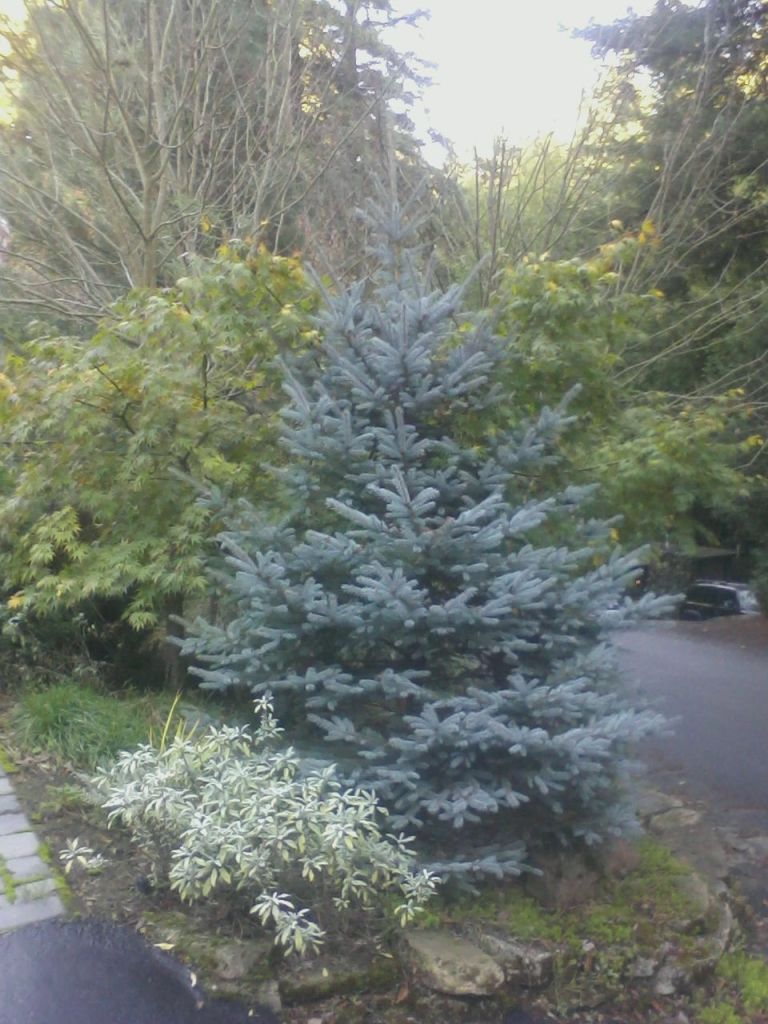
Blue spruce is a good choice for a living Christmas tree, since it can be happy for years in containment.

Just three weeks after Christmas, many of us are already wondering what to do with poinsettias, cyclamens, Christmas cacti, hollies and living Christmas trees. Christmas cacti and hollies are perhaps the easiest of these to accommodate. Christmas cacti do not even need to leave the home as their flowers eventually deteriorate, since they are happy as foliar houseplants or potted on sheltered porches, and with good sun exposure, will bloom annually. Hollies make handsome shrubbery where their prickly foliage will not be a problem. Since some hollies get quite large, and others stay low and compact, it is helpful to know which variety any particular holly plant is.

Cyclamens are popular as cool season bedding plants as well as blooming potted plants. Gardeners typically dispose of those grown as bedding plants as if they were mere annuals. However, they are actually cool season perennials that go dormant through summer. If they are not in the way of warm season annuals in spring, and are among other plants that will cover for them during their dormancy, they can be left in the garden to regenerate and bloom again next winter. Individual potted plants that get too tired to be appealing in the home can be retired to partly shaded shallow ground cover or mixed perennials for a bit of winter color.

Poinsettias are a bit more complicated, which is why so many people simply discard them as they slowly lose their color after Christmas. They can keep their color for many months, and be happy as houseplants, but rarely bloom again in the home once their first bloom is gone. Alternatively, they can be planted into sheltered and partly shaded spots in the garden after frost. Through summer, they develop taller scrawny stems that bloom early in January or so. (Yes, they bloom ‘after’ Christmas.) They are sensitive to frost, so like to be under eaves.

Of all the popular potted plants associated with Christmas, living Christmas trees are the most problematic, not because they are difficult to care for, but because they so often get planted in bad situations. Only the compact conifers, like spruces, junipers and Scots pines, can stay potted to function as Christmas trees for a few years or more. Almost all other pines grow too vigorously to be happy for long in containers. After Christmas, they should instead get their circling roots severed, and then be planted into the garden.

The problem is that most living Christmas trees are Italian stone pines or Canary Island pines, each of which gets much too large for confined garden spaces. If there is not enough space for such a tree to grow to maturity without causing trouble, it best to find another home for it, or to discard it when it outgrows containment.

Chinese Evergreen

With such lush foliage, Chinese evergreen is a bold houseplant alone, and is also quite compatible with all other houseplants.

It is no coincidence that Chinese evergreen, Aglaonema, is perhaps the most common tropical plant for interiorscapes. It is quite easy to care for, and available in so many unique personalities. Many have rich deep green foliage. Most are elegantly variegated with white, silvery gray or gold. Leaf shape is quite variable, although most have rather narrow leaves radiating outward from dense rosettes. Leaves can be half a foot to more than a foot long, and a bit more than an inch to almost six inches wide. Mature plants are at least a foot tall and a foot and a half broad.

Indirect sun exposure or partial shade is best. Chinese evergreen likes humidity, so likes to share sheltered enclosed atriums with other lush foliage plants. New plants are easy to propagate by division.

Tropical plants make a smooth transition as houseplants

Houseplants live outside somewhere.

Hibiscus, bougainvilleas, philodendrons and so many of the tropical and subtropical plants that we can enjoy in our gardens can only survive through winter in greenhouses in most other climates in America. Many of our tropical houseplants though, seem to be the same everywhere. Houseplants are generally grown in our homes not because they can not survive in our gardens, but because they ‘can’ survive in our homes.

Yes, houseplants are merely any plants, tropical or otherwise, that we grow in our houses. Yet, most and perhaps almost all of the plants that are best adapted to surviving as houseplants happen to be tropical plants. Tropicals do not need the seasons that they would get outside. Because many are native to dense and very competitive tropical forest environments, they are adapted to the sort of shade that they get in our homes, and survive on minimal volumes of soil that they have available while potted.

Nonetheless, they miss their tropical lifestyles. They only tolerate dry interior air, but would prefer more humidity. They would likewise prefer to be rinsed of dust more often than they can be in indoors. A regular supply of fresh organic debris to supply nutrients would be nice. However, if merely fertilized instead, tropicals are sensitive to salts and other toxins that eventually accumulate in the soil.

This is why some of the more resilient houseplants like to be brought outside for a gentle rinsing during a mild rain. As long as it is not too cool or windy, gentle rain rinses dust from the foliage and toxins from the soil. Plants can be brought out in the morning and brought in late to get as much time out in the rain as possible, but should not be left out overnight when it may get too cool. Even though they do not need any more moisture, plants can be watered by hose a few times to allow water to rinse freely through the soil.

Plants in overly decomposed potting soil are easier to repot with fresh soil while they are outside. Those that do not need to be repotted might still like getting grungy and potentially toxic mineral deposits scrubbed from their pots and drainage pans.

Burro’s Tail

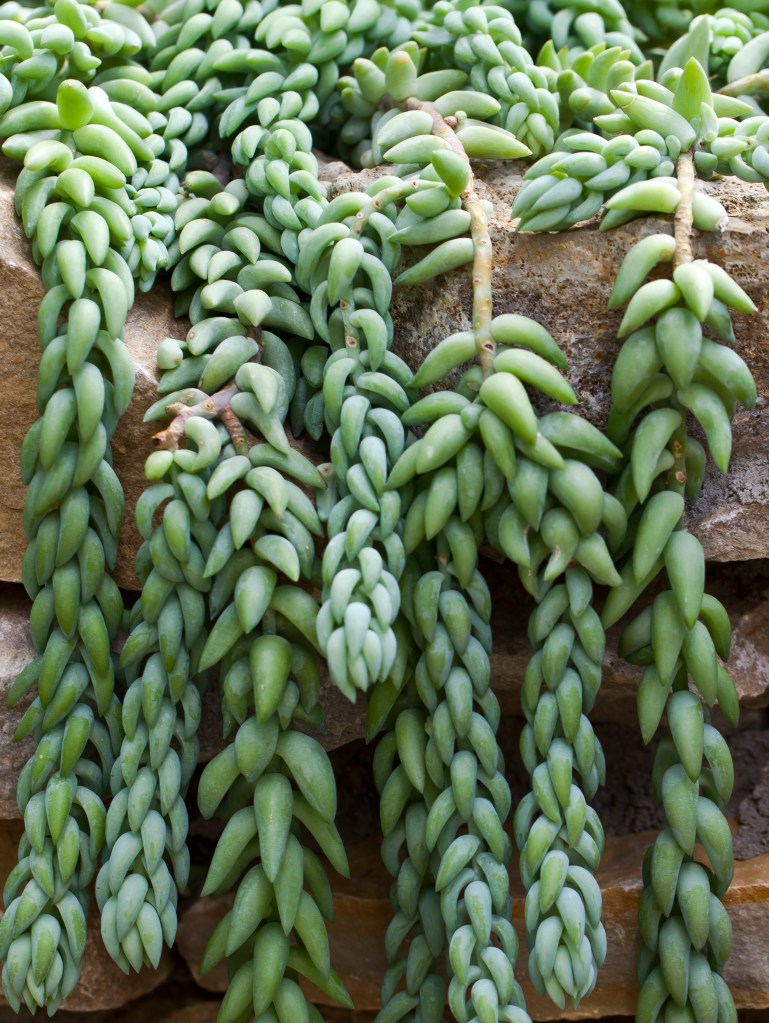
Burro’s Tail is old fashioned, but can also be contemporary.

Back when big spider plants or Boston ferns suspended in fancy beaded macrame were all the rage through the 1970’s, burrow’s tail, Sedum morganianum, was an unusual but also trendy succulent perennial for sunny spots in the home or sheltered and slightly shaded spots in the garden. The refined foliar texture and light bluish green color contrasted nicely with the big and deep green leaves of comparably trendy philodendrons. The thin stems are too limber to stand up, but cascade excellently. Plants in the garden that get pruned back while dormant in winter can easily get two feet long through summer. Without pruning, big plants can get longer than six feet. Pruning scraps and even the small but plump leaves can be rooted and grown into new plants. It is impossible to prune or even move burro’s tail without dislodging some of the leaves anyway. Watering should be regular but not excessive, but then minimal for plants in the garden through winter.

Potted Plants Need Work Too

Most potted plants would prefer to be in the ground, . . . if possible.

Potted plants can be a problem any time of the year. Some want more water than get. Most get too much water or do not drain adequately. Large plants get constricted roots if pots are too small. The roots of some plants get cooked in exposed pots that collect too much heat from sunlight. Besides, too many pots just seem to be in the way in otherwise useful spaces on decks, patios and anywhere else trendsetting landscape designers want to put them.

Now that the weather is getting cool and rainy, potted plants are not as active as they were during warm weather. Many are dormant. Although few demand the attention that they got during warmer weather, plants still need to be tended to appropriately through autumn and winter.

Cool season annuals, which are also known as ‘winter’ annuals, should get groomed as long as they are performing in the garden, just like warm season annuals get groomed through summer. Deteriorating flowers should be plucked from pansy, viola, primrose, Iceland poppy, calendula, dianthus, stock, chrysanthemum and cyclamen because they can mildew and spread mildew to developing flowers and foliage. Unplucked cyclamen and calendula can develop seed which diverts resources from bloom.

Pots that are out in exposed areas will not need to be watered while they get enough water from rain. The problem is that many that do not drain adequately can get too much water from rain and stay saturated. Dormant and defoliated plants do not need much moisture at all. Even evergreen plants do not need as much as they do while active during warm weather, because cool and humid weather inhibits evapotranspiration (evaporation from foliar surfaces).

Potted plants under eaves also need less water while the weather is cool and humid, but need to be watered nonetheless because they are sheltered from rain. Plants in hanging pots typically drain and dry more efficiently, so probably want a bit more water. Even a few sheltered small plants in the ground may occasionally want to be watered during rainy weather if they do not extend enough roots where they can get moisture from rain beyond the sheltered area. Sheltered plants are actually the most likely to be neglected because watering does not seem so important when it is raining.

Angel Wing Begonia

Begonia involucrata at Monte Verde

The simple pink or sometimes red or white flowers of angel wing begonia are not as flashy as those of other begonias, and are not abundant enough to provide much color. During warm weather, they are merely a minor bonus to the striking foliage. As the name implies, the big and angularly lobed leaves are shaped like wings of angels. Upper surfaces are glossy and dark green with irregular silvery spots. Undersides are even glossier and reddish bronze. With support, the lanky cane stems can get more than twelve feet tall. However, because older tall canes produce runty foliage, they are often pruned out to promote more vigorous and lushly foliated young canes.

Because they are sensitive to frost, and also because they are ideal houseplants, angel wing begonias are typically grown in containers. They like rather regular but not excessive watering, and rich potting soil. Abundant sunlight enhances foliar color; but harsh exposure roasts foliage. Partial shade is not a problem.

Not All Plants Like Fads.

Ornate pots and planters can be as decorative as the plants within them, and provide extra accommodation for more plants.

Like so many fads too often are, container gardening is overrated, and is actually contrary to the currently most faddish of fads; sustainability. Plants in containers need more regular watering than those that can disperse their roots more extensively into the ground. Those that are so indulged also want fertilizer to be applied more regularly, but are more likely to be damaged if fertilized too generously. Because confinement is stressful, plants in containers are innately more susceptible to disease and pests. Some plants need more pruning for confinement.

Then there are the problems with the containers. If exposed to sunlight, thin plastic containers get warm enough to cook roots within. Pots that do not drain adequately or that sit in their own drainage basins can stay saturated enough to kill roots. Water in drainage basins allows mosquitoes to proliferate. Seepage from large pots can rot decks and stain pavement. Self watering containers work nicely for houseplants (if used properly!), but lack drainage, so can not be used out where they are exposed to rain.

The advantages to container gardening are actually quite limited. Containers are obviously needed for houseplants, and where exposed soil is not available, like on balconies. They are also convenient for plants that want better soil than they can get in the garden, especially if the rest of the garden is responsibly landscaped with sustainably undemanding plants that do not require soil amendment or regular watering. Frost sensitive plants can be moved easily to sheltered locations if contained. Flashy plants like orchids and tuberous begonias that get displayed prominently while blooming can be concealed while not so impressive.

Of course there are many pendulous plants like Boston fern, spider plant, string or pearls and burro’s tail that really are at their best in hanging pots. It is also hard to deny that there are all sorts of artsy containers, like colorfully glazed pots and sculptural concrete urns, which are appealing enough to justify growing plants in them, even if just to show off the fun containers. Bonsai requires containers, but that is another big topic!

Cyclamen

Autumn is not far behind cyclamen.

The advantage of cyclamen, Cyclamen persicum, is nonconformity. Bloom begins in autumn when there are not many other flowers to provide color, and continues until spring. Cyclamen then defoliate and go dormant through summer while most other plants enjoy the warm weather. Even their red, pink, white, purple or salmon flowers are inside out, with petals flared back. The flowers can stand as high as six inches, just above the somewhat rubbery foliage. The rounded leaves are mostly dark green with silvery or gray marbling

If used as annuals for one season, cyclamen are uniform enough for bedding. However, if later overplanted with warm season annuals and allowed to stay through summer dormancy, regeneration the following season is variable, with larger and smaller plants, and some that do not survive. As perennials, cyclamen therefore work best in mixed plantings, where variety is not a problem. Cyclamen should be planted with their tubers about halfway above the soil level, and should not be mulched. Soil should be rich and drain well.

Japanese Aralia

The bold foliage of Japanese aralia is quite striking, whether kept low and dense, or suspended on taller lanky stems.

It may not grow too rapidly, but Japanese aralia eventually gets nearly eight feet high and wide, and commands a bold presence. The deeply and symmetrically lobed leaves can get as broad as a foot and a half, on long petioles (stalks). The foliage of ‘Vairegata’ emerges with a yellow border that turns pale white. ‘Moseri’ stays quite compact.

Plants grown for their foliage can be maintained by cutting the oldest stems to the ground as they begin to deteriorate, so that newer stems can replace them. Alternatively, lower growth can be pruned away as it develops to elevate the canopy and expose interior stems. However, individual stems do not last indefinitely, and will eventually need to be replaced by any convenient watersprouts.

Houseplant Culture That Contradicts Gardening

Some ferns are popular as houseplants.

Houseplant culture is a unique type of horticulture. It involves almost no gardening. Most houseplants live exclusively indoors. Many inhabit homes and offices that lack gardens. Only a few fortunate sorts get to occasionally enjoy mild weather in home gardens. Such indulgences are generally brief and sheltered. Most houseplants are innately vulnerable. 

Of course, no houseplant is native to domestic situations. Every houseplant lives outside somewhere. Most are from lush tropical rain forests, where they must compete with other foliage for sunlight. Many are understory plants that naturally live within the partial shade of bigger tropical vegetation. That is why they adapt so efficiently to partial shade inside.

That is also why most houseplants actually want to live inside here. They do not like the chill of winter, even if mild. Many or most succumb to minor frost if too exposed. They are simply unaccustomed to it. Since they adapt to shelter and partial shade inside, they are also sensitive to direct sunlight exposure. Foliage that becomes too exposed can scorch. 

Tolerance of weather is as regional for houseplants as it is for garden plants. That is one commonality of gardening and houseplant culture. The various species of Ficus that are common trees in landscapes of Los Angeles are strictly houseplants in San Jose. They tolerate the minor winter chill of Los Angeles, but not the slightly cooler frost of San Jose. 

Some ferns are popular houseplants because, like tropical plants, they generally tolerate partial shade. However, many are less tolerant of the minimal humidity of home interiors. Regular watering can compensate. Irregular watering might be distressful for some ferns. Fortunately, most ferns can recover from brief desiccation, even if their foliage dies back.

Succulents are completely different. The are intolerant of partial shade, and crave sunny and warm situations. They are nonetheless popular for houseplant culture because they generally tolerate minimal humidity. Cacti prefer aridity, and are very susceptible to rot in damp conditions. Succulents wilt to warn before they succumb to deficiency of moisture.