This does not happen often. Actually, it is quite rare, which is one of the consequences of enjoying my horticultural professions a bit too much. I almost never crave travel as I have been lately. Why should I? I live and work in such an excellent region which is excellent for horticulture and just about anything else. It is the sort of region that those who are not here travel to. Furthermore, there is nothing here that I want to get away from. In order to travel, I must first make obligations where I intend to travel to. Then, I can not change my plans for such travel. Even then, some of my obligations are horticultural pursuits, as if I must make work where I intend to go to compensate for my inability to take all of my work with me. I prune apple trees when I go to the Pacific Northwest. I procure regionally rare species where they are more available when I go to the Southwest. While vacationing in the region of Los Angeles last May, I spent a day greeting guests at one of Brent’s three landscapes that were featured on ‘Blooms With a View’, the Spring Garden Tour of View Park and Ladera Heights. I have no such plans anywhere yet. Now that it is late summer, it would be inconvenient to leave here for more than three days anyway. So, why should I so arbitrarily want to travel? I do not know. I suppose that I could go to the region of San Luis Obispo for Monday and Tuesday. I would like to find a pup of the regional variety of Hesperoyucca whipplei spp. whipplei that I first encountered while studying horticulture at Cal Poly there. But of course, I need no excuse to travel.
Electrical cables are hazardous! There is no need to elaborate. That is why high voltage electrical cables are either subterranean or aerial. Subterranean electrical cables remain safely out of reach underground. Aerial electrical cables remain safely out of reach about thirty feet above ground. However, electricity is always dangerous regardless of location.
Excavation can inadvertently expose subterranean electrical cables. Pruning large trees can similarly involve minimal proximity to aerial electrical cables. Home gardening rarely involves such deep excavation. However, it commonly involves arboriculture, or pruning, of big trees. When it does, the most eager of garden enthusiasts must know their limits.
Clearance pruning eliminates obstructive vegetation. Ideally, it prevents it from becoming obstructive before it does so. It is useful for roadways, walkways and chimneys, and also protects roofs from damage. Yet, it sometimes necessitates the service of professionals. For example, pruning trees over major roadways is likely too hazardous for anyone else.
Pruning trees over high voltage electrical cables is even more hazardous. However, it is also necessary. That is why electrical service providers employ professionals to perform such tasks. Unfortunately, proper arboricultural technique is not a priority. Reliability and safety of electrical service are. It is efficient, but can severely damage any involved trees.
What is worse is that such damage is also dangerously close to utility cables. Corrective procedures also require the services of specialized arborists. Utility service providers do not assume any associated expenses. Removal might be more practical than salvage for the most severely mutilated trees. Salvage of decapitated palm tree trunks is impossible.
Selection of appropriate trees can limit such problems in the future. With few exceptions, palms are inappropriate within aerial utility easements. Almost all grow only upward with solitary terminal buds. Conversely, some large shrubbery is conducive to pruning to stay lower than cables. So are a few compact trees. Several stay lower than cables naturally.
Proper pruning enhances performance rather than compromise it.
If gardeners can reach it, they will most likely shear it. They do not mind if it was intended to be a shade tree, a flowering shrub or even a sculptural succulent. Few will take the time to prune and groom properly. Ironically, formal hedges that actually need to be shorn are rarely shorn properly!
Most of us fortunately are not gardeners, but merely enjoy our gardens. We know the importance of proper pruning, and that various plants need different pruning techniques. The main difficulty is determining which techniques are best for each type of plant in our gardens.
Shearing is primarily for hedges; which by the way, should be slightly narrower up high, and slightly wider down low in order to optimize sun exposure to all parts. Generally, plants that are grown for their flowers, fruit or natural form should not be shorn regularly.
Fruit trees and modern roses need the most specialized pruning while dormant in winter, so are not recommended for ‘low maintenance’ gardening. Their specialized pruning thins out superfluous growth, concentrating resources for fruit and flower production. Pruning also removes suckers (from below graft unions) and the ‘four Ds’; which are Diseased, Damaged, Dying and Dead stems.
Most trees eventually need some sort of pruning to direct their growth. Limbs that are too low need to be pruned away to maintain adequate clearance from roadways, sidewalks, chimneys, roofs and anything else that they should keep their distance from. Lighting, road signs and views from cars coming out of driveways should not be obstructed. As larger trees mature, they eventually need the attention of professional arborists to maintain their health, stability and structural integrity.
Small trees like Japanese maple, Hollywood juniper and pineapple guava look much better with selective pruning and thinning to expose their natural forms. If they become obtrusive, such trees are very often pruned back for confinement. They should instead be pruned to direct their growth up and out of the way, so that lower obtrusive stems get removed, and upper growth can develop naturally.
Nandina, abelia, various bamboos, old fashioned lilac and other plants that produce new stems from the ground benefit from another type of thinning known as ‘alternating canes’. This involves cutting older canes to the ground as they begin to deteriorate or become overgrown. Alternating canes without any other pruning allows nandina to keep its distinctive foliar texture, and abelia to develop its distinctive arching branch structure.
The San Jose Heritage Rose Garden is the most complete collection of ancestral roses in the World!
(This article is recycled from several years ago, so information about events is now outdated.)
No matter how careful I am to avoid spending any money at Spring in Guadalupe Gardens, I have never escaped without purchasing something, or a few or even several somethings that I did not need but really wanted for my garden. My plunder was relatively meager this year, but did include three climbing roses from Liggett’s Rose Nursery.
One is a ‘Renae’ rose that blooms all summer with remarkably fragrant pale pink blooms. Its fragrance is so obnoxiously strong though; that I gave the plant to my neighbor, and told him that it ‘smells good’. It really does smell good, albeit from a distance, such as in my garden.
The other two roses are ‘Lamarque’, with abundant fluffy white blossoms all summer. The robust fragrance is fortunately more tolerable. I really like the monstrous canes that are already reaching out to cover a bare embankment.
The two ‘Lamarque’ roses are manageable so far. I really do not know how manageable they will be next year though. It would be nice if they could go wild, and only get pruned as they encroach into trees and the driveway. However, roses perform best if properly maintained. I will want to be able to prune off deteriorating flowers to promote subsequent bloom. This process of ‘dead heading’ will not be so easy if I can not reach all the canes.
The Heritage Rose Garden has a similar challenge. Although most of the plants are within reach of anyone wanting to prune them, there are simply too many plants for a herd of goats to remove all the spent blooms from. Since goats are not such a feasible option in a rose garden, volunteers are invited to attend a Rose Deadheading Blitz from 5:00 to 7:30 p.m. every second Tuesday of each month, beginning June 8 and continuing until September 7.
No experience is needed, either for deadheading the roses or for swilling the ice cream served afterward. Volunteers should bring shears and gloves, and wear closed-toe shoes. Shears are available from the staff if necessary.
The Heritage Rose Garden is located on Taylor Street at Spring Street, just east of Coleman Avenue in San Jose. Volunteers can get more information or sign up by contacting Volunteer Coordinator, Lucy Perez by telephone at 298 7657 or by email at lperez@grpg.org.
My bounty from Spring in Guadalupe Gardens of past years includes many succulents, particularly a few specie of Crassula that were frozen by frost early last winter. Their recovery has been delayed by the lingering cool and rainy weather through spring. Now that I am removing the last of the sludge that remains from the previously frozen leaves and stems, I am finding where snails have been hiding and breeding. Even though the sludge is harmless, the snails within are not. I probably should have cleaned it out earlier.
Foliage of fruit trees, roses or other plants that has been infected with peach leaf curl, powdery mildew or any other disease should likewise be removed and disposed of. Either next spring or later this year, secondary infection is much more likely without sanitation.
Pruning techniques are very diverse to serve various purposes. Dormant pruning during winter concentrates resources for spring or summer growth. Hedging or shearing merely contains growth. Thinning or grooming removes superfluous growth to enhance sunlight diffusion. Clearance pruning directs new growth that might otherwise become obtrusive.
There are too many distinct pruning techniques to mention. Some, such as shearing and thinning, are mutually exclusive. Shearing actually initiates the sort of congested growth that thinning eliminates. Techniques such as dormant pruning and clearance pruning are mutually compatible. After all, almost all pruning is less stressful with winter dormancy.
Clearance pruning merely becomes a concern now as spring growth becomes obtrusive. Much of the worst require professional assistance. Only arboricultural professionals can safely prune trees away from high voltage cables. Such cables are extremely hazardous! Utility services generally try to arrange such procedures before major problems develop.
However, arboricultural professionals are necessary for other clearance pruning as well. Many trees are simply too large or hazardous for anyone but professionals. Some extend over roadways that need clearance for the largest of trucks. Some extend over chimneys that could ignite vegetation that gets too close. Many simply extend beyond a safe reach.
Street trees seem to require the most clearance pruning. They must be a specified height over any roadway, as well as over any sidewalk. Also, they must not obstruct street signs or views for cars backing out of driveways. Ideally, their interference with light from street lamps should be minimal. Vegetation that is closer to buildings presents other concerns.
Besides chimneys and exhaust vents, roofs also need clearance. Stems and foliage are abrasive as they move in any wind. They collect debris that causes rot and clogs gutters. Furthermore, walkways and navigable areas are more efficient with adequate clearance. Clearance pruning should direct growth away from any obstruction, rather than contain it.
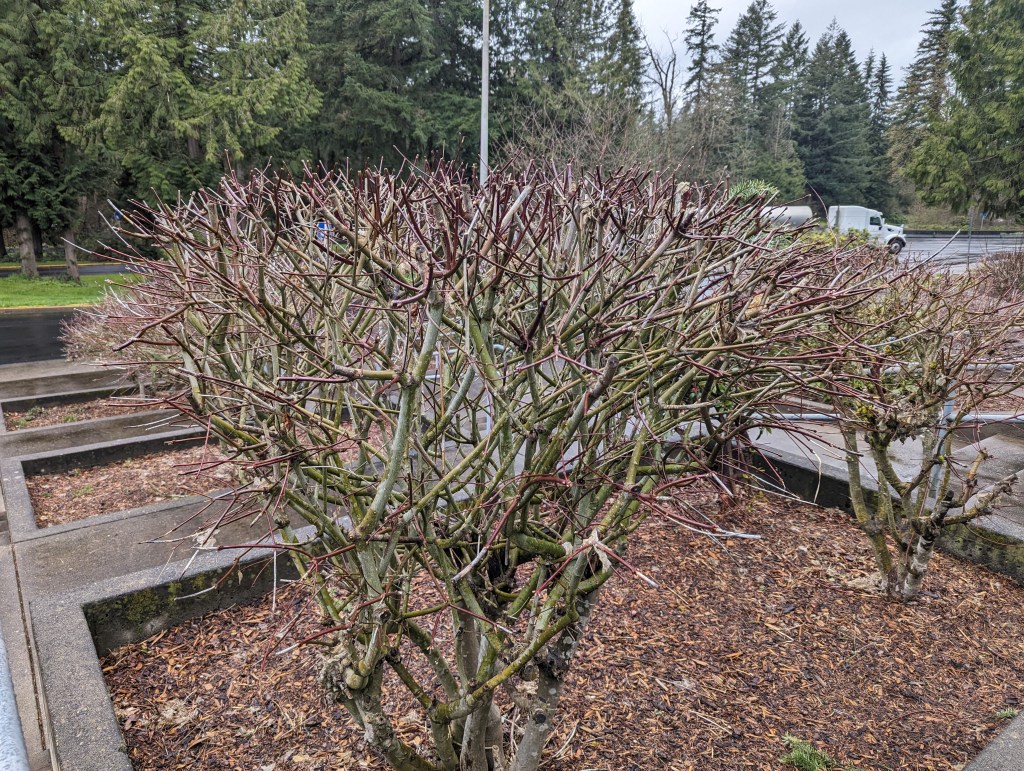
Vine maples should be small trees, not . . . this.
In the short time it took me to run to the back yard to get some big stakes and something to pound them into the ground with, the unfortunate deed had been done. I had come home to find that one of my neighbor’s new Canary Island pine trees had blown down. I also noticed that the gardeners were there; so I wanted to get the tree staked properly before the gardeners got to it. Sadly, as I returned with stakes, ties and a mallet, I found that the gardeners were faster. Instead of standing the small tree up and staking it, they had already shorn the formerly well structured canopy into a globular mound that was about the same size and shape as most other items throughout the landscape, for no other reason than it was within their reach.
This same landscape had egg shaped African iris ‘bushes’ that only rarely bloomed if they happened to get an errant flower stalk out between shearings, and short, round trumpet vine ‘bushes’ in front of hefty but bare trellises that they were never allowed to climb. Everything that was within reach was shorn, even the underside of an elegant Chinese elm that really should have been pruned properly by an arborist. The landscape was actually well designed, but could not perform as planned because of the shear abuse.
I really do not mind proper shearing of particular shrubbery that is intended to be shorn. I actually like old fashioned privet or boxwood hedges. However, even hedges need to be shorn properly; and realistically, not much else should be shorn as often. If it needs to be shorn regularly, but is not a hedge, it is probably not the right plant material for the job.
Properly selected plant material is proportionate to its particular application. This certainly does not mean that it does not need to be pruned. Most deciduous fruit trees and roses need to be pruned aggressively every winter, and almost all plant material needs to be pruned in some manner at one time or another. The difference is that shearing is indiscriminate pruning of outer growth without regard for foliage, bloom or branch structure. This is fine for hedges, but disfigures many other plants, and deprives them of their blooms and natural foliar textures that they were planted for.
For example, wisteria is an abundantly blooming robust vine that becomes a gnarled shrub that cannot bloom if shorn. Heavenly bamboo (nandina) is grown for its graceful and colorful foliage, but becomes a grungy rigid thicket of tattered leaves and stems with shearing. Although some shrubby junipers can make nice low hedges, frequent shearing deprives them of their feathery texture.
This is why it is so important to know what the various plants in the garden need. They can only perform as intended with the proper care and maintenance, which includes proper pruning. Hedges may only need to be properly shorn, but almost everything else needs to be selectively pruned, thinned, elevated (raised), divided, groomed, trimmed, trained or even cut back.
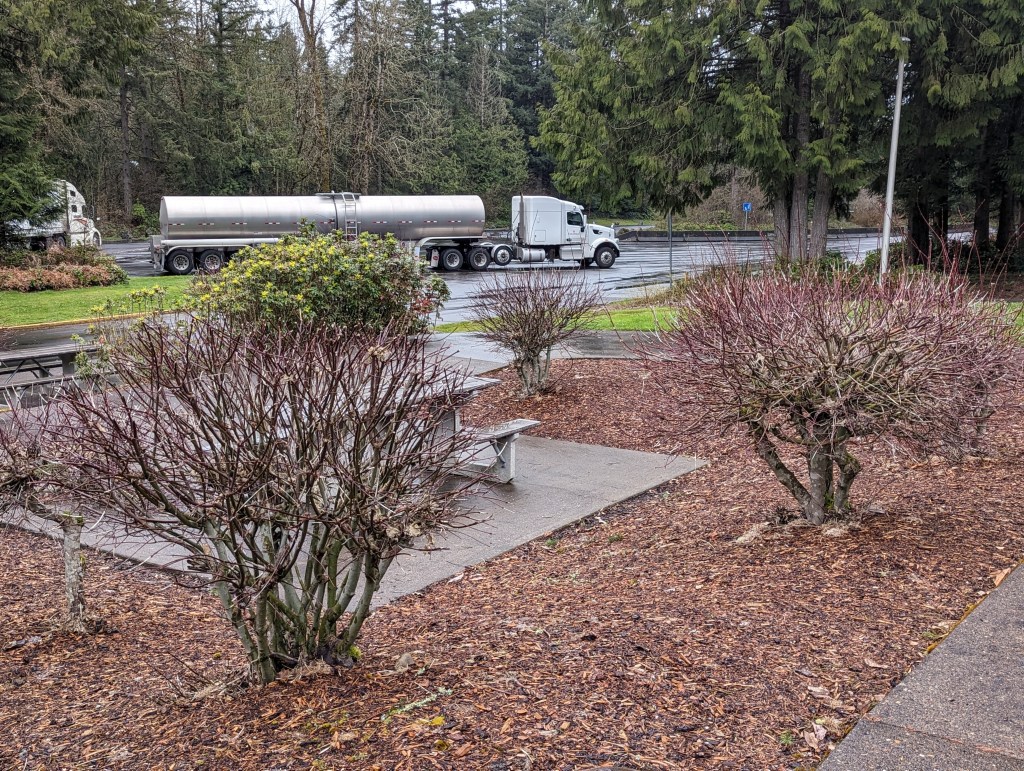
This is no simple hack job. Someone or a few someones put a great deal of effort into this very thorough hack job. This took significantly more effort than would have been needed to do it properly. Seriously, proper pruning would have been much easier, and much healthier to this victimized vegetation. In the future, this vegetation would have needed much less maintenance. Furthermore, this is more than visually unappealing. It is downright unsightly. Removal of such disfigured shrubbery would be an improvement, even without replacement. As the illustration below demonstrates, this is not merely a single specimen. It is an entire herd of brutally disfigured shrubs. How did someone determine that this was the right thing to do?!
This mangled shrubbery is vine maple, Acer circinatum, which is native to the Pacific Northwest where I got these pictures. I actually like this particular species because it can perform similarly to Japanese maple, but is not Japanese maple, which I am not at all keen on. Part of my dislike of Japanese maple is the result of working with so many that were ruined like these vine maples were. Vine maple is more tolerable to me because it is too rare here at home for me to encounter any that are ruined like these. This is a first for me. Perhaps that is why it was more difficult to ignore than the countless similarly ruined Japanese maples that I do not need to work with, but see around town.
I can not help but wonder what these vine maples would look like if they had developed somewhat natural form with only significant pruning for clearance above the adjacent pavement, perhaps with minor pruning to limit congestion within their canopies.. Would they resemble mature Japanese maples with extra trunks by now?
Rhody and his Roady, . . . still waiting to leave.
This article is scheduled to post at midnight between March 19 and March 20, which is precisely when we were scheduled to leave for the Pacific Northwest. We were supposed to arrive on the Kitsap Peninsula late in the afternoon, and likely continue to the coast the following morning. Now, we will not leave until midnight between Sunday, March 24 and Monday, March 25. I know that it is only five days later, but it changes the entire schedule. I should still be there in time to prune the apple trees prior to bloom. I do not know when we will return now, but it will likely be about Thursday, April 4.
Then, two and a half weeks later, we leave again for eleven days in Beverly Hills in Los Angeles County, and Buckeye near Phoenix in Arizona. That would involve leaving Wednesday, April 24, and returning on Saturday, May 4. That should be before the weather gets too warm in Arizona to prune the mesquite trees there comfortably. I suppose that the second trip does not necessarily need to be delayed just because the first trip was. We could still leave on Wednesday, April 17 and return on Saturday, April 27 as originally planned, even if that leaves less time between the two trips. Perhaps I should not worry about this until we return from the first trip!
This seems to happen annually. Regardless of how intent I am on leaving on time, we encounter a delay of some sort of another. Ultimately, we leave at about the same time annually, but only after planning to leave about a week earlier, just as we planned for the previous few years. I can not complain, of course, since the delay is justified, but that is another topic for another post.
Actually, this blood was not contributed by someone else. No one else was involved. Perhaps that was the problem.
I can not sharpen blades. I tried for a long time years ago, before eventually realizing that it would be best to rely on someone else to sharpen my blades. Those who know how to do it make it seem so easy. I have no idea how they do it so well, but I know that they do because it is how my blades get sharpened. It is an enviable ability.
Well, I neglected to get someone to sharpen my blades for a very long time. Naturally, my overused and worn pruning shears are beyond mildly dull. As most of us know, “A dull blade is more dangerous than a sharp blade.”.
The blade did not cause this damage directly. As I wrestled with the dull shears, they unexpectedly slipped past the stem that I was cutting so suddenly that I bashed my thumb against the accordingly damaged latch on the opposing handle. The injury was not bad; but I was too annoyed by it to stop what I was doing, which is why the blood continued to get messy.
I only took this picture so that I could later brag about rescuing a school bus full of Girl Scouts from an attacking polar bear, or something like that. I just have not gotten around to doing so yet. It might have been a grizzly bear.
Because these particular pruning shears are so worn, with a broken latch and a chipped blade, they really should be replaced rather than sharpened. They are the cheapie sort that can not be repaired. The blade can not be replaced. They performed exemplarily longer than they should have.
This is why arborists wear hard hats. It is more than eight feet tall. I do not know how much of it extends into the wet sand. Nor do I know how much it weighs. It might have fallen from about twenty-five feet up. I do not know how far the pole saw that it was plucked down with was extended. Even with a hard hat, this would have been potentially very dangerous. I am glad that it is now on the ground, or will be when it falls over.
Nature is naturally hazardous. We try to make some of it safer. We can not eliminate all hazards though. Some, like this one before it fell, are not obviously hazardous. Some are not visible from the ground. As frequently as some hazards are eliminated, others are developing. Trees are always growing and shedding limbs that get shaded out. Old trees are always dying and deteriorating. It never ends.
The alder that dropped this necrotic limb took quite a beating when the creek flooded last winter. Water was higher than this broken limb now stands. Massive trunks of trees that fell upstream floated through here, battering any tree trunks that they encountered, including the trunk of the tree that dropped this limb, which is now at the edge of the water at its current depth. Such pummelling should have dislodged such decayed limbs. Perhaps this limb was not so decayed last winter, and therefore more firmly attached.
The intention of the minor tree work that was done in this area was merely to neaten the scenery a bit. Hazards such as this were not a consideration, since the trees appeared to be reasonably safe, and because they are located on the bank of a creek where no one else goes.