Rhody and his Roady, . . . still waiting to leave.
This article is scheduled to post at midnight between March 19 and March 20, which is precisely when we were scheduled to leave for the Pacific Northwest. We were supposed to arrive on the Kitsap Peninsula late in the afternoon, and likely continue to the coast the following morning. Now, we will not leave until midnight between Sunday, March 24 and Monday, March 25. I know that it is only five days later, but it changes the entire schedule. I should still be there in time to prune the apple trees prior to bloom. I do not know when we will return now, but it will likely be about Thursday, April 4.
Then, two and a half weeks later, we leave again for eleven days in Beverly Hills in Los Angeles County, and Buckeye near Phoenix in Arizona. That would involve leaving Wednesday, April 24, and returning on Saturday, May 4. That should be before the weather gets too warm in Arizona to prune the mesquite trees there comfortably. I suppose that the second trip does not necessarily need to be delayed just because the first trip was. We could still leave on Wednesday, April 17 and return on Saturday, April 27 as originally planned, even if that leaves less time between the two trips. Perhaps I should not worry about this until we return from the first trip!
This seems to happen annually. Regardless of how intent I am on leaving on time, we encounter a delay of some sort of another. Ultimately, we leave at about the same time annually, but only after planning to leave about a week earlier, just as we planned for the previous few years. I can not complain, of course, since the delay is justified, but that is another topic for another post.
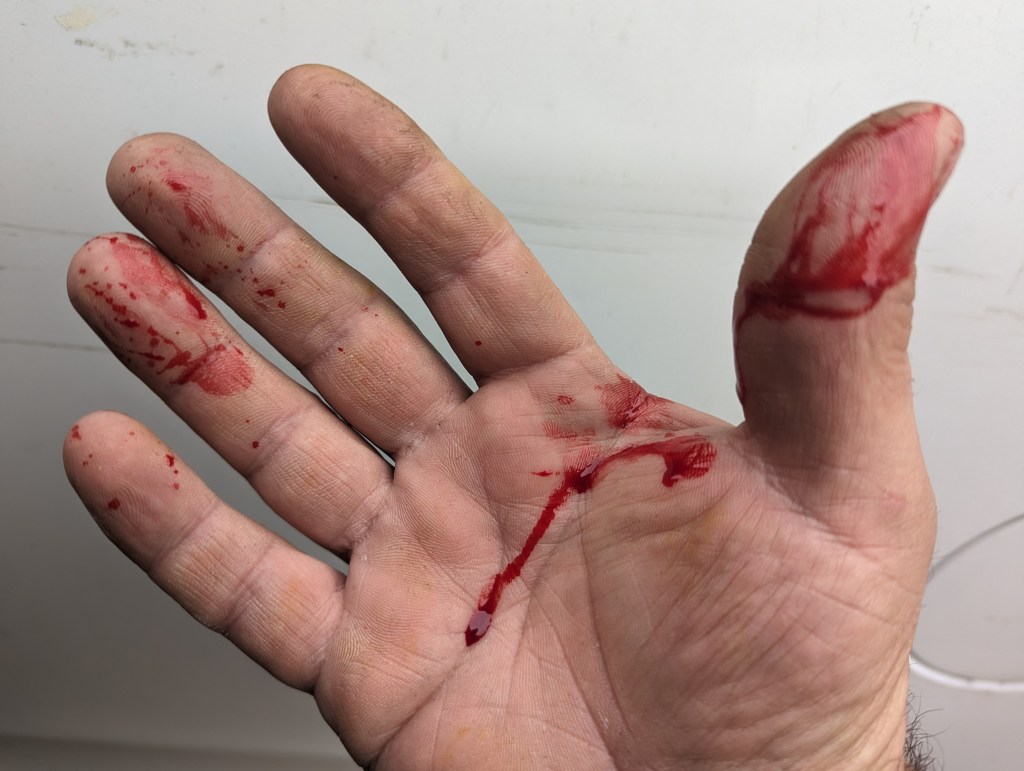
Actually, this blood was not contributed by someone else. No one else was involved. Perhaps that was the problem.
I can not sharpen blades. I tried for a long time years ago, before eventually realizing that it would be best to rely on someone else to sharpen my blades. Those who know how to do it make it seem so easy. I have no idea how they do it so well, but I know that they do because it is how my blades get sharpened. It is an enviable ability.
Well, I neglected to get someone to sharpen my blades for a very long time. Naturally, my overused and worn pruning shears are beyond mildly dull. As most of us know, “A dull blade is more dangerous than a sharp blade.”.
The blade did not cause this damage directly. As I wrestled with the dull shears, they unexpectedly slipped past the stem that I was cutting so suddenly that I bashed my thumb against the accordingly damaged latch on the opposing handle. The injury was not bad; but I was too annoyed by it to stop what I was doing, which is why the blood continued to get messy.
I only took this picture so that I could later brag about rescuing a school bus full of Girl Scouts from an attacking polar bear, or something like that. I just have not gotten around to doing so yet. It might have been a grizzly bear.
Because these particular pruning shears are so worn, with a broken latch and a chipped blade, they really should be replaced rather than sharpened. They are the cheapie sort that can not be repaired. The blade can not be replaced. They performed exemplarily longer than they should have.
This is why arborists wear hard hats. It is more than eight feet tall. I do not know how much of it extends into the wet sand. Nor do I know how much it weighs. It might have fallen from about twenty-five feet up. I do not know how far the pole saw that it was plucked down with was extended. Even with a hard hat, this would have been potentially very dangerous. I am glad that it is now on the ground, or will be when it falls over.
Nature is naturally hazardous. We try to make some of it safer. We can not eliminate all hazards though. Some, like this one before it fell, are not obviously hazardous. Some are not visible from the ground. As frequently as some hazards are eliminated, others are developing. Trees are always growing and shedding limbs that get shaded out. Old trees are always dying and deteriorating. It never ends.
The alder that dropped this necrotic limb took quite a beating when the creek flooded last winter. Water was higher than this broken limb now stands. Massive trunks of trees that fell upstream floated through here, battering any tree trunks that they encountered, including the trunk of the tree that dropped this limb, which is now at the edge of the water at its current depth. Such pummelling should have dislodged such decayed limbs. Perhaps this limb was not so decayed last winter, and therefore more firmly attached.
The intention of the minor tree work that was done in this area was merely to neaten the scenery a bit. Hazards such as this were not a consideration, since the trees appeared to be reasonably safe, and because they are located on the bank of a creek where no one else goes.
Like these dormant fruit trees, raspberry canes should go into the garden during bare root season.
My grandmother would have gotten better results by sending me out to the garden for zucchini. She should have known better than to send me out for raspberries. I could have brought in as many zucchini as she wanted in a short while. With raspberries though, I was gone too long, and returned with meager spoils and diminished appetite.
Neither raspberries nor zucchini will be exploitable for a few more months. Raspberries though, can get planted about now. Also, established raspberry canes should be pruned about now to promote abundant production later. Just like most deciduous fruit trees and blackberries, raspberries are not ‘low maintenance’, and require intensive specialized pruning.
New bare root plants should be spaced about two to three feet apart and mulched to insulate the soil until they develop enough foliage to shade their own roots. Their canes can then be cut back so that only a single bud is visible above ground. Because raspberries spread, root barriers are sometimes useful to keep them out of neighbors’ gardens.
Through summer, new plants should produce three or more new canes. These canes should be able to support themselves, but are less rampant if tied to a trellis or wire. I like to train them onto a fence like grapevines, because there are not many other uses for a fence.
The more popular everbearing cultivars like Heritage, September, Summit, Golden Summit and Fallgold may develop fruit on the tops of their new canes during their first autumn. During the following winter, the tops of the canes should be cut back as far down as fruit developed. The remaining lower portions of their canes that did not develop fruit in the first year will do so during their second summer, and should get pruned out as they finish producing.
At about the same time, about five to ten of the best new canes should be selected, and trained if desired. Superfluous canes should be cut to the ground. Like their predecessors, the remaining selected canes should fruit on top during autumn, get pruned in winter, and fruit again during the following summer before getting pruned out. This process should be repeated annually.
Summer bearing cultivars like Willamette, Canby and Tulameen should not fruit in their first year, and should be pruned to about five feet tall during the following winter. Every subsequent summer, many new canes emerge as the older canes bloom and fruit. Every subsequent winter, about five to ten of these new canes should be selected, tied to support if desired, and pruned to about five feet tall, as all spent canes and superfluous new canes get cut to the ground.
Black and purple raspberries are shrubbier, so get pruned differently than the more traditional red and yellow raspberries do. During their first summer, canes should be pruned back to about two feet to promote branching. All except about six or seven of the best of these canes should be removed over winter. The side branches of the selected canes of black raspberries should then get pruned to about half a foot long. Side branches of purple raspberries can be twice as long. After these canes finish fruiting during the following summer, they should be cut to the ground. New canes can then be pruned like during the first summer so that the process can be repeated annually.
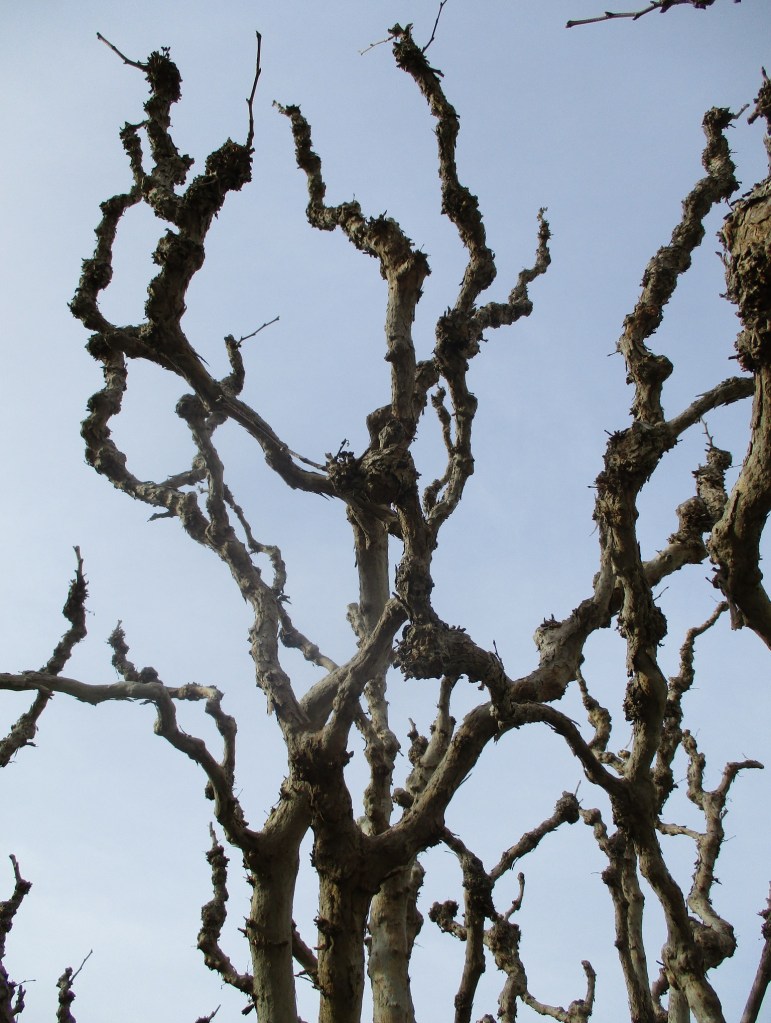
This is extreme dormant pruning. Pollard and coppice pruning involve complete removal of all new growth. They typically involve growth from a previous season annually. A two year cycle involves growth from two previous seasons, and so on. This repetitive pruning to the same origins stimulates distended callus growth there. It is as brutal as it sounds.
This is why pollard and coppice pruning are vilified in America. The techniques evolved through centuries of horticulture and several cultures. Both are still practical for various reasons everywhere else. However, American arboriculture classifies them as topping or disfigurement. Consequently, very few arborists here know how or want to do it properly.
Like other dormant pruning, pollard and coppice pruning must happen during winter. It is too severe for active vegetation. Also, pollard pruning exposes bark of trunks and limbs. Such bark would scald during sunnier summer weather. Growth from distended callus growth, or knuckles, shades lower stems by summer. It is very vigorous through spring.
That is what pollard and coppice pruning is still useful for within other cultures. Vigorous foliage is useful for fodder for livestock, including silkworms. Vigorous stems are useful for kindling and basketry. Some species bloom more vigorously on vigorous new growth. Others can not bloom to produce unwanted pollen or messy fruit within the same year.
Colorful or variegated foliage is more colorful in response to pollard or coppice pruning. Some eucalypti generate juvenile foliage for floral design. Such foliage is more aromatic than adult foliage. Improved foliar vigor enhances resistance to some diseases, such as mildew and rust. Coppicing can renovate some types of overgrown or shabby shrubbery.
The difference between pollard and coppice pruning is that pollard pruning retains limbs. Coppice pruning retains only a stump near grade. It is less reliant on repetition, and may never need it again. Pollard pruning compromises structural integrity, which necessitates repetition. Otherwise, pruning to restore structure will eventually become necessary. Not many species are receptive to such extreme pruning techniques.
Pollarding and coppicing are very unfortunately vilified here. I just wrote an article about these topics for the gardening column. Arborists are taught that they are comparable to topping, and that they cause irreparable disfigurement.
It is unfortunate because both procedures have very practical application. Both are still commonly practiced in other regions. If performed properly, both are quite sustainable, and can actually maintain some specimens of a few species longer than they typically live naturally. I use both techniques to a minor degree at work, and will likely do more of both within my home garden.
However, I almost never recommend either technique. Because they are so vilified, arborists do not learn about them. Consequently, it is nearly impossible to find an arborist who can perform either technique properly. Trees and shrubbery can very easily be ruined by either technique if performed improperly.
In fact, I am hesitant to allow reliance on pollarding and coppicing by trees and shrubbery at work because I am concerned that no one else will want to repeat the processes after my retirement or resignation, which could be at any time. Coppicing carpet roses should be no problem for whomever performs it in the future, but I can not be certain. Pollarding is a bit more specialized, so concerns me more.
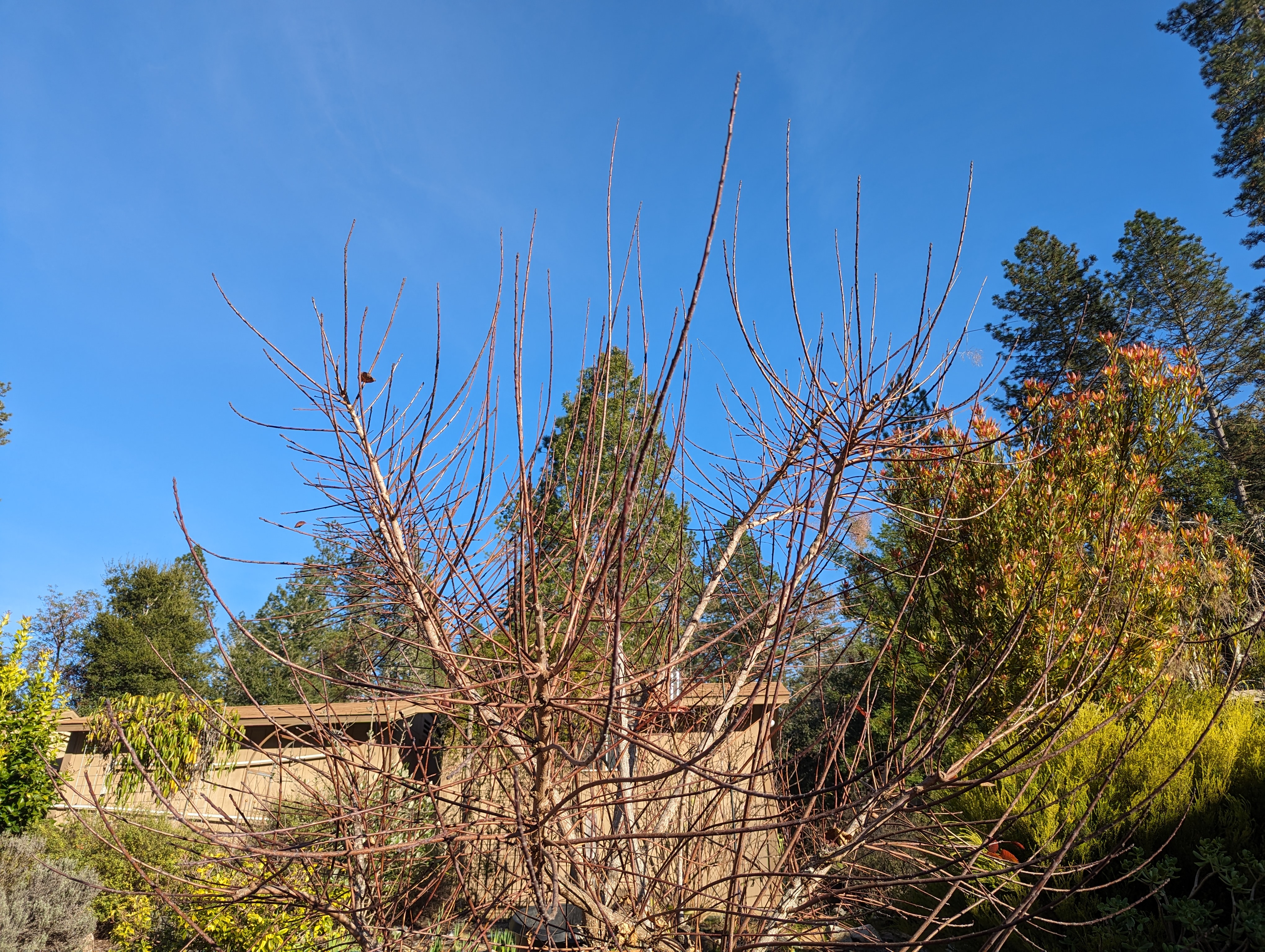
This smoke tree was initially pollarded for renovation. It was previously distressed and weak, but is now quite vigorous. Its purple foliar color is more vibrant through summer. So is its autumn foliar color. I previously believed that it bloomed only on year old stems, so would be unable to bloom on exclusively new canes after being pollarded. Instead, it blooms better on vigorous new stems that it on distressed year old stems.
It is not forming knuckles though. New stems emerge from all over the permanent stems, so leave pruning wounds that do not compartmentalize as efficiently as they would on knuckles. Also, without terminal knuckles, some permanent stems die back an inch or two annually. Although pollarding successfully renovated this smoke tree, it is not as sustainable as I would like it to be.
So, because the procedure is not sustainable for this particular specimen for very long, and I suspect that no one will want to repeat the process annually in the future, I will likely encourage more natural form. I left a few extra new canes for this year. For next year, the twiggy interior growth may be thinned, while upper and outer growth is allowed to develop into a more permanent canopy.
(This article is recycled from 2010, so includes outdated information. It is deferred from yesterday because Wi-Fi was not operational.)
Deciduous fruit trees require very specialized pruning.
So many of the kids I grew up with now have an apricot tree in their own back yard, even though not many of us actually like the fruit. We all remember the remnant orchards, mostly apricots, which were scattered about the Santa Clara Valley when we were young. We also remember how we consumed vast volumes of apricots in every form imaginable; including fresh, dried, canned and stewed, and in jams, jellies, compotes, syrups and pies. I could go on, but it would ruin my appetite.
Deciduous fruit and nut trees are certainly not ‘low maintenance’. Most need to be pruned annually, while dormant in winter. If not pruned correctly, they become overburdened with their own fruit. Also, the process of selecting from the many different cultivars of the many different types of fruit is quite a chore. There are many more cultivars to choose from for home gardens than for orchards, particularly with the many modern cultivars introduced during the past few decades.
Because those who maintained the orchards are now as nearly extinct from the Valley as the orchards are, we need to know how to care for our own trees. This is why Friends of Guadalupe River Park and Gardens has scheduled the Dormant Fruit Tree Pruning Class with Sean McGrail in only a few days, on January 23, from 9:30 to 11:30 a.m.. Tools, techniques and basic pruning concepts will be explained and demonstrated among the many fruit trees, including apricots, cherries, prunes, apples and others, of the Historic Orchard of Guadalupe Gardens. Participants will then get to participate in pruning some of these trees. The Historic Orchard is located just south of Taylor Street in San Jose, adjacent to the Guadalupe River Park Trails. Admission is $15.
A week later, on January 30 from 9:00 a.m. to noon, the Best of the Best class, also with Sean McGrail, as well as Nancy Garrison and the California Rare Fruit Growers, will discuss many of the best fruit cultivars for the Santa Clara Valley. Afterward, planting, site selection, drainage and pruning of new trees will be demonstrated in the Historic Orchard. Admission is $30. Required registration can be arranged by telephoning 298 7657. Information about both classes can be found online at www.grpg.org.
Bare root season begins as the year ends for a simple reason. That is when deciduous plants are dormant. They are unaware of the otherwise distressful process of relocation. This is also why winter is the season for dormant pruning. Such pruning would be very distressful at any other time of year. While dormant, deciduous plants are unaware of it.
Dormant pruning of fruit trees is also important for a simple reason. Extensive breeding has increased reliance on horticultural intervention. In other words, deciduous fruit trees now generate more fruit than they can support. Their fruit is both unnaturally abundant and unnaturally large. It is both too heavy and too consumptive for its unpruned stems.
Dormant pruning enhances the quality of fruit by concentrating resources. Although less copious, fruit is bigger and better. Also, dormant pruning enhances structural integrity of supportive stems. Although more vigorous, vegetative growth is more compact. Stouter stems endure less leverage from fruit weight. As a bonus, more fruit is easier to reach.
Almost all deciduous fruit trees require very specialized dormant pruning. This includes some nut trees, as well as grapevines, kiwi vines, cane berries and roses. However, it does not include evergreen fruit trees, like citrus and avocados. They do not need such aggressive pruning. Besides, pruning stimulates new growth that is vulnerable to frost.
Unfortunately, dormant pruning is too specialized to describe in a few paragraphs. For most deciduous fruit trees, it is quite aggressive. Peach and nectarine trees may benefit from removal of half of their stem growth! Apricot and plum trees need a bit less pruning. Cherry and almond trees may need only minor pruning. Yet, all six are stone fruit trees.
Apple, pear and quince are all pomme fruits. Their trees require similar dormant pruning. Their many varieties require various degrees of such pruning though. Fig, mulberry and persimmon trees all require particular types of dormant pruning as well. Deciduous fruit trees are certainly not low maintenance. This should be considered before planting any.
Aggressive dormant pruning promotes spring and summer bloom.
(This recycled article posted in 2012, so some information within is now outdated.)
Just about anyone can plant roses in the garden, and care for them for at least the first year. Pruning them properly while they are dormant in winter in order to get them to perform satisfactorily every subsequent year is what most of us who grow roses have difficulty with. Like deciduous fruit trees, roses should not be planted and expected to perform with minimal attention. They certainly should not be pruned with hedge shears!
The once modern, but increasingly old-fashioned, hybrid T roses have traditionally been the most common victims of inadequate pruning, since they need such aggressive pruning every winter to prevent overgrowth that interferes with healthy cane growth and bloom. More modern cultivars (cultivated varieties) designed to resemble older roses, as well as reintroduced old fashioned roses are generally not so demanding, but likewise perform best with proper dormant pruning. There are slightly, and not so slightly, different ways to prune the different types of roses. Even the ‘low maintenance’ carpet roses should be pruned to some degree.
Fortunately for those of us who are just learning about roses, the first of several free rose pruning lessons in the San Jose Heritage Rose Garden began this morning, January 4. These hands-on lessons continue at 9:00 a.m. every Wednesday and Saturday until late February. Participants meet in the center of the Garden. The minimum age to attend is sixteen; but minors without parental supervision require a signed minor release form that can be obtained from the Guadalupe River Park Conservancy.
Participants should bring bypass shears, leather gloves, closed-toe shoes and preferably a water bottle. Those who lack shears or gloves can borrow what they need at the Garden. The Heritage Rose Garden is located on West Taylor Street near Walnut Street in San Jose. Parking can be found on Seymour, Taylor or Walnut Streets. More information can be obtained by email to Emily of the Guadalupe River Park Conservancy at emily@grpg.org or by telephoning 298 7657.
The Heritage Rose Garden is the most complete collection of old world roses, the ancestors of modern roses, in the world! Although it lacks modern cultivars, it exhibits a remarkably extensive variety of roses, with all sorts of growth habits. There really is no other garden where one can prune roses with the same basic techniques in so many different ways.
Incidentally, modern hybrid T roses derive their designation from the ‘T budding’ technique employed to attach the scion (upper blooming portion) to the understock (roots), not because the rose hips (fruiting structures) are used to make tea. However, all sorts of roses, including floribundas, polyanthas, grandifloras and all sorts of climbing roses, are budded by the same means; and many hybrid T roses are actually grown on their own roots and not budded onto understock at all. The designation of hybrid T seems somewhat out dated, but is still effective.
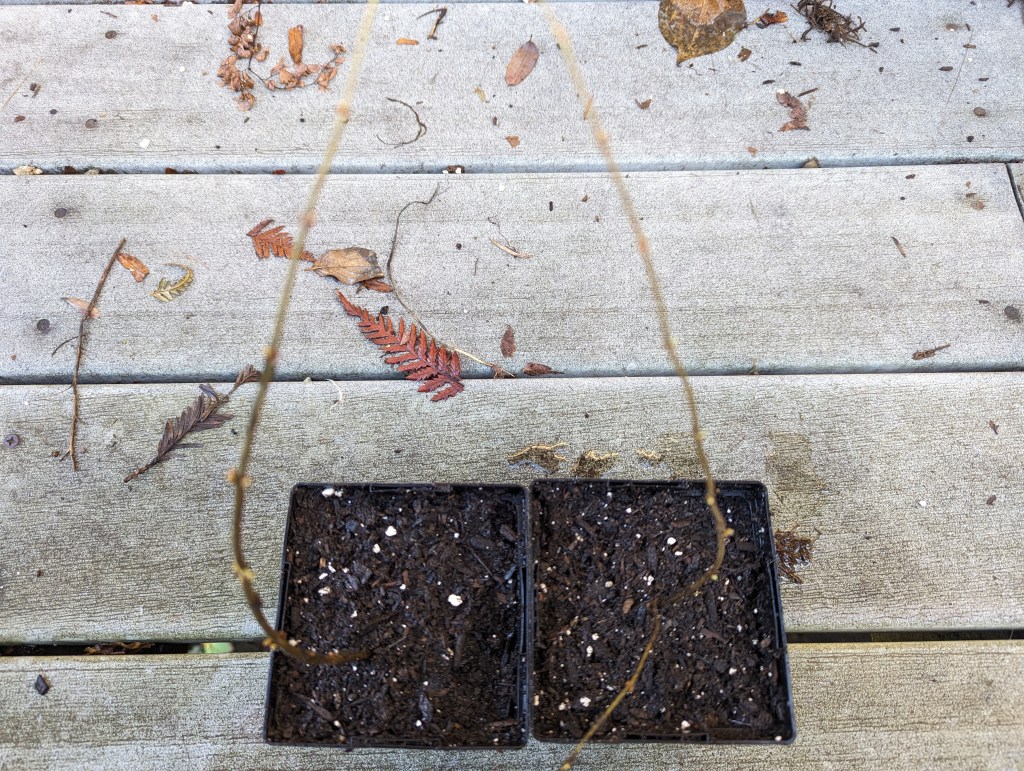
This is why I did not brag about my recently acquired snowberry within the context of my ‘Six on Saturday’ post this morning. They are not much to look at. Even if this illustration were more in focus, these bare twigs are indistinguishable from similar dormant twigs.
Nonetheless, I am pleased with their acquisition. I can not explain why, but I am pleased. The species, Symphoricarpos albus, is native, but not popular. I am beginning to realize why. Not only is it not much to look at in this particular condition, but it will unlikely ever become much to look at. It always looks scraggly, even while generating new foliage for spring. Its foliar color is unimpressively bland light green. Its twigs are very twiggy. Its dinky pale pink flowers are grungy and almost always infested with something or other. Its white berries, which is its primary attribute, are very scarce.
After so gleefully pulling this particular seedling from a landscape that it needed to be removed from, splitting it into two, and canning them as seen here, I realized that a rather large colony of snowberry inhabits another of the landscapes here. I could take as many rooted bits from it as I want without noticeably depleting it. For now, I am very satisfied with these. I have no plans for them, but will figure that out as they grow.
I suspect that snowberry can be more appealing in cultivation than in the wild. I intend to promote growth that is more vigorous than typical, which should enhance berry production. After this first winter, in which I dug and canned it, I will likely cut all of its growth to the ground annually during winter dormancy. I will not notice improvement this first year, but might after two years.





 Tony Tomeo