Cane Berries Require Diligent Maintenance

Without proper pruning, cane berries become wicked thickets.

Given the opportunity, blackberry and raspberry canes become rampant thickets. The trick is to keep them contained and controlled so that they can produce berries without conquering the garden. Besides, proper pruning promotes production. Properly maintained canes are therefore both better behaved and more productive

Berry canes are certainly not low maintenance, and should be selectively pruned a few times through the year. The type of pruning needed is determined by the type of growth that the canes exhibit in particular seasons. Spent canes or upper portions of everbearing raspberry canes that produced berries through summer and early autumn will need to be removed by the end of winter while new canes that grew through this year get trained to replace them.

Pruning and thinning of new canes should be delayed until the end of winter; but removal or pruning of spent canes can begin as soon as their fruit gets depleted. Spent canes of traditional summer bearing raspberries like ‘Willamette’, ‘Tulameen’ and ‘Canby’ can be pruned to the ground. ‘September’, ‘Heritage’, ‘Summit’, ‘Fallgold’ and other everbearing raspberry canes should be pruned only as low as their fruit was produced. Lower portions that did not produce fruit should be left to bloom and produce berries next spring.

Just like raspberry canes, new blackberry canes that grew this year do not need to be pruned until late winter. However, the canes that grew last year and are finishing berry production this year can be pruned to the ground as their last berries get taken. There is no rush for this procedure, but getting it done early makes later pruning of new canes for next year a bit easier.

Of course, every different cultivar (cultivated variety) of raspberry and blackberry behaves differently. Some finish producing and are ready to be pruned sooner than others. Their behavior is also affected by climate and environmental conditions, so that the same variety may be earlier or later in different areas, or even different parts of the same garden.

Favorite berry canes are very easy to propagate by division of superfluous new shoots during winter. Alternatively, spent canes that should be removed can be ‘layered’ instead. They simply need to be bent down and partially buried, and can be dug and separated as they develop roots.

The top few inches of cane should extend above the soil. At least a few inches of cane below the top should be buried a few inches below the surface of the soil. The length of cane between the buried portion and the base of the parent plant can remain exposed.

Layering can be done at any time of year if the layer (buried section of cane) gets watered while developing roots. Layering this time of year is easiest though, because layers get plenty of water from rain through winter, and develop roots most efficiently as they come out of dormancy late in winter or early in spring. If layers are buried where new plants are desired, they do not need to be dug and moved next year.

Palm Reading

This is painful to look at.

Not everyone is interested in horticulture. Most enjoy other interests, such as sports, arts or cooking. They may know no more about horticulture than a garden enthusiast knows about the Seattle SeaMonkeys. Unfortunately though, some are not as aware of their lack of horticultural expertise as garden enthusiasts are aware of their lack of proficiency with other interests.

For example, I can grow just about any fruit or vegetable or perhaps grain that can grow here, but if I can not eat some of them fresh, I am aware that I do not know how to cook them. I must rely on someone who does know how. Yet, someone who is proficient with cooking is likely to believe that it is practical to grow fresh vegetables on a kitchen windowsill because it seems so easy on television gardening shows.

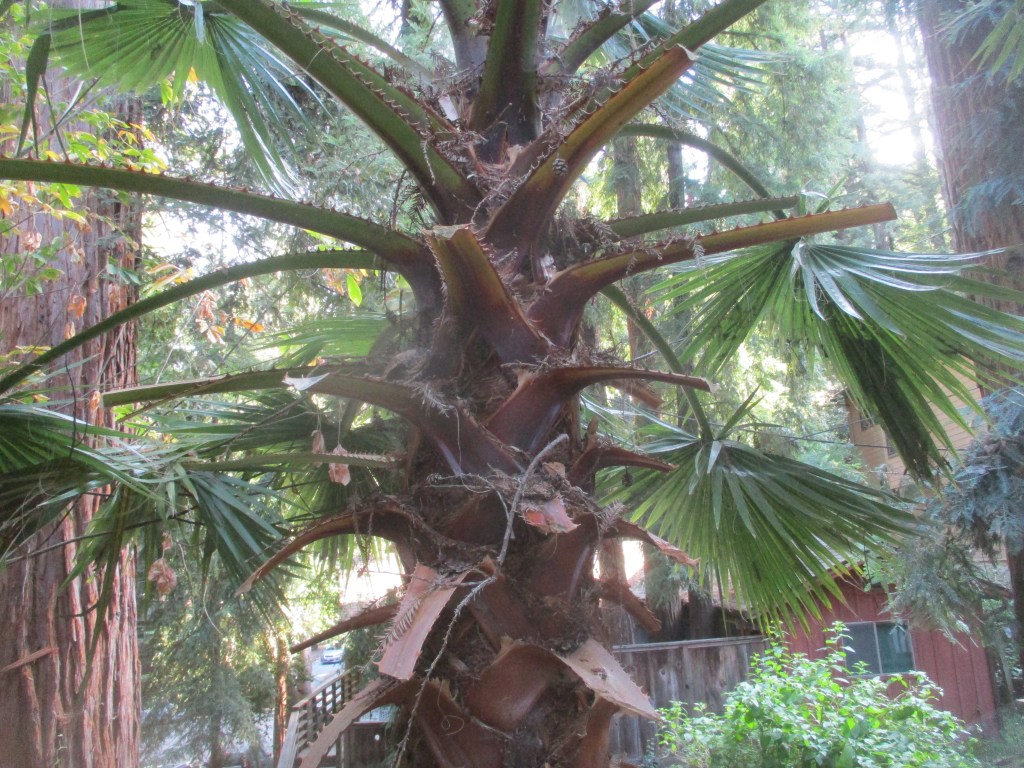
Someone I work with found this young Mexican fan palm to be bothersomely obtrusive to a confined situation within which he was working. He is, incidentally, a sports enthusiast. Naturally, as a sports enthusiast, he believed that he was qualified to groom the obtrusive fronds from the trunk of the Mexican fan palm. This was the result.

The necrotic but nonetheless harmless and relatively pliable foliage was removed to expose the wickedly sharp teeth of its rigid petioles, which extended outwardly in all directions from the trunk. This could have been quite dangerous for anyone who might have been so unfortunate as to bump into it. The thorns curve inward, to maximize damage to victims who pull back, which is, of course, the natural response to an encounter with such thorns. It was painful to merely look at! It seriously reminded me that I am no expert on sports or cooking. I pruned the petioles cleanly back to the main trunk.

Hydrangeas Perform Better With Proper Pruning

Pruning of one season affects bloom of another.

After decades of breeding, most modern cultivars of hydrangea are much more compact and a bit stockier than old fashioned hydrangeas that had long, limber stems that could bend downward from the weight of their own blooms. They stand up to proudly display their modern, vibrant color, even when their billowy blooms get heavy with rain. Yet, even with all their genetic improvements, they should still be pruned properly and annually to promote continued bloom. Without pruning, even modern cultivars can get floppy and lanky.

Because most hydrangeas bloom on stems that developed during the previous year, they should not be pruned too much while dormant through winter. Instead, solitary (generally unbranched) stems that grew from the base last year and bloomed this year should be pruned back to a pair of buds about a foot high as their blooms deteriorate. Even though some blooms continue to develop late into autumn, most are finishing about now. Therefore, pruning stems back while also removing spent blooms gets the pruning done early enough for the side buds to start to grow into secondary stems.

These secondary stems should not get pruned again, even when they go dormant through winter. They do not grow much before winter, but should be mature enough to bloom during the following spring. Thinning these branched stems through winter by cutting some of the smaller stems to the ground should produce fewer but significantly larger blooms, as well as prolong the blooming season. (However, many modern cultivars naturally bloom sporadically after their primary bloom phase until autumn anyway.)

New canes that develop from the ground to replace older branched stems may not bloom their first year, but can be left unpruned through winter to bloom early the next spring, which starts the process over again. Old stems should be cut to the ground after their third year (second bloom season). Leaving a few spent blooms on the plants long enough to dry (as dried flowers) should not interfere too much with proper pruning.

Horridculture – Deadhead (from last Wednesday)

At least the new growth is healthy.

Property management pays landscape service companies to maintain their landscapes for them. It is expensive. It is certainly fiscally adequate to justify the expectation that this sort of damage would not occur within the landscapes that property management pays landscape service companies to maintain. Now that it did occur, it should be remedied as efficiently as possible by the landscape service company that is justifiably expected to both prevent such damage, and remedy such damage if it occurs. This should not be a complicated concept.

Realistically, this is likely not as egregious as it seems to be. Automated irrigation was likely disabled through the rainy season last winter. It might have been enabled a bit too late into the dry season that began last spring. Hey, it happens. The upper stems of the subject succumbed to desiccation, likely as a result of warm and arid weather. Now that the automated irrigation has been restored, the subject is now attempting to recover from the damage by generating healthy and vigorous new growth relatively low within its canopy. Upper necrosis might remain only because the gardeners are prohibited by their insurance to perform any tasks above a particular height, even with a pole pruner instead of a ladder, and the necrosis is simply too high for them to engage. That task must instead, and perhaps more appropriately, be performed by an arborist. However, the arborist who typically maintains the trees at this particular property would need to charge an expensive minimal fee for this relatively minimal task. It would be more feasible to postpone the task until there is a need for more substantial arboricultural work. The arborist could remove necrosis from this subject within a few minutes, and without charging extra, while at the site to maintain many other larger trees.

Blackberry

Blackberries are ripening slowly this year because of the mild weather.

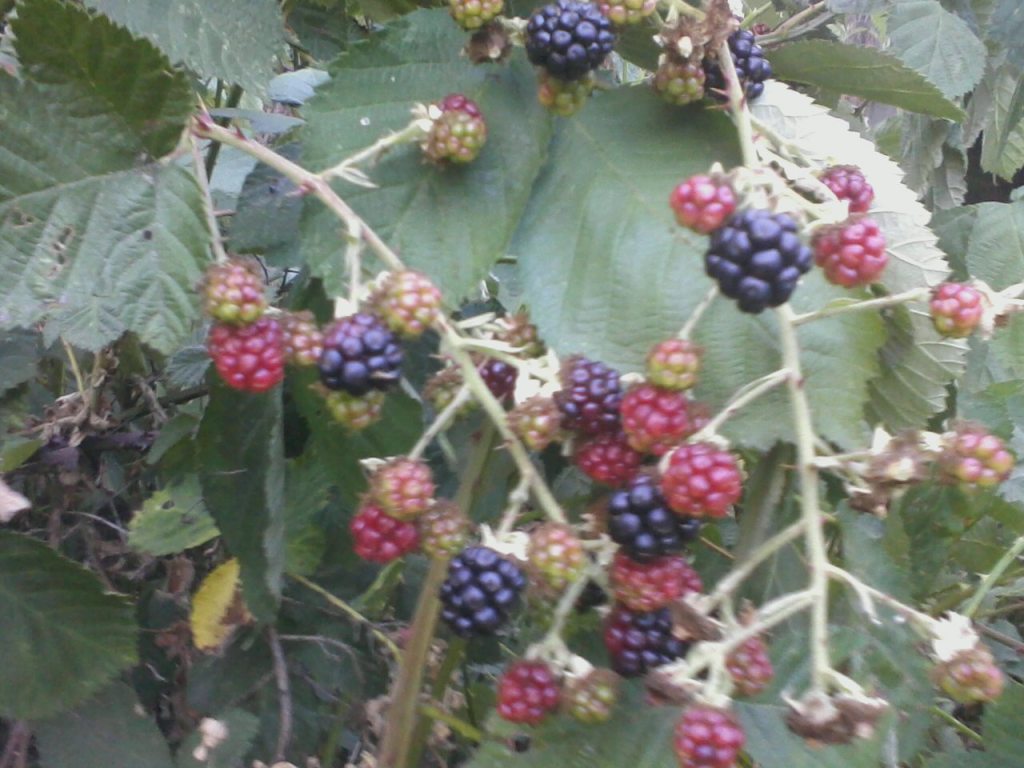
Rampant brambles of feral blackberry, Rubus fruticosus, canes are much too common and give blackberries a bad reputation. Yet, with regular selective grooming and pruning, their biennial stems that emerge from woody perennial roots are both more productive and easier to contain than one would guess. ‘Primocanes’ grow rapidly to six to sixteen feet in the first year. In the second year, they become ‘floricanes’, which do not grow longer, but instead develop lateral stems that bloom and fruit. Only a few modern ‘fall bearing’ or ‘everbearing’ cultivars fruit on primocanes.

Canes are trailing, semi-trailing or erect. As the names imply, trailing types like ‘Marion’, ‘Boysen’ and ‘Olallie’, need support. They are the most popular locally because they are more productive. Erect types that need no support, like ‘Navaho’, ‘Choctaw’ and ‘Arapaho’, are less productive, but because they are more tolerant to frost, are more popular where winters are colder. Old classic blackberry varieties are quite prickly. Modern thornless varieties are becoming more popular as more varieties are developed. All have palmately compound leaves with five or seven leaflets. Simple small white or pale pink flowers that bloom late in spring are followed by the familiar blackberries that are ripening now.

Horridculture – Post Office

Posted!

The Post Office in town is where I go to post or collect mail. For the past few years, this small coast live oak has been getting so low that I must duck under it to get onto the sidewalk from the parking spaces, or even to get past it on the sidewalk. It is particularly annoying because it is in such a prominent location where many other people park and enter the Post Office. I have sometimes considered bringing my pole saw and other pruning tools to prune it for clearance, but because I have not driven the pickup into town for a very long time, and do not intend to do so anytime soon, I would have no means with which to dispose of the debris.

Well, someone else pruned it. Well, sort of pruned it. Well, let us just say that I no longer need to duck under it. What a hot mess of stubs, or should I say, ‘posts’. This is after all, the Post Office. How could anyone think that this was acceptable?! How difficult would it have been to cut these lower limbs properly, without leaving these horrid posts?! Even someone who is not at all concerned about the tree or proper arboriculture can see how hideous this is. Seriously, this goes beyond negligence. Someone put considerable effort into doing this so extremely improperly!

I brought my pole saw the following week to remove these posts without doing any more pruning. I figured that without all the foliage, I could fit them into the trunk of the Roadmaster. However, by the time I go there, someone, likely from the Department of Public Works, had already repaired the damage. The tree could be pruned a bit more, but at least it is not so mutilated.

Hedge Pruning Straight And Narrow

Hedges should not overwhelm their landscapes.

There are rules to hedging. Many hedges violate some of such rules. Formal hedges are the most egregious offenders. Their uniformity, symmetry and form require compliance to relatively strict standards. Relatively relaxed standards of informal hedges or screen are standards nonetheless. Almost every hedge eventually needs maintenance of some sort.

The primary difference between formal and informal hedges is uniformity. A formal hedge involves only a single variety of a species. Spaces between individuals of such a hedge are all the same. An informal hedge can involve more than one species. Spacing may be variable, even if for a single variety. Informal pruning is less strict than formal shearing.

Both types of hedges are generally utilitarian, as well as aesthetically appealing. Many provide privacy. Many obscure undesirable scenery. Some divide gardens into distinct spaces. Size and shape is very relevant to how effectively a hedge serves its purpose. Unfortunately, most hedges are significantly larger than necessary. Many are obtrusive.

This happens because their depth, from front to back, is easy to ignore. A healthy facade of dense foliage conceals wasted space within. It can slowly expand outwardly as each subsequent shearing procedure allows. Expansion is faster above than below, which is why so many hedges are wider on top. Distended tops shade and inhibit lower growth.

Obtrusive hedges are difficult to restore. Most require removal of their appealingly dense foliar facades. Such a procedure exposes unappealingly bare stems within. This should be temporary for most hedges. They efficiently refoliate to develop new facades with less depth. Such renovation is impractical for junipers, which can not refoliate so efficiently.

Renovation of obtrusive hedges is unpleasant and temporarily unsightly. However, it can recover formerly useless space. A hedge that was six feet wide can be as effective if only a foot wide. There is no need for it to extend over usable spaces, such as walkways and patios. Other vegetation will likely appreciate better exposure to sunlight. Mild weather delayed but did not eliminate the need for seasonal maintenance of hedges.

Shear Abuse

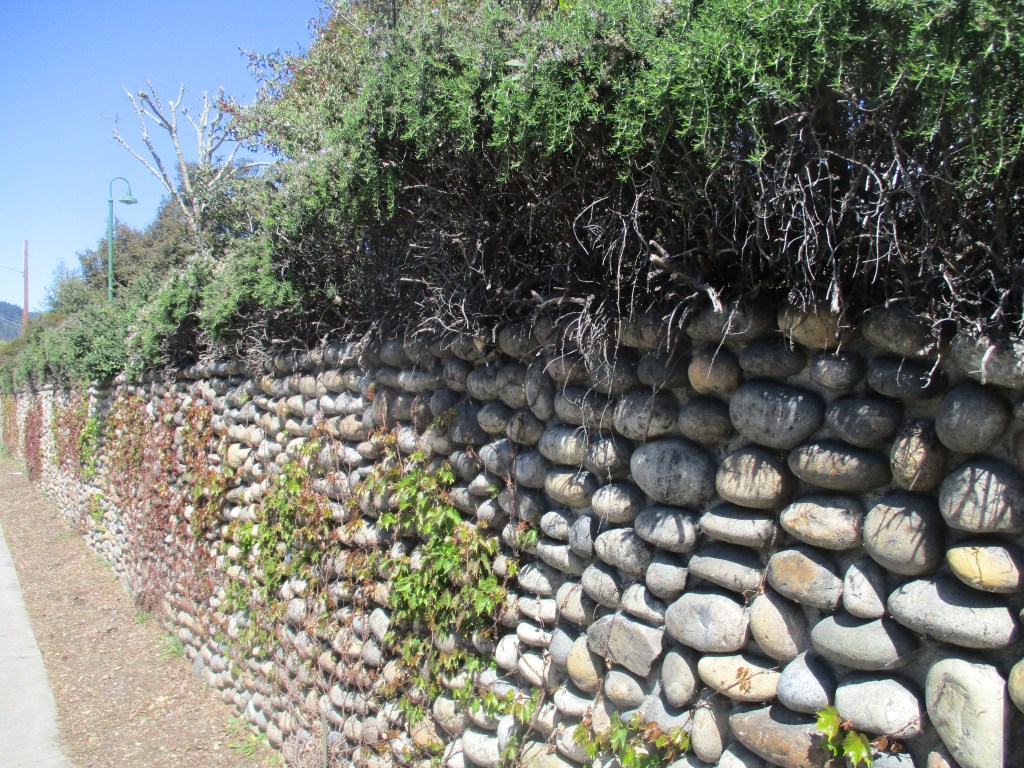
Cascading rosemary should actually cascade rather than get shorn into submission. (For this situation, it is subordinating to the climbing Boston ivy below.)

You can make fun of the decadent hair styles of the 1980s all you like; but you must admit that they were better than what came later. Back then, the assets of each particular type of hair were exploited instead of destroyed; sculpted instead of chopped into submission. Sadly, landscape maintenance evolved in a similar manner.

So many trees, shrubs and ground covers are either shorn too much to develop their naturally appealing forms, or not pruned severely enough to allow space for resulting new growth to mature and bloom like it should. Gardeners are notorious for shearing anything within reach. However, they are also notorious for allowing certain ground covers to get too deep and overgrown.

Trees that are short with multiple trunks when they first get planted are more likely than taller trees with single trunks to be shorn into nondescript shrubs. Olive, Japanese maple, tristania (laurina) and crape myrtle are commonly victims of this abuse. They are not only deprived of their form, but their grace and foliar appeal as well. Shorn crape myrtle may never be able to bloom.

Oleander, bottlebrush, arborvitae and various pittosporums that make nice informal screens in their natural forms are likewise very often shorn inappropriately and needlessly into all sorts of odd geometric shapes. Fortunately, pittosporums tend to make excellent formally shorn hedges as well as informal screens. Yet, when shorn without a plan, they more often develop into herds of noncontinuous geometric shapes. Oleander and bottlebrush, like crape myrtle, may never bloom if shorn too frequently.

Ground cover more often has the opposite problem. It does not get mown enough, or otherwise pruned down to stay shallow. This may not be a problem in most of the space covered by ground cover, but does make for hedge-like edges where the ground cover meets walkways, with all the problems of improperly shorn hedges. These edges can be softened if sloped inward and rounded off on top. However, lantana, star jasmine, acacia redolens and the ground cover forms of ceanothus do not bloom on these shorn edges unless the shearing procedure gets done at the right time to allow for enough new growth to mature in time for the blooming season.

There is certainly nothing wrong with properly planned and properly shorn formal hedges; but not everything needs to be shorn. Plants should be selected to be proportionate to their particular application without abusive shearing. Like the hair styles of the 1980s, the assets of each particular plant should be exploited instead of destroyed.

Utility Clearance Can Disfigure Trees

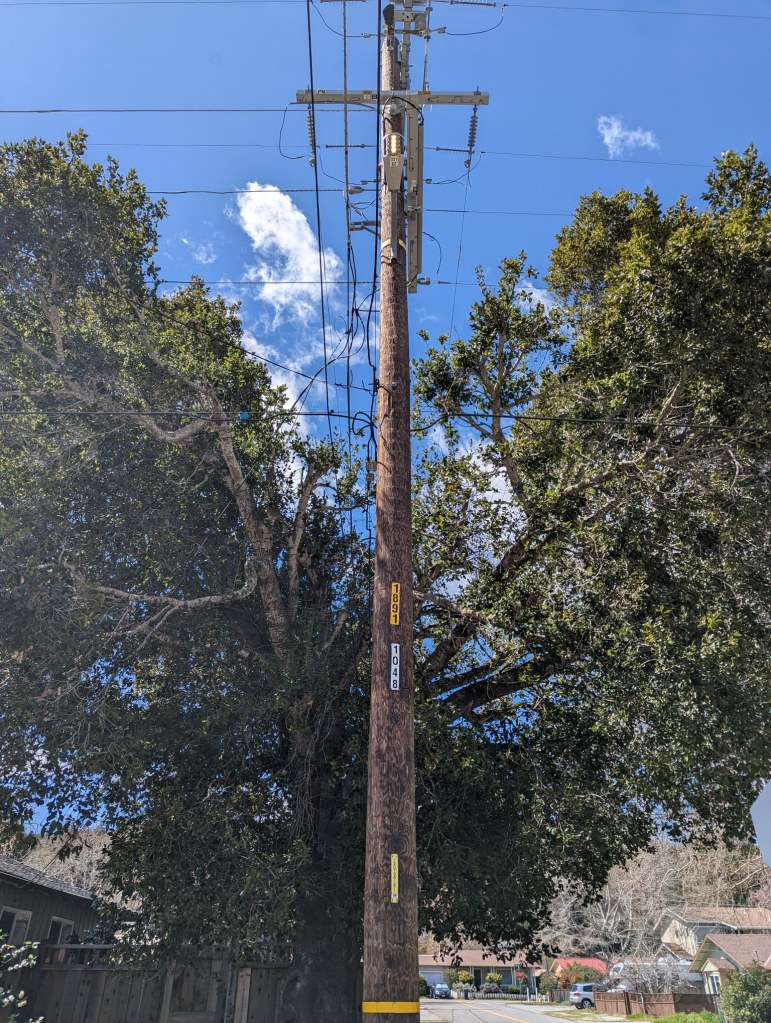
Utility cables need clearance from trees.

Last winter was a doozy! It involved historic frost, snow, rain, wind, floods and mudslides. A few roads remain closed in some regions. Major electrical outages were too numerous for prompt repair. Weather alone did not cause such outages though. It merely dislodged vegetation that did so. This demonstrates the necessity for utility clearance maintenance.

Utility pruning is a specialized but very often unpleasant sort of arboriculture. It maintains necessary clearance between vegetation and utility cables. Its unpleasantry derives from its harsh efficiency. Clearance is the priority. Proper arboricultural technique is not. There is no compromise. Trees that encroach too closely to cables are likely to regret doing so.

Proper arboricultural procedures are too expensive to justify for utility clearance pruning. Otherwise, electricity and other utilities that utilize cable would be much more expensive. Besides, for many trees within utility easements, proper arboriculture is impossible. They can not accommodate necessary pruning without disfigurement. Several can not survive such disfigurement.

Palms, for example, can not survive without their single terminal buds. They lack limbs to divert growth to. Removal of a terminal bud that encroaches too closely to utility cables is lethal. Palms generally grow only upward. Those that grow tall rapidly can not live below utility cables for long. Very few palms remain low enough to maintain minimal clearance.

Excurrent trees are generally more vulnerable to disfigurement than decurrent trees. The single central trunks of excurrent redwoods and spruces do not adapt to redirection. The several main limbs of decurrent oaks and elms are more cooperative. Compact trees that are unlikely to reach cables are least problematic. Of course, many trees are unplanned.

Arborists can repair some minor clearance pruning damage or disfigurement. They might prevent some damage by timely pruning for containment. Unfortunately, some damage is neither repairable nor preventable. Also, such procedures are too dangerous for anyone who lacks qualification for them. Typical garden enthusiasts must avoid electrical cables!

Freeze Damage Necessitates Selective Pruning

Warmth stimulates recovery from freeze damage.

Pruning at the proper time has been a concern all winter. Dormant pruning was timely as soon as defoliation began. It remains timely almost until bloom. Pollarding and coppicing are generally although unnecessarily a bit later within that range. Spring pruning begins soon after bloom. Pruning of freeze damage starts after the last reasonable threat of frost.

Frost is as variable as the many climates here. Generally, it causes more damage farther inland and at higher elevations. Conversely and generally, it causes less damage closer to the coast and at lower elevations. Many southern coastal climates experience no frost. However, frigid air drains downhill. Within any plateau, the frostiest areas are the lowest.

Last frost dates should help with scheduling of pruning or grooming of freeze damage to vulnerable vegetation. The last frost date for a climate is the average date of its last frost. Frost becomes increasingly unlikely afterward. That is the best time to add warm season vegetables and annuals to the garden. It is also when to begin grooming freeze damage.

If not too unsightly, freeze damage lingers until the last frost date for two primary reasons. It shelters vulnerable tissue below, including any new growth that develops prematurely. Also, removal of such damage stimulates new growth that would be even more exposed and innately more vulnerable to frost. However, priorities change soon after the last frost.

Then, it becomes important to groom or prune away freeze damage prior to generation of fresh new growth. For milder climates, it is already timely to do so. It might be a while for less mild climates. Even for frostless climates, this might be a good time to groom growth that is only incidentally shabby. Such grooming gets more complicated with new growth.

Many zonal geraniums are already extending new growth up through shabby old growth. Removal of such old growth or freeze damage without damaging mingling new growth is no simple task. If new growth stretches for sunlight below old growth, it might flop without support from the old growth. It may be more practical to cut all growth back to regenerate. Canna also develop similar complications.