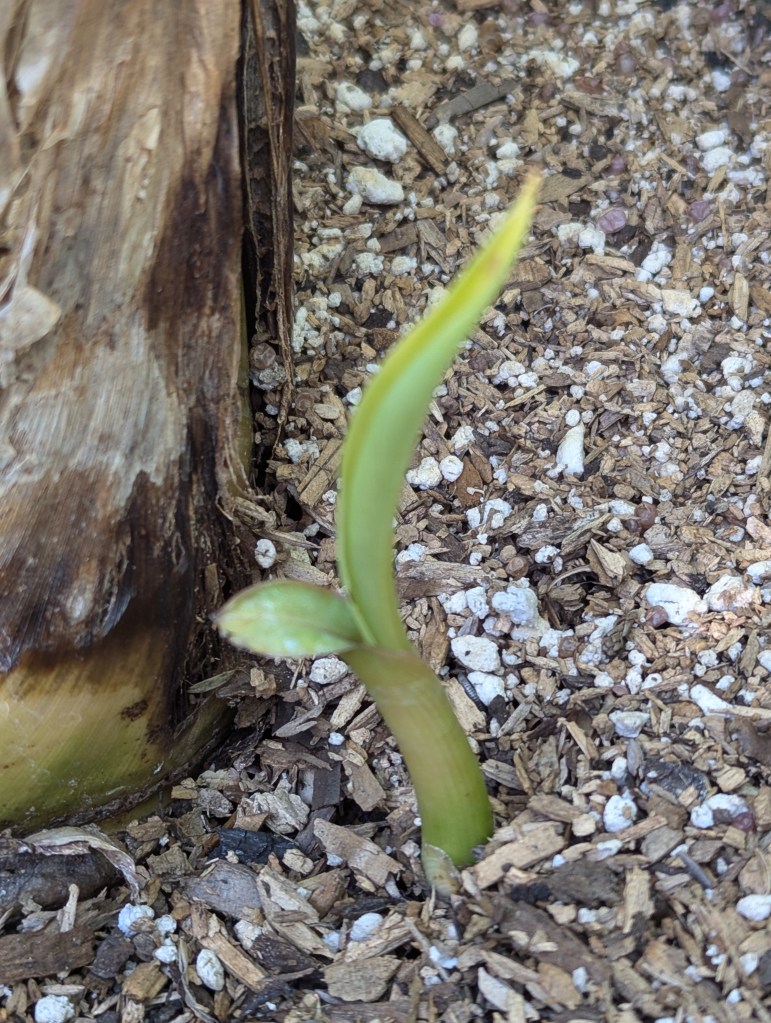
Oem is beginning its third spring here. Fortunately, it has not yet grown too big to stay. That could change soon now that the weather is warming. I still do not know what to do with it as it grows. It is the largest species of banana in the World, Musa ingens. The foliage of the original pseudostem was frosted enough last winter to get trimmed away, leaving only an unsightly bare trunk. It is only beginning to replace its foliage for this season. Just as readily though, it produced two pups, which will likely grow faster than the original pseudostem did during the last two seasons. They are growing from a larger rootbase. Meanwhile, there are several other cultivars of banana growing here also. There were about fourteen last year. There are about two dozen this year! Only a few will remain compact enough to inhabit the landscapes at work, but even fewer will be appropriate there. Banana trees are not exactly comparable with the style of a redwood forest. Most, including the oem, will likely inhabit a riparian area of my home garden, which is also in a redwood forest. Goodness! I really should have planned this better.
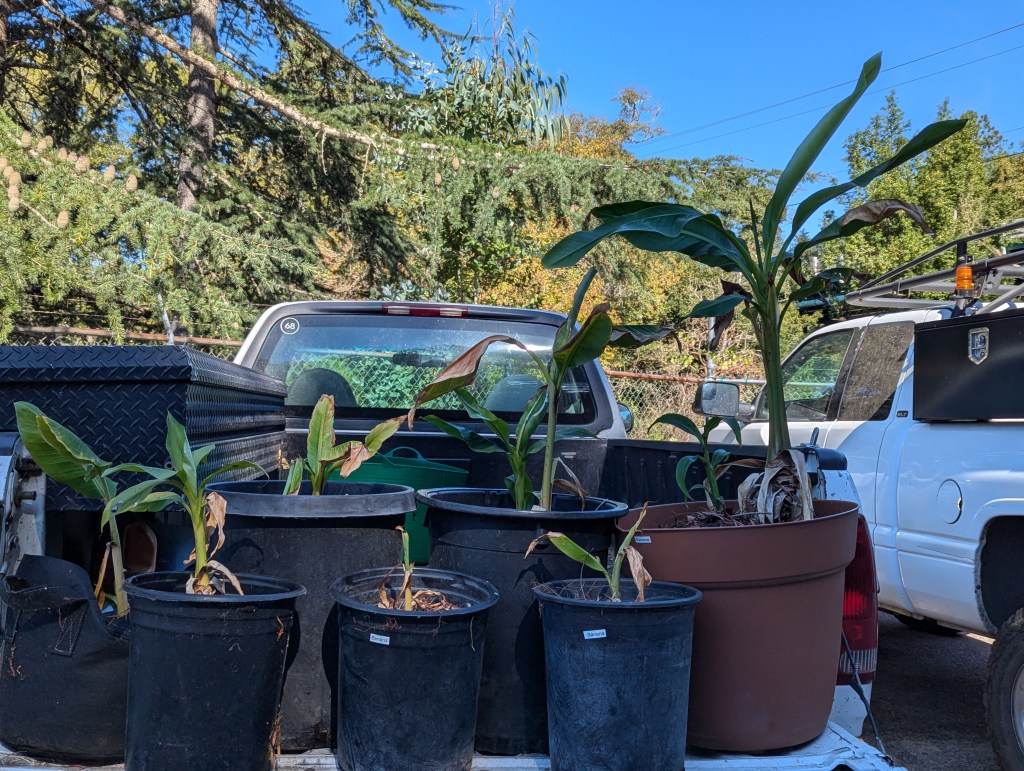
Yes! We have more bananas! I can explain. Although there are as many as twenty cultivars of banana here, almost all are individual pups or tissue culture plugs. (Of these twenty, three are unidentified. Of these three, one is likely a redundant copy of one of the other cultivars, one seems to be completely necrotic without possibility of recovery, and only one is notably distinct.) All but a few arrived earlier this year, so have not yet generated pups. ‘Double Mahoi’ has doubled by generating a single pup. ‘Golden Rhino Horn’ arrived as a pair, and one of the pair is only now beginning to generate another pair of pups. Otherwise, there are no spare pups to share. The only spare pups of ‘Double Mahoi’ and ‘Golden Rhino Horn’ (the one which lacks new pups) may be leaving in the next few days. Whatever remains of these two will most certainly go to another colleague at the end of winter. Another colleague would like to add any spares, regardless of cultivar, to his garden. However, until just now, I could not help in that endeavor. The few in the picture above just arrived from Gilroy because they were in need of a new home. The pup to the far left is ‘Blue Java’, which is also known as ‘Ice Cream’, is redundant to a copy that is already here, so can be shared with a colleague. The others, which are sufficiently numerous for all of us to get copies, are unidentified, which merely means that if they produce fruit, it will be a surprise. Even if their fruit is not palatable, their foliage is good for forage and compost. For the colleague who would like to add any spares regardless of cultivar, they can live in a riparian area of his garden that is too steep, damp and shady for gardening. These pups may not look like much in the picture, but their corms are quite plump, so will provide an abundance of foliage after they get into the ground and the weather warms after winter. Soon afterward, they will generate more pups, but we can worry about that later.
Yucca whipplei seed is likely more rare in cultivation than in the wild.
Yucca whipplei, which is now known as Hesperoyucca whipplei, should not be so difficult to procure. It is the most common species of the genus within the next few hundred miles south of here, and was quite common in the hills around San Luis Obispo, where Brent and I studied horticulture at California Polytechnic State University (Cal Poly). I should have taken pups from wild specimens within the region, but I know of no one with wild specimens within their gardens. I can only see them from a distance, and, although within view, they are far enough away to necessitate quite a hike to get to. I never bothered to procure pups from specimens that I encounter directly in the Santa Monica Mountains north of Beverly Hills because they might be a different variety, or related to such a variety. Contrary to dramatic bloom, seed of the species is supposedly rare because the larvae of its very specialized pollinating moth devour almost all of the seed that develops from successful pollination. (The moth pollinates a flower only to provide seed for its larvae to eat.) Seed should be even more rare here because the specialized pollinating moth has no business so far from the natural range of its sustaining species. Somehow, a specimen that bloomed at work produced these few seed capsules. Someone else besides the specialized pollinating moth apparently took interest in its bloom. Although I have no idea what variety of Yucca whipplei the particular specimen is, I am pleased with the seed, and will try to grow them if they are viable when their capsules dry. (I hope that removal from their deteriorating stalk does not compromise their development.) Furthermore, I will get at least one pup from the original parent now that it will generate a litter after its monocarpic bloom. It is likely the variety that I want and am most familiar with anyway, because that particular variety happens to be the most common. Of course, I will procure a pup from a wild specimen within the region of San Luis Obispo if I ever get the opportunity to do so, just in case it is any different from what is growing and now blooming here.
Most of the banana pups and plugs are manageable, . . . for now.
Three more cultivars of banana arrived this week. There are now as many as twenty here. Three are unidentified. Of these three, two could be redundant to others. Of these two, one is merely dormant corms that could rot before generating new foliage. Another is already generating pups. Another is represented by a pair of pups. Eight grew from pups. Twelve grew from tissue culture plugs. Five have already grown too big to remain in the nursery where this picture was taken. At least three can grow more than twenty feet tall. At least two can grow more than forty feet tall. One is Musa ingens, which is the largest species of banana in the World, which can grow more than sixty feet tall! This sounds like fun, but so far, we only intend to add one of these twenty to only one of the landscapes! Three other small cultivars might remain potted in other landscapes, but are merely a minority of the total. Banana ‘trees’ are not exactly easy to accommodate. They want generous irrigation. Their ‘trunks’ grow very fast, but do not last long. Because they can not be climbed, every ‘trunk’ requires a radius that is comparable to its potential height to free fall when it gets cut down. None of the refined landscapes can forfeit areas that are large enough for ‘trunks’ of the larger cultivars to fall. Riparian areas that can accommodate them, and even without irrigation, are forested with redwoods, which banana ‘trees’ are not aesthetically compatible with. I would say that we will figure this out as they grow, but banana ‘trees’ grow very fast. They can remain canned for the rest of this season, but would be very displeased with such confinement next year. It is about to get even more interesting.
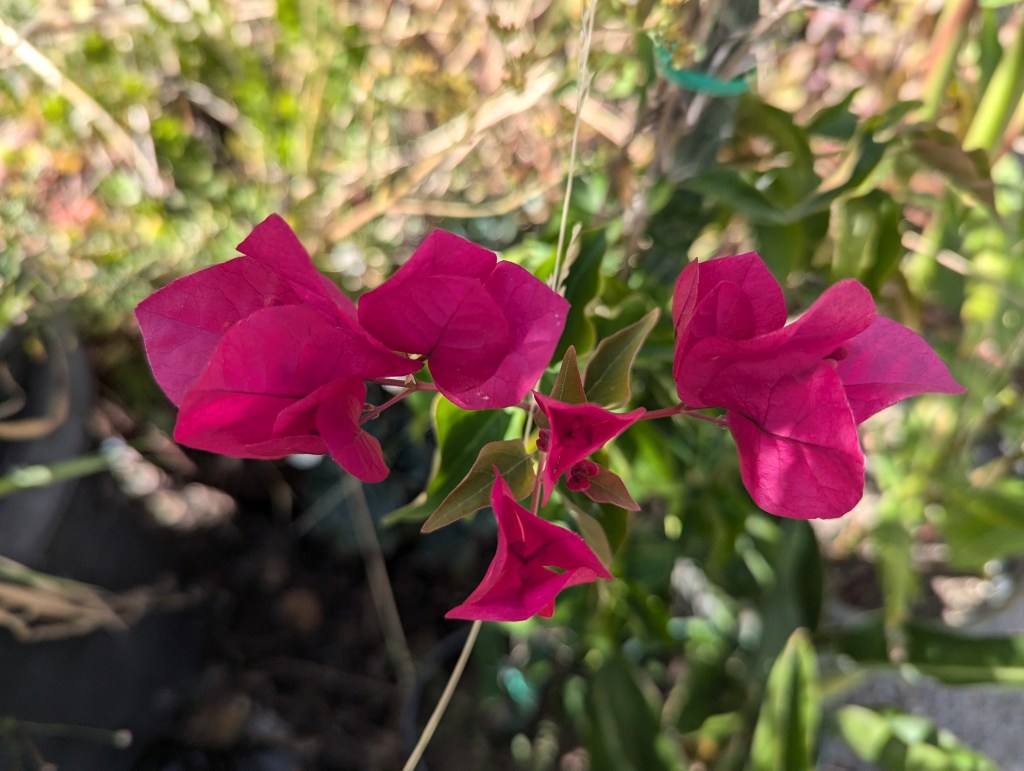
Some of these six are early. Some are late. Some merely seem to be one or the other, but are actually right on schedule. Only the banana pup, which is the only of these six that is not blooming, was influenced intentionally.
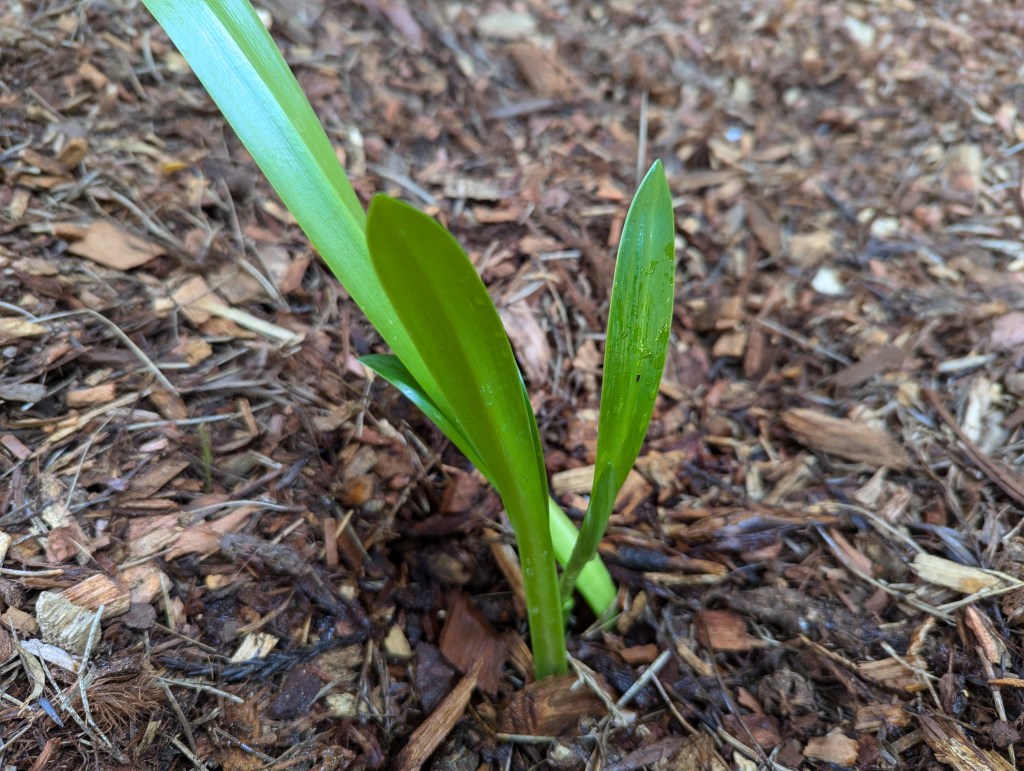
1. Hymenocallis latifolia, Peruvian daffodil is actually right on schedule. I expected it to remain dormant through summer to bloom for autumn, after naked lady. It may still do so if it foliates first. Otherwise, it should naturally bloom for summer. These are my first.
2. Musa acuminata ‘Cavendish’ banana was divided earlier and allowed to grow for two months, but then lopped and sent by mail. It must now grow new foliage before autumn. It is actually less likely to rot with this technique. I am quite pleased to have procured it.
3. Hedychium gardnerianum, kahili ginger surprised me with what initially seemed like early floral trusses. However, they have since grown so slowly that they might bloom for later summer or autumn, which is when I previously thought that they normally bloom.
4. Gladiolus hybridus, gladiola has been unexpectedly reliably perennial, and is actually slowly multiplying. A sport of an orange and yellow variety now blooms yellow. Another blooms red. This one seems to be trying to extend its bloom season by blooming so late.
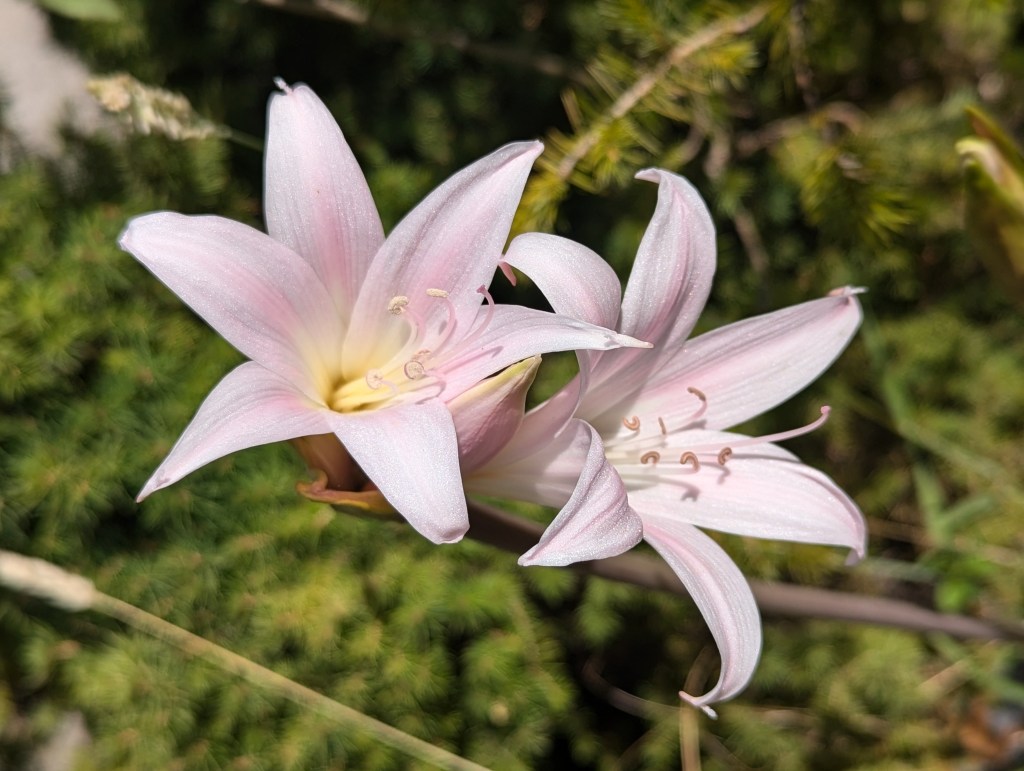
5. Amaryllis belladonna, naked lady is doing the opposite. It should not bloom for about another month. This bulb might be blooming early as a result of distress associated with crowded confinement with too many other bulbs within a big pot. It is pretty regardless.
6. Bougainvillea, which lacks a common name that is actually common, could have been blooming since the weather began warming at the end of last winter. It recovered slowly from minor frost damage, though. It still seems to be rather lean, but at least it is trying.
‘Double Mahoi’ banana has been tediously slow. Although I now know why, I am disappointed with its development so far. After the primary pup that I split from the original last year got frosted over winter, I noticed that its central bud survived and was barely beginning to recover. Then, it stopped. I mean, it did nothing for several days or maybe more than a week, even though the weather was warming. Also, the foliage remained pale, as if it had just emerged. Because it was stagnating for so long as the weather was warming, at least one of its leaves got scalded in the middle. Then, because I gave it a bit too much soluble fertilizer, its leaves got bad tip burn. I suspected that it was up to something while seemingly inactive, but did not really know. Finally, the tip of its first pup appeared. Then another appeared, and then a few more! While still just a pup, it had an entire litter of eight pups, which is four times ‘Double Mahoi’, and I do not know if it is finished. Of course, eight pups sharing resources do not grow fast. Also, the tip burn continued as the pups initially emerged, which likely inhabited growth for a while. For now, I can only give them plenty of water, and refrain from giving them more fertilizer. They have good exposure, but I will move them under saran if the weather gets too warm for such small pups to be so exposed. I doubt that all eight pups will survive, but I would have been pleased with merely one. Of course, the one original pup will not survive the process of diverting its resources to its pups, but that is an acceptable consequence of getting a bit more than expected.
Original ‘Double Mahoi’ pup not much more than a month ago
We have a litter problem. At least three species of Agave continually have litters of pups. We give almost all of the pups away to friends and neighbors, but more constantly appear. I suppose that we could dispose of some, but that is not easy for those of us who enjoy growing vegetation instead of destroying it.
Pups of one Agave continue to appear where the original was relocated from several years ago. Although I do not know what species it is, it is likely my favorite of the three. However, we can not accommodate all these pups! The original is happy with its new situation, but is beginning to generate a few more pups there as well.
Pups of Agave americana, century plant, got canned because we thought that we could eventually find homes for them. Now, and for the past few years, these maturing pups are producing more pups, some of which are emerging from the drainage holes of their cans! The original is happy to be a neighbor of the unidentified Agave, but could generate more pups at any time.
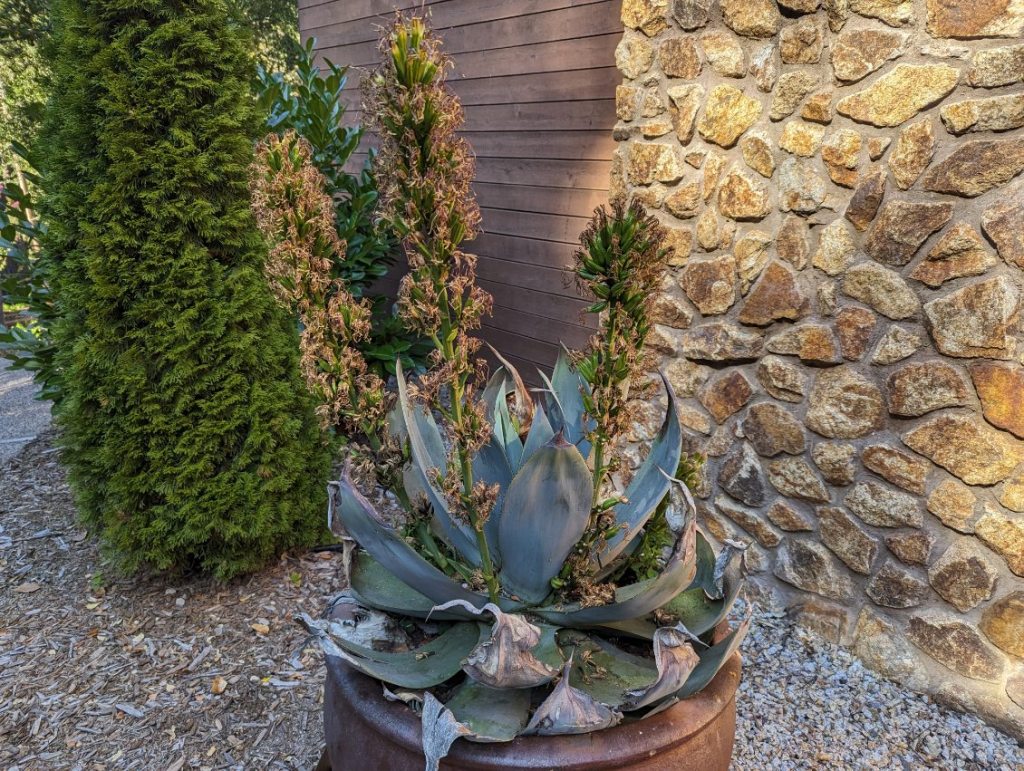
Agave ovatifolia, whale tongue agave, was purchased by the other horticulturist for a specific situation. It was a striking specimen that was worth what was spent on it. However, it began to generate pups almost immediately after installation, and then suddenly and unexpectedly bolted and bloomed. It was disappointing for such an expensive specimen of a monocarpic species. We removed it after bloom, with the intention of replacing it with one of its several maturing pups. Of course, I could not simply dispose of its carcass. I canned it like a dormant perennial, just in case it did something. Well, now it is doing something! It is bolting and blooming from the grave! I expect more pups soon. We really should get all the Agave spayed!
Hyacinth Bucket of ‘Keeping Up Appearances’ might say, “It’s ‘Bouquet’.” However, this really is about the contents of two buckets, two cans, a bin, and a terracotta pot, without flowers. Most of these items must be processed prior to the end of the rainy season.
1. Agave ovatifolia, whale’s tongue agave bolted and bloomed too soon after installation. It is monocarpic, so died an ugly death while trying to replace itself with fresh new pups. I planned to later select the biggest pup to replace its original. Unfortunately, a gardener who did not know what they are pulled them all with nearby weeds. I scrounged through the debris to find these. Incidentally, I must still find homes for Agave americana pups.
2. Chrysanthemum X morifolium, mum contrarily will not die. It was abandoned after a wedding, but then potted into a landscape as it bloomed again. Removal for replacement as it again finished bloom revealed that each of these many stems is rooted individually.
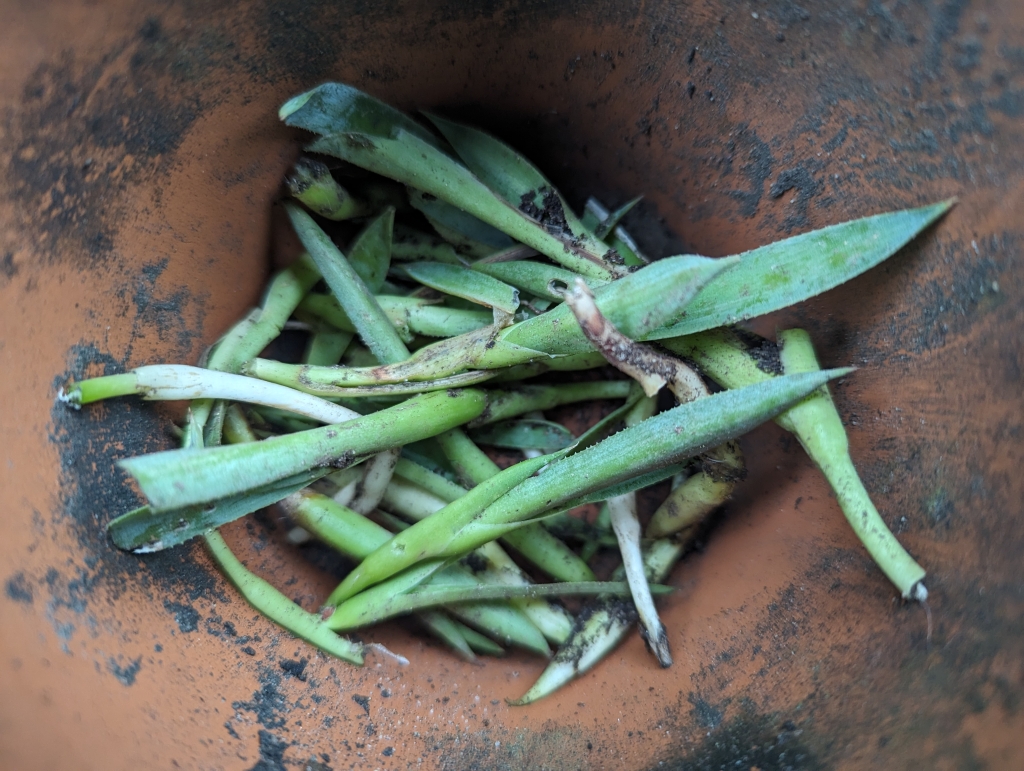
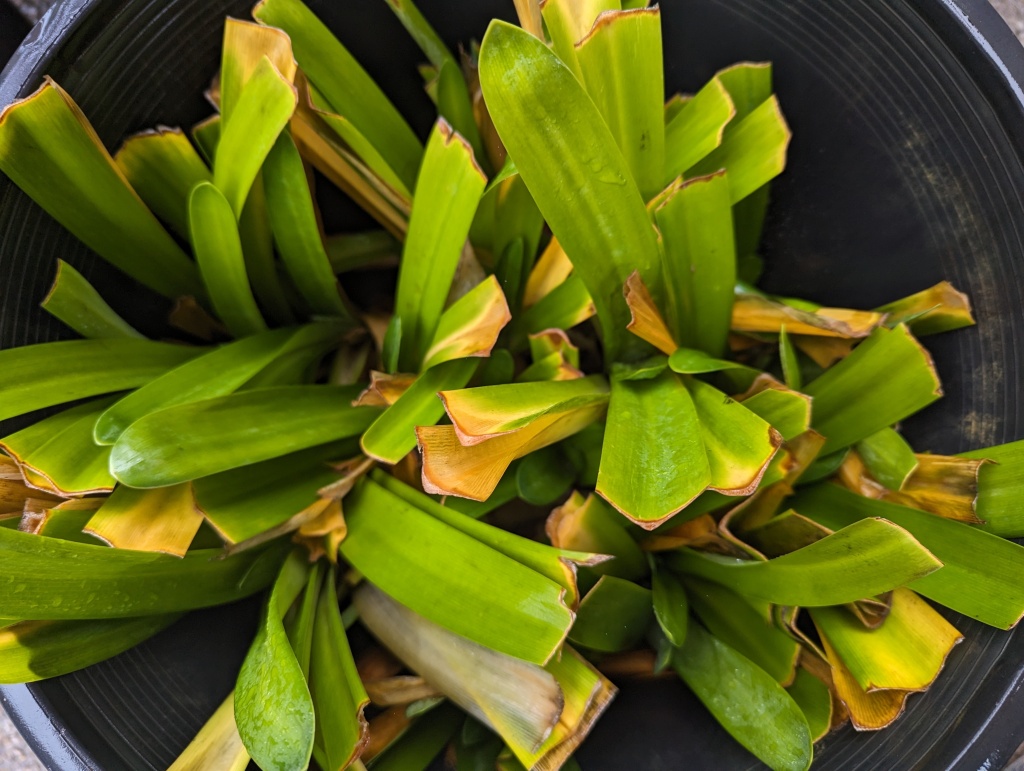
3. Agapanthus orientalis, lily of the Nile is getting to be rather tedious. These shoots are of the same batch that I featured last week, and that I processed more than a month ago. I processed too many, so must now get the leftovers into the ground before winter ends.
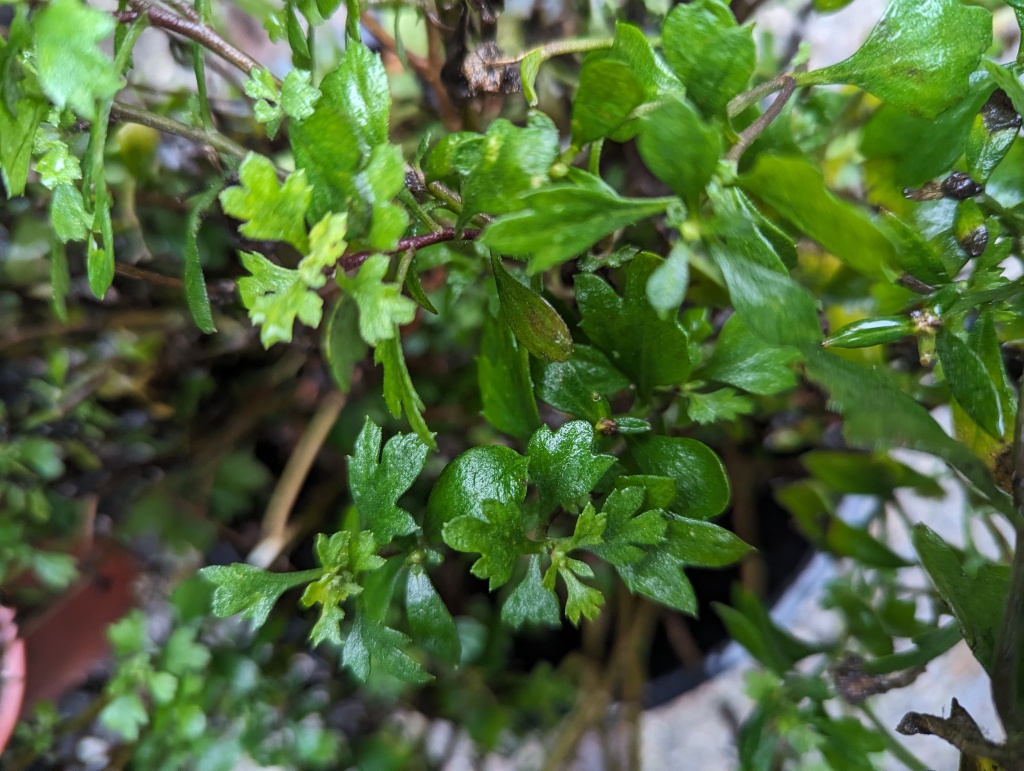
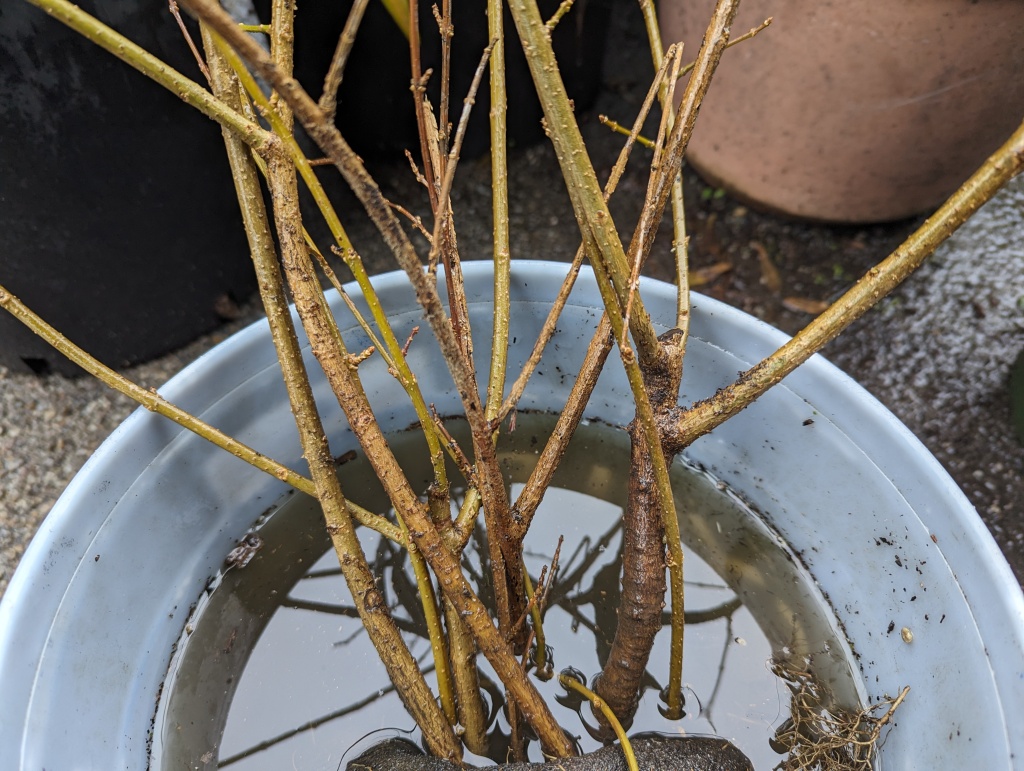
4. Forsythia X intermedia, forsythia will bloom soon, but for the moment, is dormant. I relocated an old specimen that was always in the way. These spare twigs can be forced.
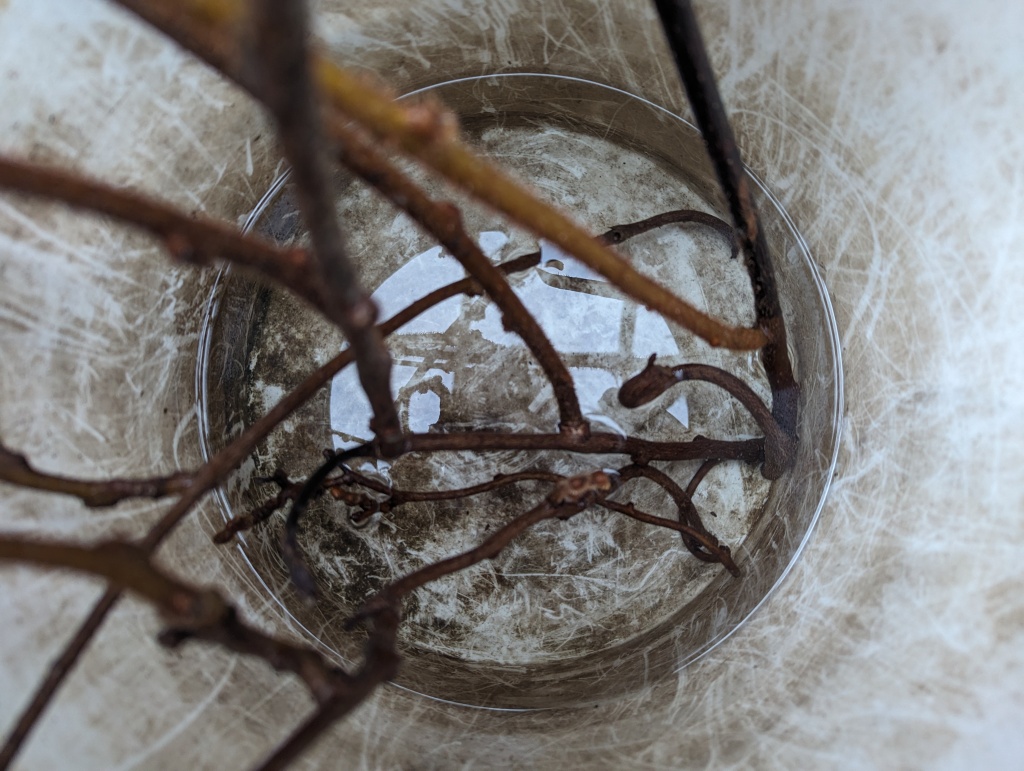
5. Actinidia deliciosa, kiwifruit vines grew easily from a broken bit that I found in a load of debris that someone left here last winter. They are female without pollinators though. These are dormant pruning scraps of its male pollinator, and should grow just as easily.
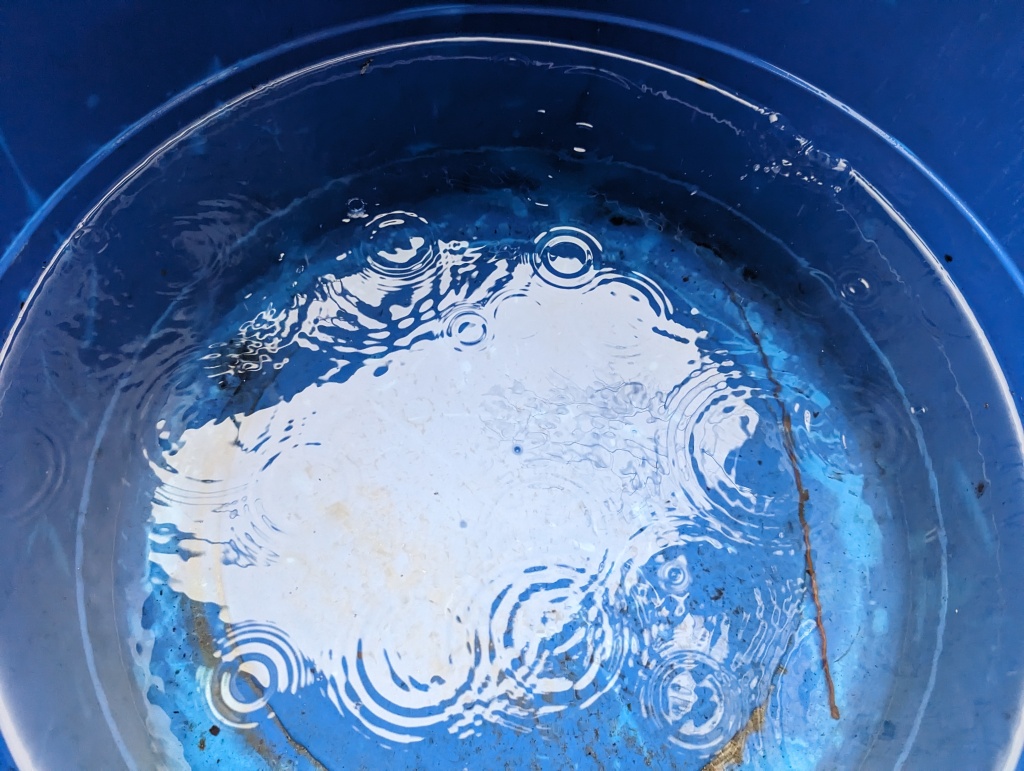
6. Rain was falling yesterday and is forecast to continue lightly through most of Monday.
I can explain. Firstly, I should mention that this is an industrial building at work, not a home garden; so no one else cares what it looks like. Secondly, although this building is outfitted with an abundance of external electrical lighting, it lacks external electrical outlets. Thirdly, I brought a ‘Double Mahoi’ banana tree back from the Los Angeles region less than a month ago, so divided its pups at the most inconvenient time, as autumn weather was getting cooler. Fourthly, I should stop numbering all these individual statements, and get on with a simple explanation of this visually unappealing contraption.
The banana tree went to its permanent home already, where it can hibernate through winter. However, its pups languished and immediately began to deteriorate here. Because they will not grow much until warmer weather after winter, their rudimentary corms can rot faster than they can recover from their division. Therefore, I purchased an electrical heating mat to warm their media from below, and accelerate root and corm growth. It was not a pleasant purchase, since I object to reliance on such technology, but that is another topic for later.
I did not want to extend an extension cord too extensively from a window to the nursery benches on the deck to the lower right in the illustration above. I thought that this shelf would be less obtrusive. Perhaps I should have thought a bit more about it. I successfully extended and obscured an extension cord for the fountain on the mountain, but again, that is another topic for later.
Now that it is installed directly outside the window, without the need for an extension cord, the shelf fits the heating pad reasonably well, and suspends eight #1 cans with three 4″ pots nestled in between.
By the time this explanation posts at midnight next Sunday morning, the largest of the four ‘Double Mahoi’ banana pups, which incidentally is already in the process of generating another rudimentary pup, might be exhibiting a slight bit of accelerated growth. The two smallest of these four pups were cut back to their corms, and the third will likely get cut back also, so will take a bit longer to exhibit growth. All four are arranged in the front row at the bottom of the illustration below.
The three 4″ pots that are nestled in between the #1 cans contain tissue cultured plugs of ‘Gran(d) Nain’, ‘Cavendish’ and ‘Orinoco’ banana. With all seven pups and plugs of banana neatly arranged on the heating mat, remaining space accommodated a few cuttings that should also benefit from the warmth of the heating mat.
The four #1 cans in the rear row at the top of the illustration below contain cuttings of passion flower vine and cup of gold vine. The passion flower vine to the right of center is unidentified, but ‘Constance Elliot’ is to the left of center, with a single cutting of ‘Frederick’. Almost predictably again, that is another topic for later. Nine cuttings of unvariegated cup of gold vine to the far right are shabby because they were superficially damaged by minor frost earlier. Six cuttings of variegated cup of gold vine are to the far left.
Although shabby, they do not look so silly from inside.
Monocarpic species bloom only once. They die afterward. Many annuals are monocarpic by default. After bloom and production of seed, they have served their purpose of perpetuating the next generation. Some may bloom more than once within their respective season, but realistically, do not expect to live for long after doing so.
Agaves are monocarpic. Unlike annuals, some grow for many years before maturing enough to bloom. In fact, the century plant is known as such because, in the wild, it supposedly takes a century to mature enough to bloom and finally die. Of course, they do not take nearly so long to bloom within cultivation.
That could be either an advantage or a disadvantage. Their bloom is awesome, but their death is ugly. Removal of their deteriorating but wickedly thorny foliage is a horrid chore. The sap from their foliage causes a rash that can be comparable to the allergic reaction from poison oak. What is worse is that they are not really monocarpic!
Again, that can be either an advantage or a disadvantage. They provide more than enough pups to replace their deteriorating carcass. However, these prolific pups must be divided from each other and the deteriorating carcass of their parent. They are too numerous to accommodate within the same garden or share with neighbors who likely do not want them. Furthermore, they continue to generate pups long after the parent and first litter of pups is gone. Without intervention, they seem to never die completely. Even with diligent intervention, they can linger for many years.
This particular agave should have remained vegetative for many years, but bloomed after only two or three years. The first litter of pups bloomed immediately afterward, as this picture demonstrates. Ultimately, we would like only a single pup to replace the parent.








 Tony Tomeo