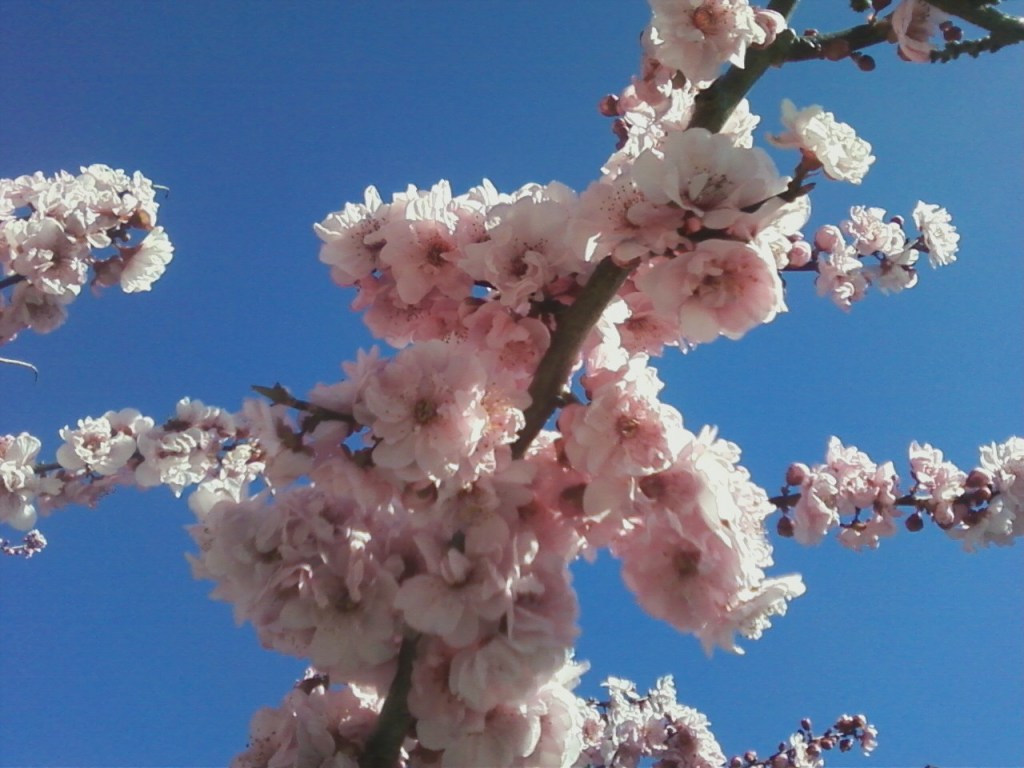
Purple Leaf Plum

Purple leaf plum bloom is more colorful than its purplish foliage.

There are actually several different purple leaf plums, Prunus cerasifera, to provide colorful white or pink bloom sometime between the middle of winter and the middle of spring, followed by colorful bronzy or purplish foliage through summer. Some also provide good fruit, which can unfortunately be messy if it is not harvested. Most stay quite compact, less than twenty feet tall and broad, so are proportionate to small garden spaces. ‘Hollywood’ is the largest, but rarely gets more than thirty feet tall, and not quite as broad. Prunus X cistena does not get much more than six feet tall and broad.

Because each cultivar has a distinct personality, it is important to match trees when adding or replacing trees in a grove. The fruitful ‘Atropurpurea’ has single white flowers in spring, followed by bronzy red new growth that turns purplish in summer and reddish brown in autumn. ‘Krauter Vesuvius’ has single pale pink flowers and the darkest foliage, but lacks fruit. ‘Thundercloud’ has similar or paler flowers, lighter or more bronzy foliage, and sometimes produces tangy red fruit about an inch wide. Prunus X blireiana (illustrated) fades to bronzy green by summer, but has handsome branch structure and double pink flowers that are slightly fragrant. Unlike plums that are grown for larger and more abundant fruit, purple leaf plums do not need much pruning.

Bronze Is The New Green

00624thumb
Color like this needs no bloom.

Bronze foliage will never actually replace green foliage. Even if there were enough variety of plants with bronze foliage to do so, too much bronze would look dreary. Bronze is just another option for foliar color in landscapes with significant vegetation. It is distinct from simpler green, and contrasts nicely with gold, blue, gray and variegated foliage. Some bronze foliage is variegated too.

There is all sorts of bronze foliage. Some is brownish bronze. Some is reddish. The most popular bronze foliage is rather purplish. It can be evergreen or deciduous. Annuals, perennials, shrubs, vines, trees and houseplants can provide bronze foliage. Most plants that provide bronze foliage are variants of plants that also provide bloom or fruit. Some are common. Others are rather rare.

Bronze foliage is not an advantage to plants that produce it. The most efficient foliage is green. Gray or bluish foliage has the advantage of reflecting some of the harsh sunlight that could scald it in severe climates. Otherwise, foliage that is a color other than green reflects more of the useful sunlight than it should. Incidentally, dark foliage also absorbs more of the sunlight that can scald it.

This is why many bronze plants are noticeably less vigorous than their greener counterparts. Although it would not be an advantage in the wild, diminished vigor makes some bronze plants more adaptable to compact home gardens. For example, the brownish bronze ‘Summer Chocolate’ silk tree will not get half as high and wide as the common silk tree. It can fit nicely into a cozy atrium.

Cultivars of purple leaf plum, Japanese maple and Eastern redbud are more familiar complaisant bronze trees. ‘Ruby Lace’ honeylocust is still quite rare. Bronze shrubbery includes smokebush, Chinese fringe flower, elderberry, barberry and ninebark. New Zealand flax, canna, houseleek, ajuga, mondo grass and coral bells are popular bronze perennials. Cordyline is a larger perennial.

Bronze foliage adds a bit more color than typical green foliage. In the right situations, it is appealing bold.