Rain Will Increase Until Late Winter

The weather is about to change.

Defoliation is the colorful beginning. It indicates that the weather is getting progressively cooler. It then gets messy with the first rain. This is inevitable at this time of year. After all, it is late autumn. Storms will become more frequent as weather simultaneously becomes cooler. So, while gardens are getting wetter, they also take longer to dry between storms.

Ironically, vegetation uses much less moisture while it is so abundant. Deciduous foliage can not perform any evapotranspiration after it defoliates. Evergreen foliage is much less vascularly active while cool. Roots can not utilize all the moisture that autumn and winter rain provides. Soil in some areas might stay moist from now until next spring or summer.

Conversely, summery weather is innately arid and warm. That is how the Mediterranean climate here operates. Moisture is either scarce or abundant. Rain will eventually stop in spring, and then not resume until next autumn. Summer thundershowers are uncommon. Gardening could likely be easier with a bit less rain for winter, and a bit more for summer.

With more rain expected, irrigation needs seasonal adjustment. Such adjustments might need to be incremental, since weather changes incrementally. Manual irrigation might be either less frequent or less voluminous, or both. The same applies to automatic systems, which have a disabling ‘rain’ option. It turns irrigation off without modifying the schedule.

Besides necessitating modification of irrigation, rain can also be messy. It dislodges and accelerates the deterioration of defoliating deciduous foliage. It causes even formerly dry soil to become muddy. A bit too much rain can cause erosion. Cleaning up such mess is less pleasurable while the weather is wet and cool. Then, the weather gets messy again.

Rain can not postpone all gardening. Spring bulbs must get into their garden soil prior to winter chill. Dormant pruning happens later in winter, prior to spring. Fortunately though, gardening is less involved than it is during spring and summer. Maintenance of tools and sorting seed can be indoor tasks for rainy days. So is shopping online for seed, plants or garden tools.

Pollen

For urban areas, the first rain of the season is typically icky. It mixes with all the crud and filth that has accumulated since the last rinsing rain of the previous spring. Damp roads smell like a mix of automotive fluids and wet tires. Asphalt roofs smell like tar. Even urban trees can initially smell like damp dust. It takes a while and a bit of rain for the crud and filth to rinse away.

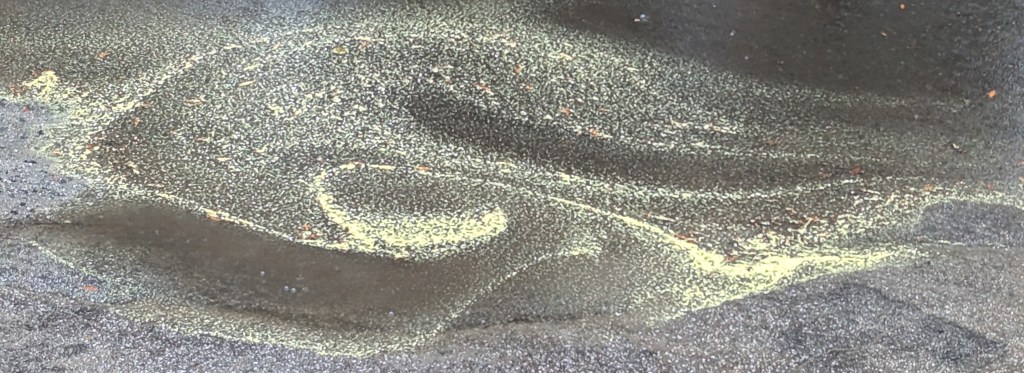
This is the second rain of the season, and in a less than urban area. It does not smell objectionable, and is not notably cruddy. However, it still flows with an abundance of pollen that had not rinsed away already. Perhaps this pollen accumulated just since the previous rain, although not much has been blooming visibly at this time of year. It is impossible to say even what species dispersed so much pollen. Nonetheless, here it is, floating in the first few puddles to accumulate. Yuck!

It is no wonder that pollen is as effective at pollination as it is. It is impressively abundant and permeating. It is also no wonder that it is such a pervasive problem for those who are allergic to it.

Watering Increases As Rain Decreases

Automated irrigation should help conserve water.

Rain is less abundant and less frequent now that winter has become spring. Humidity is decreasing. Temperatures are increasing. Moisture within both the soil and the air is less abundant than it had been. Irrigation that discontinued as the rainy season began should resume soon. Only supplemental watering compensates for the increasing lack of water.

Warmer and drier weather does more than simply deprive vegetation of natural moisture. It also accelerates new growth of formerly dormant or partially dormant vegetation. Such growth requires more moisture as it becomes less available. Increasing day lengths with intensifying sunlight enhance this need for watering. Although natural, it all seems ironic.

This recent need for watering is progressive. Rain still sometimes interrupts it, but will be less frequent as spring progresses. Rain will be very unlikely after later spring. Humidity will continue to decrease as temperatures continue to increase. Watering frequency and volume must increase accordingly. They might not begin to decrease until after summer.

Soil composition and texture also influence the increasing need for watering. Organically rich soils retain moisture more efficiently than sandy soils, for example. Gravely soils that drain well may necessitate frequent watering, even if less copious. Potted plants require frequent watering because they can not disperse roots. Hanging pots require even more.

Furthermore, different types of vegetation need different or specialized types of watering. Fibrous but shallow roots usually need frequent watering, even if they do not need much. Species with deep roots usually need watering less frequently. Some of them need more significant volumes of water than others. Some vegetation prefers only minimal watering.

With all these many variables, there are no simple formulas to determine watering rates. Manual irrigation is easiest to monitor, but is also tedious. Automated irrigation, although less tedious, requires more diligent monitoring. For any particular type of vegetation, soil should not remain too dry for too long. Also, vegetation should not exhibit any symptoms from desiccation.

Fe

ICK!

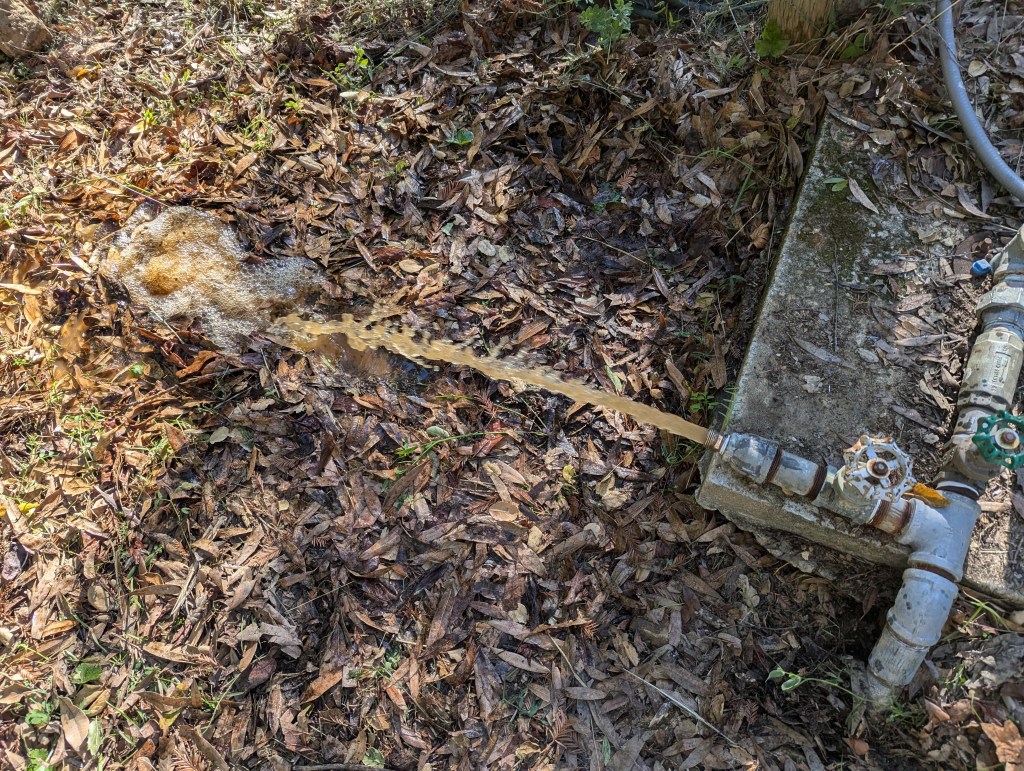
Ferrum, which is abbreviated as “Fe”, is the chemical and element name of iron. It is apparently too abundant in this well water. Actually though, it is from the lining of the well. It accumulated because the pump has been inactive for so long. I am impressed that it functions at all after being idle for so long. I am concerned about the lining of the well, though. The hydrologic engineer tells me that I must superchlorinate the well to kill most of the iron oxidizing bacteria, and then flush the well by operating the pump for a long time. That all sounds like quite a bit of risky work. I do not like the concept of pouring something into a well that does not belong there. I am also concerned about what to do with the chlorinated water as it gets pumped out. I suppose that I could apply it to undesirable vegetation around the well. There will undoubtedly be a large volume of such water; but there is also a large amount of undesirable vegetation. I suppose that I could collect some or much of the water into an otherwise unusable tank to let the chlorine slowly volatilize from it. For now, until this superchlorination process begins, I suspect that this water is safe for irrigation. I do not mind if it leaves a temporary rusty residue that eventually rinses away. The water was even muckier before, and will get less mucky as more of it is used, so it could appear to be clean before superchlorination. Besides, I suspect that mucky water is less toxic to vegetation than superchlorinated water is. Because the rain stopped as suddenly as the rainy season began, and no rain is forecast for the next week, irrigation is now becoming a priority.

Tornado

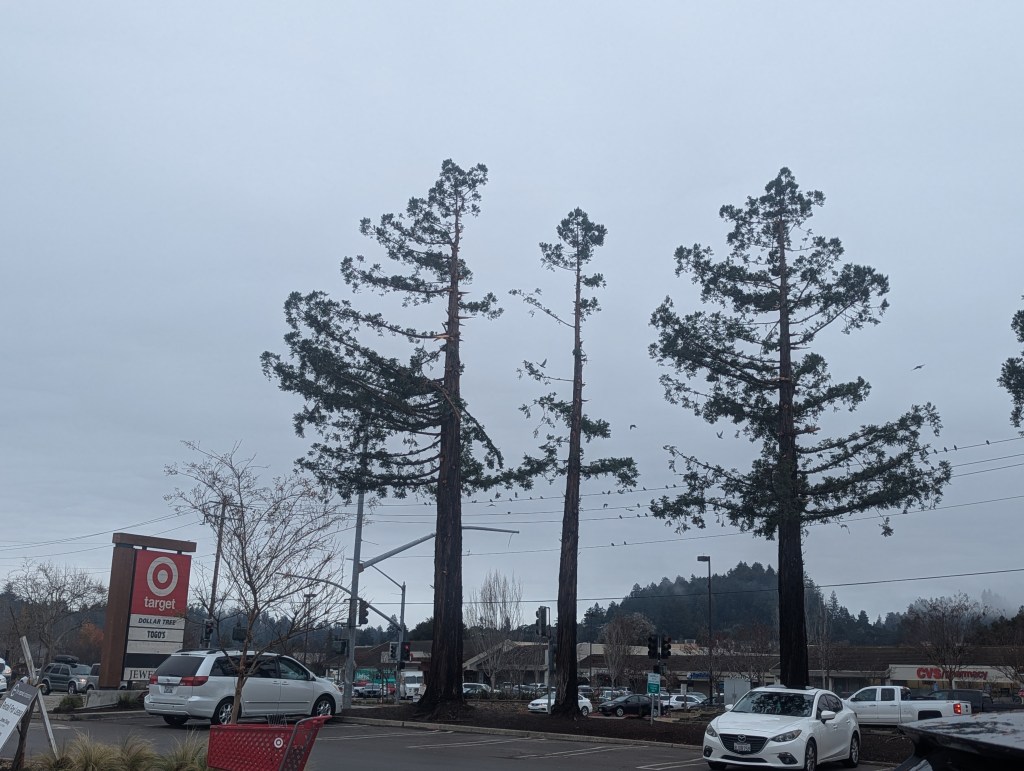
The tornado that stripped these redwoods landed right on Target. Notice the sign to the lower left.

The weather here may seem boring to those who are acquainted with other climates. It gets neither too warm nor too cold. Rain is limited to the relatively short rainy season. Humidity is minimal. Snow is so extremely rare that I can remember it only once in the Santa Clara Valley during my lifetime, and it was only half an inch deep. Tornadoes are about as rare, or at least they were. I can now remember two here, which is twice as many occurrences of snow that I can remember. Shortly after half past one last Saturday, rain, which had been falling for a while, suddenly became torrential, then instantly stopped, then instantly became torrential again. I stepped outside with Rhody to observe, and noticed Heather, Rhody’s feline ‘associate’ who prefers to stay inside during such stormy weather, had also come outside to observe, and was staring to the south. When I looked to see what she was looking at, I saw that not only were dark clouds speeding to the east, but that a portion of them was backtracking, as if swirling. My comment to Rhody and Heather was something like, “Well, at least tornadoes do not happen here.”. A few minutes later, a tornado did happen, right on Target, literally. It landed right on the Target store in Scotts Valley, less than two miles away. It was rated as an EF1 tornado, which apparently means that it was rather minor. It lasted for five minutes, though, while travelling only about a quarter of a mile. That is much slower than the clouds that we observed only a few minutes earlier. Fortunately, injuries were minimal, although a few cars were tossed. Utility cables, streetlamps and traffic signals were thrashed. So was much of the vegetation of the urban landscape.

Precipitation Should Continue Through Winter

Red sky at morning, meteorological warning.

Deciduous foliage gets colorful with autumn chill. Then, it gets messy. Then, with a bit of precipitation, it gets even messier! It seems like a waste as it all succumbs to rain and, in other climates, snow. It is sensible, though. Deciduous vegetation will be less vulnerable to stormy weather without it. Weather will be getting increasingly stormy through autumn.

This is how the Mediterranean climate here operates. The dry season that begins during spring continues until autumn. The relatively shorter rainy season centers around winter. Therefore, most precipitation occurs during winter. Spring and autumn are brief transition seasons that tend to favor the dry season. Almost no precipitation occurs during summer.

Spring and autumn transitions between rainy and dry seasons are innately variable. The rainy season tends to finish early during spring, but may not. It sometimes pauses before resuming. It may do so more than once. Conversely, the rainy season tends to begin late during autumn, but may begin earlier. Occasionally, precipitation begins disturbingly late.

Generally, the first significant storm with significant precipitation begins the rainy season. This may be difficult to believe with typically significant time between the first few storms. Yet, with cooler weather, elevated humidity, and shorter daylength, moisture lasts longer. Precipitation, even if merely drizzling fog, will likely dampen gardens before they get dry.

Irrigation obviously does not need to be as generous as it was during summer. Until next spring, some vegetation will require none at all. Not only will weather provide and retain more moisture, but vegetation uses much less. Refraining from manual irrigation is easy. Adjustment of automated irrigation systems actually requires more effort and awareness.

As deciduous species defoliate for winter, some other species might get more vivacious. Cacti, agave, and some yuccas that lack irrigation become more turgid with precipitation. Remaining palo verde foliage is likely to become greener and fresher prior to defoliation. Most xeric species utilize moisture from precipitation as it becomes available seasonally.

Automated Irrigation Should Adjust To The Weather.

Some irrigation becomes temporarily obsolete through the rainy season.

Now that it has started to rain, what should be done with automatic watering systems? In almost all situations, automatic irrigation systems should be adjusted to accommodate for moisture provided by rain. If rain is sufficient to provide enough or too much water, irrigation can be discontinued until needed again when the rain stops a few months from now.

If the first few storms are discontinuous enough with warm and dry weather mixed in between, lawns and plants that want more substantial watering may need to be watered a few times until the rain becomes more reliable. However, because of cooler temperatures and shorter days, plants do not use nearly as much water as they did during the summer anyway, so do not need to be watered nearly as much as they were only a month or so ago.

Deciduous plants that are losing their leaves need the least moisture, since they can not lose any moisture through evapotranspiration (evaporation from foliar surfaces). The very few plants that bloom or even start to grow during winter use a little bit more water than those that really are dormant, but are still likely get all they need from rain even without getting watered.

Flowering annuals, particularly left over warm season annuals that continue blooming late, may get moldy with too much rain. Their flowers and some of their foliage can turn to mush until there is a break in the rain. Removal of damaged flowers and leaves slows the spread of the mold but does not cure it. Good air circulation among well spaced plants and in exposed areas helps inhibit mold. Regardless, moisture from abundant rain can eventually cause mold to be a problem.

In fact, the only plants that are not likely to get all the water that they need from rain are those that are in pots and planters under eaves or in the home as houseplants. Nonetheless, sheltered plants that are outside should still get much less water now than they do during the long and warm days of summer. These plants are either dormant or at least more sedate because of the shorter cooler days through winter. Houseplants may likewise use less water because the home environment is also cooler.

However, if the heating system of the home decreases humidity, some large houseplants may actually want a bit more water through winter! Humidity fluctuates most in older deficiently insulated homes that are heated by wood stoves or fireplaces; since these homes get humid without a fire burning, but then get much drier with a fire. 

Six on Saturday: Attempted Autumn

Astronomical autumn began more than a month ago. It is about a third done, with about two thirds remaining. Meteorological autumn can start at any time. Sometimes, it starts, but then pauses before restarting a bit later. Sometimes, the first rain is the beginning of the rainy season, which typically continues through winter. A bit of rain arrived between Wednesday and Thursday, and a bit more is here now, but no more is in the forecast for next week. Regardless of future weather, some flowers bloom, or at least try to, as late as they possibly can. Of course, some actually prefer to bloom even later and during winter. Apologies for the lack of focus of pictures #4 and #6.

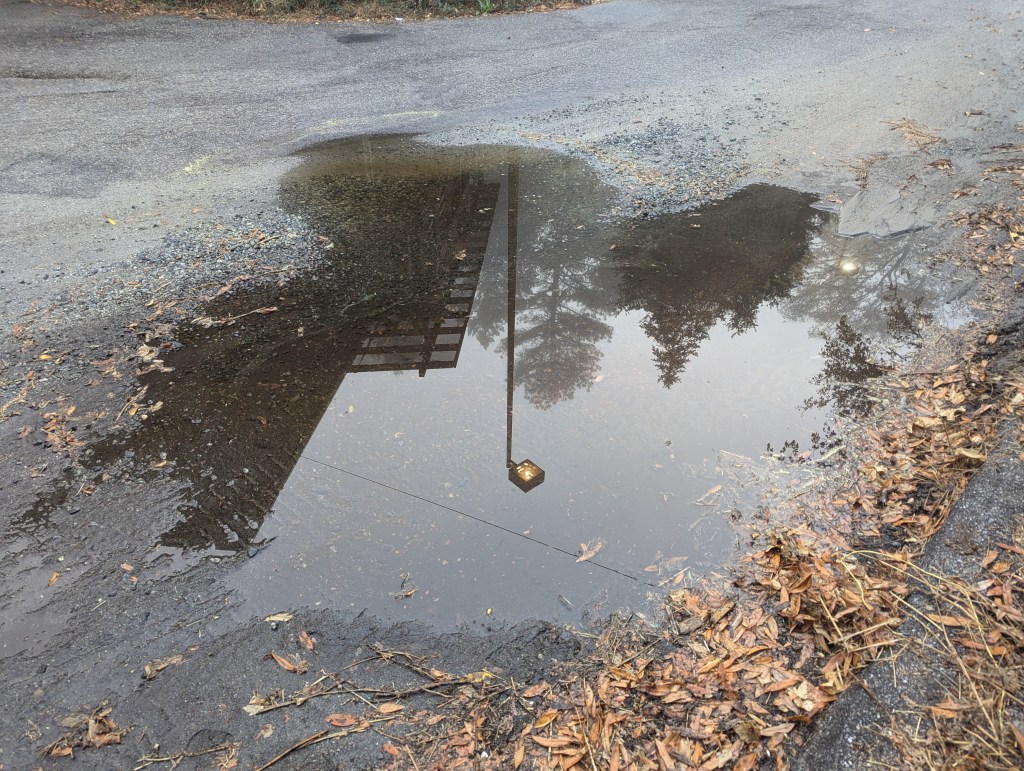
1. A ‘chance or rain’ in the weather forecast here is generally not taken too seriously until something like this happens. It is a genuine puddle. It is wet, and full of water from rain.

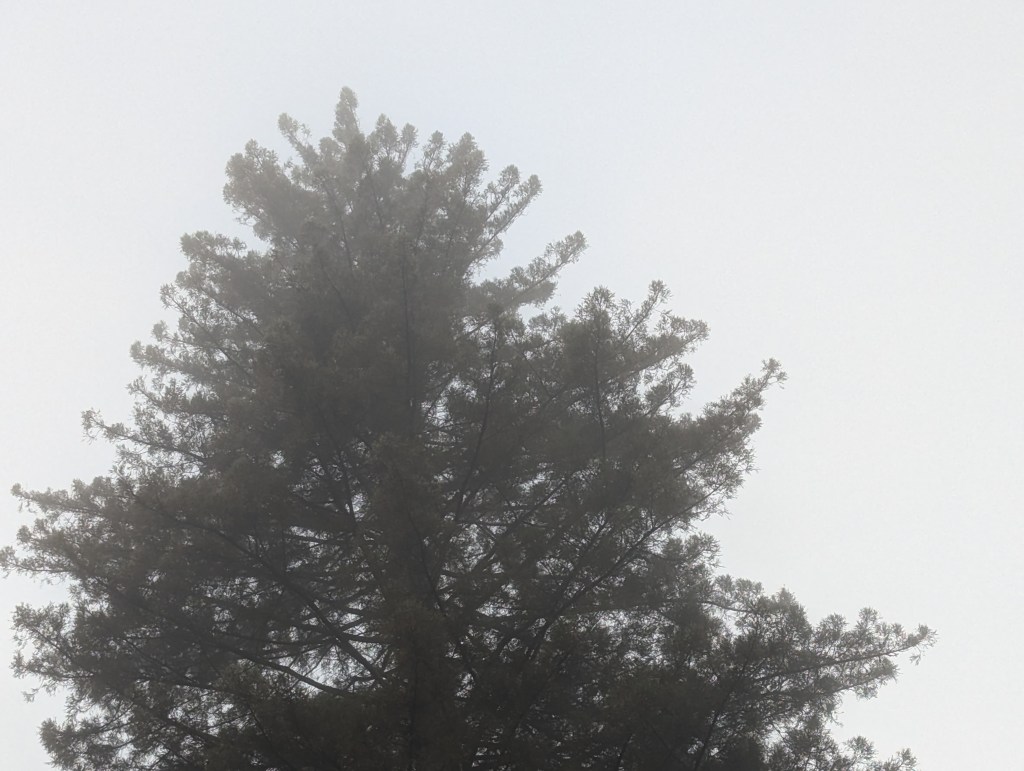
2. Sequoia sempervirens, coastal redwood seems to enjoy this damp weather. It actually enjoys all weather, but appears to be more refreshed by any interruption of arid warmth.

3. Lemna minor, duckweed is even weirder with this border of white foam that develops as the first rain washes away pollen and dusty crud that accumulated since the last rain.

4. Hedychium coccineum X coronarium ‘Peach Delight’ ginger lily, which was blooming for last Saturday, is trying to bloom again. I already doubted its ability to follow through.

5. Brugmansia X cubensis ‘Charles Grimaldi’ angel’s trumpet looks like Carl’s Junior ate too much of its own food. I added this because of response to angel’s trumpet last week.

6. More interestingly, it produced this seed pod. Such hybrids should be sterile. I can not help but wonder if seed is true to type. If so, propagation by cuttings is easier than seed.

This is the link for Six on Saturday, for anyone else who would like to participate: https://thepropagatorblog.wordpress.com/2017/09/18/six-on-saturday-a-participant-guide/

Irrigation Resumes With Drier Weather

Spring gets progressively drier and warmer.

Spring, in several regards, is like autumn in reverse, or vice versa. Bloom increases for spring but decreases for autumn. Foliage increases for spring but decreases for autumn. The two seasons are in opposition. In this chaparral climate, the rainy season that began last autumn ends now. Irrigation that became redundant then becomes necessary now.

Diminishing rain is not the only reason that irrigation becomes more important for spring. Spring weather also becomes warmer and more arid, or less humid. Warmth and aridity increase evaporation of moisture that rain deposited not long ago. Increasing day length, intensifying sunlight and warmth accelerate plant growth. Such growth consumes water.

This need for moisture is progressive, though. Vegetation certainly requires more water as the weather becomes warmer and drier. However, it does not yet require as much as it will require later during summer. By then, the weather will be even warmer and drier, and the days will be even longer. Irrigation should increase accordingly in regard to weather.

Unfortunately, there are no simple formulas to determine how much irrigation is needed. Some vegetation with shallow roots may require frequent but moderate irrigation. Some vegetation with deep roots may prefer less frequent but more copious irrigation. Rain is possible at any time. It can briefly interfere with the most efficient of irrigation schedules.

Soil also affects irrigation. Sandy soils drain efficiently, but do not retain much moisture. This may not be a problem for some species that tolerate occasionally dry soil. It may be more of a concern for species that prefer more regularly moist soil, though. Dense soils retain more moisture, but do not drain as efficiently. Soil amendments can improve soils.

Manual irrigation is easier to monitor than automated irrigation, but can be tedious. That is why most irrigation is automated nowadays. Automation is more likely to be excessive than insufficient. Desiccation, wilting and other symptoms of insufficiency of irrigation are obvious. Symptoms of saturation may not become obvious until too late for remediation.

Horridculture – Rainy Days and Mondays (deferred from Wednesday)

Deferred maintenance has consequences.

Karen Carpenter famously said, “Rainy days and Mondays always get me down.”

Several old and deteriorating box elders on the roadside outside the gate at work have survived many rainy days and many Mondays during the past many years that they have grown there. Earlier this week though, a rainy Monday brought one down.

It was no surprise. All of the several box elders there are in very bad condition. Most are completely dead and collapsing. However, I can do nothing about them because they extend over the roadway. They must be removed by a County Crew who can remove them safely. Unfortunately, they are unable to do so in a timely manner while so much similar work is needed throughout the County.

The problem with the demise of this particular tree is that it fell onto the hood of a Ford F150 that was travelling toward town. The Ford swerved and collided with a Subaru station wagon of some sort that swerved off the other side of the road, where it seemed to stop just inches from a utility pole. The tree or portion of the tree that fell was not very big, but indirectly caused extensive damage to both vehicles, and necessitated lane closures while the vehicles were removed.

In the picture, which was taken as I opened the gate for the crew, the Subaru is still visible on the opposite side of the road, at the center of the picture. The Ford has already been removed to the side of another road that extends to the right in the distance, beyond the bridge, where the traffic signals are. The taillights belong to one of the responding Sheriff’s cars. Most of the debris from the fallen box elder has already been pushed into the ditch to the right.