For urban areas, the first rain of the season is typically icky. It mixes with all the crud and filth that has accumulated since the last rinsing rain of the previous spring. Damp roads smell like a mix of automotive fluids and wet tires. Asphalt roofs smell like tar. Even urban trees can initially smell like damp dust. It takes a while and a bit of rain for the crud and filth to rinse away.
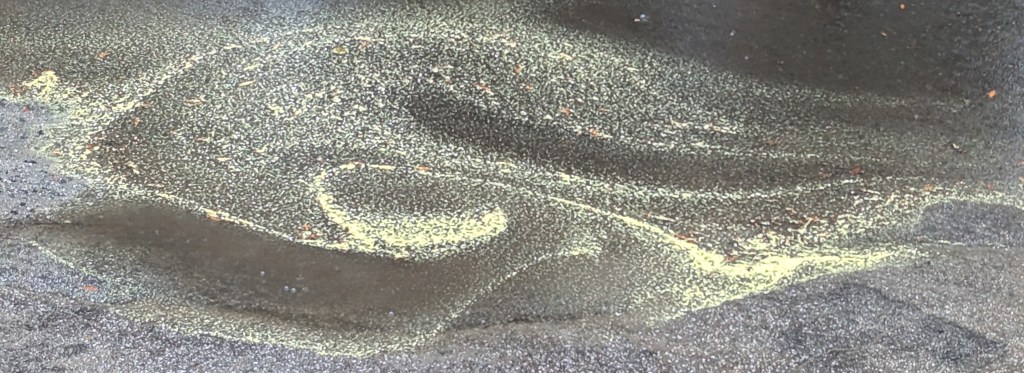
This is the second rain of the season, and in a less than urban area. It does not smell objectionable, and is not notably cruddy. However, it still flows with an abundance of pollen that had not rinsed away already. Perhaps this pollen accumulated just since the previous rain, although not much has been blooming visibly at this time of year. It is impossible to say even what species dispersed so much pollen. Nonetheless, here it is, floating in the first few puddles to accumulate. Yuck!
It is no wonder that pollen is as effective at pollination as it is. It is impressively abundant and permeating. It is also no wonder that it is such a pervasive problem for those who are allergic to it.
The ‘Week of Flowers’ theme was fun for the past several weeks, but the beginning of the rainy season is rather important locally. I suppose I should have gotten more interesting pictures instead of rotting stumps, a leaky gutter and a bare cottonwood tree. Hopefully, they are not as bad as this sounds. If the first five are, the sixth might compensate. There really are no flowers, though.
1. Winter is the rainy season here. It is probably appreciated more than in other climates because it is the only time that significant rain falls. If a thunderstorm passes through in summer, it might start a fire without enough rain to put it out. Anyway, gutters still leak.
2. Rain was sufficient to finish defoliation of this grand cottonwood out back. The foliage had been bright yellow for quite a while. It does not need much chill to develop splendid color. Windy weather typically dislodges the last of it. This year, rain finished it off first.
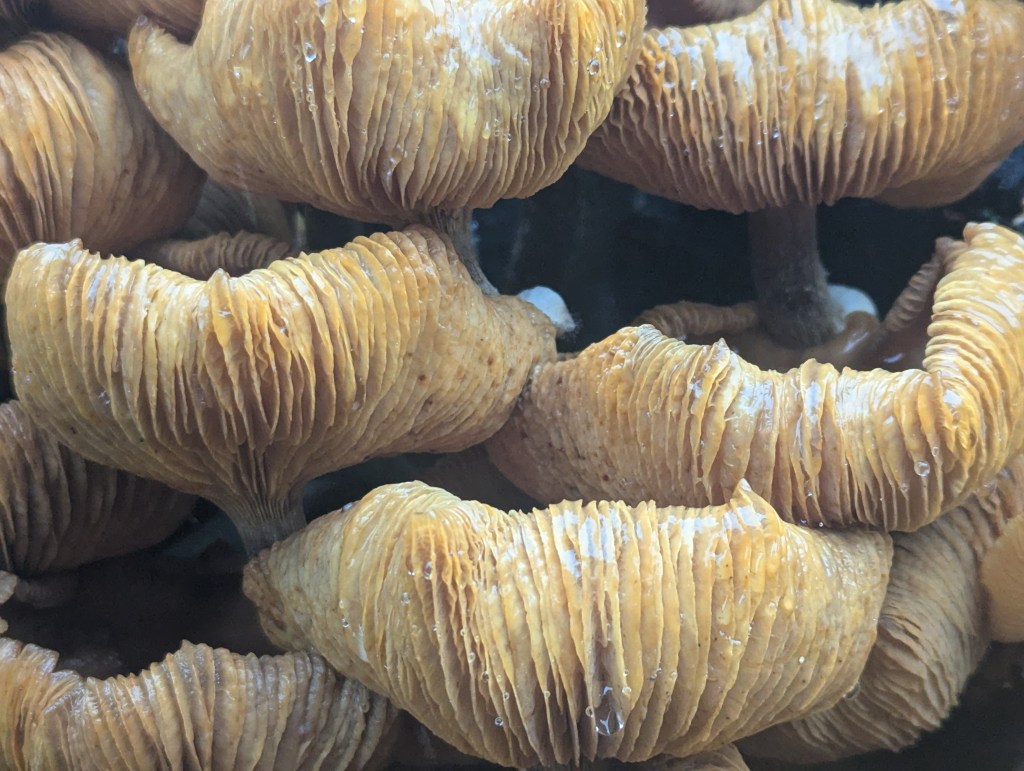
3. Mushrooms grow as the forest dampens through the rainy season. These are growing from a coast live oak stump that has been rotting for several years, but is somehow quite sound. I have been unable to dislodge it, even as the roots rot enough for the soil to sink.
4. Mushrooms that are growing from a rotten toyon stump are weirder, but could be the same sort at a more advanced state. I should recognize them since they do this annually. Some hideously big mushrooms grew elsewhere, but are already melting into black goo.
5. The madrone stump that was maintaining the integrity of the top of this embankment has been rotting for many years. Actually, I am impressed that it remained intact as long as it has. It looks worse from the other side. I could post a picture of that on Wednesday.
6. Heather would not cooperate for a picture against the clear sky between rainy weather a few days ago. She really just wanted to roll around on the sunny pavement, which was still damp and probably cold. She is impressively tolerant of this sort of embarrassment.
Burned trees are visible on ridge tops within the CZU Fire zone.
Rain is gratifying at the beginning of the rainy season. We all know that it has potential to become excessive later in the season, but we are not yet concerned with flooding or mudslides. After a typically long and dry summer, we enjoy it while we can. A storm that finished earlier yesterday was relatively minor, but was nonetheless the first significant storm of this new rainy season of 2023 and 2024. Only minor drizzle preceded it.
The beginning of the rainy season is also the end of the fire season. Forest fires become less likely as the forests become more saturated through the season. However, rain also sustains growth of vegetation that will become combustible during the following fire season, especially if the weather becomes unusually warm and arid by then. Unfortunately, this is the natural pattern of the climate here. Fire is a major component of local ecosystems.
Three years ago, the CZU Fire was the most destructive forest fire within documented history of this region. Larger fires likely occurred prior to documented history, but burned forests that expect to occasionally burn, without damage to unnatural infrastructure that did not exist at that time. Prehistoric fires were likely less common than modern fires, but involved much larger areas. They also likely burned faster and less violently. Modern forest fires involve more fuel because of regeneration of hardwood species after clear cut redwood harvesting a century ago. That is why so many coastal redwoods that survived several fires during their long lives succumbed to the CZU Fire.
Much of the marginal area of the CZU Fire is regenerating efficiently enough to eliminate evidence that it burned so recently. The scenery of areas that burned more severely remind us why we are grateful for the beginning of the rainy season.
Seasons here may seem to be less extreme than they are within other climates. Summer warmth is rarely too hot, and when it is, it does not continue for too long. Winter chill may be insufficient for some plants that rely on it to sustain their winter dormancy. Autumn and spring are as notable for the first and last seasonal rain as for colorful foliage and bloom.
This is actually very relevant within local chaparral climates. Rain and lack of rain define seasons here as much as extremes of temperature. Where the traditional four seasons of winter, spring, summer and autumn merge so softly, the rainy season and the dry season generally do not. Rain begins abruptly in autumn, and ends almost as abruptly in spring.
Consequently, home gardens can get inhospitably dry without adequate irrigation during more than half of the year. Then, they may require no irrigation for almost half of the year. Warm weather that coincides with the dry season enhances aridness. Cool weather that coincides with the rainy season enhances dampness. Mild climates can get extreme too.
Recent rain ended both the dry season and the fire season, and began the rainy season. For many plants, irrigation will be unnecessary until the dry season resumes next spring. Plants that continue to require irrigation will require much less, and only as their soil gets dry during prolonged lapses of rain. Therefore, automated irrigation requires adjustment.
Potted plants, bedding plants and young plants with minimal root dispersion will be more likely to want watering during warm lapses of rain. Substantial foundation plants beneath eaves generally extend roots beyond sheltered soil, but some do not. Also, potted plants under eaves of porches are unable to reach rain moistened soil with their confined roots.
While diminishing the need for irrigation, rain can be messy. It is, of course, wet. It makes soil muddy. Runoff can cause erosion. Stormy weather, which typically involves both rain and wind, dislodges copious foliar debris. Such debris accumulates while no one wants to go outside during stormy weather to rake it. Inconvenient timing seems to be a pattern. Yet, rain is undeniably gratifying.




 Tony Tomeo