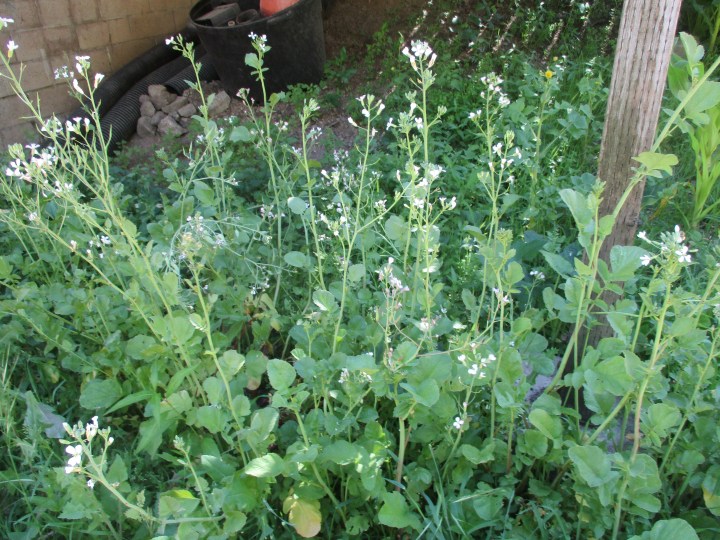
Radishes seemed like a good idea back when I sowed the seed in the garden. I had not grown any in many years. I thought that the particular location would be cool enough to inhibit bolting, even though it was starting to get close to the end of their season here. They are definitely a cool season vegetable here, with brief seasons in spring and autumn. Some linger through winter.
The seed germinated efficiently. The seedlings started out well. Radishes are small roots that mature in only about three weeks. Technically, they were right on schedule. I happened to get a few tiny radishes from the batch. However, after the seed were sown, but before the radish roots developed, the formerly cool spring weather warmed suddenly enough to stimulate bolting.
The elongation of floral stalks was visible within the foliar rosettes of most of the individual radishes while they were still quite dinky. Initially, I thought it would be no problem. There were a few good radish roots, which was all I needed to brag to my colleague down South about. Those that bolted would sort of be palatable as radish greens. Bitterness does not bother me much.
Now, because so few of the radishes were pulled for their roots, too many are growing as greens, and they evolved from merely bolting to blooming. The flavor evolved from normal bitter to almost icky bitter. I will not be sharing these with anyone. I can not leave them in the garden to get shabby either. Besides, I want the space for something else. I suppose I will freeze some.
After all the effort, I got only a few small radishes, some decent greens, and mostly bitter greens. Perhaps I will try radishes again in autumn. This radish trial was a ‘FAIL’.
Even Charlie Brown would reject this little blue spruce.
No one wants to cut down this little blue spruce. What is worse is that no one wants anyone else to cut it down either. We all know it is ugly. We all know that it can not be salvaged. We all know that it really should relinquish its space to the healthy and well structured coast live oak next to it, in the lower left of the picture. Yet, it remains.
It was planted amongst a herd of gold junipers in about 1980 or 1981, shortly after the construction of the adjacent buildings. An abandoned irrigation system indicates that it was likely irrigated for some time afterward, although it is impossible to know for how long. Otherwise, it and the junipers were completely ignored for the last four decades.
When the vegetable garden was installed nearby, brambles, weeds and trash that had been accumulating for forty years was removed from the area. A few of the most decrepit junipers that were not worth salvaging were removed too. The young and feral coast live oak that grew next to the spruce should have been removed as well, but is actually in very good condition.
Furthermore, the coast live oak is a better tree for the particular application. It is native, so does not mind neglect. The spruce was never really happy there, which is why it is so puny and disfigured now, with the lower two thirds of the trunk bare of limbs and foliage. Obviously, the spruce should be removed so that the oak can continue to develop as it should.
We just like the spruce too much to remove it directly. Even though it would look silly if the bare trunk were exposed by the removal of the oak, the bit of foliage on top is so pretty and blue and familiar. I mean, it looks like we have a spruce in the yard; and everyone likes a spruce!
The plan is to subordinate it to the oak. As the oak grows upward and outward, the lower limbs of the spruce will be pruned away to maintain clearance. Eventually, the spruce will look so silly that the landscape would look better without it, and we will not mind cutting it down so much. It will be unpleasant, but it will be better than interfering with the development of the oak.
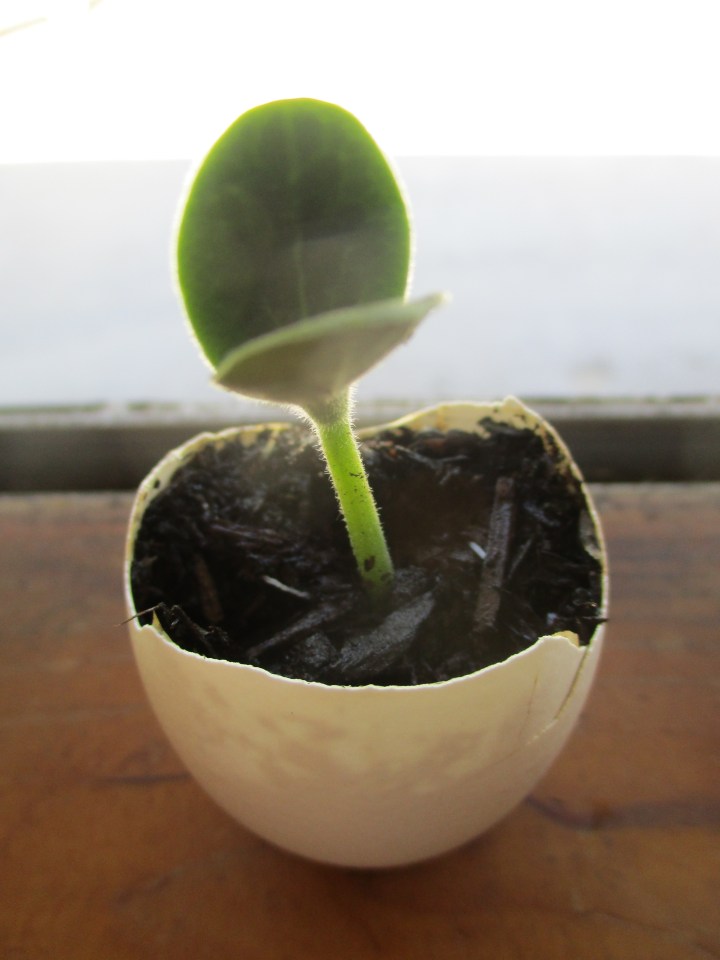
This was not planned very well. Actually, it was not planned at all. While sorting through the seed for a vegetable garden, I found a can of seed for winter squash that was a few years old. They might be close to five years old. I really do not remember. I did not expect them to be viable, but did not want to discard them without at least trying to test them for viability.
Rather than just put them in damp rag for a few days, I plugged a few seed into a spider plant on a windowsill, and forgot about them. I really did not expect to see them again. When the first one emerged, I though it was a weed, so plucked it out. When I realized what it was, and that it came out intact, I felt badly for it, and like the original seed, could not discard it.
I do not remember why, but at the time, I did not want to go out to can it in a real pot. Nor did I want to plug it into the garden while I was still getting other seed situated. I therefore planted into an empty eggshell from those drying for coffee. I scraped a bit of medium from a potted bromeliad. It was happy on the windowsill for maybe a few weeks.
The other seed germinated too, but were more carefully removed and plugged into the garden. Since the seed was still viable, I sowed more around the junipers outside. Somehow, in the process, I neglected to put the little seedling in the eggshell out into the garden with them. It has not been happy in here, so has not grown much at all.
Now that the winter squash are already growing well outside, and the summer squash are already producing, this unfortunate seedling still needs to go out to join them.
If I were to grow seedlings inside again, I would do so in some of the cell packs that we recycle from work. They are more efficient, less wobbly, and they do not look so ridiculous.
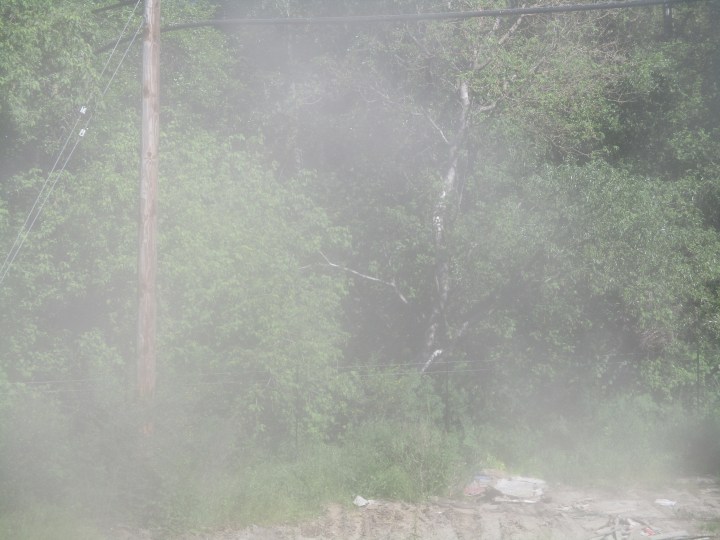
Cimarron County in 1940 or the road out back last Wednesday?
In a commotion that an Okie would flee from, the road out back got blown last week. What a mess! Dust was everywhere, and I mean, except for the road from which it was blown, it went ‘everywhere’. The engines of the two blowers at full throttle echoed loudly against pavement, the cinder block and metallic walls of the industrial buildings, and under the broad eaves above.
Fortunately, no one else was here to be bothered by it. Actually, no one would have been as bothered by it as we were by the crud that was on the road prior to getting blown. We know that blowing is sometimes necessary. There are only a few windows on the industrial buildings, and they were all closed. The few vehicles that happened to be parked nearby were already dirty.
Where I lived in town many years ago, the apartment buildings to the north and south were ‘maintained’ by so-called mow-blow-and-go ‘gardeners’. The building to the south lacked a lawn, but there was plenty of shrubbery there to be destroyed, even though the name of the technique does not rhyme with the rest of the routine. For both buildings, blowing dust was extreme.
There was no attempt to be tactful about it. The so-called ‘gardeners’ operated their blowers very loudly at full throttle, with no regard for where all the crud went from the pavement. Much of it went onto cars in the carports. Much went into the washrooms. Almost monthly, I needed to ignite the blown out pilot for the water heater in the washroom of the building to the north.
Both back corners of my garden were paved. There was a small paved laundry yard to the north, and a small paved trash yard to the south. The so-called ‘gardeners’ on both sides removed the kickboards from below the rear panels of those dreadful fences that I disliked so much, and blew the detritus from the neighboring properties into may back yard as if I would not notice.
When I replaced the kickboards, the so-called ‘gardeners’ broke pieces of them out, and continued with their technique. There was not much detritus from pavement that got blown weekly, but it was enough for me to collect and show to the property management of the adjacent apartments. It put the ‘go’ in ‘mow-blow-and-go’. It was the same technique only a few years apart.
As necessary as they are, and even though they can be used properly and tactfully, blowers still annoy me. The noise, the dust, and the seemingly innate disregard for others are not justified by their efficiency. I have used them, so I know that a practical degree of tact does not compromise efficiency. They exemplify the worst of what a formerly respectable industry has become.
Rhody, . . . because everyone loves Rhody, . . . and this is not about horticulture anyway.
This is not a misspelling of a misspelling. There is no misspelling of “Horticulture” in the title this week. “Horridculture” is typical of my rants on Wednesday. It is not the only deviation from the norm here. I included the contraction of “It’s” in the title. I have been trying to relax my otherwise objectionably uptight writing style; but a contraction in the title still makes me cringe.
“Horridculture – It Is What I Do Not Do.” would be consistent with my style, but silly, and not so relevant to the subject matter. I am a horticulturist, arborist and garden columnist. I enjoy what I do very much, which is why I made a career of it. It is demanding work though, and does not afford much time for blogging. The quality of my blogging is consequently compromised.
I still work as many as three days weekly at a job that was supposed to be temporary two years ago! It is so excellent that I can not bear to leave, although I must eventually do so. It entails the maintenance of many acres of landscapes and forest at a Christian Conference Center. We have been unable to work for the past month, so will be busier than typical as we resume work.
Mondays and Tuesdays are my days for writing my weekly gardening column. I should probably retire from this work, but enjoy it so much, and would prefer to instead expand it into other publications to fill in the gaps between San Francisco and Los Angeles. I do intend to simplify this writing, even if expanding it; so that I can do it all on Mondays like I used to not so long ago.
For more than the past two years, I have not inspected trees or landscapes for other arborists or landscape professions. There just is not sufficient time! I do miss that work, and composing reports for those who dislike writing. (Arborists and landscape professionals who enjoy their trees and landscapes innately dislike writing.) If I ever resume such work, it will be only rarely.
I intend to eventually return to the farm where I belong, and resume production of horticultural commodities. As much as I enjoy the rest of what I do, growing things is what I do naturally. It is why my ‘temporary’ job was supposed to be ‘temporary’ two years ago. It will involve even more demanding work than what I already can not keep up with, but it is what I need to do.
Therefore, I will have even less time to devote to blogging. I intend to continue to post my brief weekly gardening column in two parts on Mondays and Tuesdays, as well as old articles from the same gardening column in two parts on Thursdays and Fridays. I would also like to continue with Six on Saturday and other brief posts for Saturdays at noon, Sundays and Wednesdays.
I write for my gardening column weekly regardless of the blog. Old articles from the column are already written. Only new posts for Saturdays, Sundays and Wednesdays need to be written separately; so some or all will be omitted if necessary. What I must discontinue now is my involvement with the many compelling blogs that I have been following for the past many months.
I will not stop following any of the blogs that I presently follow. I will just not be able to read all of the posts, or interact with them like I had been. For me, it will be quite a weird adjustment. I feel obligated to read much of what others post into blogs that I follow. If someone puts effort into positing it, then it must be important. I certainly enjoy how others interact with my blog.
I certainly do not want anyone to think that I lost interest in their respective blog. Many of them provide ideas for what I should write about within the context of my own weekly gardening column. Insight into horticulture in other climates, regions and even cultures has been fascinating. This is merely something that I must sacrifice in order to continue on with my own writing.
This is the backside of some of the better junipers!
Junipers have a bad reputation. They earned it at a time when they were too common. Too many were installed into situations that they were not appropriate for. As they grew, they were unpleasant to handle. If not handled enough, they became overgrown and shabby. Once that happened, there were nearly impossible to prune back into confinement without being ruined.
I was never one to completely subscribe to that bad reputation. There were just too many junipers that I really liked, particularly the Hollywood juniper and the Hetz blue juniper. There were a few that I disliked, and I still loath the common tam juniper, but they were in the minority, and happen to be the same sort that are becoming more scarce.
For landscape situations that they happen to conform to, there really is no reason for junipers to be any less appropriate than any other genus is. They are happy with local climates and soil types. Once established, they do not need much water at all, and many need no supplemental irrigation. They last for a very long time. Best of all, they need only minimal maintenance.
However, even some of the best junipers are not perfect. I know. I just needed to work with some that were installed in 1980, and, except for getting pruned back around the edges, were completely ignored. After days of trying to tame them, I can not longer deny that some of what I have not wanted to believe about them is very true.
Besides all the trash and road debris that had been dumped into them during the past four decades, they were thickly infested with Himalayan blackberry. Removing the bramble was not only wickedly unpleasant, but it exposed bare spots where juniper foliage had been shaded out. Removal of a few junipers that had been overwhelmed and died left even more bare spots.
Well, I could not just leave all the dead twiggy growth under the bars spots, so tried to remove some of that too. That only exposed more of what what under and behind it, and caused the well foliated stems above to sag into the whole mess. In the end, the junipers are an unsightly mess, and I know that they will stay that way for a very long time.
Removal of all the bramble and dead junipers exposes a lot of bare branches.
Would these hanging potted plants even be noticeable if they were not circled?
Container gardening is overrated. Perhaps not so much now as it had been while it was more of a fad a decade or so ago, but it is still overrated nonetheless. Most plants are happier in the ground than they are in confinement. They want to disperse their roots freely to where the goodies are, and not contend with the unnatural temperature fluctuations of contained medium.
There are only a few exceptions for which containment of potted plants is an advantage. Houseplants are the most obvious exceptions. Also, plants that are sensitive to frost can be relocated to sheltered situations for winter if contained. Potted orchids and other flashy bloomers can be prominently displayed while blooming, and then returned to utilitarian locations as they finish.
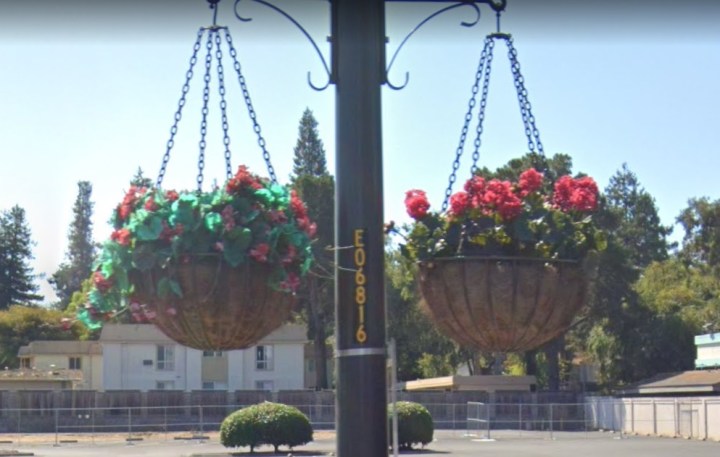
The justification for the hanging potted plants in the picture above escapes me. Does anyone besides me even notice that they are there? They are hung too high for anyone on the sidewalk to appreciate them, or actually see the flowers that are visible from above. Those on the opposite sidewalk can see them, but only at a great distance across all those lanes of El Camino Real.
Those in cars on the road see less of them than pedestrians. Even those who happen to look up while riding past in convertibles with the tops down will see only the undersides, and only at significant speed. These potted plants would be in the way of the sidewalks if they were lowered to be more visible. No matter where they are, they are not proportionate to the broad road.
Maintenance of the flowers in these many hanging pots was quite a bit of work. The annual flowers needed to be replaced a few times a year, or more if ruined by the weather. Without automated irrigation, someone needed to manually water them, which left puddles on the sidewalks that were more noticeable than the highly hung pots above.
As if all these hanging pots were not already tacky enough, the flowers within were eventually replaced with . . . fake flowers, as seen in the picture below.
Just when it could not get any tackier; they are fake!
A bit of Boston ivy adds a bit of texture and color to the stone wall.
My rant for this week is that I was deprived of my rant. I went to a nearby landscape that had been trashed by the so-called ‘gardeners’ for many years, only to find some unexpected and major improvements. I do not know what happened. Although it will take some time for the landscape to recover from the prior damage, it is already starting to function as intended.
It is obvious that the landscape was very well designed. Although I know very little about design, I know what is horticulturally correct. The designer selected species that are very appropriate for every application, even though none were particularly trendy at the time. Those who were hired to maintain the landscape only interfered with its intended development.
I noticed several improvements, but got pictures of only two features that bothered me the most prior to this season.
Obviously, the landscape designer intended the trailing rosemary in the picture above to cascade over the stone retaining wall, not so much to obscure the appealing stonework, but to break up its expansiveness. Obviously, the Boston ivy was intended to climb up from below to do a bit more of the same, and provide a bit of color in autumn, without overwhelming the rosemary.
Until recently, the so-called ‘gardeners’ had shorn the Boston ivy into useless little globs at the base of the wall. If it crept onto the wall, they were sure to remove it just as it was starting to exhibit color for autumn. The rosemary was never allowed to hang over the edge, and typically got shorn just as it was beginning a bloom phase.
Now, the Boston ivy is allowed to climb the wall somewhat. I suspect that it will be partly removed through the year, just so that it can provide a bit of color by autumn, but without getting too overgrown. Also, the formerly shorn edge of the rosemary is beginning to take on a natural form, and will likely start to cascade through summer, hopefully with occasional thinning.
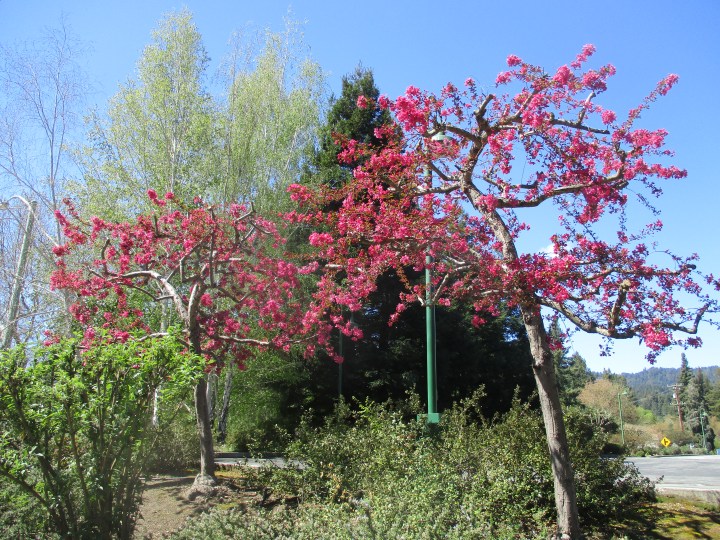
What bothered me even more than the glaringly bare wall was how this pair of flowering crabapples in the picture below got hacked back annually just as the flower buds were beginning to show the slightest bit of color. Seriously! Every little twig that could have bloomed was removed. The so-called ‘gardeners’ were weirdly punctual about this.
Well, the trees got pruned a bit earlier last winter. What I did not bother to notice earlier was that much of the unsightly stems that had been disfigured by what the so-called ‘gardeners’ did to them were pruned back to healthier growth, while much of the blooming stems were left intact to bloom now! All the damage can not be repaired in one season, but this a great start.
Someone is putting serious effort into renovating these flowering crabbaple trees.
Okay, so I felt slightly guilty about not posting anything of any horticultural interest today. Okay, perhaps a bit more than slightly. Okay, perhaps guilty enough to post a few pretty flowery pictures . . . and the last one, which some might find objectionable.
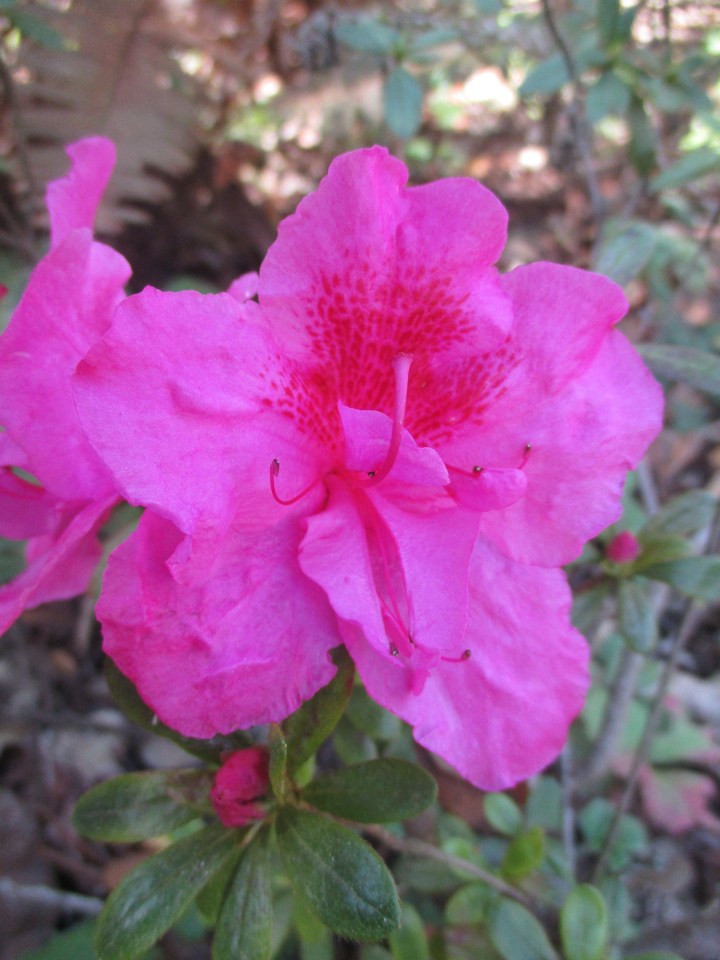
‘Coral Bells’ is not one of my favorite azaleas, but is reliable and profuse.
I will not put much effort into this. I did not even take these pictures for any particular article. I am only sharing them here and now because I have no use for them, but did not want to just file them away unseen forever. Hey, these flowers work hard to bloom!
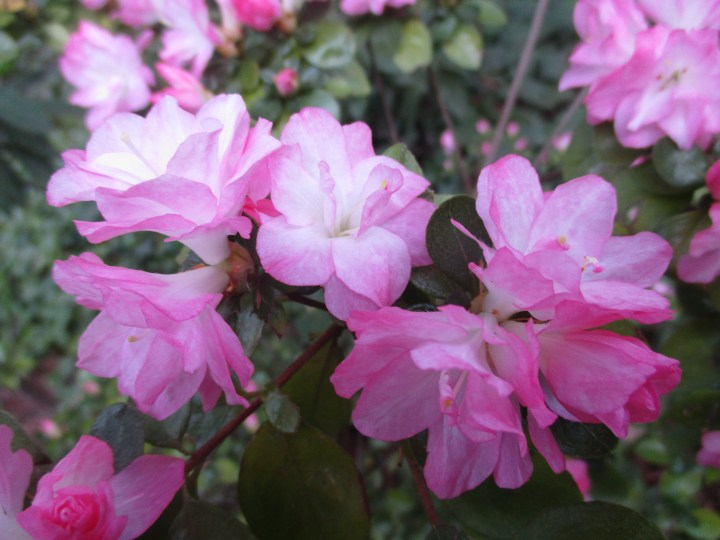
I have no idea what this azalea is, but I am impressed.
Actually though, except for the last picture, all are about a month old. The last picture is half as old, and the bloom that is shows continues. Otherwise, the other blooms are already finished. Although colorful, none are particularly remarkable or interesting.
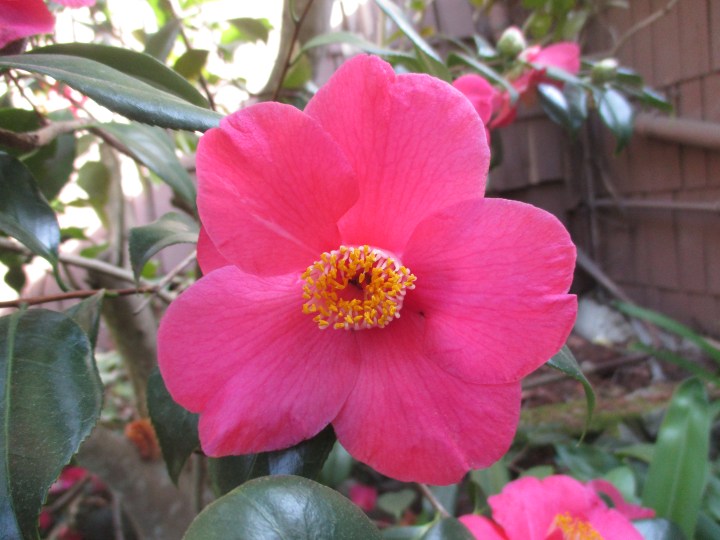
This odd camellia seemed to grow from the base of a bigger and older specimen, as if it is a sucker from understock. However, there is no indication that the original specimen is grafted. Nor is there any reason why a Camellia japonica should be grafted. The odd camellia could have grown from seed. It is rare but not impossible for Camellia japonica to produce seed here. It is not crowding anything, so remains.
This odd camellia looks like it could be an extra on the Muppet Show.
I really should eradicate this pampas grass. However, it has been here for many years without becoming aggressively invasive. We have observed no seedlings nearby. Besides, even if we did eradicate it, there are herds of more just over the ridge. I can not explain why it is not migrating inward, but I am not complaining. I happen to like the bloom.
This is not just any pampas grass. It is the dreaded Cortaderia jubata.
These pictures are, of course, not nearly as awesome as the pictures of Rhody that posted earlier. They just happen to be more relevant to what should be a horticultural blog.
Wednesday has been my day for ranting about aberrations of horticulture. I certainly have plenty to rant about. However, there is plenty of other ranting going on nowadays without my help. Therefore, for this Wednesday only, I will forego the ranting. Furthermore, I will forego the horticulture too. I can not remember ever doing that before. This could be something totally new for me.
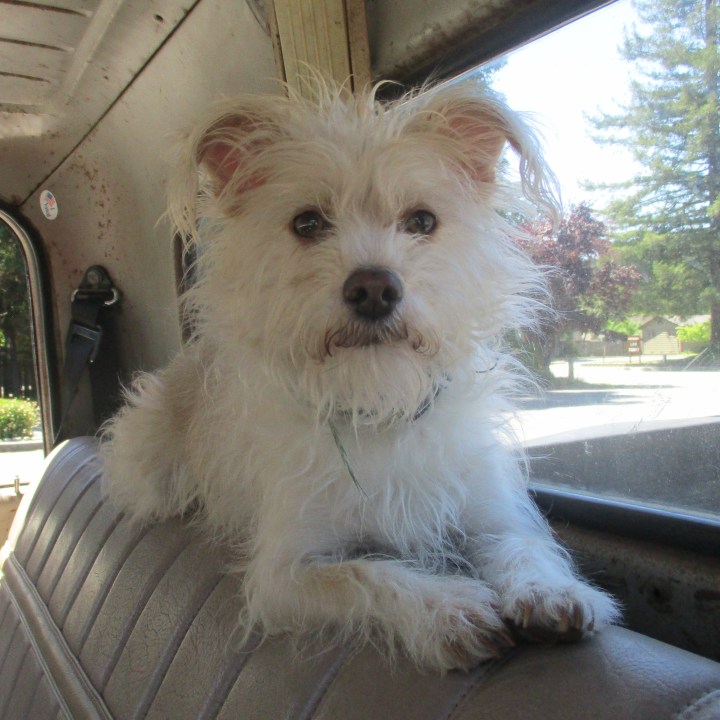
After Rhody photo bombed one of my pictures that was featured on Saturday, others suggested that I feature more pictures of Rhody. Everyone loves Rhody.
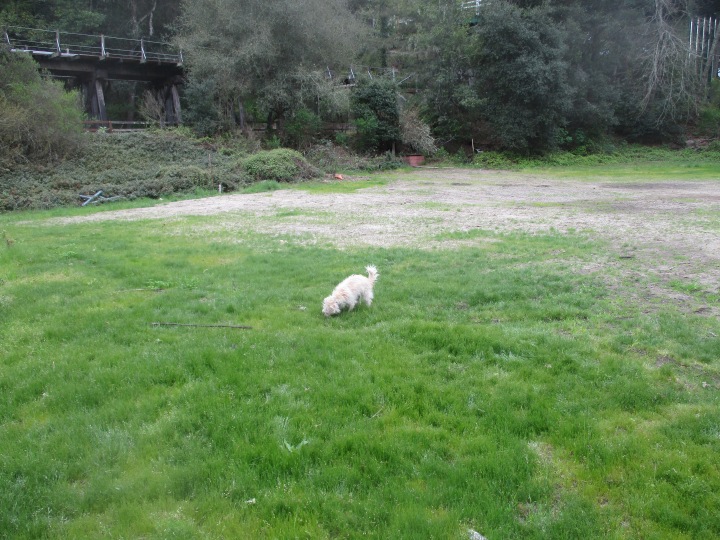
Most of these pictures are devoid of vegetation. The minimal vegetation that is visible in the other pictures is mostly unrecognizable in the background. There are a few redwoods, a few firs, some English ivy and all that riparian mess around Zayante Creek behind the abandoned ball field. They are unimportant in this post.
This post is just pictures of Rhody, complete with captions that all begin with ‘Rhody’.
Rhody really has been a good sport. He has been coming to work without his crew for more than a week. Only a few of them stop by in the morning. One or two rarely come by through the day. We avoid each other.
Rhody misses them very much. He frolics on their sofa where he typically does ‘laps’ during morning staff meetings, and sometimes settles into the rocker chair that he typically avoids when no one else in it. He neglects his favorite thrasher toys, but instead drags around a dirty glove that belonged to someone of his crew. He takes it to bed, but I somehow wake up with it.
We will work in the still unvegetated vegetable garden in the morning. It is right outside, so he will be here if anyone of his crew happens to stop by.
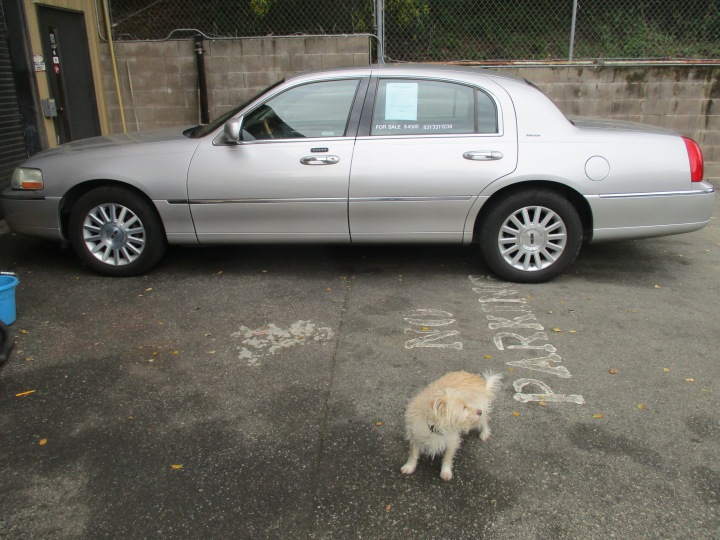
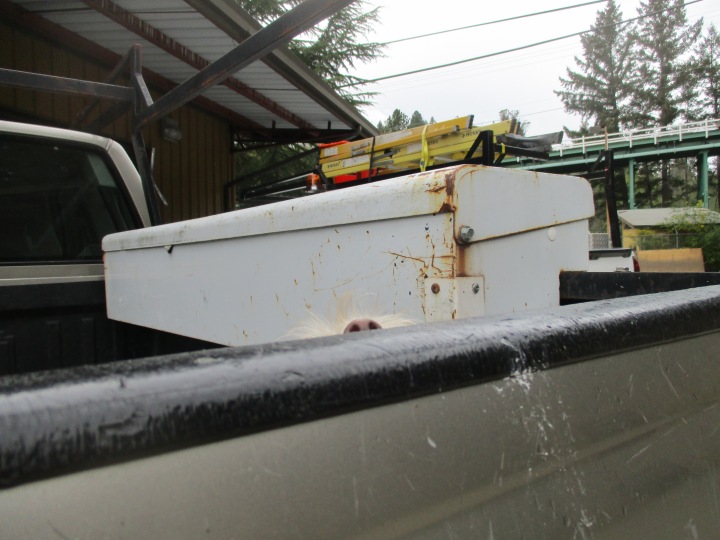
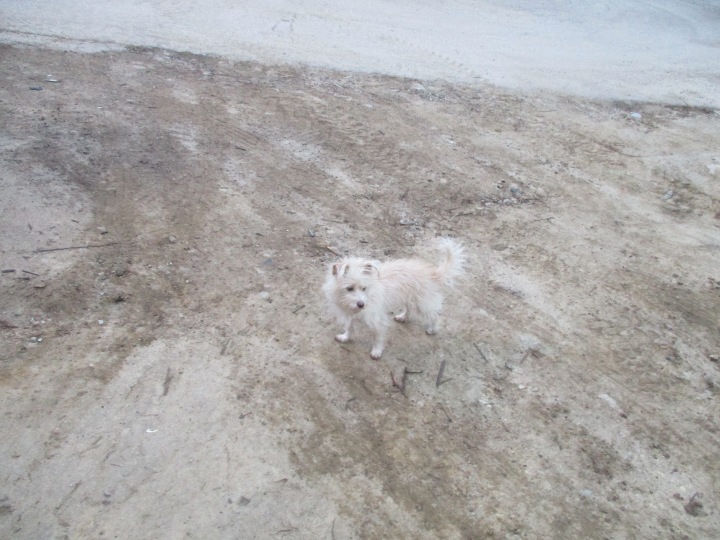
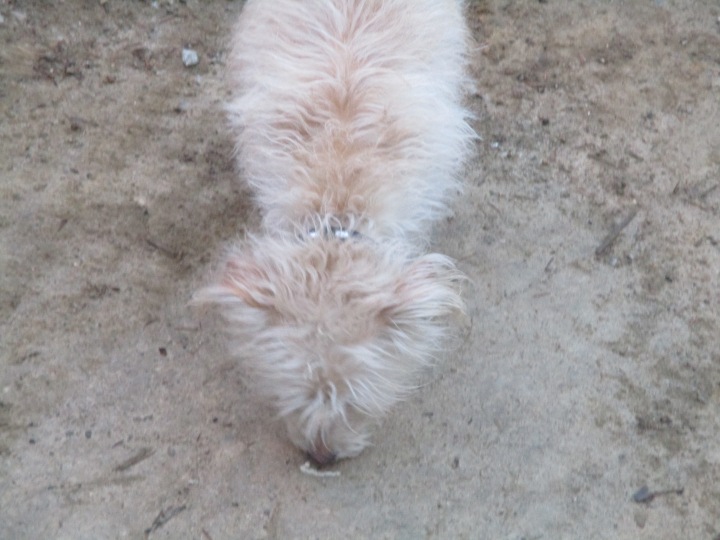
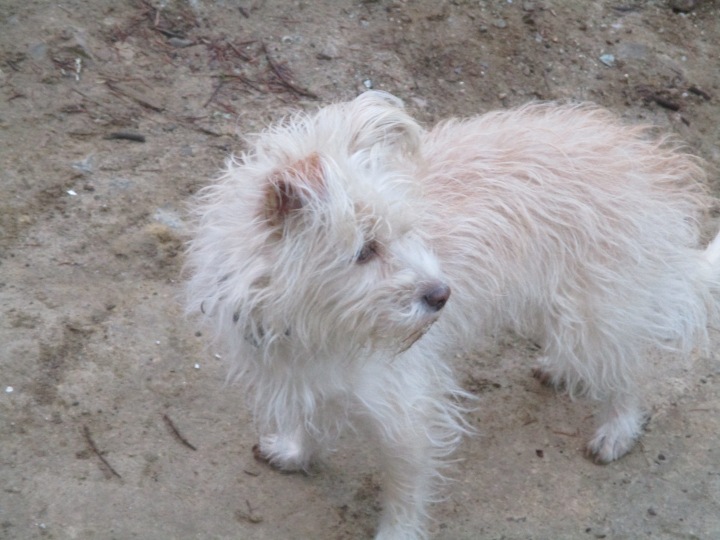
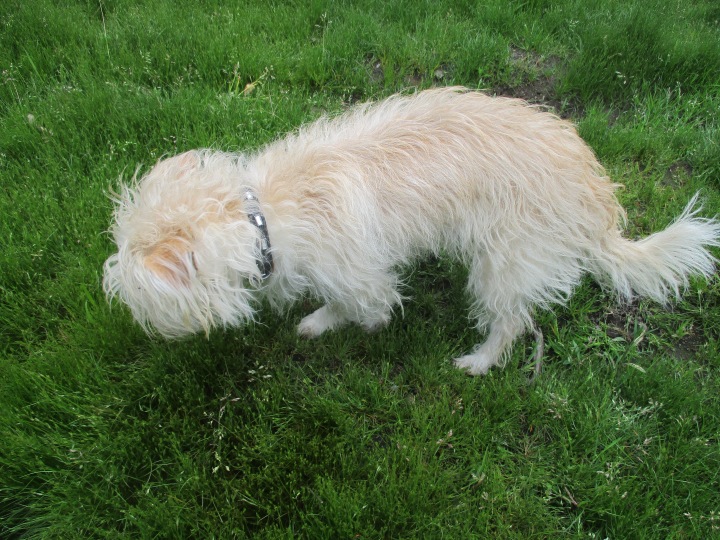
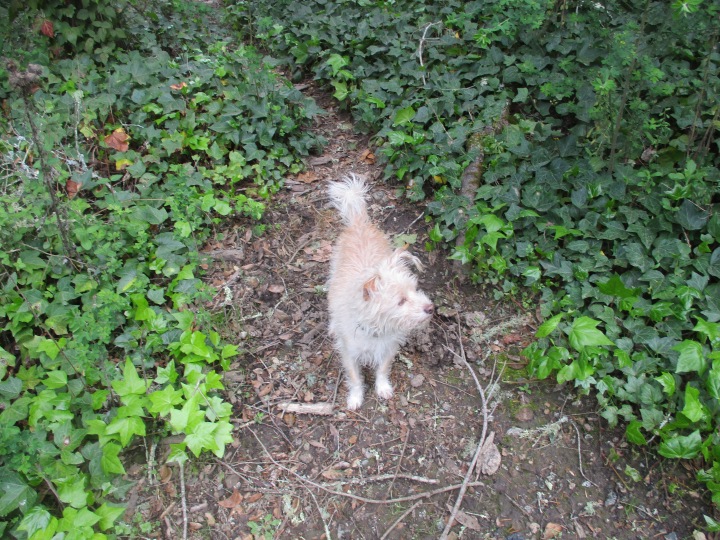
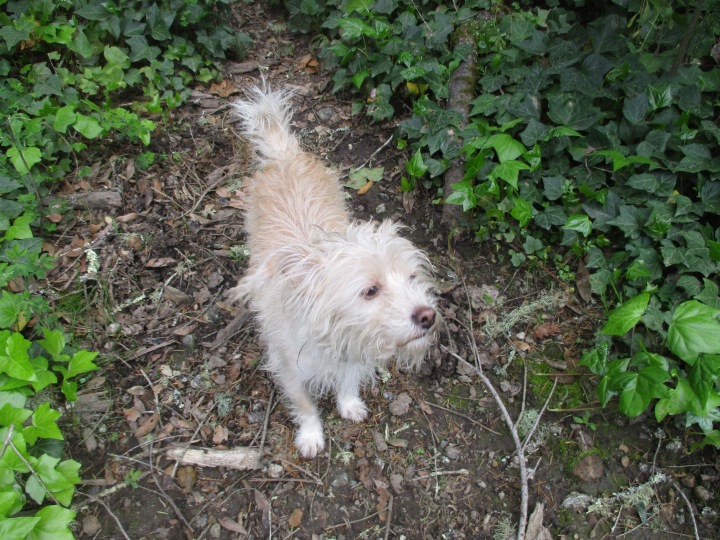
Rhody found us a new car.Rhody still prefers his friend’s work truck.Rhody in camo.Rhody found it, . . . but doesn’t know what it is.Rhody likes the beach, . . . but can’t find the ocean. (It is a few miles away.)Rhody gets to second base and beyond, past the outfield of the abandoned ball field.Rhody is easily amused. I don’t get it.Rhody is still intent on finding . . . it.Rhody can be such a ham.Rhody knows how cool he is.Rhody misses his staff who can’t come to work yet.Rhody misses them a lot!Rhody still works hard at being cute, even though there is no one here to see it.Rhody is done with pictures for now.Rhody thinks the camera smells . . . interesting.













 Tony Tomeo