Sunday Best – Gifts from Tangley Cottage Gardening (from yesterday)
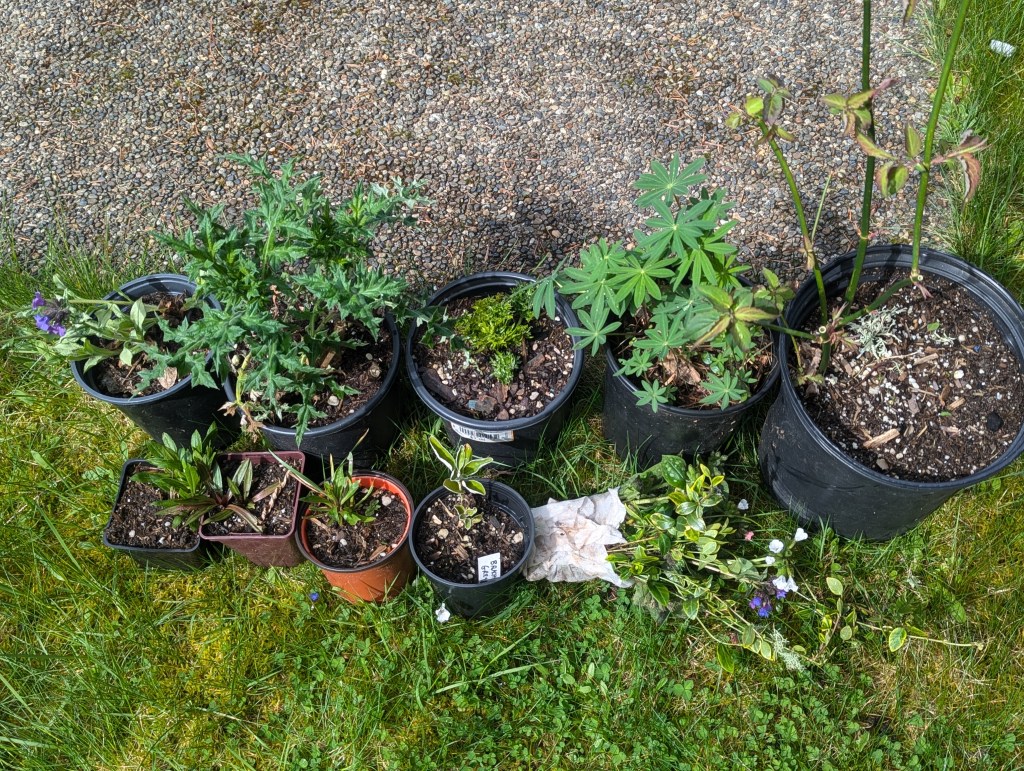
Tangly Cottage Gardening was a primary destination of my vacation. I posted pictures of it last week. These are six more species that I received as gifts.
1. Acanthus spinosus, armed bear’s breech has the strangest common name of these six. Is the bear armed or just its butt? Regardless, I happen to like common Acanthus mollis, and had coincidentally been wanting to try this less common species as well. Now, I will.
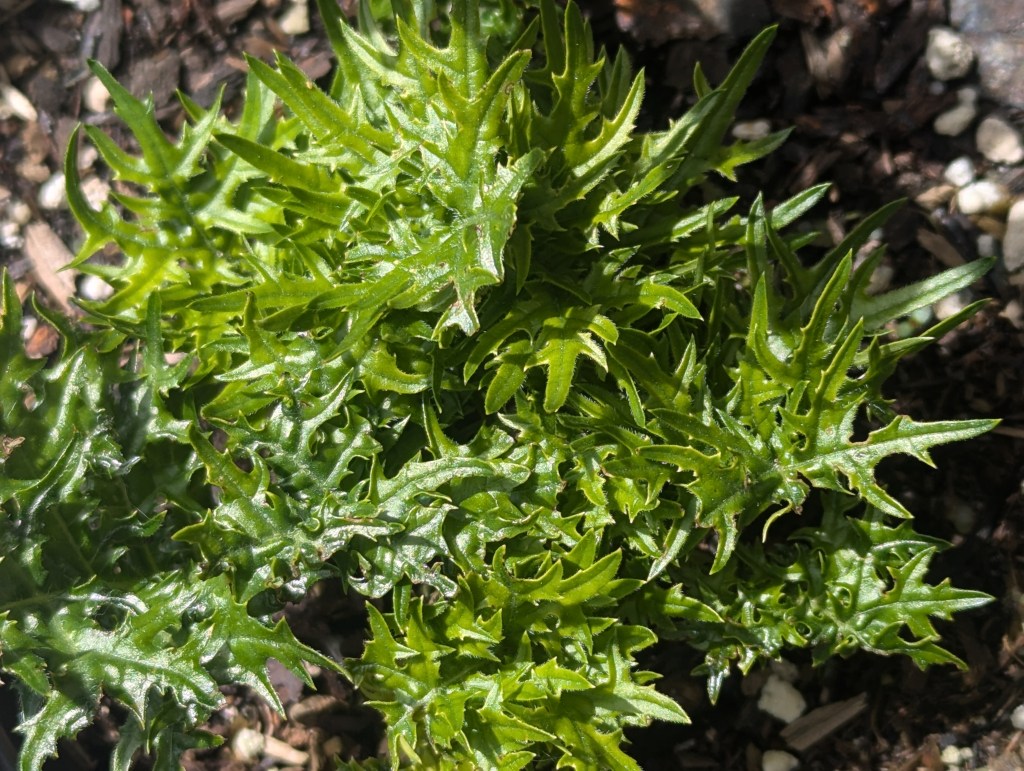
2. Echinops ritro, globe thistle was a minor crop where I worked with cut flowers during the summer of 1986. I did not enjoy harvesting it then, but recently, I had coincidentally been wanting to add a single specimen to my garden. I just could not think of an excuse.
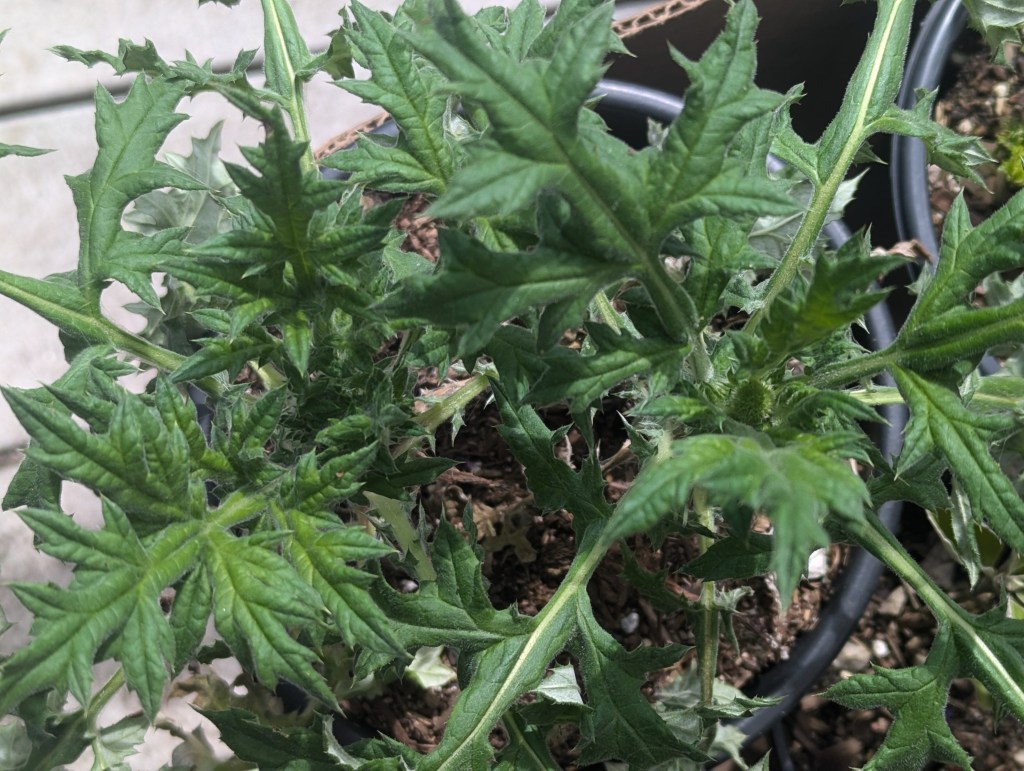
3. Helenium autumnale, common sneezeweed also has an amusing common name. I am unfamiliar with this species, although its botanical name somehow seems to be familiar. I got three distinct cultivars of it now! If we were not already acquainted, we will be now.

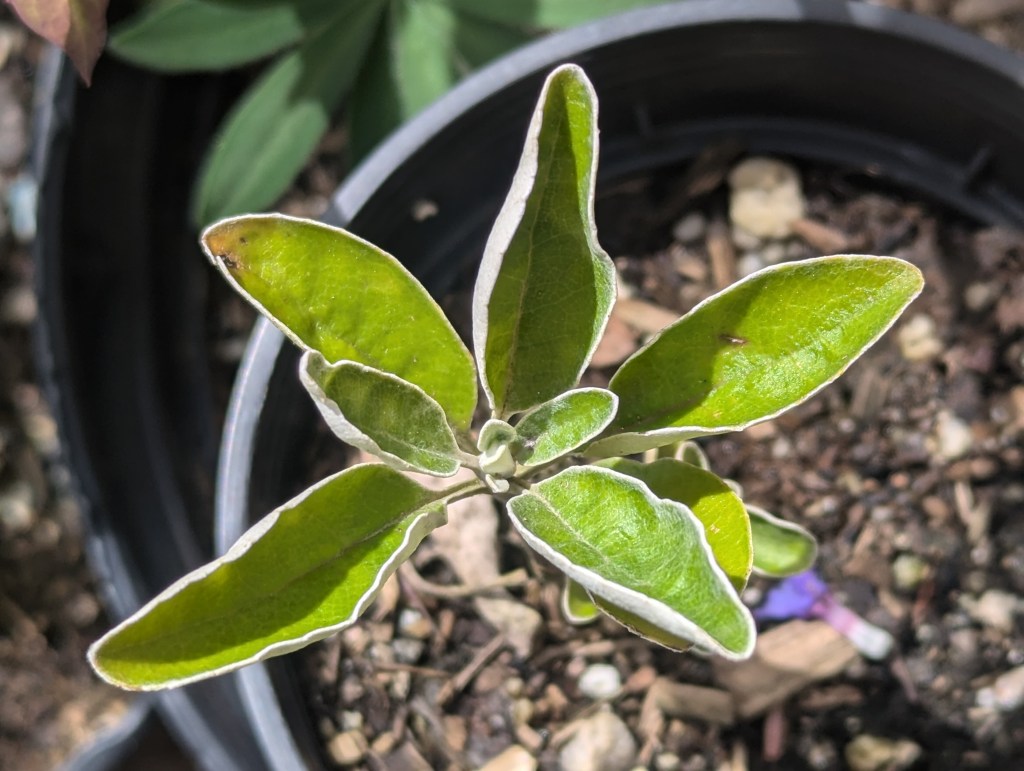
4. Brachyglottis greyi, daisy bush has a contrarily mundane common name. Many other species could easily qualify for its name. Somehow though, it makes it more compelling. Now, I want to see what makes it distinct from all other daisies, bushes or daisy bushes.
5. Leycesteria formosa, Himalayan honeysuckle or pheasant berry is yet another species that I had coincidentally been wanting to acquire. I embarrassingly did not recognize its name initially. I was told that I would find its flowers to be more appealing than its fruit.
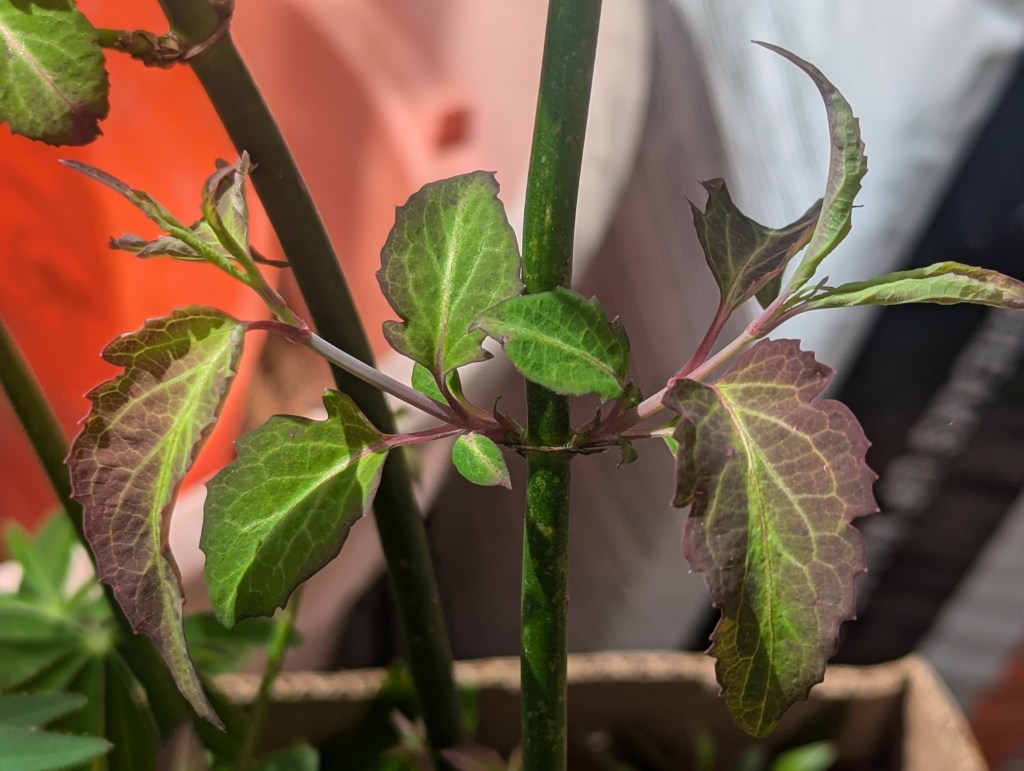
6. Lupinus, lupine is regifted and unidentified. I do not know if it is annual or perennial. Because it was grown in a can rather than merely shared as seed as annuals should be, I suspect that it is perennial. I will find out. This one can contains several swell seedlings.

This is the link for Six on Saturday, for anyone else who would like to participate: https://thepropagatorblog.wordpress.com/2017/09/18/six-on-saturday-a-participant-guide/

It is not as important as it sounds. Two varieties of Canna bloomed for the first time here during the past few weeks. They are important only to me because of their origins. With very few exceptions, such as the still elusive ‘San Jose’ bearded iris, I do not pursue rare or unusual species, varieties or cultivars. Actually, most of my favorites are quite common, and most that are rare here are common where they came from. I obtained some from places I have travelled to. Most were gifts from friends, neighbors and colleagues. The Canna to the left is ‘Stuttgart’ from Tangly Cottage Gardening. This is its second season here, but it did not bloom successfully before autumn chill last year. It is the second of three different Canna musifolia here. The first has moderately bronzed foliage. The third has simple green foliage. ‘Stuttgart’ has the most distinctive foliage that is variegated with variable white bands. All three bloom with similarly subdued and pastel orange flowers, but for this first bloom, ‘Stuttgart’ is blooming with a bit more peachy pink. The Canna to the right was a gift from a friend of a friend last winter. It is the third red Canna here, but the first is an unidentified compact cultivar that gets only about half as tall with garishly big flowers, and the second is ‘Australia’ with darkly bronzed foliage. This new unidentified cultivar is quite tall with simple green foliage, which is actually what I prefer for my own garden. (Although, I like the short cultivar also because it has been here longer than anyone can remember; and I like ‘Australia’ because everyone else likes the impressively darkly bronzed foliar color. Furthermore, I like the moderately bronzed Canna musifolia because it has also been here for a very long time; and I like the simple green Canna musifolia because it was a gift from a neighbor, and it is the biggest Canna here.)
Bauhinia punctata, Tupidanthus calyptratus, Olmediella betschleriana and Oreopanax capitatus are a few species that Brent and I studied in school during the late 1980s, then encountered only very rarely afterward. Actually, neither of us have encountered a single specimen of Oreopanax capitatus since 1990. Brent managed to procure a Tupidanthus calyptratus for his driveway. I may eventually procure a Bauhinia punctata. Nowadays, I work with Cocculus laurifolius and Pittosporum crassifolium, which, previously, I had not seen since school. Agapanthus orientalis and Juniperus chinensis ‘Kaizuka’ could be just as old fashioned, but never really got scarce. Perhaps I should post more pictures of species here that are actually rare instead.
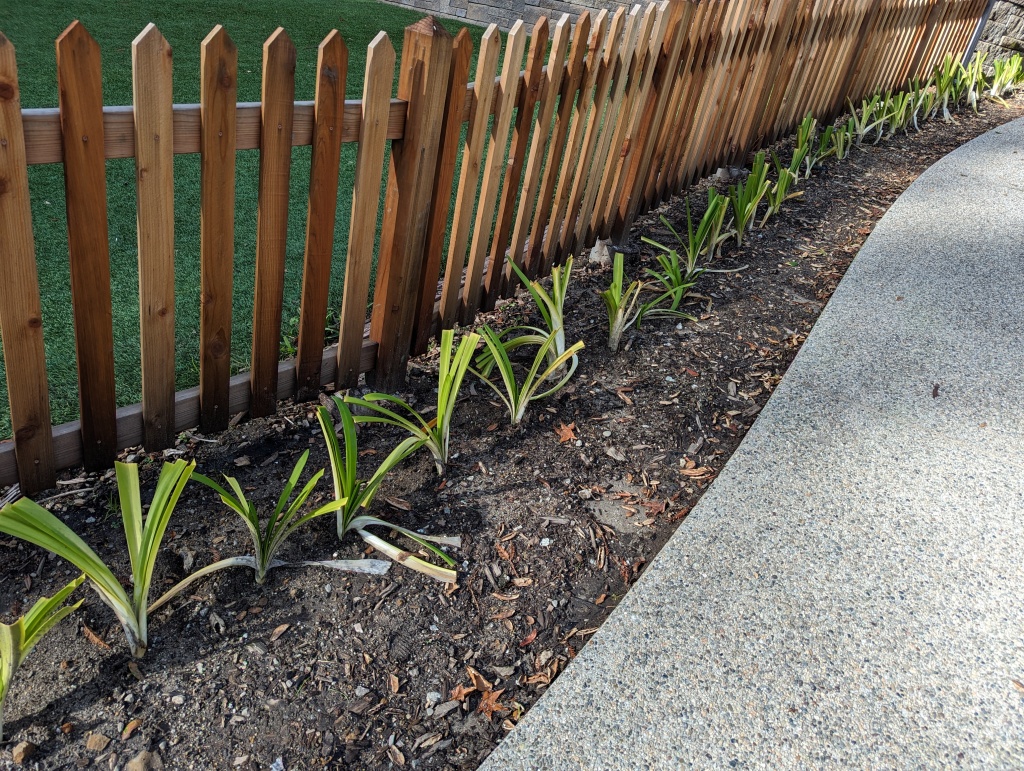
1. Agapanthus orientalis, lily of the Nile has been very popular and even common longer than anyone can remember, and still is. This picture of these divided and plugged shoots is here because I neglected to post it as I discussed them in Six on Saturday a month ago
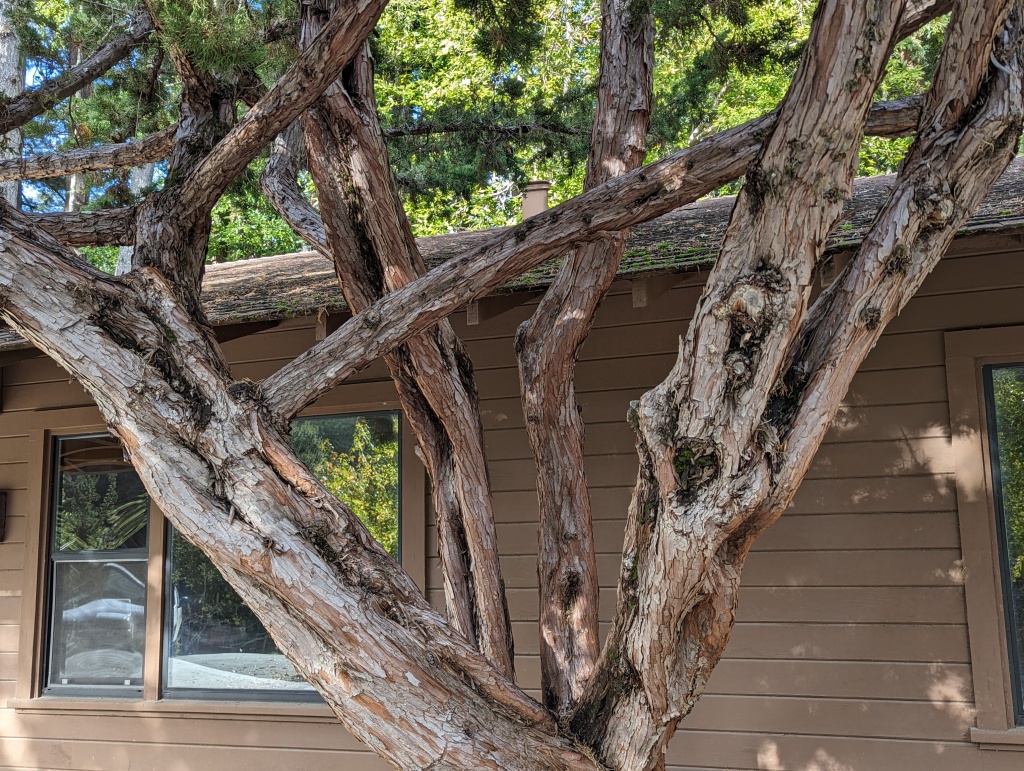
2. Juniperus chinensis ‘Kaizuka’, Hollywood juniper was passe prior to when Brent and I were in school, but older specimens remain. They are like sculptural small cypress trees.
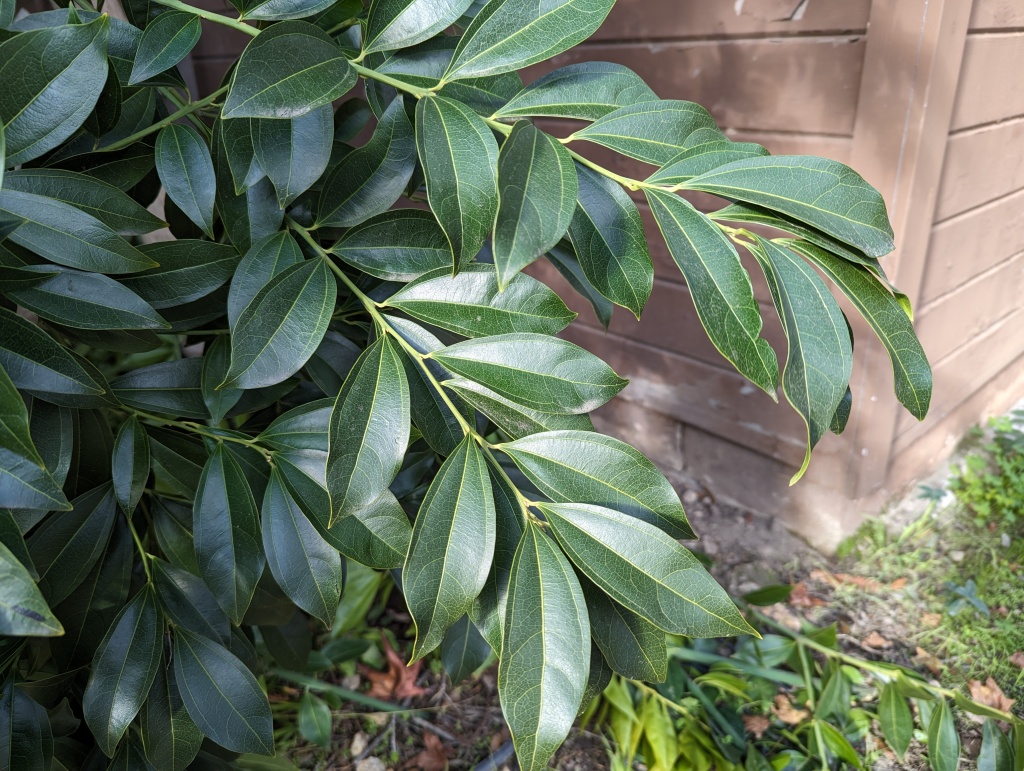
3. Cocculus laurifolius, laurel leaved snailseed is a species that we studied in school, but have seen in only a few situations since then. I happen to be acquainted with a few now.
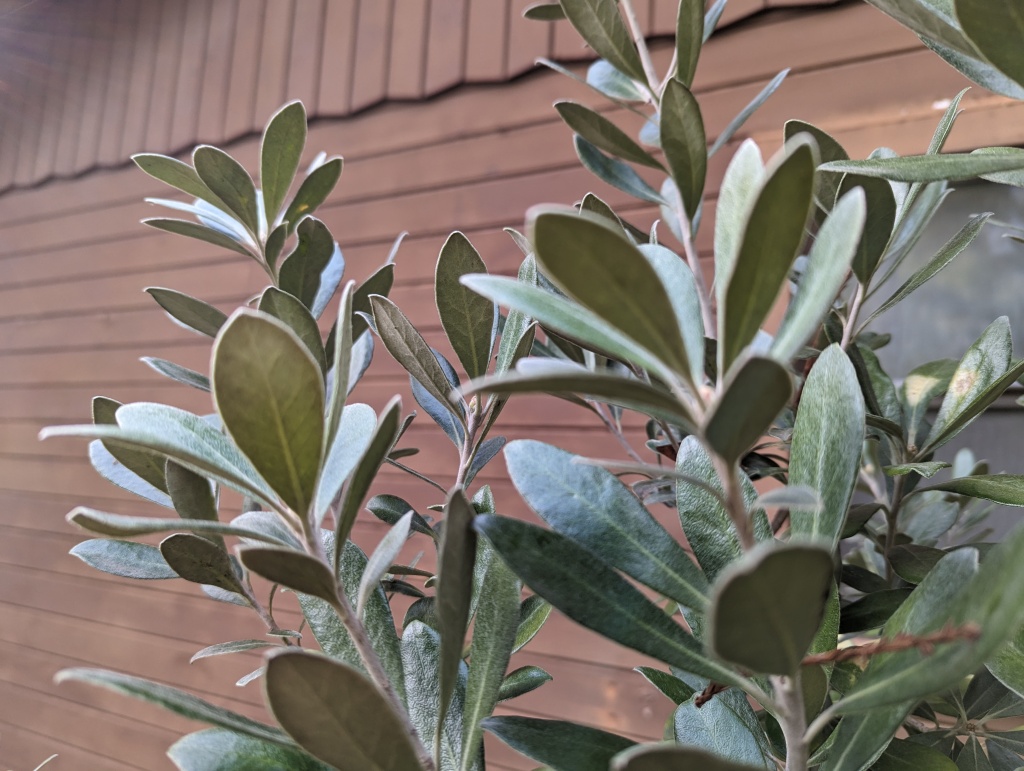
4. Pittosporum crassifolium, karo is very similar in that regard. It might have been more popular a long time ago, but lost popularity as more interesting species were introduced.
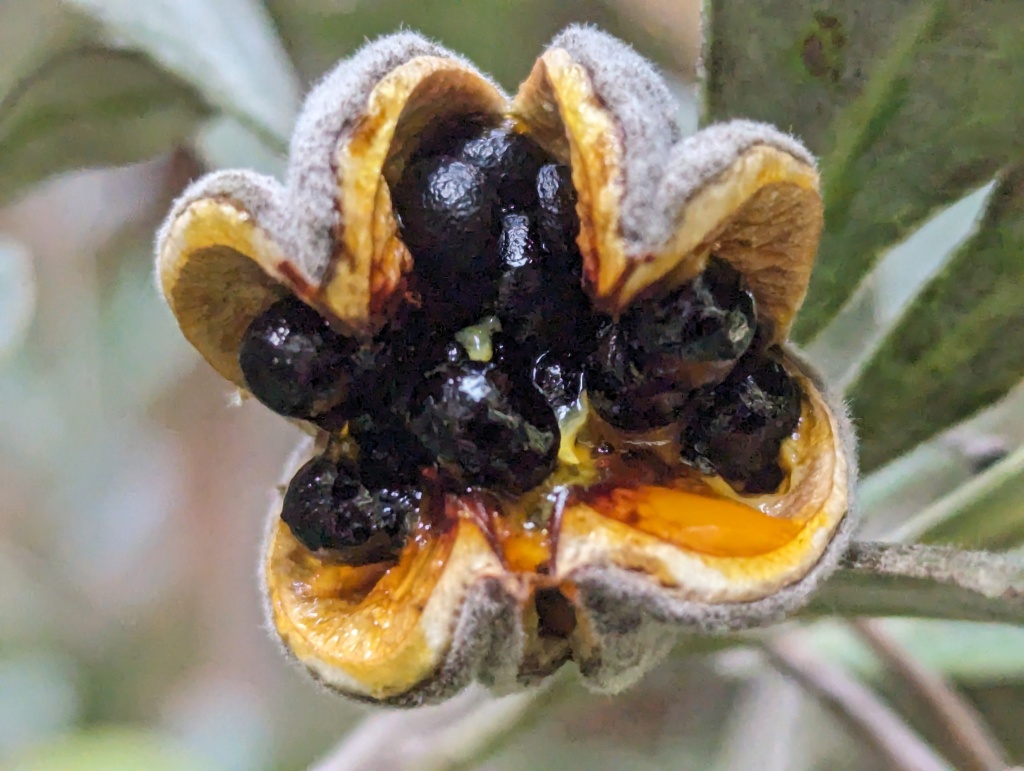
5. Pittosporum crassifolium, karo produces annoyingly abundant and annoyingly sticky seeds. ‘Pittosporum’ translates to ‘pitchy seed’. If they germinate, they do not do it here.
6. Rhody’s Roady got its new license plate with the colors of 1969. ‘O’ is for ‘Occidentale’, which is Rhody’s last name. It is irrelevant to an Isuzu or a downtown shopping district.

This is the link for Six on Saturday, for anyone else who would like to participate: https://thepropagatorblog.wordpress.com/2017/09/18/six-on-saturday-a-participant-guide/

There are very few coniferous (cone bearing) trees that are deciduous; and because most prefer cooler winters, very few are ever seen in local gardens. The bald cypress, Taxodium distichum, happens to be one of the few deciduous coniferous trees that really could be more popular than it is, since it seems to be right at home in mild climates. It is native to coastal riparian regions from Maryland to Florida to eastern Texas, and up the Mississippi and Ohio Rivers as far as Indiana.
The soft foliage resembles that of coastal redwood, but is more finely textured. It is still mostly light green, but will soon be turning paper bag brown before trees go bare. The tiny individual leaves are shaped like flat pine needles, and are not much more than half an inch long. The ruddy or grayish brown bark is finely shaggy.
In the wild, mature bald cypress trees can get more than a hundred feet tall with trunks more than five feet wide. Some of the largest trees have buttressed trunks as wide as fifteen feet! Trees in swamps develop distended growth from their roots known as ‘knees’, which can stand several feet tall! Fortunately, bald cypress rarely get half as tall or develop such massive trunks locally.

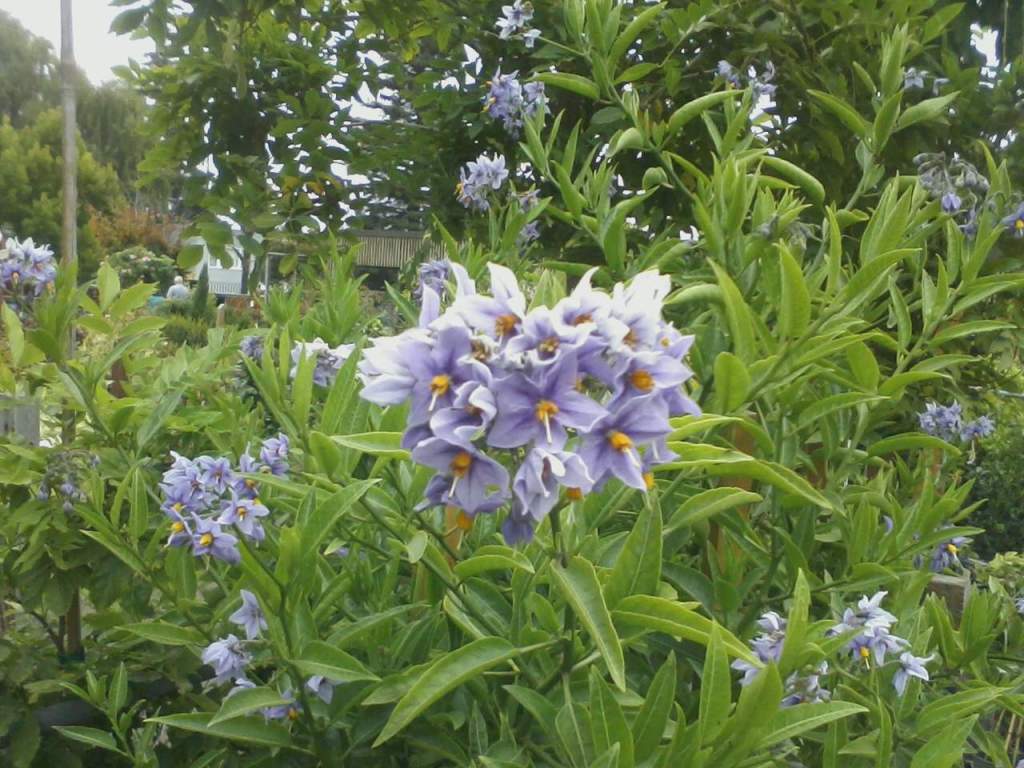
Yellow centered blue flowers like those of the familiar potato bush, on vines almost like those of the comparably familiar potato vine would be like the not so common Chilean nightshade, Solanum crispum. However, Chilean nightshade needs to be trained onto support in order to climb, and only reaches fifteen feet or so. The cultivar (cultivated variety) ‘Album’ is like a shrubbier redundancy to potato vine, since it has white flowers. ‘Glasnevin’ is the most popular cultivar because it flowers freely and is hardier to frost.
The nearly inch wide and slightly fragrant flowers bloom in small clusters from May or June until about now. Small but sometimes prominent green berries that turn yellowish orange and then dark purple are toxic. Partial shade inhibits bloom and vigor.
Canna have been so extensively hybridized that very few modern cultivars are identified by species. They are known merely by their generic designation of Canna with a cultivar name. Canna flaccida is an ancestor of many hybrids, and the only species that is native north of the Rio Grande, but seems to be rare here. I want it! NOW! I should be satisfied with flashier modern cultivars, but I prefer simpler species, especially one from Florida.
Well, it may be here already. Late last spring, at the worst time to dig Canna, I dug a big colony of it from a site that was about to be landscaped. Even after most were recycled to other gardens, the remnants were canned into two dozen #5 cans. One dozen contained three rhizomes each of ‘Wyoming’. The other dozen cans contained five rhizomes each of an unidentified cultivar with narrower green leaves and yellow bloom. That is enough to plant thirty-six linear feet of ‘Wyoming’ and sixty linear feet of the yellow sort! Now that they are blooming, the unidentified yellow sort seems to be the rare Canna flaccida. I do not know for certain, but it keys out accordingly. If so, it is much more than I hoped for!
Two other Canna that live here were omitted from these pictures because there are only Six on Saturday rather than eight. Without its billowy red bloom, the foliage of a cultivar that remains unidentified is indistinguishable from #1 anyway. ‘Cleopatra’ is normally a hot mess of color, but is sharing only green foliage at the moment. Its foliage is typically randomly striped with broad and narrow bands of green like #1 and dark bronze like #2. Its weird bloom is randomly blotched with bright red and bright yellow, like condiments that squirt out the far side of a hamburger, or Pikachu on the grill of a Buick.
1. ‘Edulis’ was a gift from a neighbor. I wanted it for its fat rhizomes, which are like small potatoes. The slender flowers are red. (‘Edulis’ is a group of many cultivars and hybrids.)
2. ‘Australia’ is one of very few plants that I actually purchased. It cost nearly six dollars! A neighbor of my downtown planter box requested bronzed foliage; but I still feel guilty.

3. ‘Musifolia’ may have inhabited one of our landscapes since its construction in 1968. It gets so tall that I bend it down for deadheading. It and ‘Edulis’ produce viable seed. The slender flowers are peachy orange. (‘Musifolia’ is a group of many cultivars and hybrids.)

4. ‘Pretoria’ lived with ‘Musifolia’, but in spring, was dug and canned for protection from gophers. Only four #1 cans of its rhizomes survive. The billowy flowers are vivid orange.

5. ‘Wyoming’ is recovering from relocation while actively growing last spring. Most went directly to new homes. The billowy and vivid orange flowers resemble those of ‘Pretoria’.

6. Canna flaccida remains unidentified. It arrived with ‘Wyoming’, so is also recovering from untimely relocation. The elongated foliage is simple light green. Flowers are mildly fragrant at night. Apparently, only one other extremely rare species of Canna is fragrant.

This is the link for Six on Saturday, for anyone else who would like to participate:
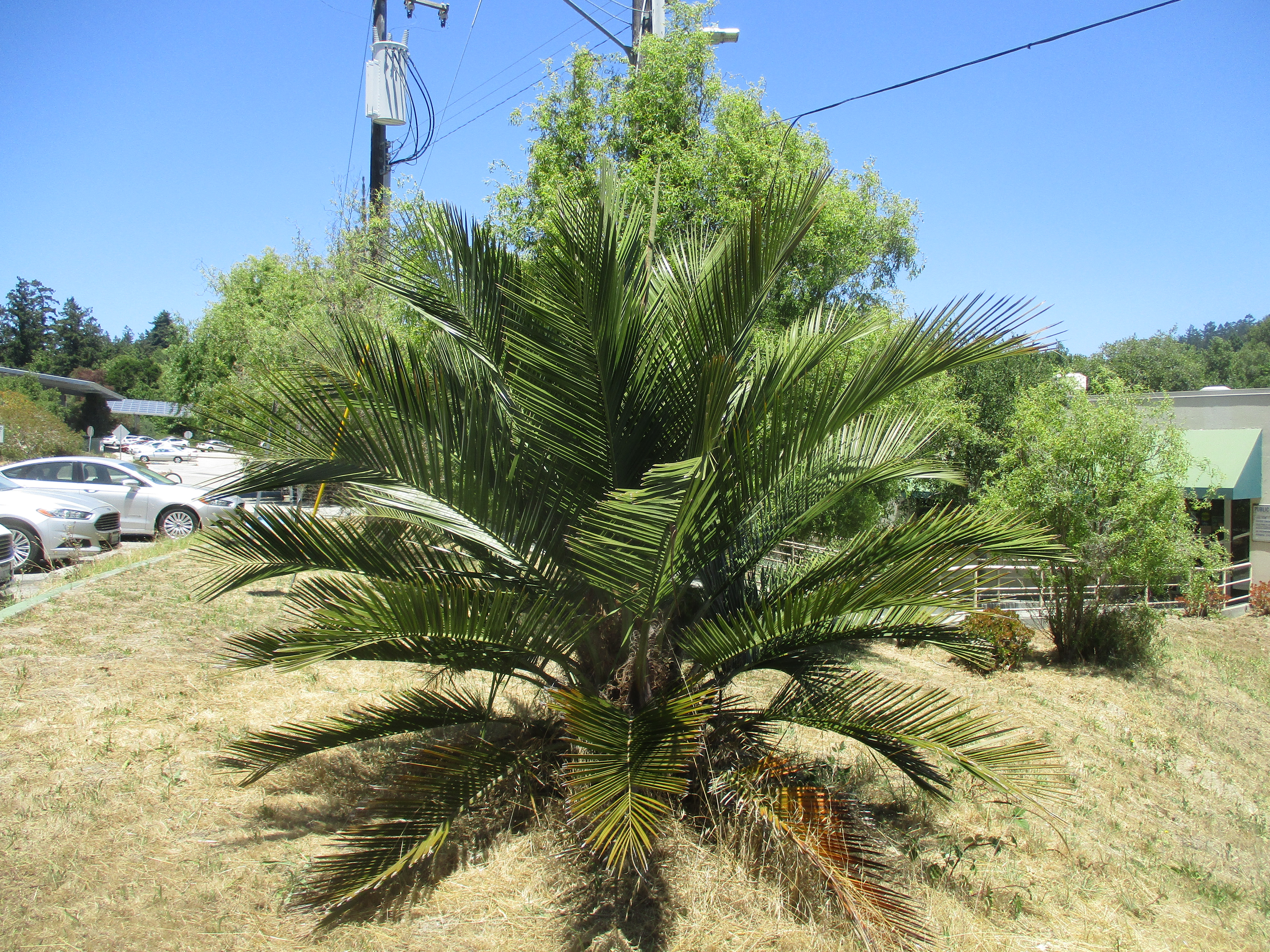
Italian Americans, particularly Californians, are expected to be experts in regard to wine. I am not. I can not explain it. I dislike wine, especially the best of it. It smells and tastes like rotten grapes. When I learned that Chilean wine palms were, and might still be, decapitated for the collection of their sap, from which wine is made, I learned yet another reason to dislike wine.
This little Chilean wine palm, Jubaea chilensis, pictured above, lives just a block or so away from the bad date palm that I wrote about last Sunday. No one here will try to make wine from its sap. The utility cables that seem to be too close in the background actually pass with plenty of clearance to the right, so will not be a problem in the future. This young palm should be safe.
Although I have encountered too few of the species in my career to be completely certain that this little palm is a well bred Chilean wine palm, it is very convincing. I see no indication that it is a hybrid of another species. About half of the Chilean wine palms that I encounter are hybrids. Most of these are hybrids of queen palm. Others are hybrids of pindo palm. Both look weird.
Of course, well bred Chilean wine palms are not much better. The specimen pictured below demonstrates that, regardless of how bold and striking they are, they are still rather weird palms. That is probably why they are so rare now. They were rare even during the Victorian Period, when weird species were trendy. Yet to many, their distinctive weirdness is part of their allure.
I can not help but wonder where this Chilean wine palm came from. Someone must really appreciate it to put it here.


Of all the strange seed I brought back from Oklahoma, none were from the scrub palm, Sabal minor, that is endemic to McCurtain County in the very southeaster corner of Oklahoma. I did not get to that region.
Sabal minor is nothing special to those who are acquainted with it. However, a variety that was selected from those in McCurtain County, which is known simply as Sabal minor ‘McCurtain’, is becoming increasingly popular in climates where winter weather is too cold for other palms. It is sufficiently resilient to frost to survive in New England and Canada.
I just wanted it because it is from Oklahoma.
Since I did not collect any wild seed, I had considered purchasing a seedling of the ‘McCurtain’ variety online. It would have been rather expensive for a single seedling. I was pleased to find seed of the same variety that were significantly less expensive for several seed. I know they grow slowly, but I am in no hurry. I gain bragging rights as soon as the seed germinate.
Unexpectedly, I was even more pleased to find seed on eBay that were collected from trees that were collected from the wild in McCurtain County, but were not of the ‘McCurtain’ variety! I know that seems trivial, and maybe even less desirable to those who want a garden variety, but for me, such seed are more closely related to those I would have collected if I had been there.
For $6.00, I expected delivery of a packet of ten seed of Sabal minor from McCurtain County. I could not pass on a deal like that. Instead, I got the 104 seed in the picture above! That is ten times what I was expecting. They will grow into more scrub palms than my garden can accommodate. RAD!
 No, this is not a Paris daisy. It is a common euryops daisy, Euryops pectinatus. It is obviously related, but the flowers are bright yellow rather than clear white with yellow centers, and the foliage is darker green. It is more resilient, so became more common in landscapes as quickly as mow, blow and go ‘gardeners’ replaced real gardeners who actually know something of horticulture. There is certainly nothing wrong with it. It is just cliché.
The few remaining Paris daisies are fancier cultivars of the old fashioned traditional sort anyway. Some bloom pale pink. Some bloom pale yellow. Flowers might have fluffy centers of the same color. Foliage might be pale grayish green. Plants are more compact. The cultivar that most closely resembles the old Paris daisy has more profuse, but smaller flowers. The cultivars are all quite nice, but are not quite the same as what we remember.
The original Paris daisy, Chrysanthemum frutescens, which is now known as Argyranthemum frutescens, was the sort of flower you wore in your hair if you were going to San Francisco in the late 1960s, or according to my memory, in the very early 1970s. It looked just like the three plastic daisies in the upper right (or lower left) corner of those cool AstroTurf door mats that were so popular. Perhaps they were cliché for their time too.
Cuttings rooted in half pint mason jars on kitchen windowsills to replace older plants. Our mothers grew them in the garden, supposedly to repel the bad insects, and attract the good insects to eat the bad ones who did not take the hint. In that regard, Paris daisies were how young horticulturists learned about vegetative propagation and ‘integrated pest management’ (IPM). They were so familiar back then; but then disappeared by the 1990s.
Only recently, Brent, my colleague in the Los Angeles region who I so frequently mention (typically in a disparaging manner) found just two specimens at a nursery in Southern California, and promptly procured both. One if for his garden, and one is for mine!
 Tony Tomeo