Cast Iron Patio

Tangly Cottage Gardening made good use of obsolete water meter lids as stepping stones. Now that I procured quite a bunch from where I work part time, I can try something similar. Because they are rectangular and of standardized dimensions, they can alternatively function as contiguous pavers. I intend to eventually pave a small patio with them. Forty-three are identical, 20.75 inches long by 10.5 inches wide, which is approximately 1.5 square feet. One is slightly different, but of the same dimensions. Two are smaller. Because they are not exactly twice as long as wide, all must be set in the same orientation, but that will not be a problem. They can be arranged in five rows of nine, or nine rows of five, as an almost square patio of approximately 68 square feet, with approximately eight foot long sides. Only one lid will be different, and one lid, likely in a corner, will be lacking. If necessary, I can add the two smaller lids to awkwardly fill the otherwise lacking corner, or simply find another lid somewhere. More will be available later. Although it is not yet constructed, I am already pleased with this recycled cast iron patio.

Banana Republic

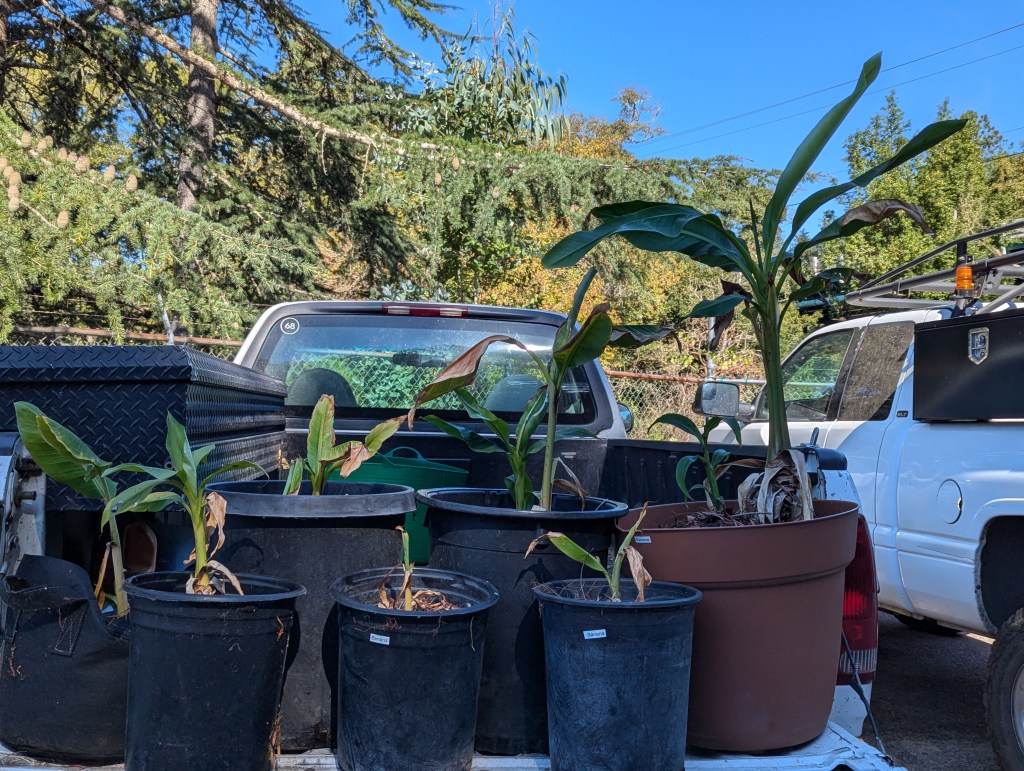
Yes! We have more bananas! I can explain. Although there are as many as twenty cultivars of banana here, almost all are individual pups or tissue culture plugs. (Of these twenty, three are unidentified. Of these three, one is likely a redundant copy of one of the other cultivars, one seems to be completely necrotic without possibility of recovery, and only one is notably distinct.) All but a few arrived earlier this year, so have not yet generated pups. ‘Double Mahoi’ has doubled by generating a single pup. ‘Golden Rhino Horn’ arrived as a pair, and one of the pair is only now beginning to generate another pair of pups. Otherwise, there are no spare pups to share. The only spare pups of ‘Double Mahoi’ and ‘Golden Rhino Horn’ (the one which lacks new pups) may be leaving in the next few days. Whatever remains of these two will most certainly go to another colleague at the end of winter. Another colleague would like to add any spares, regardless of cultivar, to his garden. However, until just now, I could not help in that endeavor. The few in the picture above just arrived from Gilroy because they were in need of a new home. The pup to the far left is ‘Blue Java’, which is also known as ‘Ice Cream’, is redundant to a copy that is already here, so can be shared with a colleague. The others, which are sufficiently numerous for all of us to get copies, are unidentified, which merely means that if they produce fruit, it will be a surprise. Even if their fruit is not palatable, their foliage is good for forage and compost. For the colleague who would like to add any spares regardless of cultivar, they can live in a riparian area of his garden that is too steep, damp and shady for gardening. These pups may not look like much in the picture, but their corms are quite plump, so will provide an abundance of foliage after they get into the ground and the weather warms after winter. Soon afterward, they will generate more pups, but we can worry about that later.

Horridculture – Profitable Waste

Surplus should be a useful resource.

There is nothing wrong with this picture yet. It simply shows African daisy as it begins to encroach into a row of lily of the Nile. Because it is already September, we will delay the pruning of the African daisy to maintain clearance from the lily of the Nile. Then, we can process the pruning debris into cuttings that we can plug into areas where we want more African daisy. These cuttings can grow slowly and disperse their roots through cool and rainy autumn and winter weather to be ready for next spring and summer. It is how a bit of something that is undesirable here can be desirable somewhere else. That is how the lily of the Nile arrived here. It needed to be removed from where it had migrated beyond its preferable confinement, so was relocated to become an asset to another landscape.

So called ‘gardeners’ would do this very differently; partly because, within their stringent schedules, they have no time to process cuttings or divide perennials, but partly because it is less profitable. They would be more likely to shear a neat edge for the African daisy whenever it happens to be convenient for them, and then efficiently dispose of all of the debris. If more African daisy is necessary elsewhere, they would purchase and install it, and charge their client accordingly. The lily of the Nile would probably not be here, since they would have likely disposed of it immediately after digging it from where it needed to be removed from. If any were desirable here, they would purchase it from a nursery and install it, and, of course, charge their client accordingly. Ultimately, their technique might not be much more expensive, but it is nonetheless wasteful, and frustrating to those who are aware of it.

Donation

Heather thinks that she just found a new house with a view.

Donations can be annoying. At the farm, neighbors sometimes left random pots and cans from their home gardening at the gate on the road. Sometimes, they left other bits of gardening supplies, such as short pieces of PVC pipe, a pound or so of lawn fertilizer, or perhaps a broken rake. Only very few of the standardized cans could be added to the huge pile of recycled black vinyl cans that the horticultural commodities were grown in. The majority of what was left was merely more junk that we then needed to dispose of. If I found such items while driving a sedan, I needed to move them out of the way of the gate and return with a pickup to retrieve them. The gate is directly in front of the very well kept home of a nextdoor neighbor, which made such piles of junk even more inappropriate. The same happens here. Neighbors leave all sorts of useless random gardening paraphernalia and deteriorating houseplants. Because we do not grow acres of horticultural commodities in thousands of cans, the few random cans that I get here can actually be useful. Some of the houseplants recover in the nursery, and get recycled into landscapes or shared with neighbors. Perhaps such donations are not so annoying. I did happen to find this small home garden ‘greenhouse’ contraption to be quite annoying though. It was left in my parking space as if it were important. I would never actually purchase such an item. I am accustomed to working in real greenhouses. This thing is for those who enjoy gardening in small urban gardens, not professionals. I wanted to find who left it so that I could return it. Then, it occurred to me that the small banana plugs might appreciate it this winter. Oops.

Ancient Ruins

Eight columns arranged in a semicircle behind the High Place garden at Filoli were found by excavation for the foundation of a skyscraper in San Francisco. The stone from which they were carved is European, but no one knows how or why they were buried under San Francisco. They could have been recycled into one of many buildings that were destroyed by the Great Earthquake and associated fire of 1906, and subsequently buried within landfill with tons of other debis. They were more likely recycled as ballast for a European ship that, as it deteriorated or became obsolete, was dismantled and buried within landfill in San Francisco. It is a mystery. They are in a formal landscape at Filoli now, and will likely remain there for a very long time.

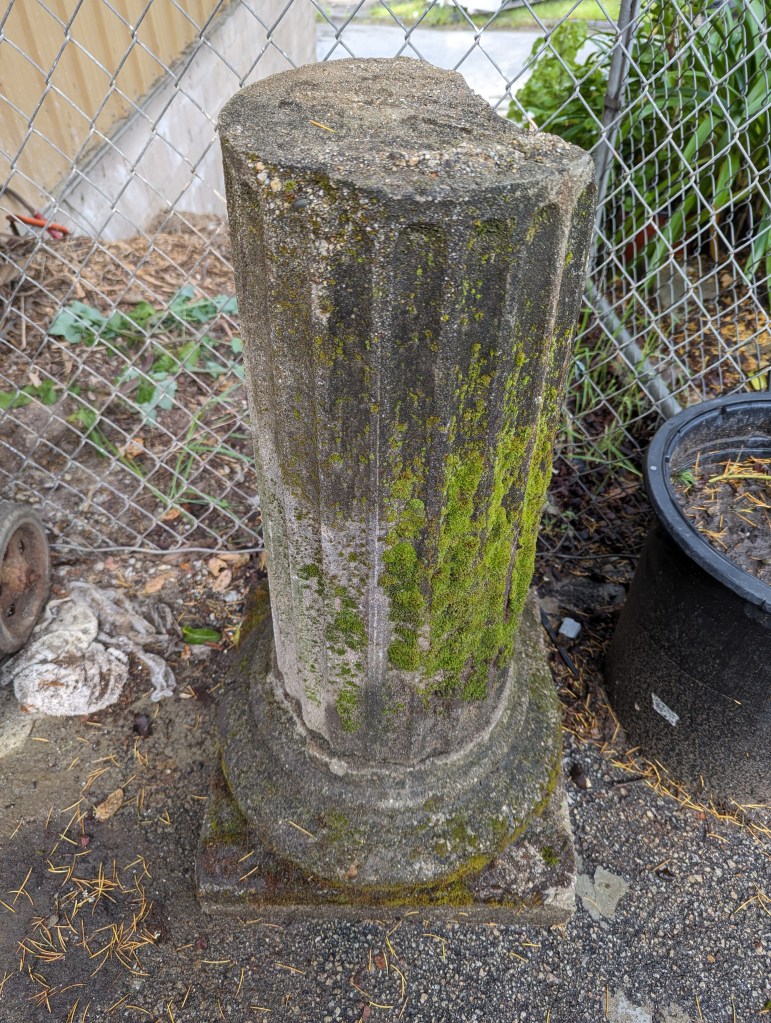
Within a dumpster of recyclable broken concrete, I noticed this old concrete column. With a bit of investigation, I also found the base. Each component is very heavy. I have no idea what they were, but I suspect that they were the base of an elaborate birdbath. I did not find any associate basin within the dumpster. In order to identify their origin, I inquired about these items with those who disposed of them. At the location, I found a small portion of the column that fits between the base and the larger portion of the column, as well as another column that is identical to the original with the smaller portion attached, but no other base. Nor did I find any basin or other features that might have been supported by the columns. They are either already disposed of, or buried by earlier excavation. It is such a waste. Regardless, these items are here now, and will hopefully be incorporated into the landscapes, although I have no idea how.

Horridculture – Salvage

A hedge of a dozen like this came from one branched stump.

This is an old and redundant topic. I should know better. Some vegetation is not worthy of salvage. Even that which is worthy can become excessive if too much is salvaged. The problem is that I find it very difficult to discard vegetation that I can relocate to another landscape, or grow in the recovery nursery whether or not we have use for it.

A few stumps of shrubbery needed to be removed from a small landscape of one of the buildings at work. With one exception, the shrubbery was common Photinia X fraseri, which had been cut down some time ago, and had not grown back much. The one exception was a common Escallonia rubra, which had been cut down even earlier, so had grown back about five feet tall, with a few distinct trunks.

I had no problem discarding the Photinia X fraseri. The stumps came up with mostly severed large roots, and very minimal fibrous roots that they needed to survive. If I really want to grow more, it would be more practical to grow it from cuttings. I am none too keen on the species anyway.

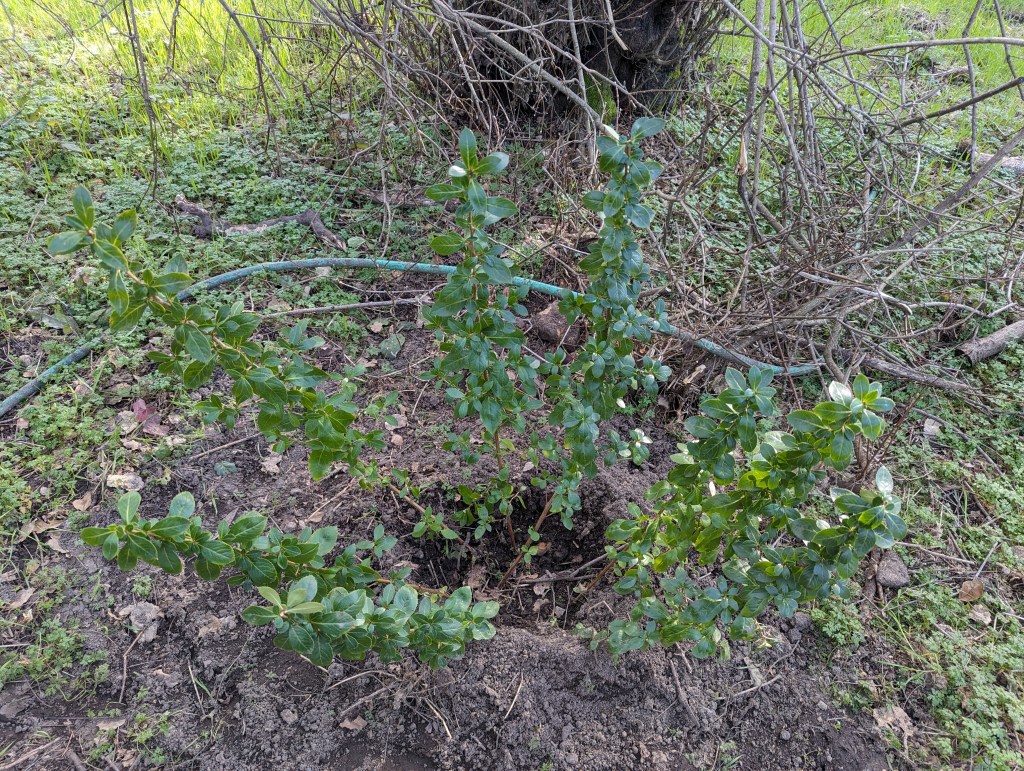
The Escallonia rubra was not so simple. Although I was determined to discard it all, and I am no more fond of the species than I am of Photinia X fraseri, it came out with more than enough fibrous roots to survive relocation. What is worse is that the several trunks were easily divided into several individual well rooted specimens, with several more layered stems attached to them. I assembled an even dozen well rooted specimens as a hedge outside a fence of our maintenance shops, and nine smaller rooted cutting to alternate between cypress trees outside another similar fence. Although pleased with the results, I should have discarded them.

This is one of the smaller well rooted specimens, although the layered stems are smaller.

No Bad Habit

Washingtonia robusta, Mexican fan palm

Technically, this one is different. I did not get it from a situation that it needed to be removed from at work, and then can it because I did not want it to be discarded. I did not grow it from seed or cutting that I ‘borrowed’ from a landscape somewhere else. I did not ‘borrow’ it from Brent’s gardens at the Jungalow. I did not find it for free on Craigslist.

I found it for free on the Marketplace of Facebook, which is NOT Craigslist or any other familiar source. Therefore, technically, it is not a bad habit.

It is a Mexican fan palm, Washingtonia robusta. It was too appealing to ignore. I noticed its post several days ago, but did not respond immediately. I thought that someone else would claim it if I ignored it long enough. No one claimed it; so it is here now. Actually though, I am very pleased with it.

It came from the Willow Glen neighborhood of San Jose, so is accustomed to excellent soil and climate. Its species is remarkably adaptable though. It will be as satisfied with the slightly cooler climate and sandier soil here. I will need to provide it with plenty of water while it disperses its new roots. It is only canned now because the situation that it will be installed into is not yet ready for it. A few deteriorating black locusts and box elders will need to be pruned or removed first.

As it recovers from transplant, the presently healthy leaves will likely desiccate and need to be pruned away. I will leave them until they do so because they may not, and they help to sustain new root growth and dispersion. The process is actually less stressful through the cool and rainy season of winter.

‘Rosalie Figge’?

Bearded iris should bloom for early spring, not winter.

Each of the several bearded iris that I grow have history. Their origins are more significant than their performance. None were merely purchased. I obtained my first, which is actually Dalmatian iris rather than bearded iris, from the garden of my maternal maternal great grandmother when I was about five years old, before I was in kindergarten.

Some of the seventeen or so that inhabit my garden may be added to a designated iris garden at work as they multiply. Some of the eight or so that inhabit the designated iris garden at work may be added to my garden as they multiply. I will likely procure at least two additional cultivars when I return to the Pacific Northwest later in winter, as well as Louisiana iris from another source.

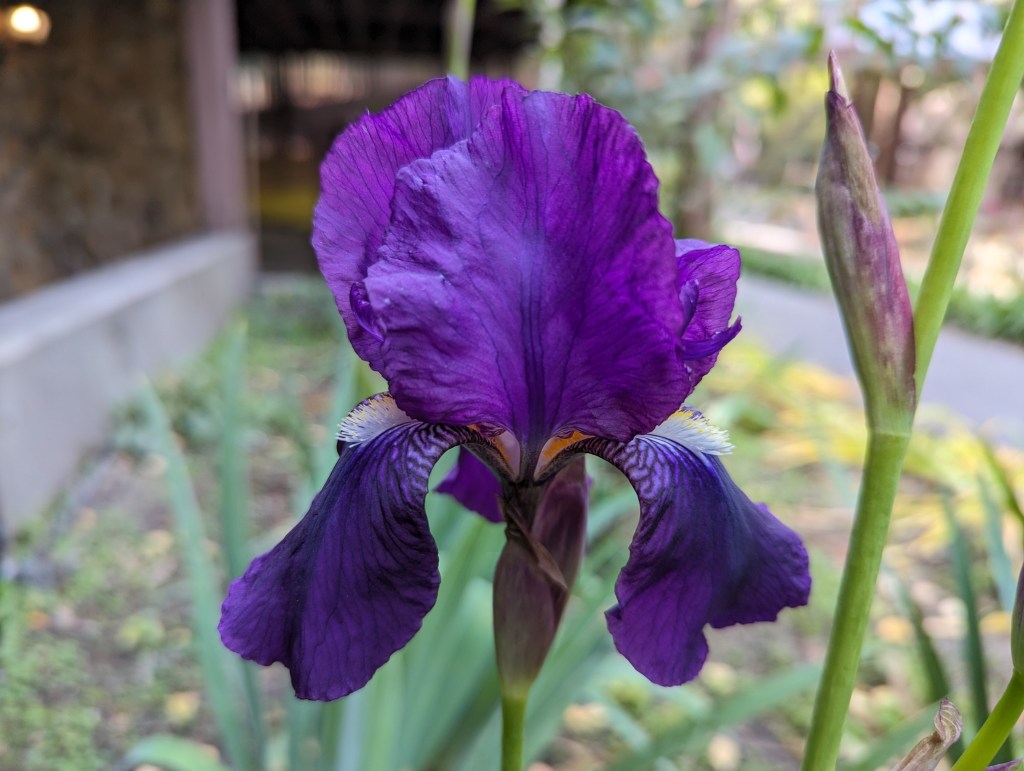
The most abundant of the bearded iris within the designated iris garden at work were recycled from where they had become too abundant in a home garden in Santa Cruz. They are unidentified. I suspected that they might be a simpler species, rather than a hybrid bearded iris, because they resemble my simple Dalmatian iris. Their floral stems are similarly slender. The leaves are similarly somewhat narrow. The fragrance is similar. The main differences are that the floral stems are a bit shorter, the flowers are rich purple rather than lavender blue, and instead of blooming promptly and thoroughly only for early spring, they bloom sporadically throughout spring, and again about now.

After posting a picture of them last winter, I was informed that they could be ‘Rosalie Figge’. They conform to the description of the cultivar, although they bloom for winter rather than autumn. They were blooming a month ago, and are still blooming now. Although I do not care what they are, it would be nice to know.

It was blooming a month ago.

Giant Bird Of Paradise Migration

A Flock Of Seagulls

Giant bird of Paradise is not actually from Paradise, and if it were, it would not be the Paradise in Butte County that burned five years ago. This particular species, Strelitzia nicolai, is from South Africa, Mozambique, Botswana and Zimbabwe. These particular specimens are from none of these places though. They came from Morgan Hill. Nor are they actually birds, although they seem to be migratory like so many species of birds that migrate about the southwestern portion of Africa, and apparently Morgan Hill, but not Paradise. Oh, this is getting confusing.

Giant bird of Paradise, which is unrelated to Big Bird of Sesame Street, is a grand perennial that can get twenty feet tall. It resembles the more common bird of Paradise, but with tall trunks that resemble those of small palm trees. Also unlike the common bird of Paradise, their appeal is more foliar than floral. In other words, their primary attribute is their lush foliage, rather than their bloom. Actually, their bloom can be undesirable within some situations.

In fact, that is why these particular specimens needed to be removed. Their bloom was drooling messy nectar onto the pavement below. In horticultural slang, they are known as ‘drooling seagulls’ because of this habit, and also because their bulky white flowers look like seagulls peeking from the lush foliage, and of course, drooling while they do so.

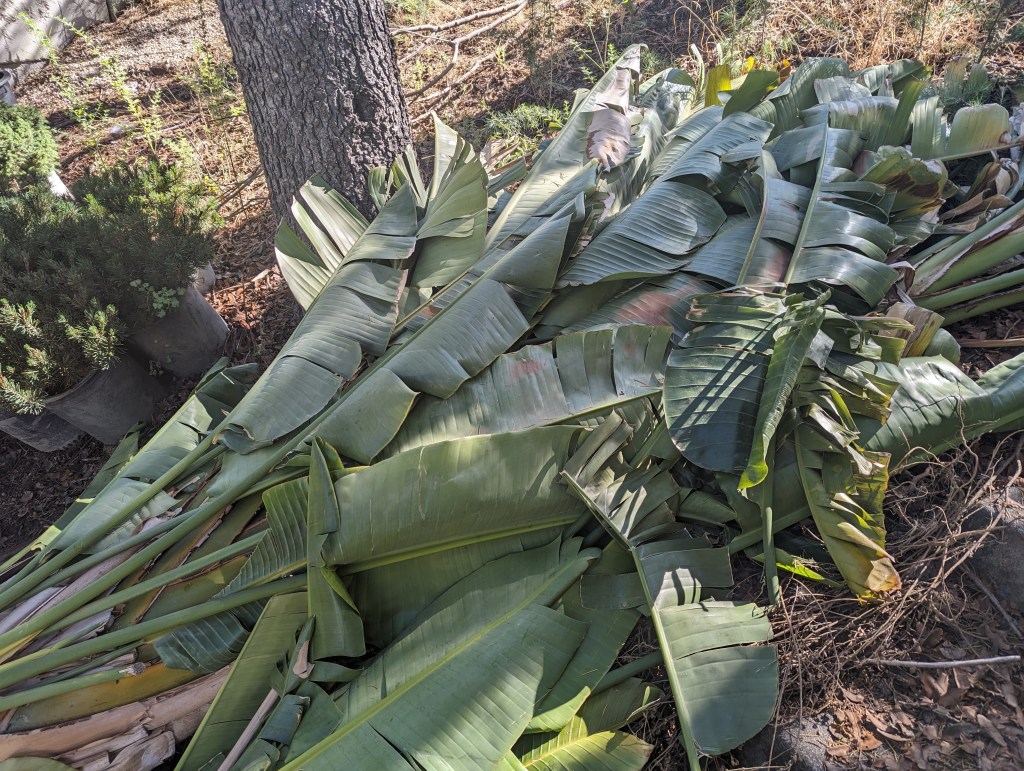
Morgan, the old F250 who coincidentally is named after Morgan Hill, and I brought these giant bird of Paradise here, where they await processing. They are supposed to be left out of the ground for about two weeks anyway, so that they will be less susceptible to rot when planted and irrigated. After their processing, they will get heeled in here so that I can monitor them more directly as they begin their recovery. The best of them will migrate again to their permanent landscape after the rainy season starts. I should get better pictures of them and their processing for Six on Saturday.

Six on Saturday: Bummer!

Things do not always go according to plans. Seasons and weather change faster than we can keep up. Many plants do what they want to do rather than what we want them to do. There is always compromise. It is a bummer that a unique agave is bolting now, and will eventually die, but it provided plenty of pups to replace itself with. It is a bummer that I must remove a productive elderberry bush before the berries ripen, but there are plenty more elsewhere. It is a bummer that two exemplary red maples may have died, but there are three more. The excess of recycled cannas is not a bummer though, but merely extra work.

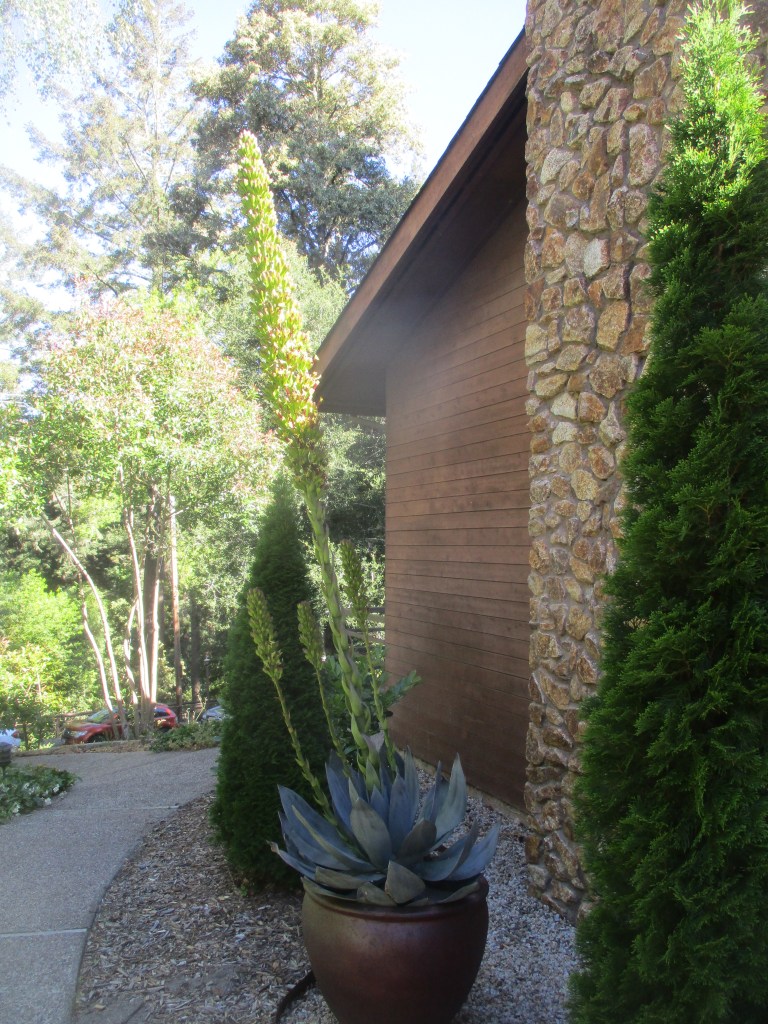
1. Whale’s tongue agave was a splurge. The horticulturist who got it had been wanting to grow it for a while. However, two years later, it had a litter of pups and is now blooming!

2. The flowers are not even very pretty. At least the floral stalks are weirdly striking, and bloom slowly. Although monocarpic, it could take months for the original rosette to die.

3. Six big potted maples were installed temporarily last year. Three are red maple. Three are Norway maple. The red maples foliated before we made arrangements for irrigation.

4. Elderberries are developing nicely. These are some of the best. However, they are on a big healthy elderberry bush that must be cut back from a roadway before they can ripen.

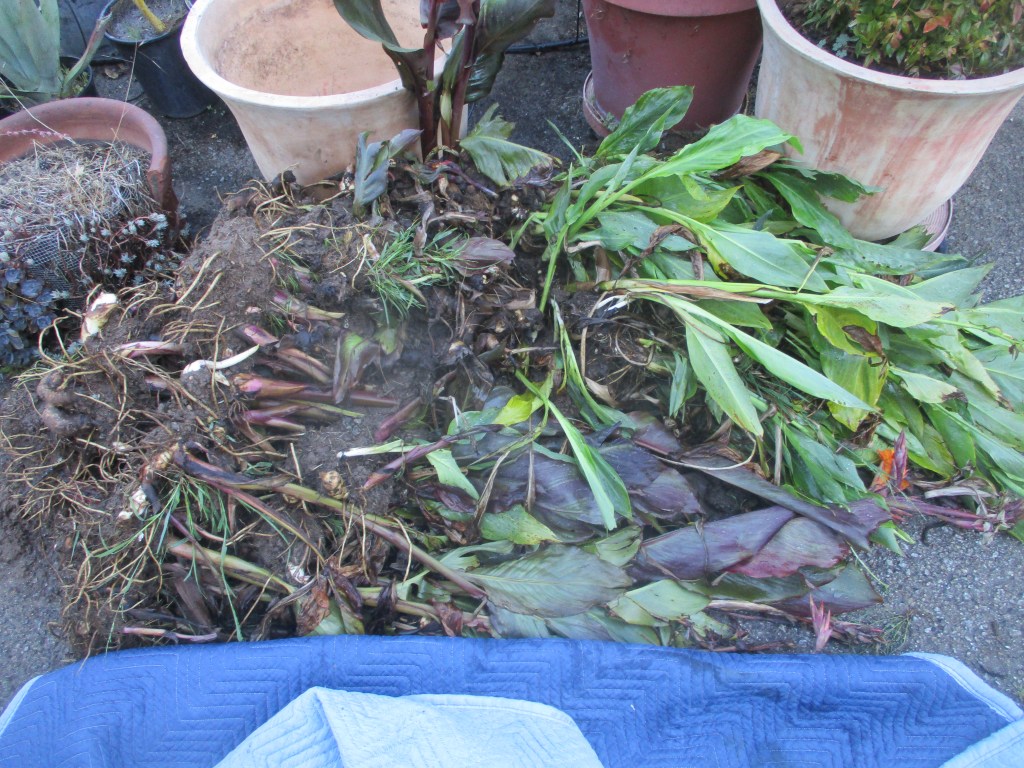
5. Cannas are fun! I was pleased with an opportunity to recycle a bunch from a neighbor. However, this pile is HUGE! Well, I know what I will be doing this Saturday. Goodness!

6. These cannas bloom very nicely. Most are bright orange. Most of the rest are yellow. A few are red. Unfortunately, they are blooming in the big pile, unseen and unappreciated.

This is the link for Six on Saturday, for anyone else who would like to participate: https://thepropagatorblog.wordpress.com/2017/09/18/six-on-saturday-a-participant-guide/