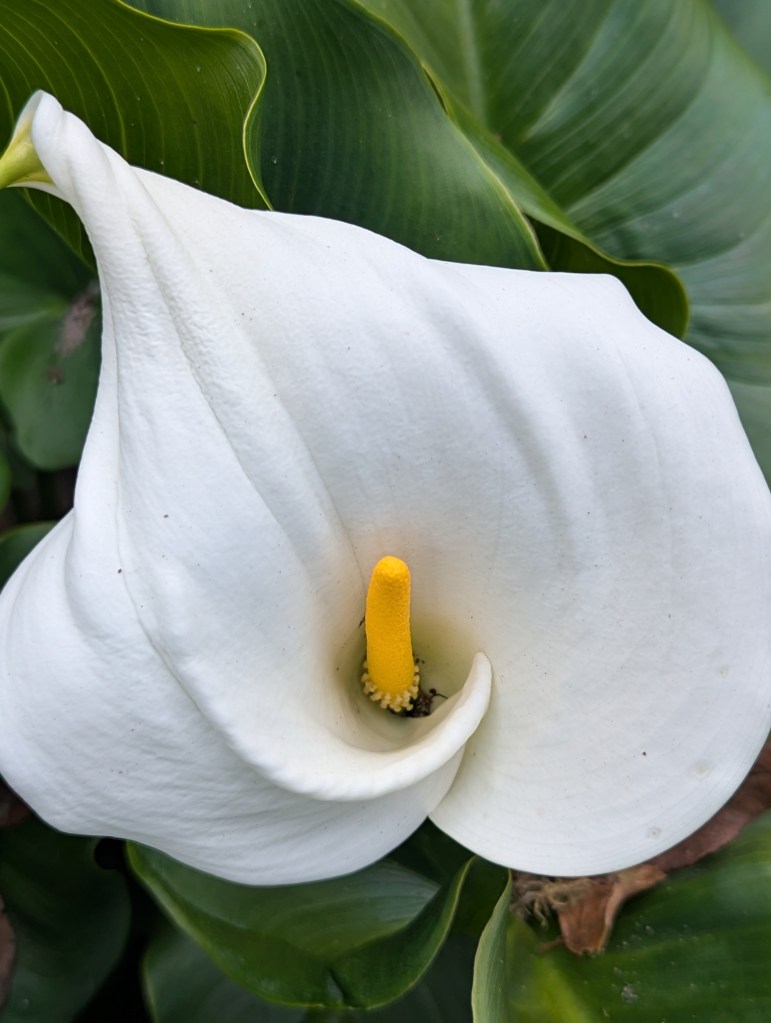
With few exceptions, common calla, Zantedeschia aethiopica, blooms exclusively white. ‘Green Goddess’ blooms with green stripes on bigger and more open blooms. ‘Pink Mist’ blooms with a pale pink blush at the bases of its blooms. More colorful summer calla are Zantedeschia elliotiana, which is a different species. Cultivars of common calla are rare.
Calla is an herbaceous perennial that grows from thick rhizomes. It can be invasive, and difficult to eradicate once it gets established. Its basal leaves stand two or three feet high or a bit higher if shaded. More than the lower half of their height is petiole. The upper leaf portion is broad and arrow shaped. All growth is rather spongy and soft, and tears easily.
Callas bloom mostly sporadically for spring, summer and autumn. Mature colonies often bloom with more profuse phases. New rhizomes do not bloom for a few months, though. Individual blooms consist of a solitary flaring spathe surrounding a spike shaped spadix. Compressed flowers adhere tightly to the yellow spadix. Callas are splendid cut flowers.
Spring bulbs go into their gardens through autumn because they enjoy the chill of winter. Summer bulbs do not. They instead prefer to wait until after the coolest of winter weather. If they start too early, some might decay in cool and damp soil before they begin to grow. Some may grow while the weather is warm only to incur damage from later cool weather.
However, they should not wait for too long. Summer bulbs dislike winter but enjoy spring. Those that start about now will be ready for it. By the time their new growth emerges from the soil, there will be no concern of frost. Although most generate only vegetative growth through spring, they bloom for summer. Many continue until frost or the following autumn.
Summer bulbs, like spring bulbs, are merely dormant perennials. Only a few are actually bulbs, though. Most are corms, rhizomes or tubers. They produce new foliage and bloom while the weather is warm. Then, they go dormant as the weather cools for the following autumn or winter. Once in the garden, several types can stay and perpetuate indefinitely.
For example, new canna rhizomes might rot if they go into the garden too early in winter. However, after their first summer, they can survive in the garden through their next winter. Dahlias might also survive winter dormancy in the garden. However, they are more likely to survive if dug and stored for winter. Their tubers might return to the garden about now.
Summer bulbs that are actually bulbs or corms, such as gladiolus, generally bloom once. Dahlias grow from tubers, so bloom for a more extensive season. Summer bulbs that are rhizomes, such as gingers, may bloom once or sporadically. Gingers and crocosmia can eventually become invasive. However, gladiolus is rarely as sustainable as it should be.
Summer bulbs become available from nurseries as it becomes time to plant them. Some are available now, and more will become available as their season progresses. Dahlias, cannas and callas should be available growing in pots after early spring. Summer bulbs that proliferate a bit too much are easy to share. Many propagate very easily by division. Most perform as well within large pots and planters as they do in the soil.
Not many summery bulbs provide as much immediate gratification as Canna. They grow very fast as soon as the weather begins to warm at the end of winter. They could become a bit too invasively vigorous for some situations. Canna are almost too easy to propagate by division. They probably perform better with annual thinning, preferably while dormant.
Dormant canna rhizomes are now available from nurseries. Potted specimens should be available a bit later. Canna, though, might be as available from friends or neighbors who grow too many. They crave frequent irrigation, and can inhabit riparian situations such as ponds. Although they are not too discriminating about soil, the prefer organically rich soil.
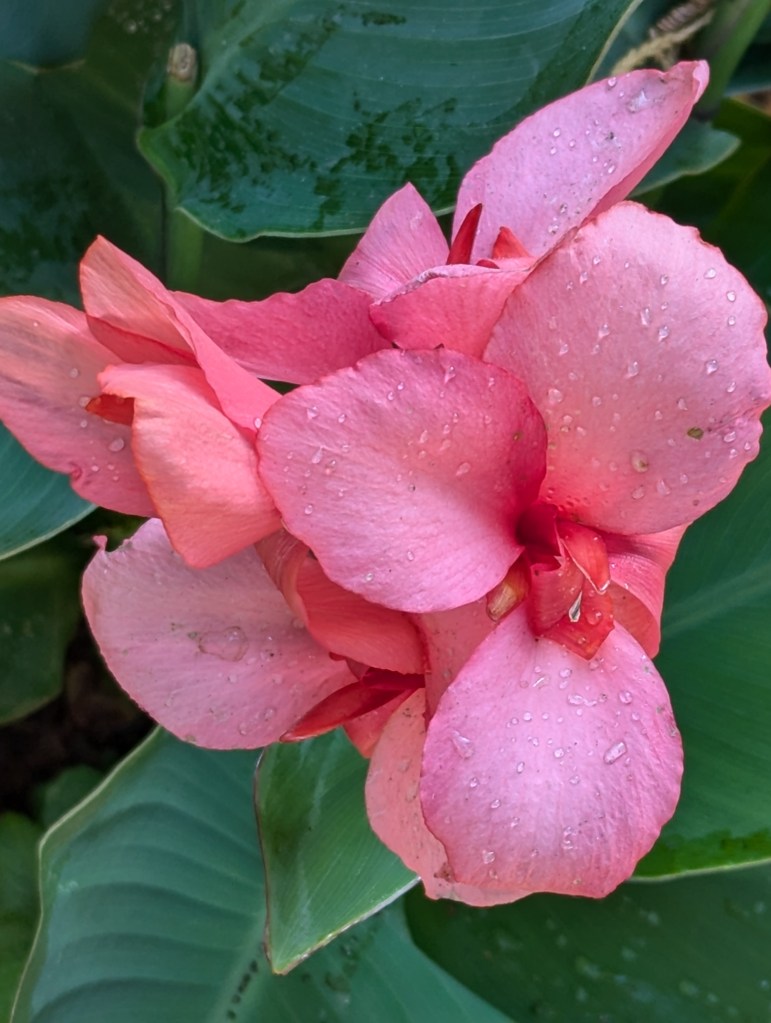
Canna foliage is about as lush and striking as its bloom. It can be green, various shades of bronze or variegated with white, yellow or bronze. Flowers can be thin and ribbony, or big and billowy. Floral color is various hues of yellow, orange, red, pink, or rarely creamy white. Flowers are commonly spotty or blotchy. Some canna grow higher than eight feet. Dwarf cultivars bloom splendidly without growing taller than two feet.
Spring is beginning to express itself. Only one of my six thinks that it is still winter. After a mild winter, I expected this sooner.
1. Colocasia gigantea ‘Thailand Giant’ elephant ear is the only one of these six to remain dormant. I still must determine if two will go directly into a landscape or get canned like the other two next week. I actually purchased these corms, but do not feel guilty about it.
2. Alocasia macrorrhiza ‘Borneo Giant’ elephant ear is another guiltless purchase. It has a very similar name and is from a similar region as the ‘Thailand Giant’ elephant ear, but grows from smaller rhizomes rather than fat corms. It is already generating new growth.
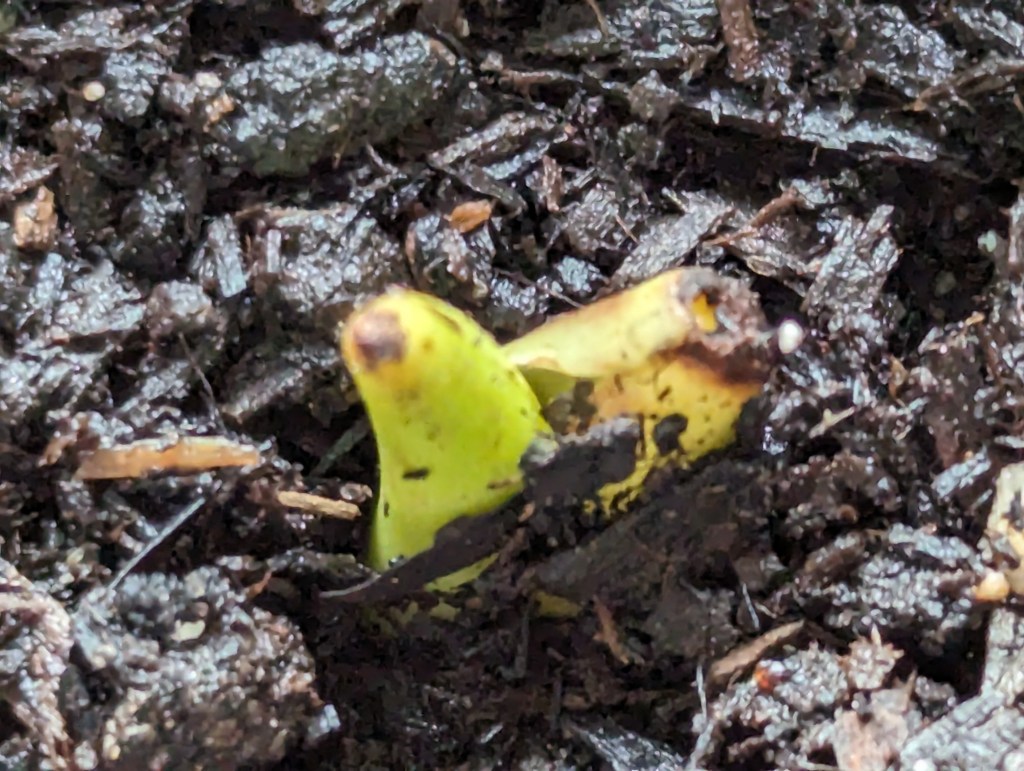
3. Musa acuminata ‘Double Mahoi’ banana was one of several items that I brought back from Los Angeles last year. After taking several small pups from it, I gave the original to a neighbor. Then, all the pups seemed to die! Now I am pleased that they are recovering.
4. Actinidia deliciosa, fuzzy kiwifruit cuttings are generating foliage. I hope that they are also generating roots. They are a male pollinator for a female cultivar that grew last year from a single pruning scrap that an associate here neglected to remove from his pickup.
5. Platycerium bifurcatum, staghorn fern looks weird as it extends new foliage. Actually, it always looks weird, which is its primary allure. I am concerned that such fresh foliage can be damaged by cold rain. It likes rain and humidity but in conjunction with warmth.
6. Viburnum tinus, laurustinus is the only floral feature of these six. I am not so keen on it, but am learning to appreciate it because its early spring bloom is popular where harsh weather through winter inhibits other bloom. It is simple white, without any pink blush.
Spring bulbs begin to go into the garden during autumn to benefit from the chill of winter. Summer bulbs begin to go into the garden during late winter to avoid the chill of winter. Spring bulbs know to remain dormant through winter. Some summer bulbs do not. If they grow prematurely, they can be vulnerable to cool wintry weather. Late is better than early.
Frost is still possible within some climates. However, summer bulbs are now in season. That is because, like spring bulbs, they disperse roots prior to developing foliage. By the time they extend foliage in a month or so, the weather will not be so cool. Later phases of a few sorts bloom later to prolong bloom for the first season. They synchronize afterward.
That is because they establish themselves within the garden. Once they do, some types of summer bulbs become hardy perennials. Some might try to grow prematurely during subsequent winters. If they incur frost damage as established perennials, they can easily replace the damage. Ornamental gingers and cannas do so regularly in inland climates.
Ornamental gingers and cannas may eventually benefit from division. Even if they do not become too crowded, they can migrate where they are not wanted. Their surplus is easy to relocate or share while dormant for winter. Their foliage becomes shabby or dies back during dormancy anyway. Even if mostly green, its removal stimulates healthy refoliation.
Ornamental gingers and cannas also are oblivious to phasing. Gingers bloom only once for late summer or autumn. Cannas bloom randomly from spring until autumn. Gladiolus bloom only once like gingers, but are more conducive to phasing. Early planting allows early bloom. Late planting delays bloom. Unfortunately, they are much less sustainable.
If summer bulbs do not look like bulbs, it is because few actually are. Most are rhizomes. Dahlias, which, like cannas, bloom from spring until autumn, grow from tuberous roots. As the name implies, tuberous begonias grow from tubers. Crocosmias grow from corms. So do taros, which are large foliar perennials. Gingers and cannas are familiar rhizomes. Although alliums bloom as summer bulbs, they go into the garden along with earlier spring bulbs.
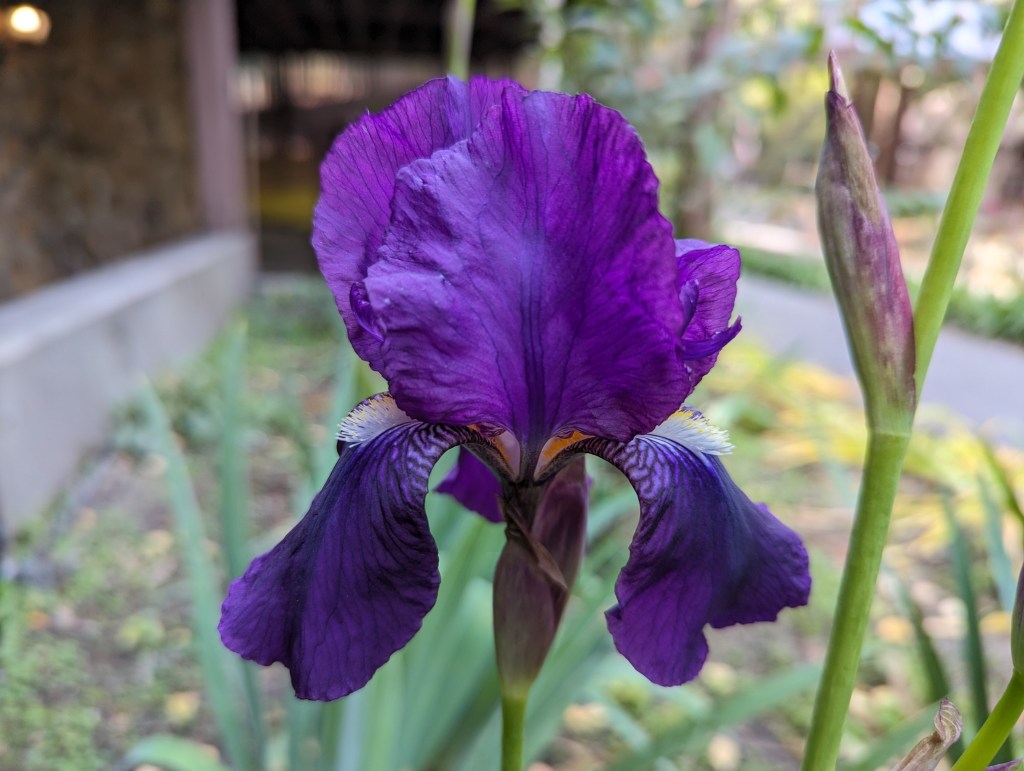
Bearded iris should bloom for early spring, not winter.
Each of the several bearded iris that I grow have history. Their origins are more significant than their performance. None were merely purchased. I obtained my first, which is actually Dalmatian iris rather than bearded iris, from the garden of my maternal maternal great grandmother when I was about five years old, before I was in kindergarten.
Some of the seventeen or so that inhabit my garden may be added to a designated iris garden at work as they multiply. Some of the eight or so that inhabit the designated iris garden at work may be added to my garden as they multiply. I will likely procure at least two additional cultivars when I return to the Pacific Northwest later in winter, as well as Louisiana iris from another source.
The most abundant of the bearded iris within the designated iris garden at work were recycled from where they had become too abundant in a home garden in Santa Cruz. They are unidentified. I suspected that they might be a simpler species, rather than a hybrid bearded iris, because they resemble my simple Dalmatian iris. Their floral stems are similarly slender. The leaves are similarly somewhat narrow. The fragrance is similar. The main differences are that the floral stems are a bit shorter, the flowers are rich purple rather than lavender blue, and instead of blooming promptly and thoroughly only for early spring, they bloom sporadically throughout spring, and again about now.
After posting a picture of them last winter, I was informed that they could be ‘Rosalie Figge’. They conform to the description of the cultivar, although they bloom for winter rather than autumn. They were blooming a month ago, and are still blooming now. Although I do not care what they are, it would be nice to know.
Dinnerplate dahlias should be about ten inches wide.
Mail order scams are a topic that I have been avoiding. I do not want to consider that some of a few items that I purchase by mail order may not be what they were sold as; and, if so, I will not know until they grow, bloom or produce fruit. Furthermore, I want to believe that if such items are not what they were sold as, that the situation is merely accidental.
This was no accident.
It began with the purchase of thirty rhizomes of ‘Red King Humbert’ canna last year. They were the cheap sort that become available after their primary season. I did not expect them to be of exemplary quality. Nor did I expect them to bloom. I only wanted them to grow a bit during the remainder of their season so that their rhizomes could survive winter dormancy to grow and bloom for the following season, which would have been last spring.
They grew as expected, but seemed to be virused. I tried to believe that the supplier would not send me virused stock, and that the striations of their foliage were normal. However, as growth resumed last spring, the foliage was very obviously virused.
Also, as they grew, they were very obviously not ‘Red King Humbert’. They grew only about two feet tall, and bloomed with scrawny orange flowers. ‘Red King Humbert’ gets about six feet tall, with big and billowy orangish red bloom.
The supplier gave me a credit for the expenditure, to spend on more of their products, I should have requested a simple refund. Instead, with the credit and a slight bit more for the difference in price, I purchased two dozen rhizomes of assorted dinnerplate dahlias.
As with the canna, I did not expect exemplary performance from these dahlias so late in the season. I only wanted them to survive and grow enough to store enough resources to survive their winter dormancy, to grow and bloom for the next season.
Most were completely necrotic and mummified upon arrival. Because this was after my experience with the canna, the supplier agreed to refund what I spent, but then only refunded a random amount of a dollar and a few cents. When I asked about the refund, I was informed that it was comparable to the cost of the one rhizome that I sent a picture of, as if I was expected to send a picture of every rhizome that I wanted a refund for. I explained that almost all of the rhizomes were comparable the the one that I sent a picture of, but received no more response.
I still have heard nothing about it. I decided to be satisfied with the few rhizomes that survived, and just accept the loss. The time that I had already wasted on pursuing a refund was worth more than any refund that I would have gotten.
So, . . . a few of the dinnerplate dahlia rhizomes survived and generated a bit of growth to partially recharge their resources prior to their next dormancy. Two actually bloomed. Apparently, these are very special dinnerplate dahlias. Instead of producing blooms that are about ten inches wide, the largest bloom is less than three inches wide. I have never seen such a dinky dinnerplate.
Hyacinth will not bloom for a few months, but goes into the garden about now.
Some of the most familiar flowers to bloom in the earliest of spring get planted now as bulbs. They sit and wait in the garden to finish their dormancy, perhaps get a bit of a chill through winter, and get an early start to their bloom cycles as soon as weather permits. Because winters are so mild here in the Santa Clara Valley, some do not even bother to wait for spring, but are instead happy to start bloom before winter ends.
Bulbs become available in nurseries when they can be planted. Those that are not available yet will become available when it is time to plant them for later spring or summer bloom. The first to become available are generally the first to bloom; although bearded iris seem to know when they want to bloom, regardless of when they get planted.
As long as they do not get stored too long or get planted too late, bulbs do not need to be planted immediately, and actually extend their performance if planted in phases. The earliest phases to get planted will bloom earliest. Phases of the same bulbs planted a few or many days later should bloom about the same amount of time later.
With proper planning, later phases bloom as earlier phases finish. For example, because crocus flowers do not last very long, different phases of bulbs can be planted only a few days or a week apart, so that more flowers start to bloom in time for earlier flowers to fade. Freesia flowers last a bit longer, so different phases can be planted two weeks or so apart.
Narcissus and daffodil bulbs are not so discriminating about how deeply they get planted, so various phases can be put in the same spots. As long as they do not get planted too deep, the earliest phases can be planted deep and covered with only a bit of soil, so that later phases can be planted above. If similarly covered with only a shallow bit of soil, later phases of the same bulbs can be stacked, as long as the last and shallowest phase still gets planted deep enough.
Not many bulbs are actually real bulbs. Most are corms, tubers, rhizomes or tuberous roots. They all do the same thing though; store resources through dormancy to sustain quick bloom as weather allows. Although many bloom reliably only once in their first season, some naturalize to bloom at about the same time each year. Tulips are capable of naturalizing, but rarely get enough chill in winter to bloom after their first season.
Anemone (windflower), hyacinth, lily, rananculus, tulip and small colorful callas are the less reliable of spring bulbs after their first year. Crocus, freesia, hymenocallis and harlequin flower can be more reliable if they get what they want. Grape hyacinth, narcissus, daffodil, watsonia, bearded iris and the old fashioned white callas are the most reliable of bulbs that get planted about now.
Narcissus, including daffodil, started to bloom during all that earlier torrential rain. Those that bloomed after the rain stood up a bit better than those that started earlier. Crocus are stouter so are more resilient. Hyacinth are both relatively stouter and slightly later. While such spring bulbs contend with late wintry weather, it is about time to add summer bulbs.
Unlike spring bulbs that like to be in the garden early enough to benefit from winter chill, summer bulbs do not benefit from chill. Some actually dislike it. Also unlike spring bulbs, very few summer bulbs, or late bulbs, are actually bulbs. Almost all are rhizomes, tubers, tuberous roots, corms or other types of dormant but reliably perennial storage structures.
Summer bulbs do not grow through early winter to bloom later in winter or early in spring like spring bulbs do. They instead grow through late winter and early spring to bloom for late spring or summer. A few bloom for autumn. Several are more reliably perennial than the majority of spring bulbs. However, some bloom splendidly only for their first seasons.
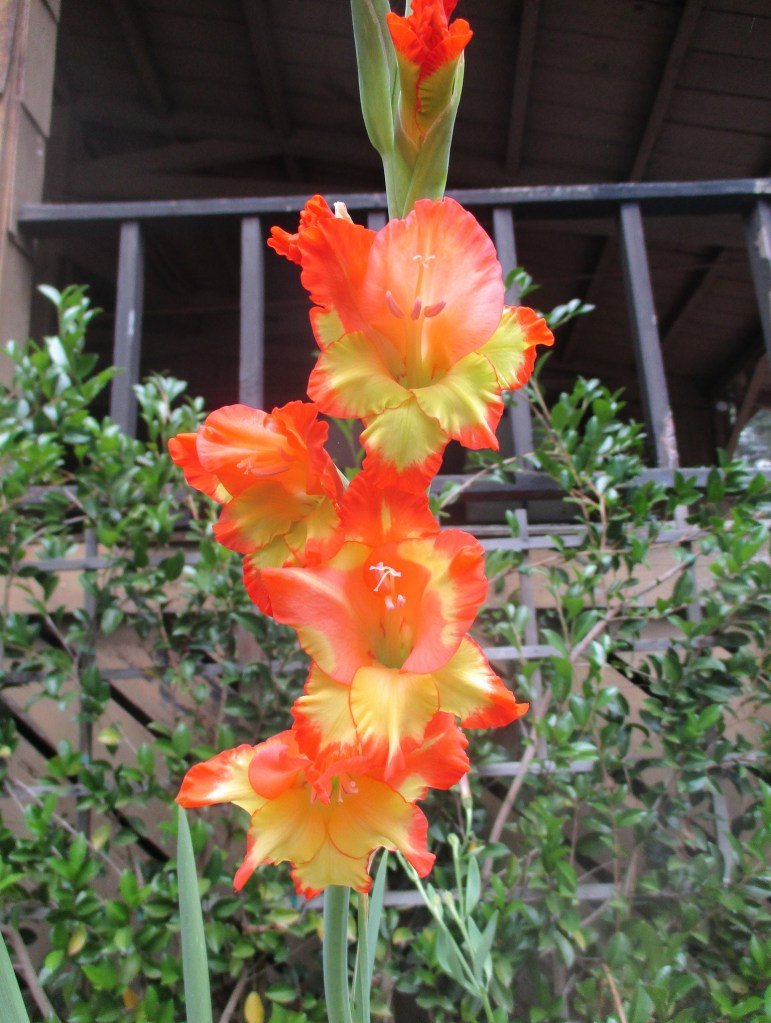
Gladiolus is one of the most popular summer bulbs, but like many spring bulbs, it blooms only once annually, and is not reliably perennial. Planting in phases every two weeks or so through their planting season prolongs bloom. However, most corms do not survive to bloom for a second season. Those that do will synchronize for their subsequent blooms.
Dahlia blooms for a longer season from the middle of summer until the middle of autumn. Also, it is more reliably perennial. Tubers remain dormant through winter after stems and foliage die back. They generate new stems and foliage through warming spring weather. Overgrown or crowded tubers propagate efficiently and easily by division while dormant.
Summer bulbs are not quite as diverse as spring bulbs, but some types are too vigorous for much diversity. A few rhizomes of canna can become overwhelming within a year. Old fashioned white calla forms broad colonies that might exclude other perennials. Smaller and more colorful modern cultivars are fortunately docile. Crocosmia might get invasive, and is difficult to mitigate.
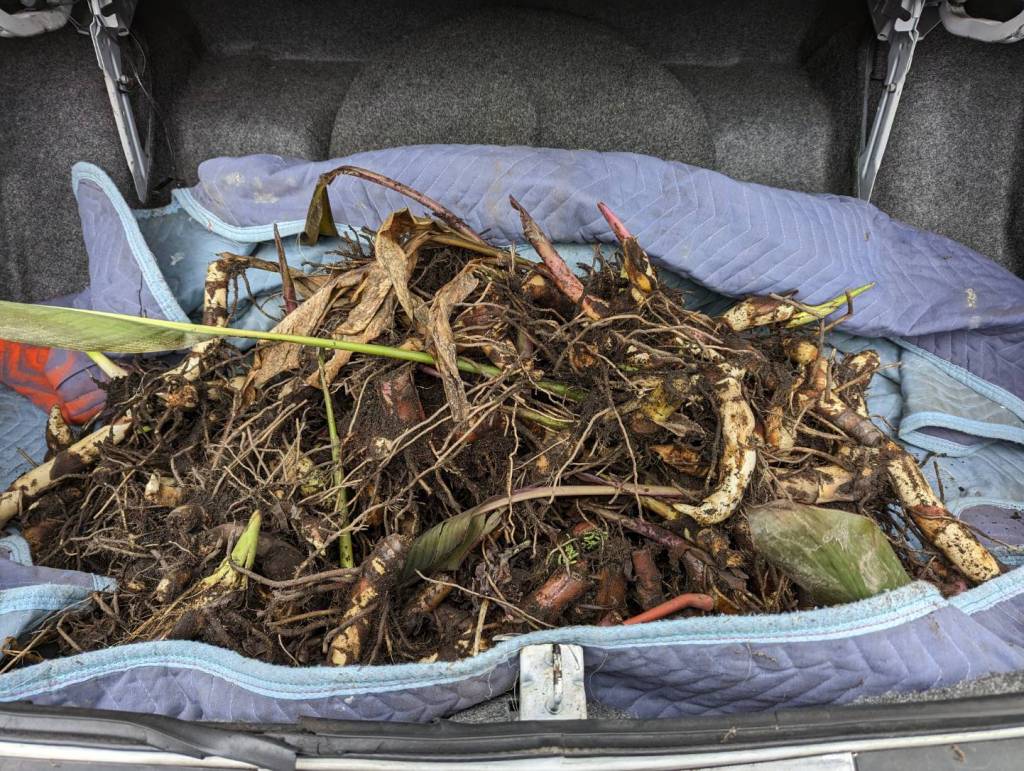
It is exactly what it looks like; more Canna rhizomes. I am very aware that there are already too many Canna here. I grew them. I do not care. I saw these in a neighbor’s garden, and asked for a few copies. She told me that I only needed to dig them myself, as if that might be a problem. As she pointed out those that were migrating a bit too close to her home, I dug many more than I should have. Since she was so generous to share so many, I felt obligated to remove all that were superfluous. Besides, to me, they are not junk. I am very pleased with them, even if they are a bit excessive.
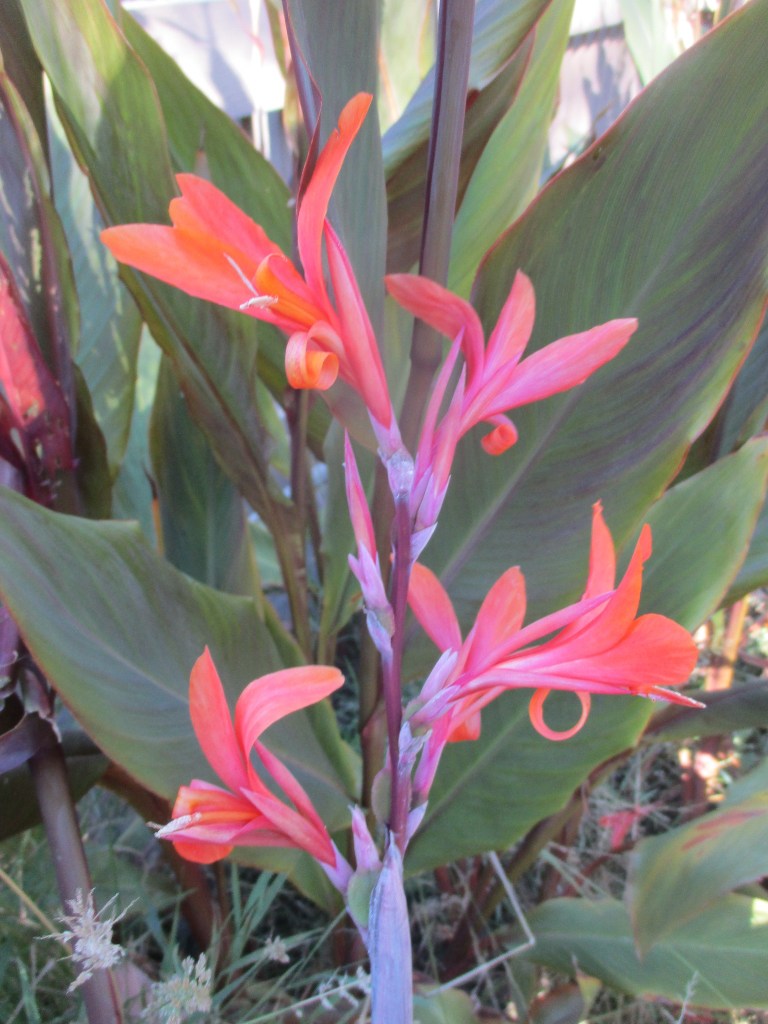
There are two cultivars, and perhaps seed grown rhizomes of one of the two cultivars. The shorter sort are ‘Inferno’, which is the same as ‘Tropicanna’ and ‘Durban’. Some Canna cultivars seem to develop several synonyms. Its bright orange bloom stands tall above distinctively striped and bronzed foliage. It gets about six feet tall, so is only the shorter of the two cultivars because the other is so much taller. Although it is one of the more popular cultivars, I only recently acquired a single can of it from Brent last year. I am pleased to grow much more.
The other cultivar seems to be comparable to the unidentified cultivar at work that resembles and might actually be Canna musifolia. It has similar scrawny orange bloom on top of very tall canes that I must bend over for deadheading. Because I did not notice them until after frost, I do not know how bronzed the foliage is, or if it is bronzed at all. The neighbor who gave them to me says that they are ‘lightly’ bronzed. The newly emerging buds seem to be green without any bronze. I will be pleased with any color, but simple green would be awesome! Some of these may have grown from seed, so may be slightly different from the original.
There were enough rhizomes of ‘Inferno’ for a dozen #5 cans with about four rhizomes each. There were enough rhizomes of the taller sort that might be Canna musifolia for sixteen #5 cans with about three very plump rhizomes each. That was after sharing some with others at work, and leaving some for a neighbor of the neighbor who shared them with me. I intend to take some to the Pacific Northwest before the end of winter, but canned them all because I do not yet know when I will leave. I can always remove some from their cans, or just take them in their cans.
Since they fit into the trunk more easily than a previous batch of ‘Wyoming’ and a cultivar that resembles Canna flaccida that I obtained from another neighbor, they seemed to be less numerous. However, the previous batch included foliage. These rhizomes lacked foliage, and were actually a bit more numerous. Regardless, I am very pleased with them, and intend to enjoy growing them. As I closed the tailgate after unloading them, I could see that Rhody did not share my enthusiasm.








 Tony Tomeo