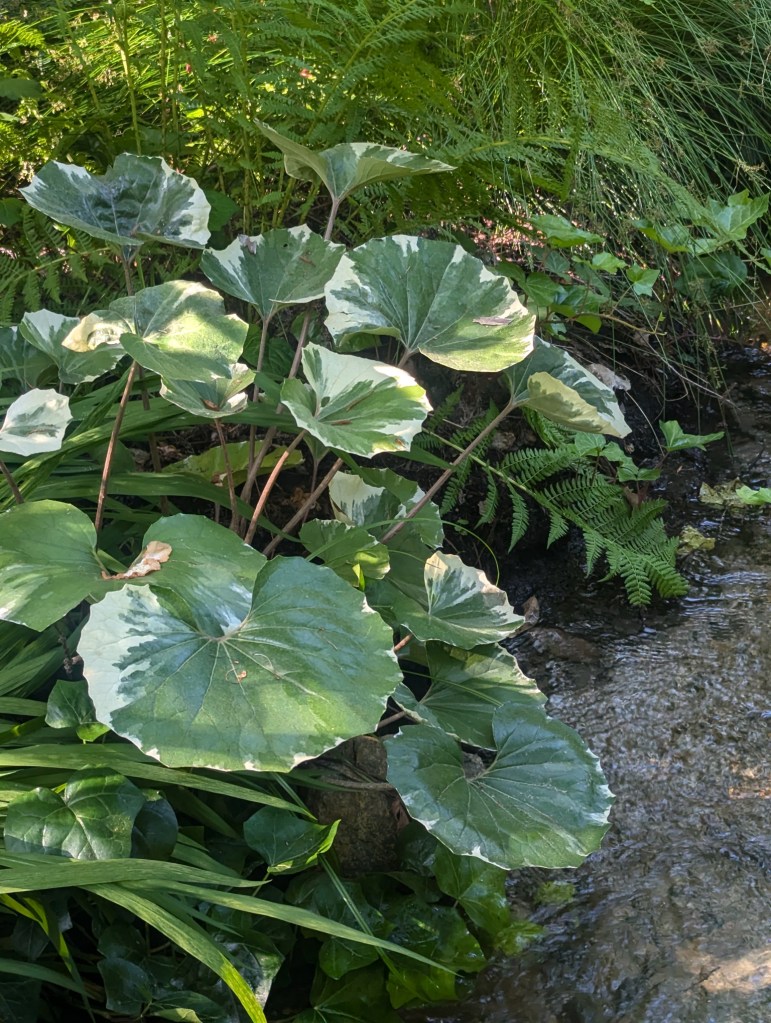
Chilean Rhubarb

Chilean rhubarb is a grand perennial.

Only riparian and aquatic vegetation tolerates sustained soil saturation. Chilean rhubarb, Gunnera tinctoria, almost qualifies as such. It enjoys such generous irrigation that it may perform well on a bank of a pond or stream. However, it should be sufficiently high on its bank to avoid constant saturation. Otherwise, it can rot, likely during its winter dormancy.

Chilean rhubarb is a spectacular foliar plants. Its humongous lobed leaves may grow six feet wide and eight feet tall. Although they succumb to mild frost, they regenerate quickly from rhizomes for spring. Leaves and petioles have a rather raspy texture, with small soft spines. Odd conical floral spikes that bloom about now might grow nearly three feet high.

Although not related to real rhubarb, Chilean rhubarb is as edible as its name implies. Its big petioles only need peeling to remove the raspy exteriors. Locally, Chilean rhubarb is more of a striking ornamental perennial. It is as appropriate to woodsy gardens as it is to sleek modern gardens. The absence of its bold foliage for winter is the main disincentive for its usage.

Lungwort

Most lungwort blooms blue or purplish.

Its unappealing common name is less common than its more agreeable botanical name. Lungwort does not sound as pretty, or at least as official as Pulmonaria officinalis. It is an evergreen perennial, although its foliage likely desiccates through summer. New foliage replaces it during cooler autumn weather. Lungwort prefers cool and moist partial shade.

Mounds of foliar rosettes grow no deeper than a foot. They often stay only half a foot high as they spread as wide as two feet. Their lowest rhizomes produce adventitious roots so that they can sprawl even farther. Such growth is easy to divide. Foliage of most cultivars exhibits pretty lighter green or silver spots or blotches. Some is almost completely silver.

Lungwort blooms mostly for late winter and early spring. Trusses of daintily small flowers hover barely above their basal foliage. The most popular sort blooms with pinkish purple flowers that mature to blue. Others bloom with purple, pink, purplish red or white flowers. Although foliage is healthier within partial shade, sunshine promotes profusion of bloom.

Canna

Cannas are as foliar as floral.

Not many summery bulbs provide as much immediate gratification as Canna. They grow very fast as soon as the weather begins to warm at the end of winter. They could become a bit too invasively vigorous for some situations. Canna are almost too easy to propagate by division. They probably perform better with annual thinning, preferably while dormant.

Dormant canna rhizomes are now available from nurseries. Potted specimens should be available a bit later. Canna, though, might be as available from friends or neighbors who grow too many. They crave frequent irrigation, and can inhabit riparian situations such as ponds. Although they are not too discriminating about soil, the prefer organically rich soil.

Canna foliage is about as lush and striking as its bloom. It can be green, various shades of bronze or variegated with white, yellow or bronze. Flowers can be thin and ribbony, or big and billowy. Floral color is various hues of yellow, orange, red, pink, or rarely creamy white. Flowers are commonly spotty or blotchy. Some canna grow higher than eight feet. Dwarf cultivars bloom splendidly without growing taller than two feet.

California Sycamore

California sycamore develops massively gnarly trunks.

The tallest, largest and oldest trees of the World are all native to California. So are the rarest pine, rarest fir and largest oak. California sycamore, Platanus racemosa, is loyal to this tradition of distinction. Although not the tallest sycamore, it might be the grandest. It develops gnarly and sculpturally irregular form. Some develop multiple massive trunks.

Because of its scale, California sycamore is uncommonly available from nurseries. It is simply not proportionate to home gardens or even big landscapes. Most old specimens are older than the landscapes around them. They are somewhat adaptable to landscape irrigation. However, increased moisture increases potential for spontaneous limb failure.

California sycamore can grow a hundred feet tall with bulky trunks and limbs. Old trees may exhibit scars from shedding limbs throughout their long lifespans. The mottled bark is gray and tan, and roughens only slowly with age. The deciduous foliage of such large trees is very copious through a long defoliation. Foliar tomentum (fuzz) is quite irritating.

White Alder

White alder is not exactly . . . white.

During the summer, the native white alder, Alnus rhombifolia, is a nice shade tree that looks bigger than it really is. By late winter, the bare deciduous canopy has an appealingly picturesque silhouette. This time of year is actually when white alder is typically less appealing, with dead foliage that provides no interesting fall color, but lingers until knocked down by rain or late frost. Yet, even now, it sometimes surprises with these funny looking floral structures that are interesting both in the early winter landscape, and with cut flowers.

In past decades, white alder was an ´expendable’ tree that was put into landscapes for quick gratification while slower but more desirable trees matured. By the time the desirable trees matured, the alders were removed to make more space for the desirables. This technique was practical because, like many fast growing trees, alders do not live very long, so start to deteriorate after about twenty five years anyway. However, alders often live longer than expected.

Mature alders are usually less than fifty feet tall where they are well exposed. They can get at least twice as tall where shaded by other trees or big buildings. Their plump trunks with mostly smooth silvery gray bark make them seem larger than they really are though. Too much water promotes buttressed roots which can displace pavement.

Alocasia or Colocasia?

Alocasia odora

‘A’ or ‘co’? What is the better prefix for ‘locasia’? There are certainly differences between the two, but information regarding such differences and characteristics is confusing and potentially misleading. It is amazing how much less information is available now that so much more information is so much more available than it has ever been before.

Alocasia generally develops big leaves that point upward. Colocasia generally develops big leaves that point downward. Alocasia prefers a bit of partial shade. Colocasia prefers more direct sunshine. Alocasia generally has more colorful leaves. Colocasia generally has bigger leaves. Of course, these are generalizations, and some species of each of these two genera seem to be species of the other genus.

Colocasia gigantea supposedly develops the biggest leaves and can get twenty feet tall. Alocasia macrorrhiza supposedly is the biggest of its genus and can get fifteen feet tall. It is difficult to know what to believe.

One the edge of a pond at work, we would like to grow whichever of these massive perennials develops the biggest leaves. If we grow Alocasia, we can put it in a partially shaded situation. If we grow Colocasia, we can put it in a sunnier situation nearby. If we grow Alocasia, we can put it a short distance from the edge of the pond. If we grow Colocasia, we can put it right at the edge of the pond. We only need to know which cultivar of which species of which genus we should grow.

I am inclined to grow Colocasia gigantea. We have a few months to decide, since we do not want to plant it during autumn or winter. We recently acquired this Alocasia odora. Also, another similar but unidentified perennial that seems to be a Colocasia must be relocated from another disproportionately compact landscape.

Sweet Flag

Sweet flag is a riparian perennial that performs well in saturated soil.

After many centuries of being grown for use in herbal medicine, sweet flag, Acorus gramineus, is still a popular evergreen perennial; but is now appreciated more for its low mounds of grassy foliage. ‘Ogon’, one of the most popular cultivars, has light yellow variegated foliage that contrasts well with deep green foliage, or brightens partially shaded spots in the garden. Individual clumps grow quickly to about eight inches tall and broad, and then spread slowly by producing more shoots. New plants are easily propagated by division. Sweet flag likes plenty of water, and does well in partially submerged pots in koi ponds, or poorly drained spots.

Tasmanian Tree Fern

Tasmanian tree fern is more tolerant of significant frost than Australian tree fern is.

The trunk of a tree fern is really just tough compressed roots growing downward through dead organic material left behind by earlier growth. The foliage and terminal shoot high on top is just like any other fern that never leaves the ground. Because such a trunk is porous, it is ideal for epiphytic plants that, in the wild, mostly cling onto trees instead of growing on the shadier forest floor. Even though most epiphytic plants are able to cling to just about anything, many prefer tree fern trunks because they can actually root into them.

The shaggy trunks of Tasmanian tree fern, Dicksonia antarctica, take decades to grow tall enough for smaller plants to be visible below the lush foliage, but are plump enough to host a rowdy party of  clinging epiphytes. Most get only about four or five feet tall, with the foliage standing a few feet higher, although some old specimens in Golden Gate Park are more than fifteen feet tall, and very old specimens in their native Tasmania can get nearly fifty feet tall.

The big lacy leaves spread about six feet wide, and can reach twice as wide in shadier spots. Shade also makes the foliage darker rich green. Like almost all ferns, Tasmanian tree fern like relatively rich soil and regular watering. Unlike other tree ferns though, it tolerates frost.

Sweet Flag

Sweet flag might enjoy wasteful watering.

If unpaved drainage ditches and collection ponds were more common locally, sweet flag, Acorus gramineus, might be also. It can provide a nicely neat border for such waterways, where the ground is too steep and damp for mowing. It can migrate into muddy situations and even into shallow water. Its dense network of fibrosus rhizomes helps to retain mud.

‘Variegatus’, with elegantly elongated and variegated leaves, is the most popular cultivar locally. It is rare in nurseries, but occasionally shared by friends and neighbors who grow it. Propagation by division is very easy. Single shoots or clumps of shoots grow if merely plugged into damp soil or mud. ‘Pusillus’ lacks variegation, and develops stouter leaves.

Sweet flag aggressively excludes other herbaceous vegetation, but does not migrate too rapidly. Plucking shoots and plugging them elsewhere accelerates migration. The dense foliage might get a foot deep. Individual leaves are very narrow, like grass. The mundane bloom is easy to ignore and is uncommon where the soil is not often saturated or muddy.

Duckweed

Duckweed can thoroughly obscure a pond.

Ducks somehow find water. They eventually visit most home garden ponds that they can fit into. Duckweed, Lemna minor, is likely to come with them. It adheres to waterfowl and other wildlife for that purpose. It proliferates very efficiently, and almost typically becomes a nuisance. Eventually, proliferation in a healthy pond should stabilize to a tolerable rate.

Individual duckweed plants are tiny. Their oval leaves are typically less than a quarter of an inch long. Each floating leaf extends its single root less than three quarters of an inch into the water below. Plants produce no more than four rooted leaves before dividing into a few smaller plants to repeat the process. Bloom and subsequent seed are uncommon.

As a floating aquatic plant, prolific duckweed might obscure koi and submergent aquatic plants within garden ponds. However, it also helps stabilize healthy aquatic ecosystems. In fact, it is useful for bioremediation of agricultural and industrial applications. It absorbs detrimental substances from water, while producing fodder and biomass for composting.