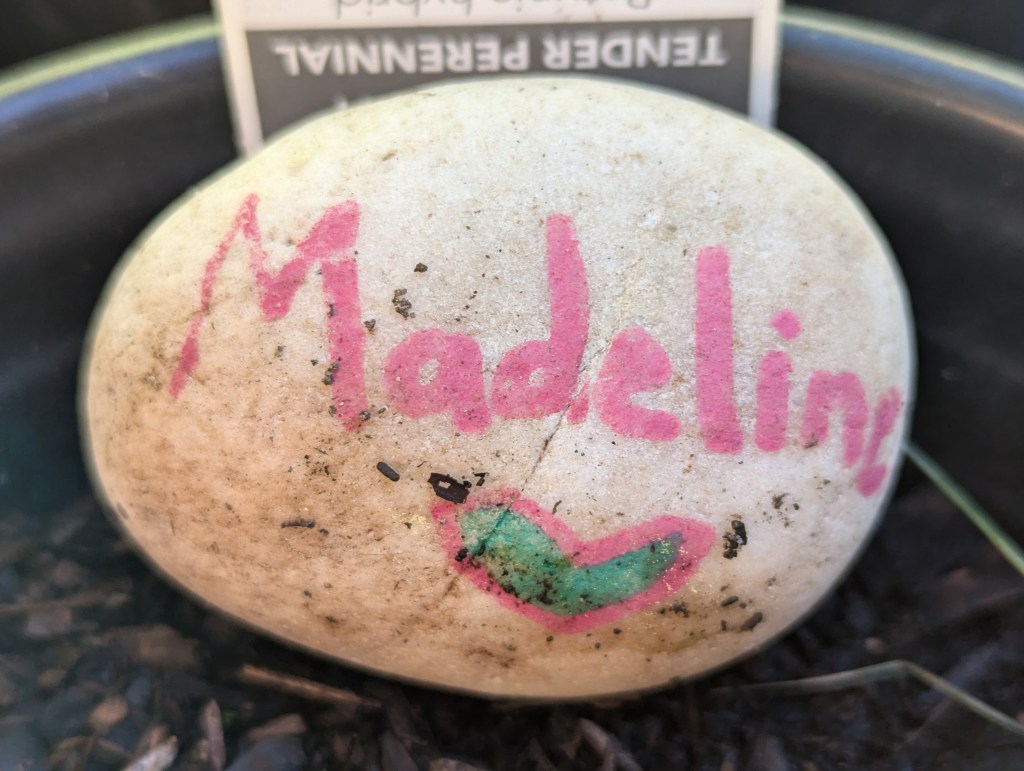
It has been nearly seven years since I documented the discovery of this mysterious Pet Rock in a hanging pot of zonal geranium at work. Until only recently, it had remained where it was for all this time. I did not want whomever left it to return to find it gone. Even after the zonal geranium were replaced with ivy geranium, it was returned to its original position. Unfortunately though, the ivy geranium did not perform much better than the original zonal geranium, so their hanging planters were recently removed completely with no plans to replace them. The Pet Rock was regrettably removed with them. There are no other planters nearby to deposit it into. I can only hope that whomever left it will not miss it. Realistically, I suspect that it was forgotten about shortly after it was left there. The difficulty is that I do not know. Well, the Pet Rock remains in the nursery at work, just in case someone asks about it. Perhaps it will eventually be deposited elsewhere in a landscape for someone else to wonder about. Perhaps that is how it was deposited into the hanging pot of zonal geranium where I found it!
Succulents that would not survive in alpine gardens where rock gardens were originally popularized are quite popular for rock gardens here.
Rock gardens, as they are known now, evolved from more traditional alpine gardens that were designed to display specimens of small plants found in the mountains of Europe. These plants were mostly compact and slow growing to be adapted to the harsh climates and rocky soils of higher elevations, but do not compete well with more aggressive plants. They consequently need their own space, and are quite happy surrounded by rock or gravel to insulate the surface of the soil and control weeds. Slight slopes, as well as the abundance of rock, enhance drainage to replicate mountainous conditions.
Compact plants from all over the world now find homes in rock gardens. The compact nature of rock garden makes them practical for small spaces, particularly where slopes make other gardening difficult. Sculptural, colorful or lichen covered rocks, as well as garden sculpture, can be as ornamental as the plants that surround them. Larger stones can substitute for low retaining walls.
Plants for rock gardens do not need to be from mountainous areas, but should be compact. They must also be appropriate to the particular microclimate. For example, small succulents and cacti want to be as exposed in a rock garden as they would be in a real landscape. Lily-of-the-valley shrub conversely prefers sheltered cooler spots.
Trees for rock gardens are generally very small. Pendulous (weeping) and dwarf Japanese maples are more desirable than those that eventually grow into mid sized trees. Dwarf forms of spruce, eastern hemlock, cedar, fir and false cypress all work well. There are also several dwarf pines to choose from, including dwarf cultivars of Scots, Japanese red, tanyosho, mugho, white and pinon pines.
Dwarf forms of cotoneaster, hebe, holly, rockrose, germander and Japanese barberry have become as popular in rock gardens as the more traditional small heathers and heaths. There are several compact junipers as well. Some rock gardens plants grow into small shrubbery. Others sprawl about as mats or dense ground cover.
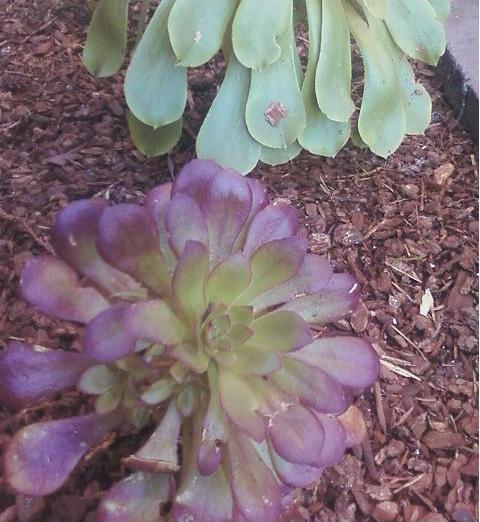
Thrift (sea pink), campanula, snow-in-summer, fleabane, coral bells, plantain lily, evergreen candytuft, carpet bugle (Ajuga spp.), and small herbs like thyme and oregano are some of the more popular perennials for rock gardens. Mat forming penstemon, columbine, cranesbill, saxifrage, rockcress and dwarf types of dianthus and primrose are more difficult to obtain, but worth trying. There are of course many small succulents like aeonium, echeveria, stonecrop (sedum) and ice-plant.
Crocus, grape hyacinth, snowdrop and wild freesia are the only common bulbs that are well suited to rock gardens. Uncommon dwarf cyclamen (not Cyclamen persicum), small types of narcissus and diminutive iris that can sometimes be found by mail order catalogues, online, or occasionally in nurseries that stock unusual plants are actually more proportionate to rock gardens than they are in more typical types of gardens.
This is the other side of the landslide that I posted a picture of for Six on Saturday a few days ago. As I mentioned then, it looked worse from this side. I suspect that it came down immediately prior to my arrival. No one else was aware of it, and there was no indication that anyone had tried to get around it or move any of its debris. It was just past my driveway, which is where Carson, the Roadmaster, was parked. However, because there are two households beyond it, the debris needed to be removed promptly. I did not want anyone else to do it, though. I wanted to separate the stone from the soil because I can use the stone to construct low retaining walls. Also, I wanted to use the soil to fill low spots within parking spaces at the top of the driveway. Although these low spots are very close to where the soil and stone was, and it should have been very obvious that soil could have been used to fill them, I know from experience that few put much effort into performing such a tasks in an efficient manner. Actually, they often seem to put significant effort into inefficiency. For example, the mound to the far right of the picture is debris from an landslide that occurred earlier. It is directly adjacent to a low spot that remains low because no one bothered to put any debris into it. So, now, there is a high spot directly adjacent to a low spot. Large stones were pushed over the edge, where they rolled into a portion of my garden below, bashed bark from trees, and are now where I do not want them to be. I hoped to avoid such problems with this landslide.
It seems that changes in fashion are sometimes partly motivated by rebellion against what they are changing from. The comfortably loose and pendulous ladies outfits of the 1920s that were so unflattering to the human form while revealing more of it than ever before were probably a rebellion to the impractically uncomfortable and strenuously refined ladies fashions of the late Victorian period that were designed to enhance the ideal of feminine form while also obscuring it. The simple and squared landscapes of the 1950s that were so neatly tailored that they would be considered to be bleak by modern standards were replaced through the 1970s and into the 1980s by a much more relaxed and curvaceous style with sculptural trees, shaggy foliar textures, hills and boulders. Ah, the boulders. They were still cool when Brent and I were studying horticulture at Cal Poly. We had to get some.




 Tony Tomeo