Kenny


If you watch Southpark, you shouldn’t.
If you do anyway, you shouldn’t admit to it.
If you happen to know someone who watches Southpark, you might have heard indirectly about Kenny. He dies in every episode. Actually, he typically dies a few times in each episode, and typically does so violently. Experts claim that there are two episodes of Southpark in which Kenny does not die, but proof is all too conveniently scarce.
There is also an opossum named Kenny. Like Kenny of Southpark, Kenny the opossum dies in every episode.
Apparently, Kenny startled someone who was working too intently in the garden to notice his approach on top of a fence directly behind where this unnamed someone was working. This unnamed someone grabbed a stick and clobbered Kenny right across the backside. Although the blow was not terribly aggressive, and not intended to be harmful, Kenny surprisingly died violently in a fit of hissing, gnashing and flailing. After falling to the ground, he smelled as if he had been dead for quite a while.
The surprised unnamed assailant went to find a box to put Kenny’s remains into for a proper ‘burial’, but upon returning to the scene of the incident, could not find Kenny.
Others briefly observed Kenny frolicking about in the same garden later, but when the unnamed assailant came within view, Kenny again died in a violent fit of hissing, gnashing and flailing, accompanied by the aroma of well aged death. Again, the unnamed assailant was unable to locate Kenny’s remains after retuning with a box in which to put them.
After a few more similarly violent deaths, it became apparent that Kenny was merely playing possum, likely in response to being clobbered with a stick by the startled unnamed assailant during their primary encounter!

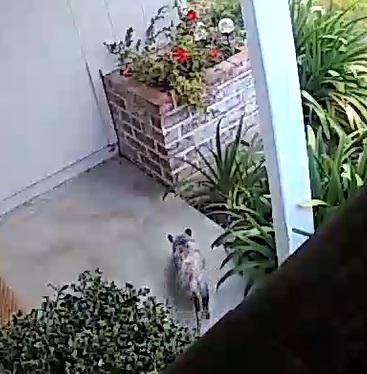
I apologize for the length of the video. My attempts to trim it compromised the quality of the imaging. The important part of the video is between ten and thirty seconds. This is not the real Kenny anyway, but merely a random opossum who happened to be frolicking in the garden.
I also apologize for posting this at noon rather than at midnight when I typically schedule my articles for the day. For midnight, I posted a short excerpt from an old article from the gardening column instead.

Halston Junior

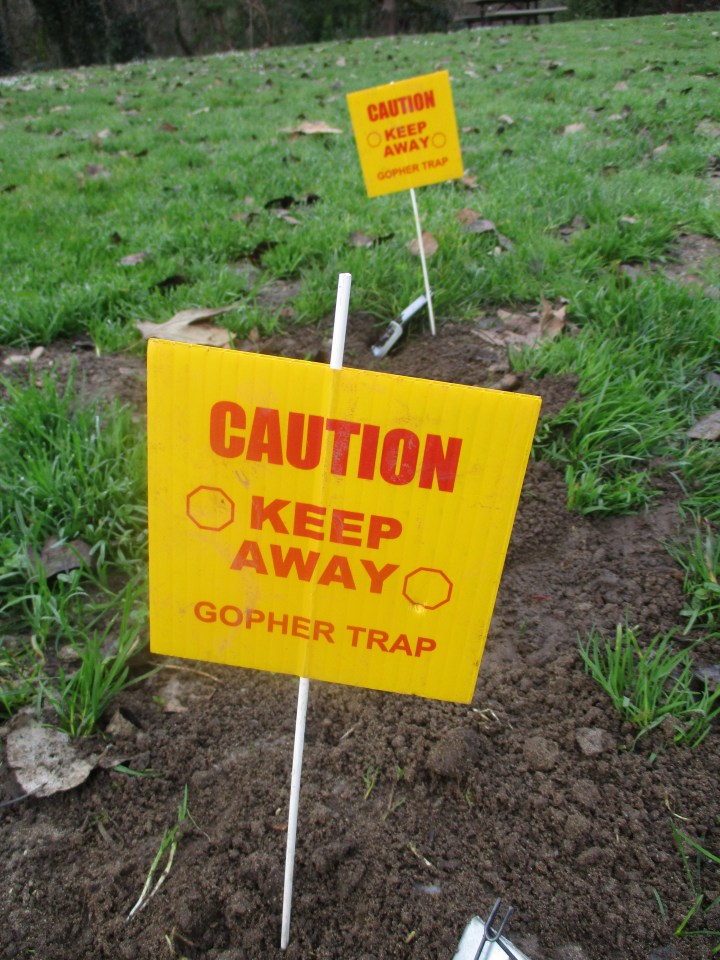
P80610Apparently, the warnings were effective. https://tonytomeo.wordpress.com/2018/01/27/caution/ . They managed to avoid the traps and survive to perpetuate another generation under the lawn of Felton Covered Bridge Park. It is impossible to know if they are directly related to the now deceased Halston https://tonytomeo.wordpress.com/2018/04/21/halston/ who infested a landscape only about two miles away. It is unimportant. They all are intent on conquest.

Halston Junior, a baby gopher who may or may not be a descendant of the famed Halston, was found wet and shivering on the surface of the ridiculously perforated lawn. Rhody wanted to play, but was restrained from consorting with the enemy. The prisoner was detained, dried and put in one of Rhody’s blankets to recover. There was no formal interrogation, but the detainee was found to be well armed.

It is impossible to imagine what sort of damage such sharp and strong claws could inflict!P80610+

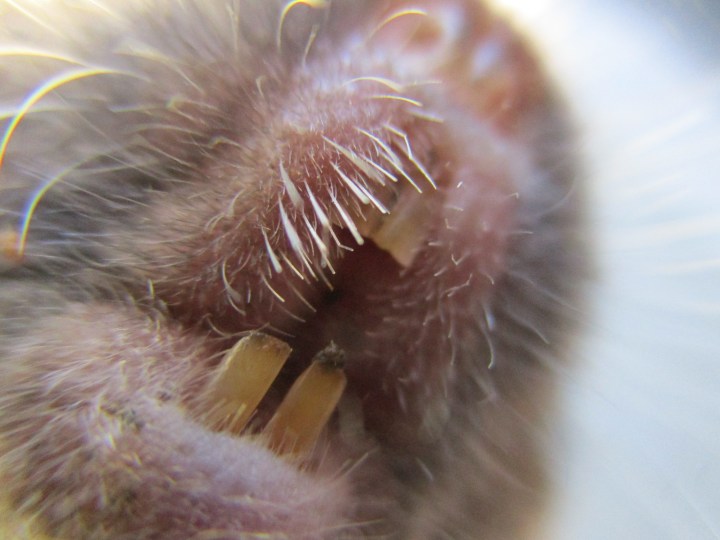
It is equally as impossible to imagine how dangerous such nasty fangs could be!P80610++

The purpose of this formidable weapon is unknown, but it is undoubtedly very dangerous!P80610+++However, the most effective weapons of all were mind control techniques. Halston Junior used them merely for self defense, by convincing his captors that he was too cute to be euthanized. It could have been much worse if he had not been so mentally compromised from his ordeal.
We knew that Halston Junior could not be released back into the lawn from which he came, but we also knew that relocating him somewhere else would disrupt the ecosystem slightly, and that Halston Junior would likely migrate back to where he came from. Ultimately, he did get released into a nearby meadow. We can only hope that the rest of the ecosystem will not notice.

Halston Junior won this battle, but not the war.


O

P80530

‘O’ is for ‘opossum’. That it the proper common name for the familiar North American critter who lives in or near many home gardens where fruit, vegetables or pet food are available. When a similar critter was found in Australia, it was given the same name by someone who did not spell it properly, hence ‘possum’. It is marsupial, and therefore related to many familiar Australian critters like koalas, kangaroos and the most terrifying of all, wallabies. Well, if the North American name can be applied to an Australian critter, it only makes sense that the Australian name can be applied to the North American critter. Thought technically and correctly ‘opossum’, many of us know them simply as ‘possum’, without the preceding ‘O’.

Opossums have a vast native range in North America. They can live anywhere that does not get too cold for them. They have likely always lived in the Santa Clara Valley to a limited degree. There was not much for large populations of opossums to eat just a few centuries ago.

As orchards grew and displaced native vegetation, there was more fruit that they could eat in season, but still not so much else during the rest of the year to sustain large populations of opossums. It was not easy for opossums to make homes at the modest home sites isolated by large orchards with only seasonal vegetation on the ground.

As orchards were developed into suburban neighborhoods, more habitat was created for opossums. They lived in and around homes, woodpiles, sheds, and areas landscaped with permanent vegetation. Vegetable gardens and more varieties of fruit trees in home gardens provided food throughout the year. There were citrus, avocados, guavas, persimmons and loquats, as well as ornamental berries like pyracantha and cotoneaster. Pet food and household trash were abundant. While San Jose was still a small town, it was inhabited by more opossums than could have been sustained in the entire Santa Clara Valley only a century earlier.

Those old suburban neighborhoods are now even more urban, and their landscapes are much more overgrown than they were when the homes were new. Rats, snails, slugs, grubs and large insects that live in the landscapes are fair game for opossums. Aging and deteriorating homes are easier for opossums to get access to, so finding shelter is easier than it has ever been. With more than a million people just in San Jose, there is no shortage of trash.

All through history, people have been moving in on wildlife. However, what we do not often hear about is the wildlife that moves in on humans.

Gophers Go For Roots And Lawns

80509thumbWho do they think they are?! This ain’t ‘Caddy Shack’! They have such attitude! Gophers move into our gardens and lawns, take what they want, and build their messy volcanoes of loose soil. They do not care how much work we put into our gardens, or how much we spend on nice plants, or how much we crave our first zucchini of the year. They are safe in their subterranean tunnels.

Or so they think. There is more than one way to . . . well, you know. There are also several methods that either do not work, or are not practical. For example, gasoline poured into a tunnel may volatilize, and then explode if ignited, killing gophers below, but can very easily start a fire anywhere the fumes happen to seep from the tunnel, and there is no way of knowing where that might be!

Poisons are dangerous either because gophers do not eat them, leaving them to be dug up by someone else later, or because gophers do eat them, and then stagger from their tunnels in search of water, and then get eaten by someone else who gets poisoned as well. Putting razor blades in the tunnels is just plain wrong. Even if it actually kills gophers, who wants to dig up razors later?

Traps are still the most efficient way to eliminate gophers. This is of course more easily said than done. It must be done properly and VERY carefully. Gopher traps are dangerous! It is safest to learn how to set traps from someone who is experienced with them. Safer modern types that fit into holes that gophers are expelling soil from only work if gophers happen to be active at the time.

Conventional gopher traps are set and placed in a pair, with one trap in each direction of an excavated and cleared main run. A main run is found by following a surface tunnel below the freshest volcano of expelled soil, to where it splits into two direction. The paired traps should be attached by wire to a stake that stays visible at the surface. A bit of crushed vegetation can be placed behind the traps before the run gets buried firmly. If set properly, a gopher springs a trap as it returns to clear the run.

Halston

P80421KHalston, with the help of several friends, could make a nice pill box hat. That is the origin of the name; from pill box hate fame. This might help clarify, https://tonytomeo.wordpress.com/2018/01/27/caution/ . Yes, Halston was a gopher.

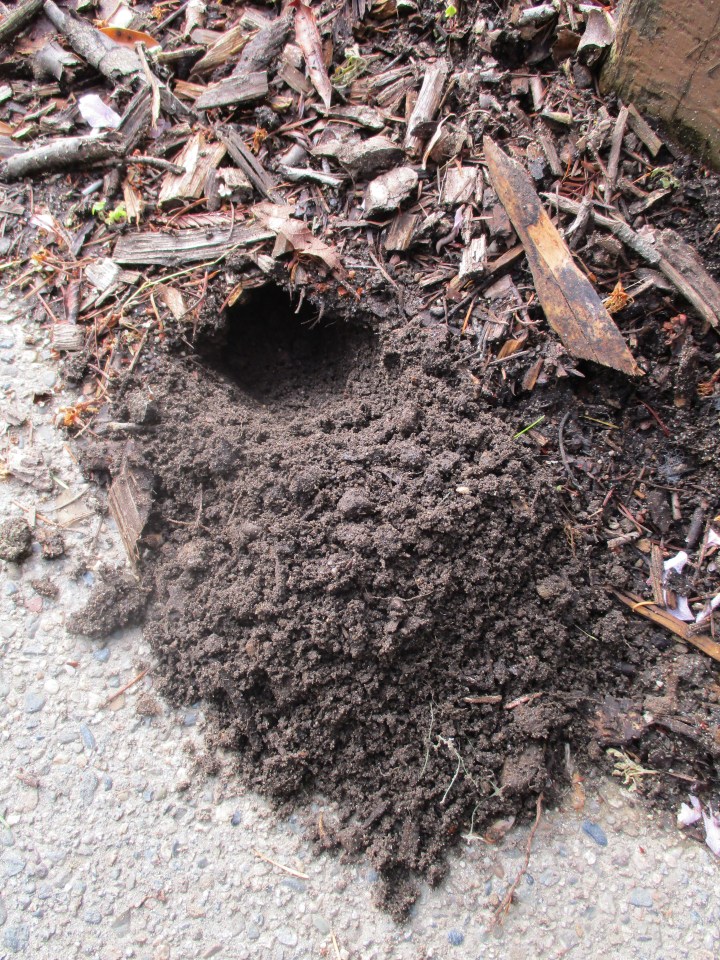
Halston was causing some significant damage that was more of a concern than fashion. Halston started by making several large volcanoes under an already distressed ‘Yoshino’ flowering cherry tree right on the edge of the main road. I really did not want any more of the roots to be ruined. I dug into the main tunnels and set traps; but Halston was very elusive, and pushed traps out of the tunnels, and left them unsprung at the surface of the soil.

Halston was very busy last weekend, creating a chain of volcanoes like the volcanic islands of Hawaii. They were right along the edge of a paved walkway, so were both unsightly and messy. Halston had to go.P80421K+

Halston would not go easily though. Excavation into the tunnels was getting to be as damaging as the tunneling had been. I dug to follow the tunnel from the volcanoes for several feet without reaching the main lateral tunnel. I did not want to dig any farther. I had already cut a few small roots, and did not want to cut any more.

Halston compelled me to do something that I had never done before with gopher traps. I was always taught to dig down from the tunnel that comes to the surface, to find the main lateral tunnel, or ‘run’, that continues to the left and right of the tunnel to the surface. Traps should be set in pairs, with one to the left, and one to the right, within the main run. If a gopher perceives a problem in a tunnel to the surface, that tunnel gets abandoned, and the gopher simply excavates a new surface tunnel. However, a gopher is not so likely to bypass a main run. Since I could not find the main run without damaging more roots, I set the first trap in the tunnel that I had dug up for several feet from where it came to the surface, and the second trap in another open tunnel with only a small volcano that was located several feet away.

I really did not expect to catch anything, but to my surprise, all excavation stopped, and Halston was in the first trap when I pulled it up the following morning. Also to my surprise, Halston was quite diminutive! Because of the extend of all the damage, I was expecting a larger gopher. Several more that I would have estimated would be needed for a pill box hat.P80421K++

Bat

P80311KHe or she; let’s just go with ‘it’ – has no name that I am aware of. It might be an acquaintance of Pepe. ( https://tonytomeo.wordpress.com/2018/03/04/pepe/ )

It showed up in a conference room at work, and needed to be removed. The young lady who found it motionless on the floor did not want to handle it, so I took it outside and laid it on top of a utility panel, hoping that it might fly away. After only a few minutes, it was gone. I did not see a cat or anyone else who would have eaten it; so I am hopeful that it flew into a nearby riparian area to find some insects to eat, and to recover from being trapped inside.

I have no idea what happened to it, or how it ended up in such a bad situation. It was on the floor below a skylight window, like a dazed bird who crashed into the glass while trying to fly through the window. However, bats do not try to fly through closed windows. Their sonar informs them that the glass is there, even if they do not see it. Someone I was working with at the time said that it might have been trying to find a way out near the window just because of the sunlight there, and because it was higher than the other windows. Perhaps it just got exhausted while flapping around trying to find an exit.

Bats are mysterious here. I do not even know what kinds of bats live here. They are nocturnal, like Pepe, so they do what they do while most of us are not up and about or outside to see them doing it. Even those who are out at night do not see much of what bats do because nighttime is rather dark. I think that is what makes it nighttime. Bats are dark too, so are not easy to see without sunlight.

I know that the small bats like this one eat mosquitoes. Since mosquitoes follow people about, and bats follow mosquitoes, bats seem to follow people. We see them every once in a while as they dart about. Yet, almost all of their activity goes unnoticed, even if it is only a few feet away. They are small, dark, silent and fast. Even if we are not aware that they are about, and they are not very concerned about us, they make our time in the garden after sundown a bit more tolerable by eliminating so many of the otherwise bothersome mosquitoes.

In other regions, and perhaps here as well, bats interact with plant life as well. Some eat soft fruit, such as prickly pear, and distribute the tiny seeds within. They do what birds do for brightly colored berries. Since bats are not impressed with bright colors, the fruits that want to attract them use sweet fragrance and flavor. Unlike small brightly colored berries that birds eat whole, fruit that is designed for bats is large and squishy, with tiny seeds dispersed somewhat homogeneously throughout the pulp, so that small bats can eat the seeds just by taking small bites of fruit.

Bats also pollinate some types of flowers. Many types of cacti that live in desert regions bloom at night while their flowers are less likely to be desiccated by harsh desert weather, and also while nocturnal pollinators are active. Flowers that rely on moths are smaller and paler, although they are brightly colored and patterned with ultraviolet color that moths can see. Those that rely on bats for pollination are wide and faced upward so that bats can land on them if they want to take their time eating the abundant sweet nectar. Sweet floral fragrance is easy for bats to follow.P80311K+

Pepe

P80304Coons are not much of a problem in the garden; but they can be a problem around the home. They scatter trash, eat dog and cat food, and can be dangerous to dogs and cats. They get into places we do not want them, including basements, attics, and even our homes. Once inside, they can cause significant damage.

That is why they sometimes need to be trapped. No one wants to do it, but it is sometimes necessary.

One problem that we did not consider when putting out a trap for a coon who was getting into the trash was that we might not actually catch the offending coon. Actually, not catching the coon was not as much of a problem as who we caught instead.

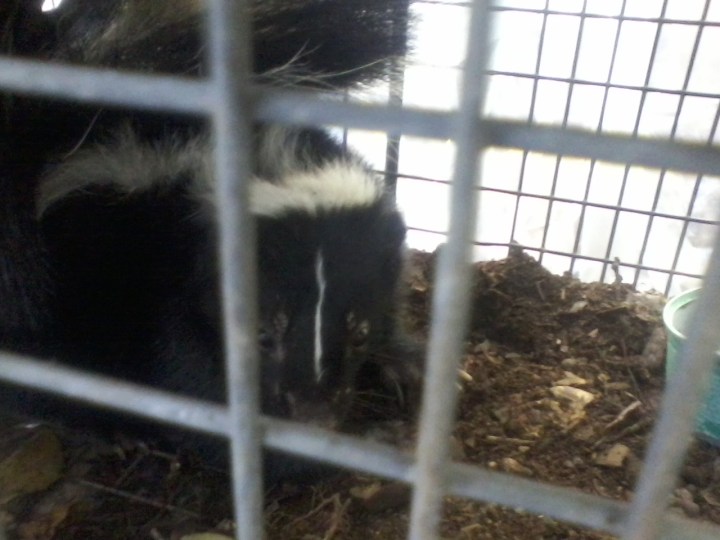
Pepe got to the trap first.

Pepe was none too happy about it.

Neither were we.

You see, Pepe, who is difficult to see in the picture, is a skunk.

Normally, skunks are more destructive to gardens than coons are. They dig grubs out of lawns, but damage the lawns at least as much as the grubs do. They pull out freshly planted seedlings because insects tend to congregate right underneath. Although they are good at controlling some types of plump insects among tough perennials, they are not very careful about getting to the insects that they pursue in more sensitive young plants and vegetable gardens.

However, this was in a situation where landscaping is minimal, and there is no lawn. Skunks had not been a problem . . . until now.

Once in the trap, we did not know what to do with Pepe. No one wanted to get close enough to open the trap. We could not leave Pepe trapped without food or water. Because Pepe had been harmless, we could have released Pepe on the spot, but instead decided to relocate Pepe nearly a mile away, on the far side of Zayante Creek, where there is more insects and water. It was a good distance between us and Pepe, but not so far that Pepe could not return if Pepe wanted to.

I got close enough to the trap to cover it with a trash bag, and then put the covered trap into a trash bag so that it was wrapped almost all the way around. Surprisingly, Pepe did not seem to mind the procedure, and watched calmly. The bagged trap went into the back of a pickup, and was taken to the relocation site. Of course, no one came with me to help.

Once at the relocation site, Pepe did not want to leave the trap. I had to literally dump Pepe out; and then step aside PROMPTLY. Once on the ground, Pepe, who had seemed to be about as big as a big kitten unfolded into a huge fluffy skunk with a big fluffy tail! I have no idea where all that fluff came from!

I had guessed that Pepe would be thirsty from his incarceration, and would be in a hurry to get down to the brambles near Zayante Creek. Instead, Pepe just stared at me sadly. I tried to explain the situation to Pepe, but my French is lacking. Apparently, Pepe did not understand.

As I turned and started to walk back to the pickup, Pepe ran past me and got there first. Pepe stopped at the open door, and looked back at me as if requesting help getting in. This was not good. I stayed back, which annoyed Pepe, who had been a good sport through this entire procedure so far. Pepe sort of hopped about with his fluffy tail flailing, as if frustrated that the floorboard of the pickup was just out of reach.

I tried to explain in English and really bad French with maybe a bit of Italian and Spanish mixed in where I could not remember the words, that the relocation site should be satisfactory. Eventually, Pepe seemed to agree to give it a try. Pepe slowly waddled away and downhill to Zayante Creek. In the second picture, that black and white blotch to the left of the roots of the alder tree is Pepe, looking back at me sadly.P80304+

RATS!

P80204

Remember the Beverly Hillbillies? That was a really lame sitcom; but it was somehow very popular at the time.

Each episode began with the stupid jingle that explains how and why the formerly impoverished but suddenly wealthy Clampetts left their home in Bugtussle and moved to Beverly . . . Hills that is.

As they drive their decrepit Oldsmobile down Bedford Drive just west of downtown, the palms flanking the roadway are prominently visible to the left and right. This strictly regimented collection of Canary Island date palms alternating with Mexican palms was not very big back then, in the early 1960s. By the 1980s, they were strikingly grand. Sadly, they are now deteriorating from old age. Many of the broad Canary Island date palms have succumbed to pink rot, so are now absent. Some of the Mexican fan palms are also lacking. It is saddening to see them now knowing how grand they were not too long ago. Although they are being replaced, they will never be as formal and uniform as they were as a monoculture (or biculture) that was planted all at the same time back in the late Victorian period. Even if it were possible to remove all of the trees and plant new ones at the same time, such conformity went out of style decades ago.

Arborists see these historic trees differently. They know that just one Canary Island date palm is likely infested with rats. Such a grand collection must be infested with a disturbingly large population of rats. Within a canopy of a Canary Island date palm rats, are safe from most predators, and get quite a bit to eat from the fruit produced by the female trees. (Most Canary Island date palms are female, with only a few taller and less billowy male trees for pollination.)

When a Canary Island date palm gets cut down from the base, it falls with a big SPLAT on the ground, followed by a blast of wind containing every Frisbee, baseball, tennis ball, kite and whatever got stuck in the tree over the previous few years. After a brief pause, but before the the baseballs stop rolling in the gutters, a herd of all surviving rats flees the scene. Most hide in the closest shrubbery they find. Some scurry up other nearby palms. It can really blow your image of the Canary Island date palm.

CAUTION!

P80127Halston was quite the rage when I was a little tyke.

I did not know exactly what that meant.

I can remember elegant ladies wearing Halston pill box hats. From the back seat of the new 1967 Chevelle, I could admire my Mother’s, while my younger brother on the other side of the car got tangled in our flower child Aunt’s abundant and long hair blowing in the wind.

Although I had never seen a Halston before, I could determine from hats made from them that they were soft, fuzzy and cylindrical. I knew that apricots, walnuts and oranges grew on trees, so I would sometimes look into unfamiliar trees, including the silk oaks next door, to see if I could see Halstons ripening in them.

My older sister eventually explained that Halston was they guy who made the hats. He was very busy. His hats were very popular. Apparently, he made the hats from coats formerly worn by small rodents known as minks. The minks were not really plumply cylindrical. In fact, they were so small that the coats of several of them were sewn together to make each hat. The thought of so many small rodents scurrying about naked until they got new coats was quite disturbing. It made me ponder the origin of the cuddly stole that Redd Foxx gave to Aunt Mary.

I certainly did not believe everything that my sister told me. Heck, she once tried to tell me that the dead bugs in Aunt Mary’s amber jewelry were trapped in tree sap millions of years ago. I know cheap Lego plastic when I see it. However, I do believe that fur obtained from animals lost popularity through the 1970s. The minks must have protested or something. My sister got a stylish coat with a furry collar made of imitation fur. Splendid; so now little kids will be cuddling naked teddy bears!

I have a better idea.

The pelts of all those nasty gophers that ruin lawns and gardens could be recycled into pill box hats . . . or maybe something more appropriate to modern fashion. Perhaps they could be sewn into reusable grocery bags. What an exquisitely stylish expression of environmental awareness that would be! Because gophers get killed when trapped, they could not protest the use of their pelts later.

Using gopher pelts in this manner would:

Protect our lawns, gardens, landscapes and green spaces from environmental annihilation

Recycle by-products of environmental protection

Provide stylish accessories that express our concern for environmental stewardship

Promote the use of materials that are completely organic, natural, non-toxic, biodegradable, sustainable and very renewable

Help save the Planet!

We only need to learn to be more efficient with trapping. What is the point of setting traps if gophers are warned to ‘KEEP AWAY’?

Rodents Eat Just About Anything

61214thumbNot much bothers old fashioned junipers. They tolerate heat and frost, and anything else the weather throws at them. They do not appeal to many troublesome insects. Once established, they do not mind if they do not get much water. So, aside from over-watering and bad pruning, they are pretty indestructible. Yet, once in a while, otherwise healthy junipers die suddenly and mysteriously.

Sometimes, entire plants die. Sometimes, only big pieces of them die. The foliage is intact, but dried to a nice light brown. The roots are firm. In fact, the damage that caused such efficient death might not become apparent until the dead stems get dismantled and removed. It might even get overlooked because it is not the sort of damage that we expect to find in our tame home gardens.

Rats! They sneak in under the dense foliage to chew the bark from the main stems. The thicket of rigid stems protects them from cats and dogs. They can kill both shrubby and ground cover junipers, as well as ivy, ceanothus, cotoneaster, firethorn, . . . and nearly any sort of shrubby plant that they feel safe from predators in. They also eat vegetables and fruits, particularly citrus fruits.

The damage should be rather distinct. Bark is missing. Bare wood is exposed. Squirrels sometimes cause the same sort of damage, but usually on smaller stems in trees. Gophers do their dirty work underground by eating roots. If they kill junipers or other shrubbery, the dead plants can be pulled up from the soil relatively easily, and fresh gopher ‘volcanoes’ should be evident in the area.

Protecting stems and roots from rodents is more difficult than protecting developing fruit. The rodents know that they are concealed by the dense growth that they chew the bark or roots from, so fake owls are not much of a threat. Poisons are very unpleasant for the targeted rodents (duh!), and very dangerous to cats and dogs that might catch the poisoned rodents. Traps are effective and safe (except for the rodents . . . duh!) but take serious dedication to empty and reset!