Does anyone really know what roots do? We know that they are important parts of almost all plants, that draw nutrients from soil and water, and that they provide structural support so that plants can stand upright. Yet, we really do not know all of what they they could be doing right now, underground, where no one can see them.
Big roots of big trees unfortunately sometimes cause big problems by displacing pavement and other features. They commonly displace pavement because they naturally disperse laterally just below the surface of the soil, and do the same directly below pavement as if it were the thin layer of soil that they require above. Roots of many trees are actually attracted to pavement because it is better insulated than some types of soil, and may even retain moisture better. As roots grow and expand, they displace the pavement above.
They do not displace retaining walls or foundations as commonly because they are not so tempted to go under them. When they do displace such features, it is usually because they disperse against them and displace them laterally.
Although often blamed for such problems, roots only rarely interfere with subterranean utilities like water pipes and sewer pipes. Most pipes are deep enough to avoid the majority of roots. However, very old sewer pipes of unsealed terracotta segments or unsealed iron can leak slightly but enough to attract and become invaded by roots. Also, some types of trees are notorious for invading septic systems.
Various types of root barriers limit lateral dispersion of roots and promote deeper dispersion to protect pavement and features at the surface of the soil. They are somewhat effective for certain types of trees that innately exhibit aggressive roots. Alternatively, trees that innately exhibit complaisant or deeply dispersed roots may be selected for situations in which aggressive roots would be a problem.
Roots that are already causing problems most often need to be severed. Unfortunately, severing substantial roots is very distressful to the affected trees, and can even be destabilizing. Trees with fibrous roots, like redwoods and crape myrtles, recover from minor root damage somewhat efficiently. Many other trees, like oaks and most maples, are very sensitive to such damage. If it becomes necessary to sever major roots or large portions of a root system, an arborist might determine that it would actually be more practical to remove the affected tree than to allow it to be destabilized or to deteriorate slowly before ultimately succumbing to damage.
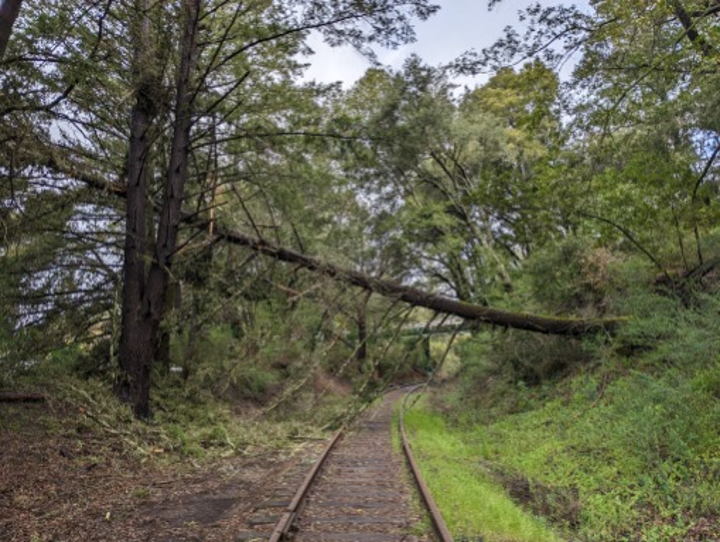
 When a tree falls in the forest, and there is no one around to hear it, does it make a sound? Of course it does! There is just no one to hear it. Why should that be such a profound question? A falling tree makes a mess too. Anyone who does not see or hear it in action can witness it afterward. Sometimes, roots that were inadequate to support the fallen tree become exposed as well.
 Tony Tomeo