Runt

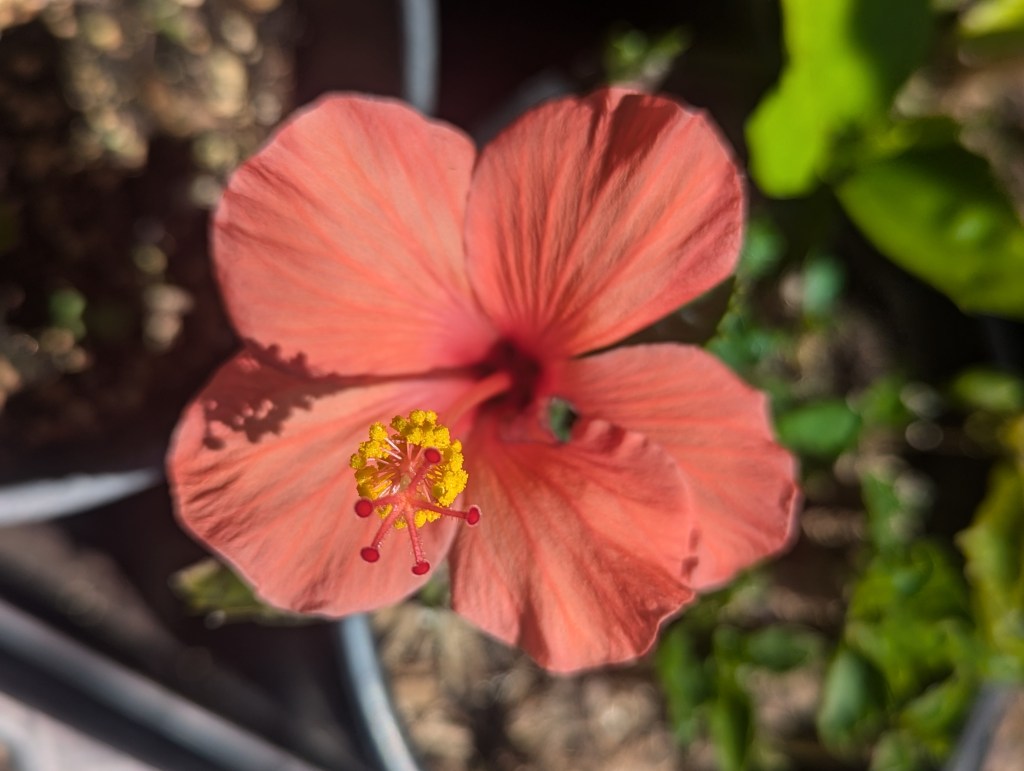
What a pathetic tropical hibiscus flower! It is only about two inches wide. It should be bright red instead of this faded terracotta pink. It even lacks foliage in the background. So, why did I take a picture of it? I was impressed by this flower because it bloomed on a cutting that is still in the process of rooting. I should have removed the bud when it appeared, to conserve resources for root growth. Instead, I let it bloom to see what would happen. This is the result. Knowing all that I know about it, I am somewhat impressed. Of course, I plucked the flower off after taking its picture. After all, I am a nurseryman, not a gardener. I want the cuttings to root as efficiently as possible. Actually, more of them than I expected seem to be rooting, so there may be a surplus of these particular hibiscus in the future. Cuttings of another cultivar that blooms yellow did not perform so well. Only three survived so far, and they are rather wimpy. I may need to go back to collect more cuttings for that one. I also would like cuttings from a cultivar that blooms orange.

Layer To Propagate Favorite Plants

Ivy takes root as it grows.

Ivy is creepy. It creeps everywhere. As it does so, it extends roots into or onto whatever it creeps over. Not only does it do this to climb, but it also does this to propagate. It literally roots as it goes, to function more as a swarm of countless small plants instead of a single big plant. A bit of well rooted stem may grow independently from the original as a ‘layer’.

Many vines do the same, even if they are normally climbing vines that just happen to fall onto the ground. A few shrubs and trees, especially riparian sorts, are happy to do it also if lower limbs lay onto damp soil. Such a rooted stem is known as a layer because it lays on the ground to root. In a home garden, a layer might root below a layer of mulch or soil. 

In fact, many plants in home gardens are easy to propagate by intentional layering. Many develop roots more reliably if layered than if propagated from cuttings. They grow almost like cuttings, but while attached to the original plants to sustain them. Layering produces only one or a few new plants, unlike cuttings, but for most home gardens, that is enough.

Some plants are easier to layer than others. Pines and most eucalypti are uncooperative to the technique. Rhododendrons, azaleas and camellias layer relatively easily, but may take more than a year to finish. Elms and magnolias are even happier to layer, but rarely retain low stems. Some plants layer best after spring bloom. Others layer through winter.

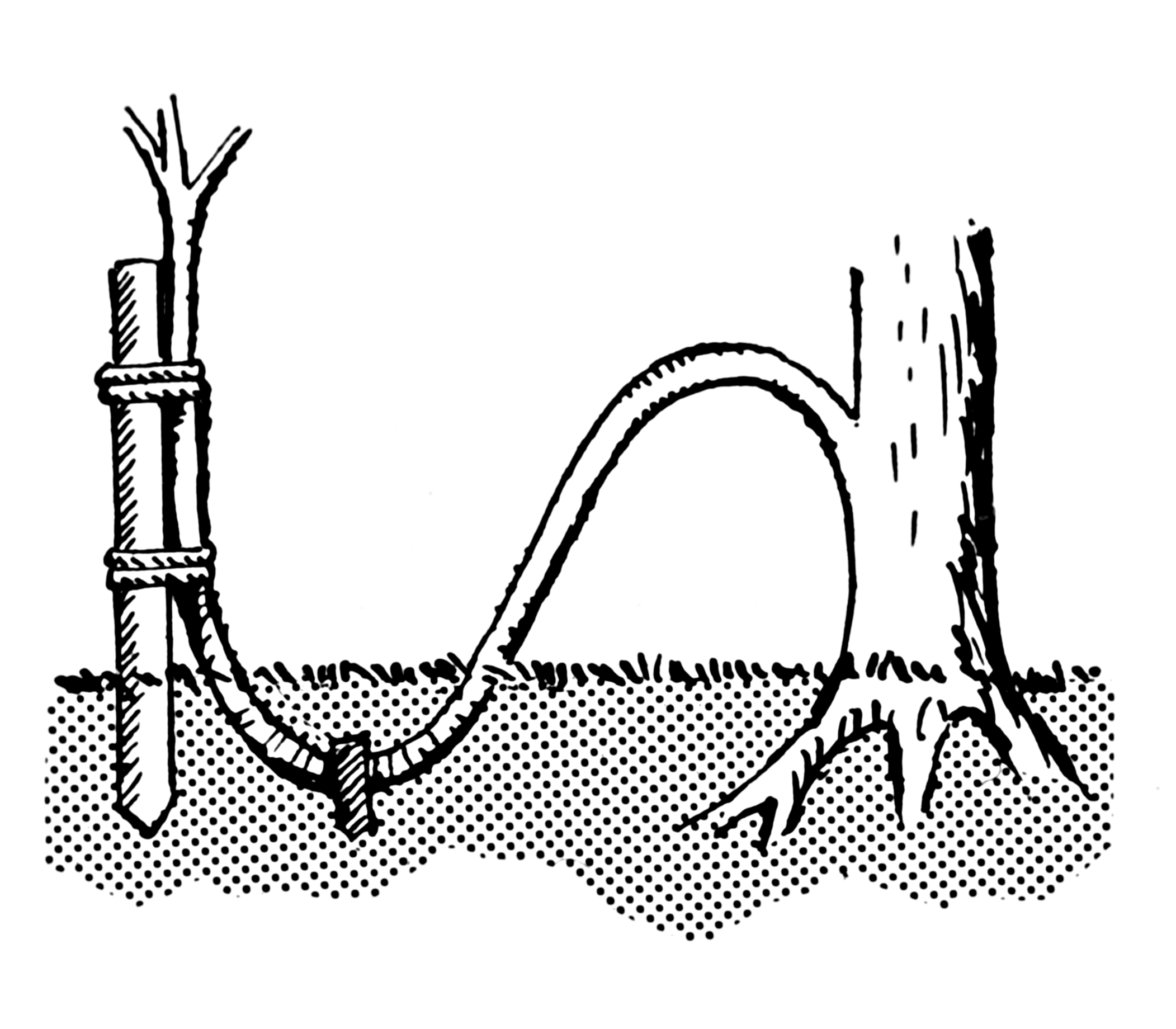
An intentionally layered stem should be partially buried, with a few inches of stem below the soil, and a few inches of the tip of the stem protruding above the soil. Notching about a third of the way through the underside and applying rooting hormone promotes rooting. Regular watering is necessary through the process, which continues at least until winter. 

Make Copies Of Favorite Plants

Honeysuckle can layer naturally, and will most certainly layer if a portion of stem is simply buried or weighed down under a rock.

Where they grow wild in riparian environments, box elders, willows and cottonwoods are not as clumsy as they seem to be. As the rivers and creeks that they live so close to erode the soil around them, they often become destabilized and fall. Yet, this is actually part of their plan. If their original roots remain somewhat intact, the limbs and trunks develop new roots where they touch the ground. Eventually, these rooted limbs and trunks develop into new and separate trees.

In home gardens, a similar technique known as ‘layering’ can be employed to propagate one or a few copies of many other plants. Many sprawling vines and ground covers, such as ivy, honeysuckle, blue rug juniper and trailing rosemary, are likely to develop roots where their stems touch the ground anyway. Rooted stems need only to be found, dug and separated as new plants. Shrubbier plants need a bit more help.

Azalea, rhododendron, camellia, holly and just about any plant that has low stems that can be bent downward into the soil can be propagated by layering. Redwood, elm and magnolia do not always have limbs that reach the ground, but any that do would be pleased to cooperate as well. In fact, there are only a few woody plants that do not develop roots by layering, such as some pines and most eucalypti.

A layered stem only needs to be partly buried to develop roots. The tip should protrude from the soil a few inches. A short stem may barely protrude above the soil. A layered stem of a plant that develops adventitious roots very efficiently can be as long as a few feet. A very flexible stem can easily be held down by the weight of the soil that it gets buried with. A more rigid stem may need to be held down with a rock.

Before getting buried, the stem should be cut about a third of the way through to promote development of roots. The cut should be made on the underside so that it stays open when bend downward and buried. A bit or rooting hormone powder applied to the open wound accelerates the process. It works almost like taking a cutting, but without completely separating the cutting from the parent plant right away.

Once buried, a layered stem should be watered regularly until it gets dug while dormant (or mostly dormant) the following winter. By that time, the rooted stem can be dug and pruned from the parent plant, and then planted where desired. Because it takes a few months for enough roots to develop, layering should be done in spring.

Propagation Is No Big Mystery

Layer_(PSF)All plants propagate. Otherwise, they would go extinct. They all have the potential to propagate by seed or spores. However, some are more efficient at vegetative propagation from stems or roots. Of the later, a few propagate by seed so rarely that it is a wonder that they can evolve, since vegetatively propagated plants are clones, or genetically identical copies, of the original plants.

A single coastal redwood can live for thousands of years. Before such a tree dies, it clones itself by producing adventitious stems from its aging root system. These stems mature into new trees that can live for thousands of years more, only to repeat the process indefinitely. There is no opportunity to generate and share any slight genetic variations that are necessary to natural selection.

Well, this is probably more information than any of us need for our home gardens. It is only relevant to demonstrate than many plants are happy to propagate themselves vegetatively, or are at least conducive to simple vegetative propagation techniques. This is why most nursery plants are grown from cuttings, which are merely pieces of stem stuck into media and forced to grow roots.

For those of us who are not in the nursery industry, there is a more practical way to propagate a few copies of certain favorite plants. Sprawling groundcovers and vines like iceplant, knotweed, jasmine and ivy know all about it. So do many low growing succulents. Their lower stems develop roots where they lay on the ground, and grow into new plants. The process is known as ‘layering’.

Some low shrubby plants that might not layer naturally might be coerced to do so simply by getting a few of their lowest stems buried just below the surface of the soil, with a few inches of the tips sticking up. It helps to scratch off a patch of bark about a third of the way around the buried section of stem, and apply rooting hormone. Sturdy stems can be held down with rocks if necessary.

For most plants, layered stems can be buried about now, left through winter, and should be ready to be separated from the parent plants by next summer, just after any new growth matures. New plants will of course need to be watered generously until they develop enough roots to be self sufficient. Most plants with pliable stems that reach the soil can be layered. Junipers, euonymus, euryops, marguerites, boxwoods and carpet roses are some of the more popular candidates.

Felony Garden

blog11Brent and I met in college, when we were assigned to the same dorm room in Fremont Hall at Cal Poly in San Luis Obispo. Our similarities were remarkable. He came two hundred miles north from west of Los Angeles. I came two hundred miles south from west of San Jose. We were both the middle of three children, although I had just acquired an extra younger sister the year before. While the other boys we grew up with were playing with Hot Wheels, Brent and I were busy planting miniature trees around the miniature roadways. His childhood dog was Speckles. Mine was Freckles. We were weirdly similar prior to September of 1986, but have been perfecting our differences since then.

Brent is now a famous landscape designer in West Hollywood. He has landscaped some of the most prominent homes in the region, including the Osbourne Residence of formerly popular realty show, ‘the Osbournes’. Many of the streets of Los Angeles are now outfitted with street trees that Brent installed. He regularly installs mature plants and large boxed trees, without giving much thought about where they came from.

I just grow things. Back in the early 1990s, I grew citrus trees. By 1995, I was involved with the production of mostly rhododendrons, as well as azaleas, camellias, pieris, and a few other minor crops of similar cultural requirements. I provide the plant material for landscapers like Brent, but do not give much thought about what they do with it.

While we were in school, Brent and I would often see plants around town that we wanted to grow in our own gardens. Sometimes they were old fashioned plants that we could not find in nurseries. Sometimes they were plants from other regions that we did not have access too. Usually though, they were just plants that we wanted but could not afford as starving students.

Being the grower that I am, it was up to me to procure pieces or seeds of these desired plants to propagate. Sometimes, we got entire plants. I did all the work; but usually by the time the copies were produced, Brent would take them back to Los Angeles, where many died because he did not care for them properly. However, in the Miracle Mile neighborhood, there is still a coastal redwood that Brent and I procured on one of our adventures. It does not like the climate much there, but it is surviving.

Our techniques were not as bad as stealing the un-pink bearded iris. (see The Colors Of Karma, https://tonytomeo.wordpress.com/2017/09/12/the-colors-of-karma/.) We merely took pieces that no one would miss. We got several types of succulents and geraniums. (I had actually acquired my favorite geranium years before I ever met Brent, so I knew how easy they were.) We sometimes took plants from compost piles and trash bins, and plants that were to be discarded from a nursery where Brent worked. You can imagine my delight when San Jose started curbside greenwaste recycling! I got piles of bearded iris; and I did not care what color they were. I got yuccas, New Zealand flax, African iris, banana trees, cannas, calas, bergenias and really too many cool plants to list.

Well, as tradition dictates, Brent had to come up with something derogatory to say about my gardening style. After all, even though he benefited more from out techniques of acquiring plants, more of mine survived. His garden was lavishly landscaped with plants that he purchased from nurseries, while most of what he got from me got shaded out. My garden was meagerly landscaped almost exclusively with plants I had propagated and grown. Well, making the observation that very few plants in my garden were acquired ‘legally’, he named the main part off my garden the Felony Garden. Yes, and to the south of that was the White Supremacy Garden. (See White Supremacy, https://tonytomeo.wordpress.com/2017/09/21/white-supremacy/.) Out back, we kept the Fruits and Nuts. Oh, the joy of gardening!