Gophers

Do not underestimate the destructive potential of gophers!

Many of the yuccas that naturally live in deserts where forage may be scarce are equipped with an efficient defense system. Each leaf terminates with a nasty spine. Leaves are so abundant that the spines are impossible to avoid. It is amazing that these yuccas are as vulnerable as they are to gophers, who simple burrow below all the advanced defense technology to eat the starchy roots and any subterranean portions of stems.

Some of the techniques sometimes used to get rid of gophers are too dangerous to even discuss. Rodent poison (for rats and mice for example) is not only dangerous to other animals that may dig it up, but not often effective since gophers prefer to eat fleshy roots and stems. The only practical poisons can only be applied by licensed pesticide applicators.

New plants can be installed within ‘gopher cages’ that should exclude gophers from the root system at least long enough for the plants to get established. Gopher cages can be purchased ready-made, or can be constructed easily from chicken wire. They only need to be as deep as the planting hole, but can be wider for perennials that spread.

Gopher cages do not protect all roots, since some extend through the cage to disperse; but should protect enough roots to keep plants alive if outer roots get damaged. By the time the cages deteriorate, the plants within should be established enough to survive gopher infestation for a while; although even large plants can be killed by unrestrained gophers.

Properly used traps are the most practical means of controlling gophers. Traps should be installed in pairs, even though each pair typically catches only a single gopher. If possible, traps should be installed away from any gopher cages that may be present, since cages are difficult to work around, and nearly impossible to release from a sprung trap.

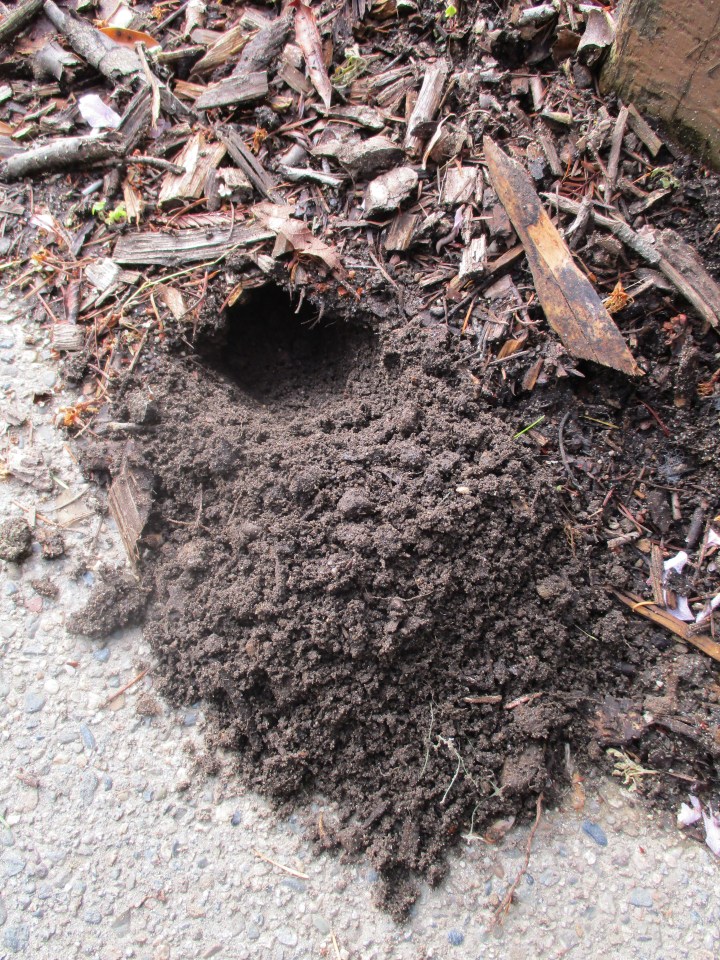
Once the entrance to a gopher run is found under a mound of freshly excavated soil, the entrance, which is typically filled with loose soil, should be excavated back as far as the main run, which extends perpendicularly to the right and left. The main run should be cleared of loose soil.

Each of the two traps can then be set and gently placed within the main run in each direction. A trap should be held by the spring end so that the claws and lever extend into the run. Wires attached to the spring end of the traps are easier and safer to pull the traps out with later, instead of digging the traps out. These wires can be attached to a stake to make them easy to find later.

The entrance hole should then be buried. Air circulation from outside will prompt the gopher to collect loose soil to plug the hole, and push the loose soil ahead, springing the trap prematurely.

The gopher within may not be interested in using the same entrance to expel soil, but will likely use the same run. Two traps are used because there is no way of knowing which direction the gopher will approach from. The unfortunate gopher can be removed in a day or so; so that the traps can be set into another run where fresh excavation has been observed.

Soil Saturation Can Drown Roots

Only riparian species tolerate sustained saturation.

Irrigation must adapt to weather. It was unnecessary for exposed vegetation during rainy winter weather. It became necessary through drier spring weather. Now, it must adjust for increasingly warm and dry summer weather. This is not as simple as application of more water more frequently. Excessive irrigation causes soil saturation, which damages roots.

Soil saturation is unfortunately common within landscapes that gardeners maintain. The risk of desiccation is more of a concern to gardeners than wasteful irrigation. Desiccation is certainly more apparent than symptoms of saturation. Besides, gardeners assume the costs of neither water nor damaged vegetation. Chronic damage can become significant.

Soil saturation is less common within gardens that lack gardeners, but is not impossible. Soil within pots can become saturated if vigorous roots clog drainage holes. Water which lingers too long in saucers under pots maintains saturation. Irrigation that is too frequent, too generous or both maintains saturation. Of course, different soil types drain differently.

Soil saturation deprives roots of the aeration that they need to survive. A few species are somewhat tolerant of saturation, but fewer tolerate it for long. With few exceptions, newer roots avoid saturation, so disperse shallowly. For trees, this limits stability and increases their likelihood of displacing pavement. Even shrubbery might develop buttressing roots.

Roots that dispersed prior to saturation are vulnerable to rot as soil saturation increases. This not only destabilizes trees, but also compromises their health. Formerly healthy turf grass and ground cover become chlorotic. Some turf grass becomes infested with fungal pathogens, and perhaps moss. Flowers and fruits might shrivel before they develop fully.

It is impossible to prescribe ideal irrigation schedules and application rates for every site. Climate, soil type, slope, exposure and vegetation types are all considerations. Moisture requirements change seasonally and as vegetation matures. Only direct observation can help determine appropriate irrigation frequencies and rates. It is a very involved process.

Soil Saturation Kills

Use irrigation responsibly.

London plane tree is trendy not because it is all that excellent, but because it is so reliable. It is actually a rather trashy and messy tree that is susceptible to anthracnose and powdery mildew. Landscapers and gardeners like it so much only because the various maples, oaks and other better trees are more sensitive to soil saturation while they get established.

The truth is that most landscapers and gardeners do not want to put any effort into proper watering. While many of us let our lawns die to conserve a bit of water, they waste enough water on lawns and landscapes to sustain rice paddies! This keeps lawns and landscapes superficially green, but eventually causes problems.

Powdery mildew, anthracnose, molds, blights, rots and all sorts of diseases proliferate in damp conditions. Of course, gardeners are happy to apply fungicides and other chemicals to help control diseases; for a price. Also for a price, they are there to replace plants that succumb to any of the many diseases associated with excessive moisture.

Like London plane, several other trees and plants can survive excessive moisture, but only by adapting. If lower soil is regularly saturated, roots are confined to upper soil. This is not a problem for lily-of-the-Nile and many other perennials that can sneak their roots unnoticed into to the upper few inches of soil. However, trees can not get away with this habit for long; since their shallow and buttressing roots eventually expand to displace pavement, other plants and anything else that gets in their way.

Mature and old trees do not adapt. Their deep roots are already set in their ways, so will only rot if they get significantly more water than they are accustomed to. Oaks are particularly susceptible.

Unfortunately, there is no exact formula for determining how much water lawns and gardens should get. There are simply too many variables, such as soil type, drainage, exposure, weather and demand for moisture. Lawns need frequent watering without much volume. Trees prefer more generous watering, but less frequently.

Lawns and trees and everything else in between all need air within the root zone. Watering should therefore not keep soil constantly saturated, but instead allow for adequate drainage and aeration of the soil between watering, without complete desiccation. New plants will of course need more attention until they disperse their roots, but will be happier and healthier with proper watering.

Inner Beauty

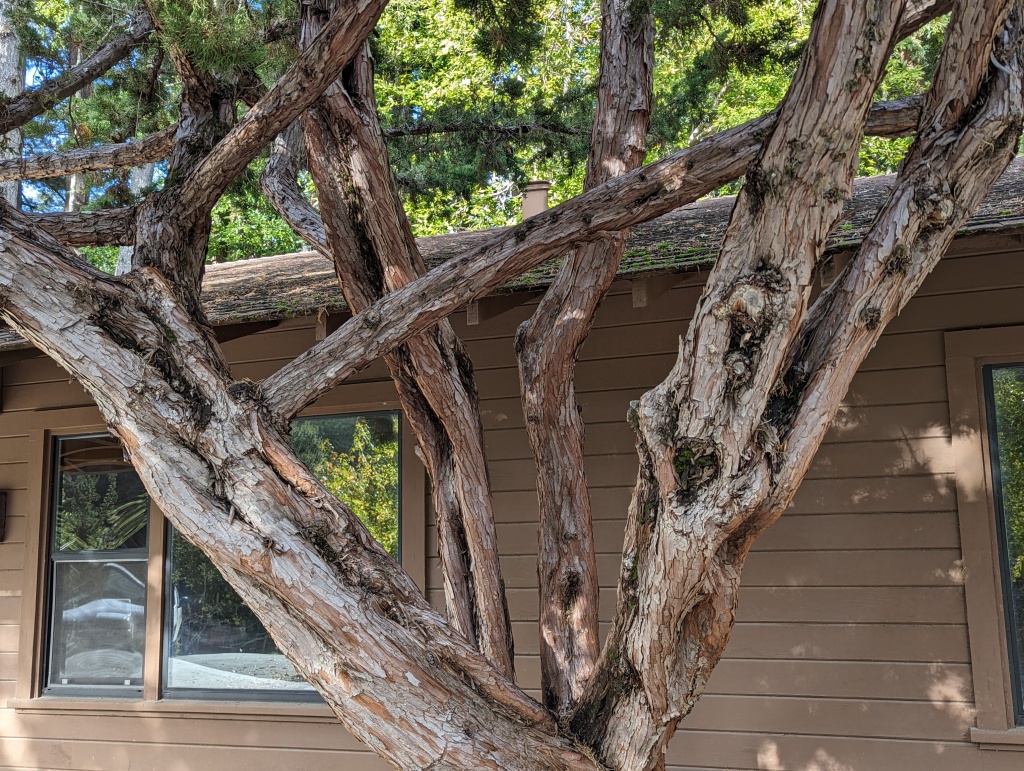
This is an exemplary specimen of Juniperus chinensis ‘Kaizuka’, Hollywood juniper

Juniperus chinensis ‘Kaizuka’, Hollywood juniper is one of my favorite junipers. The few North American junipers that I prefer more are not as appealing for prominent positions within refined landscapes. Hollywood juniper is distinctly sculptural with its strikingly gnarly form. The dense, finely textured and deep green foliage contrasts stylishly with the more coarsely textured and rusty reddish brown bark. Whether a large shrub or a small tree, properly groomed Hollywood juniper can be an elegant trophy tree.

The illustration above is from my ‘Six on Saturday’ post from two weeks ago. It shows one of the largest specimens of Hollywood juniper that I have ever worked with. Initially, I pruned it for clearance from the roof and parking spaces that it extends its canopy over. I also thinned it somewhat. I intended to elevate and thin it a bit more this year or next.

Instead, it became firewood. Sadly, it grew too big and obtrusive for its situation. One of its large roots was displacing the asphalt pavement of the parking spaces in front of it. Another was beginning to do the same. It was very saddening to see it dismembered and processed, as the foliar canopy was discarded to compost into the forest, and the trunk and limbs were taken to a woodpile.

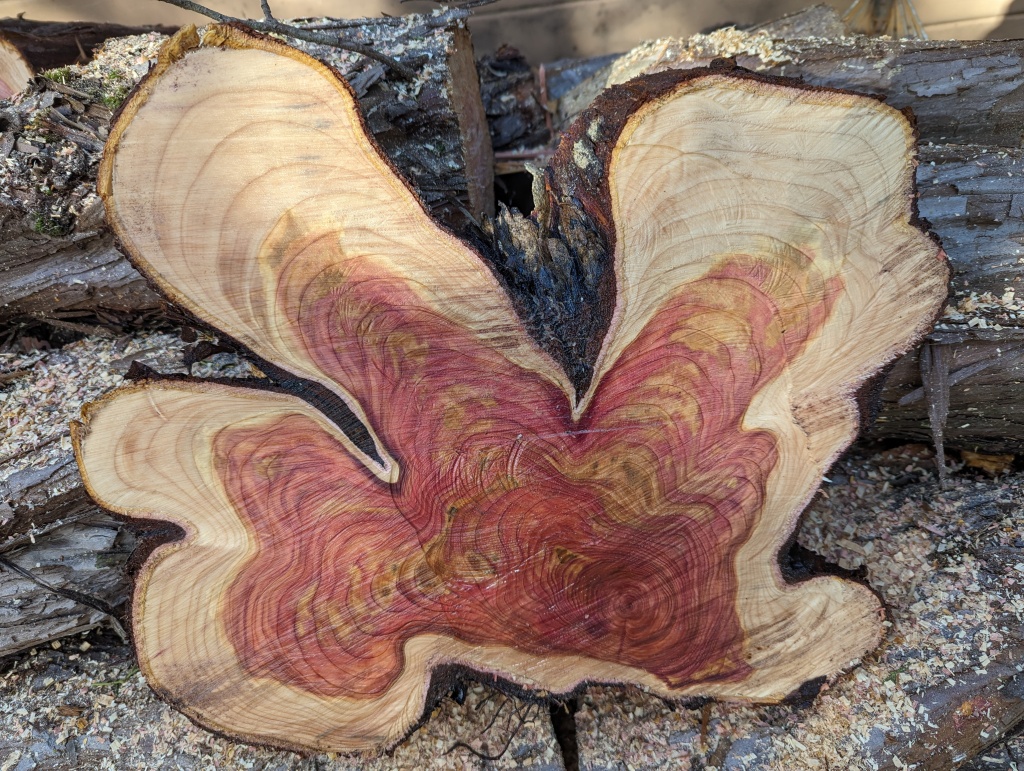
Even as firewood, it retained unique beauty. The illustration below shows the contrast of the red heartwood and blond younger wood within the interior of the gnarly trunk. If it resembles the interior of a cedar chest, it is because it is related to the Juniperus virginiana, Eastern redcedar, which is the cedar within cedar chests (but is not actually a real cedar). Although not visible within the illustration, the woodsy aroma of the exposed wood is very similar to that of a cedar chest.

Even its firewood is appealing.

Jungle Update

New foliage is already beginning to replace older foliage.

Strelitzia nicolai, giant bird of Paradise is growing! It is not much growth, but it is more than expected. The specimens were heeled in about a month ago to begin the slow process of recovery from division and relocation. Within the damp soil of their temporary situation, they should begin to develop rudimentary roots without actually dispersing them too remotely prior to another relocation to their more permanent landscape after the beginning of the rainy season of autumn. In other words, the roots should begin to grow, but not grow too much.

They can grow more when they get settled within their permanent situation. This is done in two separate processes because the specimens are easier to monitor and irrigate prior to rain within the confined space where they are heeled in. Besides, they would not be very appealing within their permanent landscapes until they begin to recover. Once they begin to recover, they should grow faster, so will not be too unappealing for too long, and even if they are, it will be through winter, when fewer people are here to notice.

Anyway, while they begin the process of recovery and development of rudimentary roots, foliar growth is expected to be minimal. It was expected to stagnate for at least a month or so, and then to slowly resume as the minimal foliage that was retained deteriorates. Like root growth, foliar growth should accelerate after final relocation.

Instead, foliar growth is already accelerating, perhaps as a response to removal of so much of the original foliage while foliage is necessary to sustain rudimentary root growth. Perhaps these specimens actually are as healthy and as vigorous as they seem to be. Although this fresh new foliar growth will be more vulnerable to frost through winter, it is nonetheless gratifyingly encouraging.

Root Of The Problem

Trees need their roots.

Does anyone really know what roots do? We know that they are important parts of almost all plants, that draw nutrients from soil and water, and that they provide structural support so that plants can stand upright. Yet, we really do not know all of what they they could be doing right now, underground, where no one can see them.

Big roots of big trees unfortunately sometimes cause big problems by displacing pavement and other features. They commonly displace pavement because they naturally disperse laterally just below the surface of the soil, and do the same directly below pavement as if it were the thin layer of soil that they require above. Roots of many trees are actually attracted to pavement because it is better insulated than some types of soil, and may even retain moisture better. As roots grow and expand, they displace the pavement above.

They do not displace retaining walls or foundations as commonly because they are not so tempted to go under them. When they do displace such features, it is usually because they disperse against them and displace them laterally.

Although often blamed for such problems, roots only rarely interfere with subterranean utilities like water pipes and sewer pipes. Most pipes are deep enough to avoid the majority of roots. However, very old sewer pipes of unsealed terracotta segments or unsealed iron can leak slightly but enough to attract and become invaded by roots. Also, some types of trees are notorious for invading septic systems.

Various types of root barriers limit lateral dispersion of roots and promote deeper dispersion to protect pavement and features at the surface of the soil. They are somewhat effective for certain types of trees that innately exhibit aggressive roots. Alternatively, trees that innately exhibit complaisant or deeply dispersed roots may be selected for situations in which aggressive roots would be a problem.

Roots that are already causing problems most often need to be severed. Unfortunately, severing substantial roots is very distressful to the affected trees, and can even be destabilizing. Trees with fibrous roots, like redwoods and crape myrtles, recover from minor root damage somewhat efficiently. Many other trees, like oaks and most maples, are very sensitive to such damage. If it becomes necessary to sever major roots or large portions of a root system, an arborist might determine that it would actually be more practical to remove the affected tree than to allow it to be destabilized or to deteriorate slowly before ultimately succumbing to damage.

Irrigation Must Not Be Excessive

Too much water can be a problem.

Remember when the Brady Bunch went to the Grand Canyon? Mrs. Brady read aloud from a brochure about how the Grand Canyon was formed by erosion of the Colorado River. Peter then commented, “Wow! No wonder you tell us not to leave the water running.” Too much watering in the garden certainly will not cause a canyon to form, but can cause all sorts of other big problems.

Roots rot if the the soil is constantly too wet. If the soil stays saturated, roots suffocate from the lack of aeration. Trees that survive saturation of deeper soil strata will disperse their roots shallowly near the less saturated surface, and will consequently be unstable. Besides, excessive watering is wasteful.

There are too many variables, such as exposure, drainage, humidity and temperature, to prescribe irrigation schedules that work for every site. Just remember that most plants like the soil to drain enough for the surface of the soil to at least look somewhat dry before getting watered again. Moss on the surface is an indication that things are too wet. Plants that like more water, like azaleas, rhododendrons, fuchsias, ferns and impatiens, do not mind if the soil stays somewhat damp, but only if the soil is porous and drains enough to also be aerated.

The most drought tolerant plants, which are generally also the most sensitive to excessive irrigation, ironically like to be watered somewhat regularly for the first few months after getting planted. This is because they are so reliant on well dispersed root systems. They need less, if any, watering once their roots get dispersed.

Watering should be done in the morning so that plants can soak in the water during the day, and the area can dry somewhat before the following evening. It is also better to water less frequently and a bit more generously than to water too frequently. This allows time for drainage and promotes deeper rooting. Fungal organisms associated with rot and foliar diseases proliferate overnight if the ground is damp at the surface and the air is humid.

Except for the few plants that like humidity, and those that need to be rinsed of aphid and honeydew, there is no need to wast water on foliage where it is simply lost to evaporation. Water should be applied to the soil where it is needed.

Taking It To The Streets

Tipu tree is the topic for tomorrow.

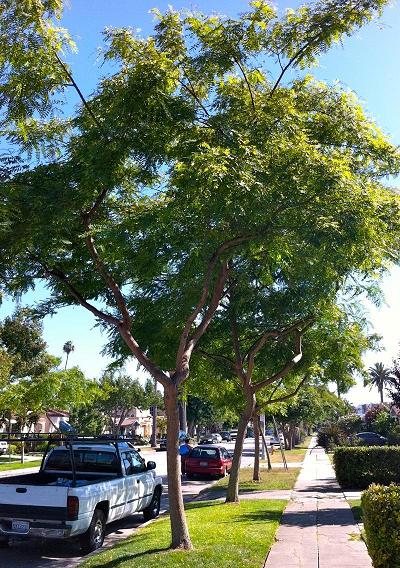
No matter how unique the individual gardens are, conforming street trees really unify a neighborhood. Streets of tract homes are typically planted with a common street tree that is complimentary to the architectural styles of the homes, and is complaisant to the difficulties of life at the curb. Neighborhoods of mixed architectural styles sometimes have difficulty finding a tree that suits every home, so often select two or more options. Older neighborhoods are not quite as selective about conforming street trees because so many various trees get mixed in over the years.

Before selecting a street tree, it is best to inquire with the particular municipality about designated street trees. Home owners associations generally install their own trees where needed, with little or no regard for the preferences of individual residents. Some urban neighborhoods (that are not home owner associations) are nearly as selective, requiring individual home owners to maintain a specific street tree or trees. Others do not require street trees, but limit selection for those who desire them. Selection is very often limited to only a single species.

There are of course many rural and unincorporated neighborhoods without limitations for street trees, and neighborhoods where limitations simply are not enforced. However, selection should still be limited to trees that are appropriate for curbside planting. Such trees should have high branch structure so that they can be pruned for clearance above the largest of trucks that can use the roadway. They should be reasonably clean, and not produce anything that could be messy on cars parked below. Roots should be complaisant with concrete curbs and sidewalks, particularly where space is limited. Foliage and bark must be resilient to harsh exposure and enhanced glare (from surrounding pavement).

London plane (sycamore) and crape myrtle trees are the two most common street trees planted by landscapers, and are the most commonly pre-designated street trees, but are actually not the best of choices. London plane is popular among landscapers because it can survive the neglect that landscapers are notorious for, but has aggressive roots that eventually damage concrete, especially since landscapers waste so much water and keep the soil saturated. Crape myrtle is remarkably colorful both in bloom and with fall color, and has remarkably complaisant roots, but does not get tall enough for adequate clearance, and often gets infested with insects that drop sticky honeydew on parked cars.

This was the topic for yesterday.

Drought Tolerance Necessitates Root Dispersion

Extensive root dispersion enhances drought tolerance.

Fads certainly complicate gardening. Most are merely marketing tactics. Most are bogus. Many even contradict their justifications! For example, most new, trendy and supposedly sustainable plant cultivars are genetically weak because of extensive breeding. Drought tolerance likewise has potential to be a constructive fad, but is so commonly misapplied.

Incidentally, its terminology is somewhat inaccurate. Drought is an extended but unusual pattern of dry weather. Whether the duration is for one year, or many, it is not permanent. The dry weather that persists through summer locally is normal for the chaparral climate. It is therefore a normal characteristic of climate, rather than abnormal weather conditions.

Drought tolerance is therefore practical here as chaparral tolerance. Most plants that are drought tolerant are naturally endemic to chaparral regions or deserts. Many of the native species naturally exhibit remarkable drought tolerance. Once established, they might not require any more moisture than they get from annual rainfall. Some prefer dry conditions.

Drought tolerance should not imply that such plants are undemanding. In some regards, they are more demanding and less adaptable than plants that require frequent watering. Such plants rely on extensive root dispersion to procure the moisture they require within dry situations. Most do not adapt to confinement, even if watering is enough to cause rot.

Container gardening is therefore a fad that is incompatible with drought tolerance. It only uses less water for plants that use more water. Also, modern drip irrigation, which is very practical for plants that rely on irrigation, requires a bit more effort for plants that use less moisture. To not promote rot, emitters must move farther from main trunks as plants grow.

Many of the most sustainable and drought plants are old fashioned sorts that became too common years ago. Fortunately, some are regaining popularity again. Some of the more compact eucalypti are proportionate to modern gardens. Grevillea, bottlebrush, rockrose, juniper, rosemary, salvia, lavender and New Zealand flax are as drought tolerant as they had always been.

Drought Tolerance Versus Container Gardening

Drought tolerant plants loathe root confinement.

There are probably just as many reasons to not grow plants in containers as there are reasons to justify container gardening. Some potted plants consume less water than they would in the ground, but only because their demand is proportionate to their limited size. They only want more water in the ground because they can grow larger.

The most drought tolerant of plants are actually the least practical for pots or even large containers. They tolerate drought because they efficiently disperse their roots so extensively. Since they can not adequately disperse their roots in pots, they rely on what they can get from a relatively limited volume of soil. However, even if watered generously, many drought tolerant plants simply can not produce enough finely textured roots to absorb enough moisture.

For example, eucalyptus trees want to begin dispersing their roots while very young. If confined, their long and wiry roots simply go around within their limited volume of soil, trying to find a way out. They can develop a few more fibrous roots than they typically would, but probably not enough to compensate for limited root dispersion.

Wild lilac (Ceanothus spp.), flannel bush, manzanita and smoke tree are not only sensitive to confinement, but have difficulty recovering from confinement if put into the ground after their roots have circled too much within a container. Pines and many other conifers are likewise sensitive to confinement, but some types can recover if the binding roots get severed before they go into the ground.

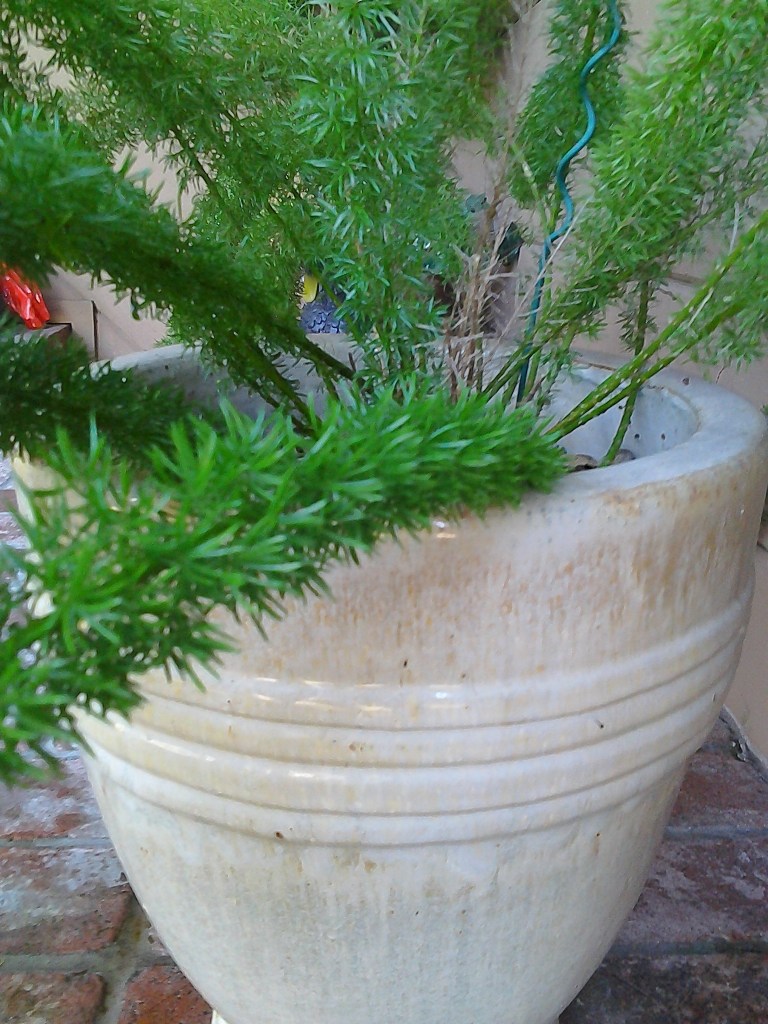
Plants with dense and fibrous roots are more adaptable to containers. Most succulents and common yucca are good choices. Ferns and some grasses also work nicely, but need to be watered rather regularly. Some types of arborvitae and juniper work better than larger coniferous evergreens. Some small bamboos can stay potted, but not larger types.

Annuals, compact perennials and many ground covers that provide color and fill in space around larger plants are naturally adaptable to container gardening, but their need for regular watering can not be denied. There simply is no practical way of combining container gardening and drought tolerance.