Knees

P80805When a plant that should be compact or shrubby gets too lanky with exposed lower stems, it is described as ‘leggy’. We do not hear much about plants that develop ‘knees’. Perhaps that is because there is only one species that does so. That one species happens to be very rare here. If there are other specie that develop knees, I do not know what they are.

‘Knees’ are weird appendages that grow upward like stalagmites from the roots of bald cypress Taxodium distichum, particularly where the trees grow wild in swampy conditions. Knees can get quite tall. One of our professors used to tell us that they could do some serious damage to a canoe. Perhaps knees are why bald cypress is locally unpopular in landscapes.

However, I happened to notice that bald cypress is a common street tree in downtown Oklahoma City. Just like most other street trees, they are installed into small tree wells, but otherwise surrounded by pavement. They were remarkably healthy and well structured specimens that were too young to have damaged the pavement. Yet, I could not help but wonder what they will do as they mature. Even before the trunks grow as big around as the small tree wells that they are in, what would happen if knees develop?

There happens to be not one, but two bald cypress at work. The smaller is alongside a small stream. The larger is adjacent to a lawn where the soil is seemingly dry on the surface, but quite soggy just below the surface. This larger specimen is already developing distended burls that seem to be rudimentary knees. Although there is no pavement to break, the tree happens to be shading a picnic area where knees, if they develop, would be quite an obtrusive problem.P80805+

Good Roots Are Seldom Seen

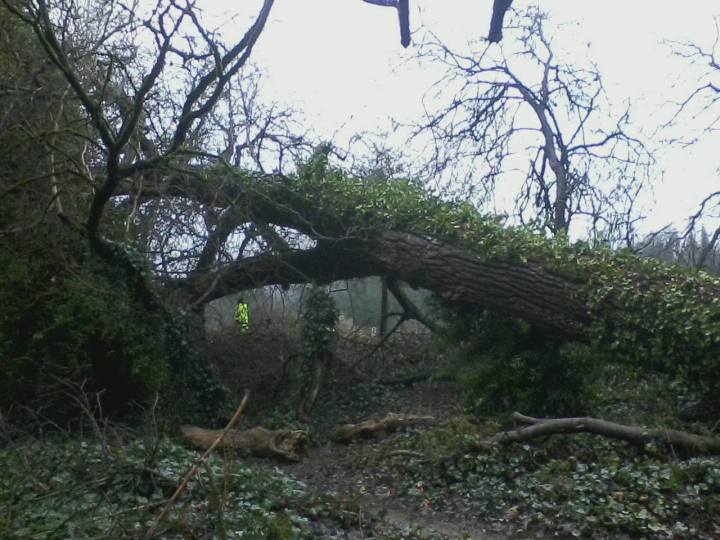
70628thumbWhen a tree falls in the forest, and there is no one around to hear it, does it make a sound? Of course it does! There is just no one to hear it. Why should that be such a profound question? A falling tree makes a mess too. Anyone who does not see or hear it in action can witness it afterward. Sometimes, roots that were inadequate to support the fallen tree become exposed as well.

There is certainly nothing unnatural about trees falling in forests. Otherwise, forests would be too crowded for new trees or anything else to inhabit. The roots of fallen trees might have been adequate for many decades or centuries, but eventually succumbed to decay and the weight of the canopies they supported and sustained. Trees falling in home gardens are completely different.

Domestic trees (in home gardens) are likely to land on homes, cars, other plants, or anything that happens to be in their way if they fall. Also, they are more likely to have problems with the roots that support them. Regular irrigation needed to sustain other landscape plants promotes rot, and also inhibits deep root dispersion. Excessive irrigation that keeps soil saturated is much worse!

The good news is that, despite their innate disadvantages, domestic trees tend to be shorter, stouter and more stable. With proper maintenance, they seldom fall; or at least they are more likely to get removed before they fall. Buttressed roots that are visible at the surface of the soil might indicate that deeper root dispersion has been inhibited. The best roots are too deep to be seen.

Whether or not buttressed or shallowly dispersed roots limit stability, they can damage pavement, lawns, septic systems, or other features on the surface of the soil. Subterranean utilities and foundations of modern buildings are typically safe, but on rare occasion, can be damaged by the largest sorts of trees. Root barriers divert roots, but those of big trees eventually get around them. Potentially damaging roots can be severed while young, but become more integral to sustaining and supporting as they grow.

Halston

P80421KHalston, with the help of several friends, could make a nice pill box hat. That is the origin of the name; from pill box hate fame. This might help clarify, https://tonytomeo.wordpress.com/2018/01/27/caution/ . Yes, Halston was a gopher.

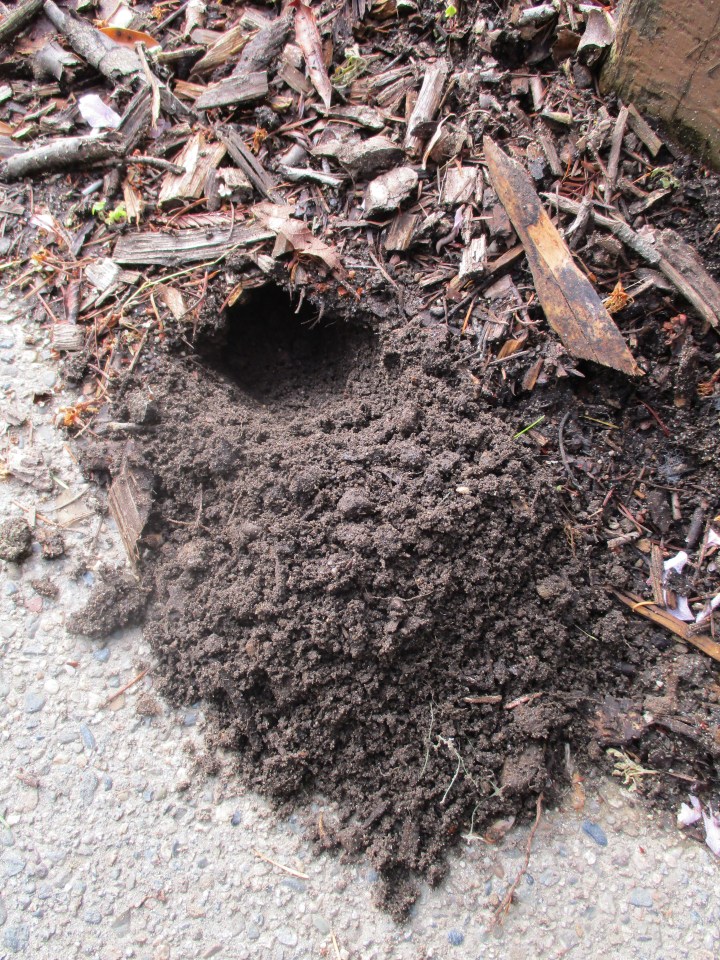
Halston was causing some significant damage that was more of a concern than fashion. Halston started by making several large volcanoes under an already distressed ‘Yoshino’ flowering cherry tree right on the edge of the main road. I really did not want any more of the roots to be ruined. I dug into the main tunnels and set traps; but Halston was very elusive, and pushed traps out of the tunnels, and left them unsprung at the surface of the soil.

Halston was very busy last weekend, creating a chain of volcanoes like the volcanic islands of Hawaii. They were right along the edge of a paved walkway, so were both unsightly and messy. Halston had to go.P80421K+

Halston would not go easily though. Excavation into the tunnels was getting to be as damaging as the tunneling had been. I dug to follow the tunnel from the volcanoes for several feet without reaching the main lateral tunnel. I did not want to dig any farther. I had already cut a few small roots, and did not want to cut any more.

Halston compelled me to do something that I had never done before with gopher traps. I was always taught to dig down from the tunnel that comes to the surface, to find the main lateral tunnel, or ‘run’, that continues to the left and right of the tunnel to the surface. Traps should be set in pairs, with one to the left, and one to the right, within the main run. If a gopher perceives a problem in a tunnel to the surface, that tunnel gets abandoned, and the gopher simply excavates a new surface tunnel. However, a gopher is not so likely to bypass a main run. Since I could not find the main run without damaging more roots, I set the first trap in the tunnel that I had dug up for several feet from where it came to the surface, and the second trap in another open tunnel with only a small volcano that was located several feet away.

I really did not expect to catch anything, but to my surprise, all excavation stopped, and Halston was in the first trap when I pulled it up the following morning. Also to my surprise, Halston was quite diminutive! Because of the extend of all the damage, I was expecting a larger gopher. Several more that I would have estimated would be needed for a pill box hat.P80421K++

A Tree Falls In The Forest

70412thumbThe Great Basin bristlecone pine of the eastern Sierra Nevada can live more than five thousand years. The giant sequoia of the western Sierra Nevada can live more than three thousand years. The familiar coastal redwood from the Coastal Ranges can live more than two thousand years. Besides impressive longevity, one thing that they all have in common is that they all eventually die.

Most trees in home gardens do not live much more than a century. Some oaks can last a long time. Willows, poplars and acacias do not. Trees typically do not live as long in landscape situations as they do naturally in the wild because their life cycles are accelerated by watering and fertilizing, and also because watering promotes rot. Some trees get removed because they grow too big.

While trees are young and growing, they sometimes need help with structural problems. They might need pruning to eliminate limbs that are likely to break away and fall. On rare occasion, trees might need pruning to reduce weight and resistance to wind if stability becomes a concern. Falling limbs or falling trees are very natural in the wild, but can be serious problems around the home.

As trees age, they develop more structural deficiencies, which are increasingly difficult to repair or accommodate. Most big old hardwood trees have some degree of decay within their main trunks, even if no such damage is visible from the outside. Although perfectly natural, this decay eventually compromises structural integrity. Stability is slowly compromised as aging roots decay.

It is true that most trees that fall or drop limbs are more likely to do so while getting thrashed by winter storms. However, there are other factors that can bring down limbs or entire trees. Warming spring weather promotes growth of new foliage, which significantly increases the weight and wind resistance of structurally deficient limbs and destabilized trees. Warmth also accelerates decay. Even after winter storms, there are many other reasons to be aware of the health of trees.