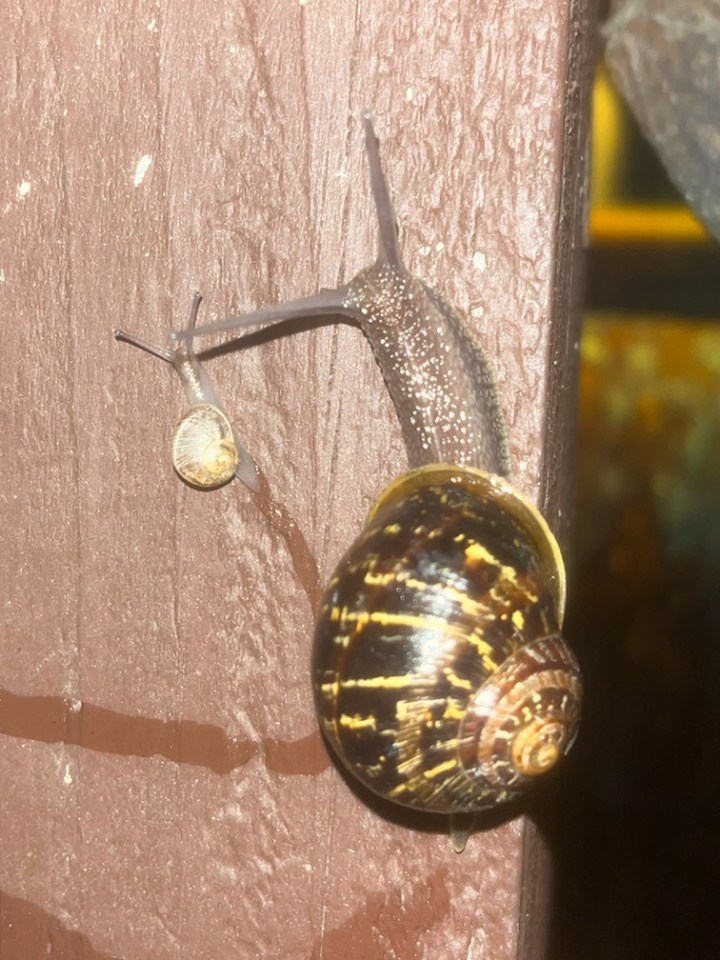
The British Invasion by the Beatles may not have been much of a problem to American gardens; but the French Invasion by brown snails is. Since getting imported as escargot, they eat much more than they get eaten, tearing apart flowers and foliage and devouring young seedlings completely. They tend to hide during the day, and emerge after sunset to graze voraciously until dawn.
Snails as well as slugs are most active this time of year, while the garden is still damp from winter rain, but getting warmer with springtime weather. Fresh vegetation that grows and starts to bloom about now is more than abundant enough to sustain them. Slugs and snails may be slow and ‘sluggish’, but have immense appetites.
Unfortunately, lush foliage that is most susceptible to the wrath of snails and slugs is also the most conducive to their proliferation. Overgrown foliage and plants with large leaves provide plenty of cool damp shade for snails and slugs to hide in during the day. Removing big weeds, fallen leaves and any debris eliminates some of the shelter that they crave while the sun is up.
Snails and slugs are neither elusive nor fast. Hunting them should be easier than it actually is. They are of course easiest to catch while they are out at night. Shallow containers, like saucers for potted plants, containing puddles of beer purportedly get snails to stay out drinking until the sun comes up and roasts them, but this technique is probably more work than it is worth. It wastes beer and seems to catch only a few victims at a time. Besides, the beer gets washed away whenever the garden gets watered.
It is easier and just as sneaky to leave boards or cardboard out overnight for snails and slugs to hide under in the morning, and then surprise the deceived snails and slugs during the day by depriving them of their shelter. They are objectionable to handle, but otherwise easy to collect. Your imagination is probably more useful than any recommendations about how to dispose of them once collected.
Copper tape that can be found in nurseries and hardware stores is a barrier to snails and slugs. It can be self adhesive, or stapled to wooden planter boxes. Plants must be contained within a copper barrier to prevent slugs and snails from getting over the barrier on any plant part that extends within their reach.
Bare copper wire can also be effective. Because trees are actively growing this time of year, copper wire wrapped as a barrier around tree trunks should have some slack, such as a flat ‘S’ shaped curve, to accommodate for trunk expansion.
Salt should not be used to control snails and slugs because it can be harmful to plants. Too much would be needed to surround susceptible plants, and like beer, it would get rinsed away when the protected plants get watered. Keeping drainage saucers filled with water as protective moats for potted plants inhibits drainage, and provides a place for mosquitoes to proliferate.
 Tony Tomeo