Village Harvest

The Santa Clara Valley was formerly famous for fruit and nut production.

(This article is recycled from several years ago, so contains outdated information.)

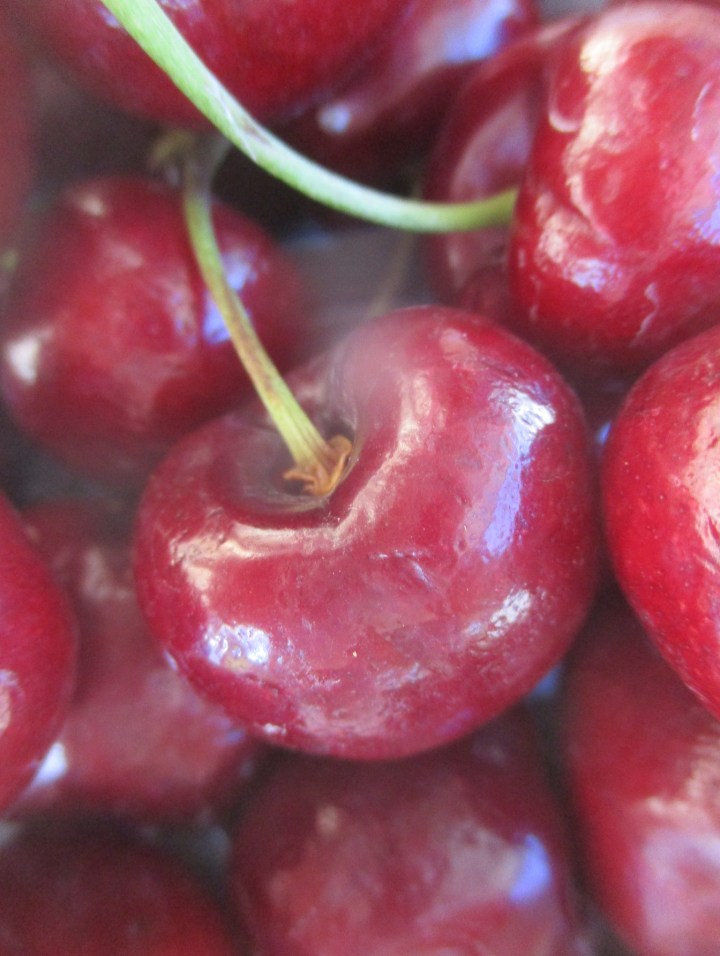
The vast orchards that formerly inhabited the Santa Clara Valley were here because this is among the best places on Earth to grow apricots, cherries, prunes, almonds and walnuts. Actually, there are not many fruit trees that would prefer to be somewhere else. Home gardens continue to produce the many traditional fruits, as well as many other types of fruit that were not so common in the orchards; such as citrus, figs, apples, pears, persimmons, avocados, peaches, nectarines and too many more to fit into a brief list.

Those of us who enjoy growing fruit trees do not need to be reminded of how well they do here. Some trees produce too much and  can become overwhelming. It is not always possible to can, dry, freeze or share with friends and neighbors all the fruit from the more productive trees. Leaving the fruit out in the garden is not only wasteful, but also bad for the garden, attractive to vermin, very messy and smelly.

Besides, there are other people in the community who could use it. During this past year, Village Harvest has harvested from local gardens, and distributed to those who can use the produce, approximately 156,000 pounds of fruit. The record for distribution of produce may be exceeded this year after apples, persimmons and citrus are harvested.

Volunteers make Village Harvest possible, by collecting excessive fruit from home gardens. Some of the people with productive trees like to retain some of the fruit. Volunteers are also welcome to take some of the fruit. The vast majority of fruit gets dispersed to others in the community who can use it.

(Most of the following information is outdated.)

The next apple harvest event in the Cupertino orchard on October 22 may no longer be able to accommodate additional volunteers; but the next major apple harvest in the Woodside Orchard on October 29 may still be in need of volunteers. Harvests take about three and a half to four hours, between 9:00 a.m. and 12:30 p.m.. Volunteers must be at least sixteen years old.

Volunteers can register for harvest events, or get more information at villageharvest.org. Early registration is recommended since space is limited. Volunteer instructions, including meeting location addresses will be e-mailed to volunteers a few days prior to each event. Those of us with excessively productive fruit trees who happen to be within range of harvest events can possibly make arrangements to get fruit harvested.

The next few neighborhood harvests will be on October 25 in Central San Jose, October 31 in Sunnyvale, November 1 in Central San Jose, November 6 in Mountain View, November 8 in Central San Jose, and November 14 in Sunnyvale. Sunnyvale harvests begin at 8:00 a.m.. Some harvests are repeated. For example, the Central San Jose harvests are weekly on Tuesday.

PruneYard

No more prunes.

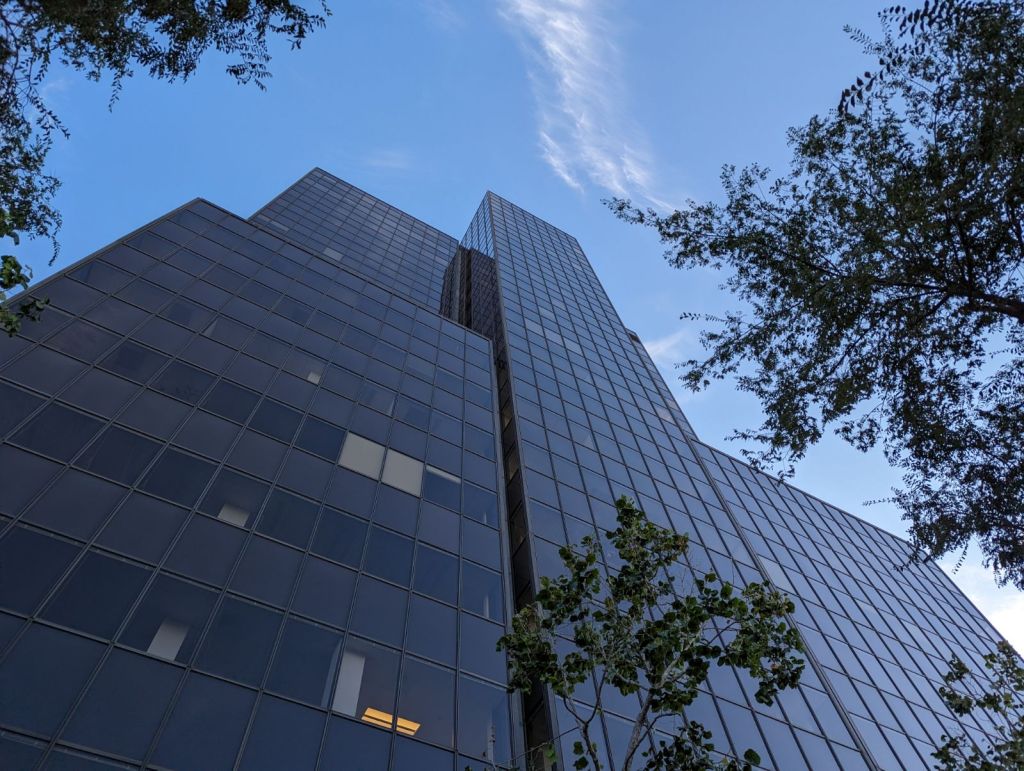
Ulmus parvifolia, Chinese elm extends most prominently into the picture from the right, with another bit from the left of the upper margin. Platanus X acerifolia, London plane extends into the picture from the right of the lower margin, with another minimal bit from the upper left. Otherwise, no other vegetation is visible. This is not exactly a horticultural topic.

The PruneYard Tower 1 is the big and dark skyscraper above the elms and planes. For a few years, it was the tallest skyscraper between San Francisco and Los Angeles. Like many major urban developments, it and its associated complex of buildings is named for what it displaced.

The PruneYard really was what its name describes, a large yard for drying prunes, as well as apricots, from the formerly vast orchards that surrounded it. Because the primary PruneYard complex of buildings is almost as old as I am, I can not remember it not being there. However, I can remember the ruins of some of the associated facilities nearby, as well as abandoned remnants of orchards. The stouter PruneYard Tower II was added in about 1976. The PruneYard Place was added in the early 1990s.

Nowadays, the name of the PruneYard must seem silly to those who are unaware of its history. Few are aware of the difference between prune and plum. Even those of us who can remember the last scraps of orchards find it difficult to believe that, not only were orchards here, but that they were formerly much more vast, and occupied most of the Santa Clara Valley. Just as tourists go to see the fall color of New England, tourists formerly came here to see the spring bloom. It is no wonder that the Santa Clara Valley was also known as the Valley of Heart’s Delight.

SNOW!?

P80110If you do not know what it is, ‘snow’ is like frozen rain.

If you do not know what rain is, I wrote about it earlier for those of us who are native to the drier parts of California. If you notice strange drops of water falling from the sky tonight, that would be rain. There is no need to be alarmed. It is expected to happen here tonight, and a few times for the next few days. Contrary to former experience, it is normal for this time of year.

Anyway, getting back to snow. Unlike rain, which sometimes happens here, snow does not happen here.

Well, perhaps that is not entirely true. It might have happened as recently as 11,700 years ago, as the Ice Age ended, and again in more recent history, in February of 1976, when an epically humongous snowstorm deposited as much as half an inch of snow over the Santa Clara Valley!

It is difficult to imagine such a huge volume of snow! It must have been disastrous! It would be even more disastrous now, with more than a million people just in San Jose, and many of them driving cars!

In 1976, we third graders did not consider it to be disastrous. We were not old enough to drive. We were perplexed and mystified at first, but rather quickly discovered that snow had serious potential for being fun. Our parents wadded it up into something known as ‘snowballs’ and then threw these snowballs at each other and the neighbors. Yes, I know it sounds crazy. Nonetheless, it looked like fun, so we tried it. It really was fun. We also discovered that we could just as easily throw snowballs at cars driving by, but we were instructed to not do that. We could see that the Santa Cruz Mountains were discolored by snow. They were an almost white hue of very pale blue, speckled with the more typical darker blue.

On very rare occasion, when the ‘smog’* and smoke blew away on clear and cold wintry days, we could see snow on the tops of the highest peaks of the Diablo Range east of the Santa Clara Valley, particularly on Mount Hamilton where Lick Observatory is located. We did not know what it was. Before snow happened in our own neighborhood, we wondered what discolored the peaks like that.

Now that smog rarely obscures the view of the Diablo Range, snow is visible on the group of peaks around Mount Hamilton almost annually. If it gets cold enough, a slight blush of snow might be seen on the lower East Hills in front of the Diablo Range. It is quite scary to think of how close to home snow can be. There happens to be snow up there right now!

I am sorry that I do not have a picture of the snow on Mount Hamilton. I will just recycle this picture of Bill trying to escape snow south of Oklahoma City.

* Historical notation – The East Hills and Diablo Range to the east of the Santa Clara Valley were rarely visible in the olden days because of ‘smog’. If you do not know what smog is, you are fortunate. I have not written about smog yet because it is a part of our history that we would prefer to forget. To be brief, smog was a common form of air pollution. Although there was less smog in winter, there was more smoke from ‘fireplaces’ and burning ‘orchard’ stubble. A fireplace was a primitive heating device that warmed the interiors of homes and other buildings with the combustion of wood. An orchard was a grove of trees that were installed and maintained for the production of fruits, nuts and a few other horticultural commodities. Orchards once occupied vast areas of the Santa Clara Valley. Orchards that were removed to relinquish space for other development provided some of the wood for fireplaces. Perhaps I should write more about these later. I understand that the ancient history of the Santa Clara Valley can be rather baffling at times.