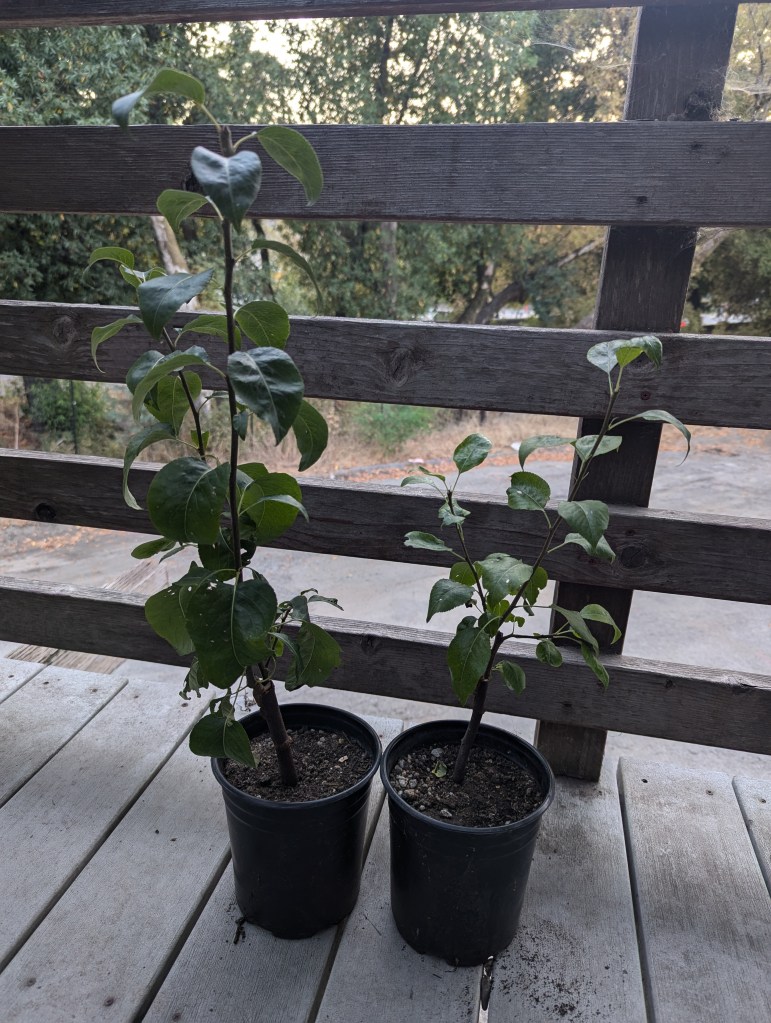
‘Beurre d’Anjou’ is to the left. ‘Seckel’ is to the right.
Two new pear trees have grown well this year after being grafted last winter.
‘Seckel’ is to the right in the picture above. I acquired its scion from the Scion Exchange of the Monterey Bay Chapter of the California Rare Fruit Growers on the first of February. It was one of only two cultivars that I wanted to graft onto one of only three quince understock trees that were available at the time.
‘Beurre d’Anjou’ is to the left in the picture above. Because it was unavailable from the Scion Exchange, and also because it was the other of only two cultivars that I wanted to graft, I purchased its scion online.
I wanted to retain one of the three quince understock trees for its fruit, and possibly for cuttings for understock for more pear trees in the future. However, more copies of it grew from cutting from the two trees that were grafted last winter. Now, I have a third quince tree to graft a pear scion onto this winter. I will most likely procure a scion of ‘Bartlett’, because, a very long time ago, that was the most common cultivar within the orchards of the Santa Clara Valley.
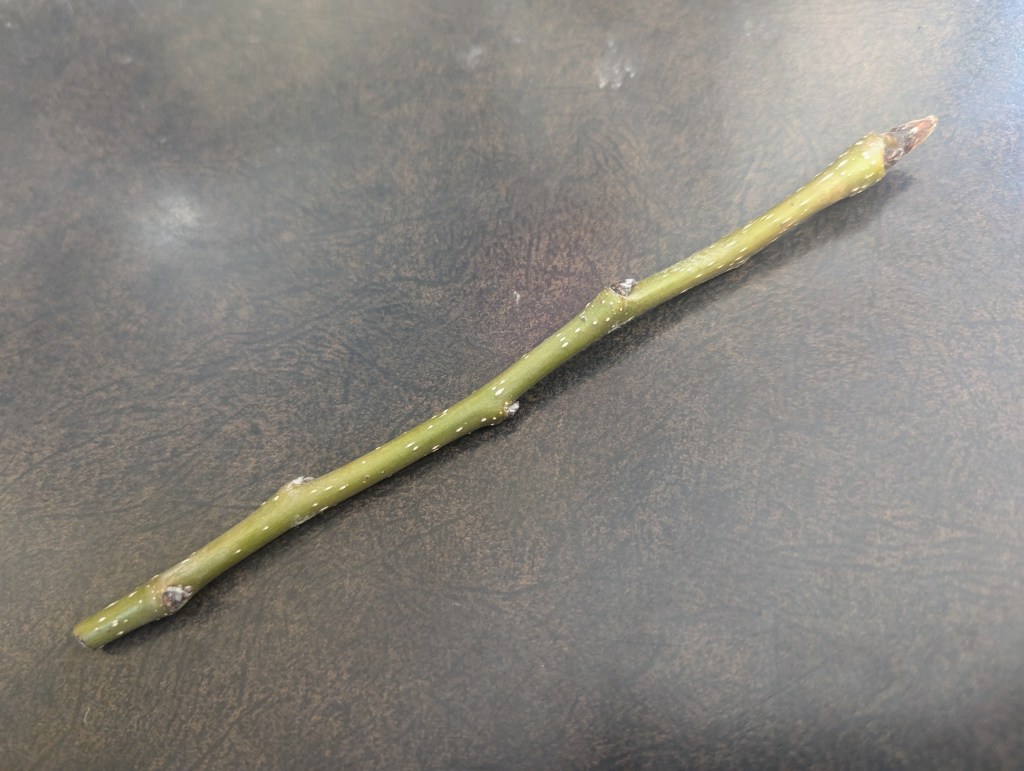
Here it is. The stick! I paid $7.79 for it with delivery from San Leandro, and waited a few days for its arrival last Wednesday. Since then, it was processed into two scions and a cutting, each with two buds. The terminal bud of one of the scions is actually accompanied by a few smaller buds. The scions were grafted, and the cutting was plugged, last Thursday, less than a day after the Stick arrived. I am very pleased with the results, and hope to be even more pleased with their favorable performance in the future. Ultimately, the finished product will be at least one pear tree. More specifically, it will be a ‘Beurre d’Anjou’ pear tree, which is more often known as ‘d’Anjou’ or ‘Anjou’. It and ‘Seckel’ were the only two cultivars of pear that I wanted to acquire this winter. After obtaining scions for ‘Seckel’ pear from the Scion Exchange of the Monterey Bay Chapter of the California Rare Fruit Growers on the first of February, ‘Beurre d’Anjou’ remained elusive. Every pear tree that I could get scions from was either another cultivar, or not identifiable by cultivar. I really thought that the process would be simpler. I could have purchased a tree from bare root stock at a nursery, but that would have been comparable to cheating, and would have cost about $40. The well rooted quince understock for grafting was already here and waiting. I grew a few specimens of it from suckers of an established pear tree, and already used one for the previously acquired ‘Seckel’ scions. Because I was so confident that I would eventually acquire the only pear cultivar that I craved more than ‘Seckel’, I retained the biggest and best of this understock for these recently acquired scions of ‘Beurre d’Anjou’.
‘Beurre d’Anjou’ pear has been elusive. I visited the Scion Exchange of the Monterey Bay Chapter of the California Rare Fruit Growers to find scions, but none were unavailable. I got the few other scions and cuttings of the first three of these Six instead. That was two weeks ago. Some other deciduous vegetation is beginning to demonstrate that there was not much time to spare. Oddly, one banana tree did not bother with dormancy this year. It seemed to be comfortably sheltered.
1. Pomegranate, persimmon, caprifig, white mulberry and black mulberry cuttings are a bit too numerous to cite with their botanical and cultivar names. Most lack labels since I can identify them as they grow. They are plugged into the same can to occupy less space.
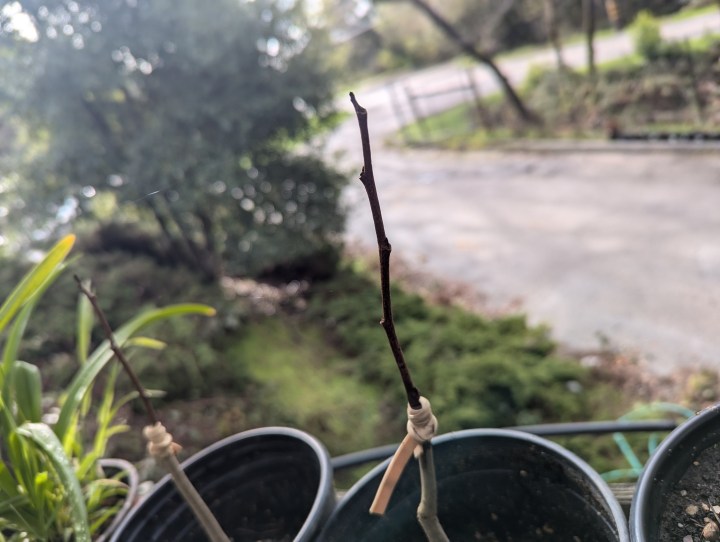
2. ‘Allegheny’ pawpaw scion is hopefully happily grafted onto seed grown understock. It is longer, with more buds than I would have preferred, but is rather thin. ‘Mango’ to the left is even dinkier. Three other small seed grown trees remain ungrafted without scions.
3. ‘Seckel’ and ‘Beurre d’Anjou’ pear were what I came for. I did not find ‘Beurre d’Anjou’ but this is ‘Seckel’. The quince understock is big enough for a pair of cleft grafted scions. Basal scraps from the scions were plugged as cuttings. Redundancy could be useful later.
4. Sambucus racemosa, red elderberry reminds me that winter dormancy will be ending soon for most deciduous plants. Grafting, bare root planting and dormant pruning must therefore be done sooner. Norway maple might be the last deciduous species to refoliate.
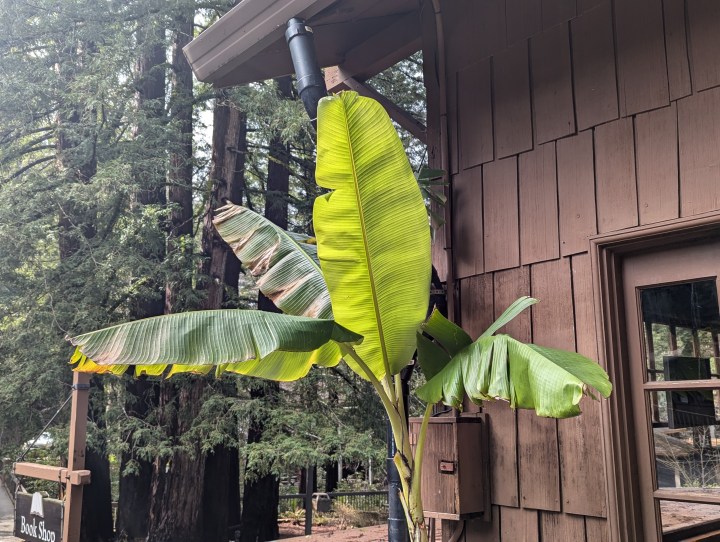
5. Musa acuminata, banana trees look so shabby after even minor frost that their foliage gets cut back. This unidentified specimen stayed nicely foliated under the eave and close to those uninsulated walls of the associated building, which happens to be a coffee shop.
6. This happens to be on the menu board of the coffee shop, which happens to be within view from where the banana tree that did not get frozen is situated. Another banana tree that is just a few feet away but unsheltered was deprived of the last of its frosted foliage.
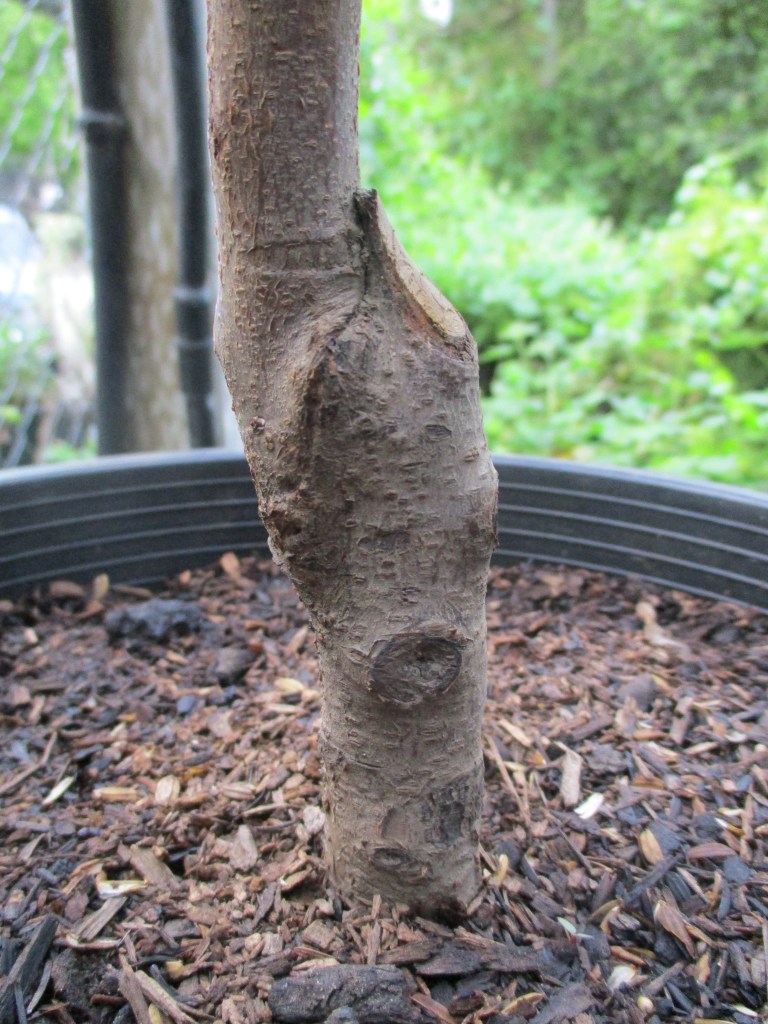
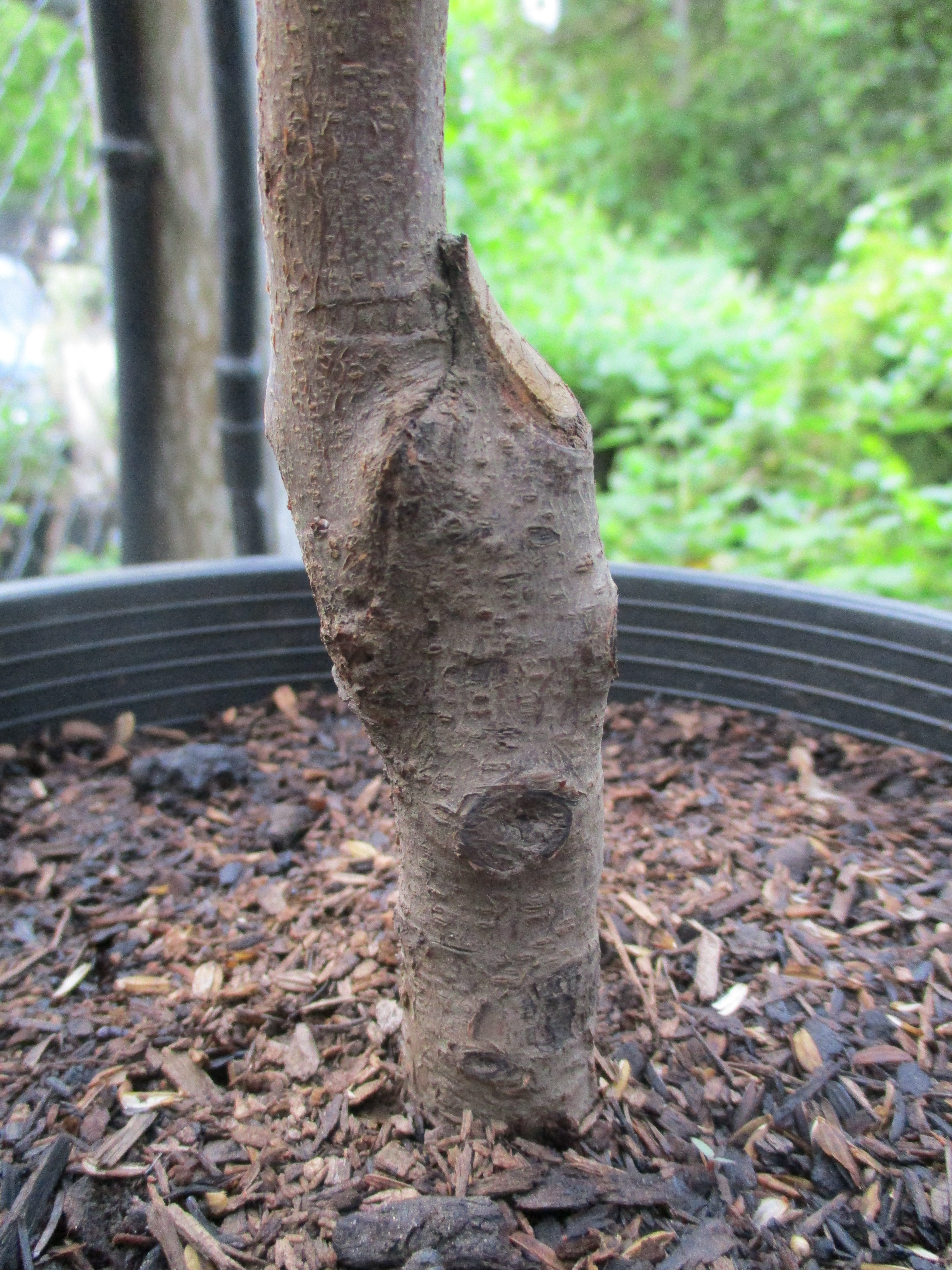
The scion is above this graft union. The rootstock is below.
There are not many Californians of my generation who do not remember growing avocado trees from seeds when we were kids. We simply impaled the big seeds around the middle with three evenly spaced toothpicks to suspend them from the rims of Dixie cups partly full of water. If just the bottoms of these seeds remained properly submerged, they grew roots and a stem with a few leaves, all they needed to grow into trees that were producing too many avocados by the time we got to high school.
Yet, I and others of my generation have always heard that avocado trees need to be grafted to produce fruit. (Grafting is the union of two or more compatible but different plants. The ‘scion’ is the upper portion that forms a trunk, branches and foliage. The ‘rootstock’ is the lower portion that provides roots.) Well, this is obviously not true, but does make us wonder about the advantages of grafted trees.
They myth of seed grown trees being unproductive probably originates from the tendency for seed grown avocado trees to be unproductive for the first few years during the juvenile stage. Scions of grafted trees are taken from adult growth that is ready to bloom and fruit immediately; although even grafted trees need a few years to grow large enough to produce more than just a few avocados.
Many plants are juvenile while young, in order to better compete in the wild. While juvenile, avocado tree seedlings grow vigorously enough to compete with other trees. Adult habits of blooming and fruiting would only slow them down. Besides being fruitless for many years, citrus seedlings are very thorny through their juvenile phase, to avoid getting eaten by grazing animals. Scions of grafted citrus trees are from relatively thornless adult growth that is immediately ready to produce fruit.
The primary advantage of grafting fruit trees though, is keeping the many different cultivars (cultivated varieties) ‘true to type’, since many seed grown plants exhibit at least some degree of genetic variation from their parents. For example, avocados from seed grown (ungrafted) trees tend to be much larger, but often less flavorful than the fruit that the original seed came from. No one really knows what the fruit will be like until it actually develops. Some seed grown peaches are indistinguishable from their parents, but most are very different. However, most pecans and chestnuts are actually produced from ungrafted seed grown trees.
The secondary advantage of grafting fruit trees is the ability to graft onto dwarfing rootstock. Although few avocado trees are dwarf trees, almost all citrus trees for home gardens are grafted onto dwarfing rootstock that keeps them more compact and proportionate to home gardens. Most deciduous fruit trees are similarly grafted onto semi-dwarf rootstock.
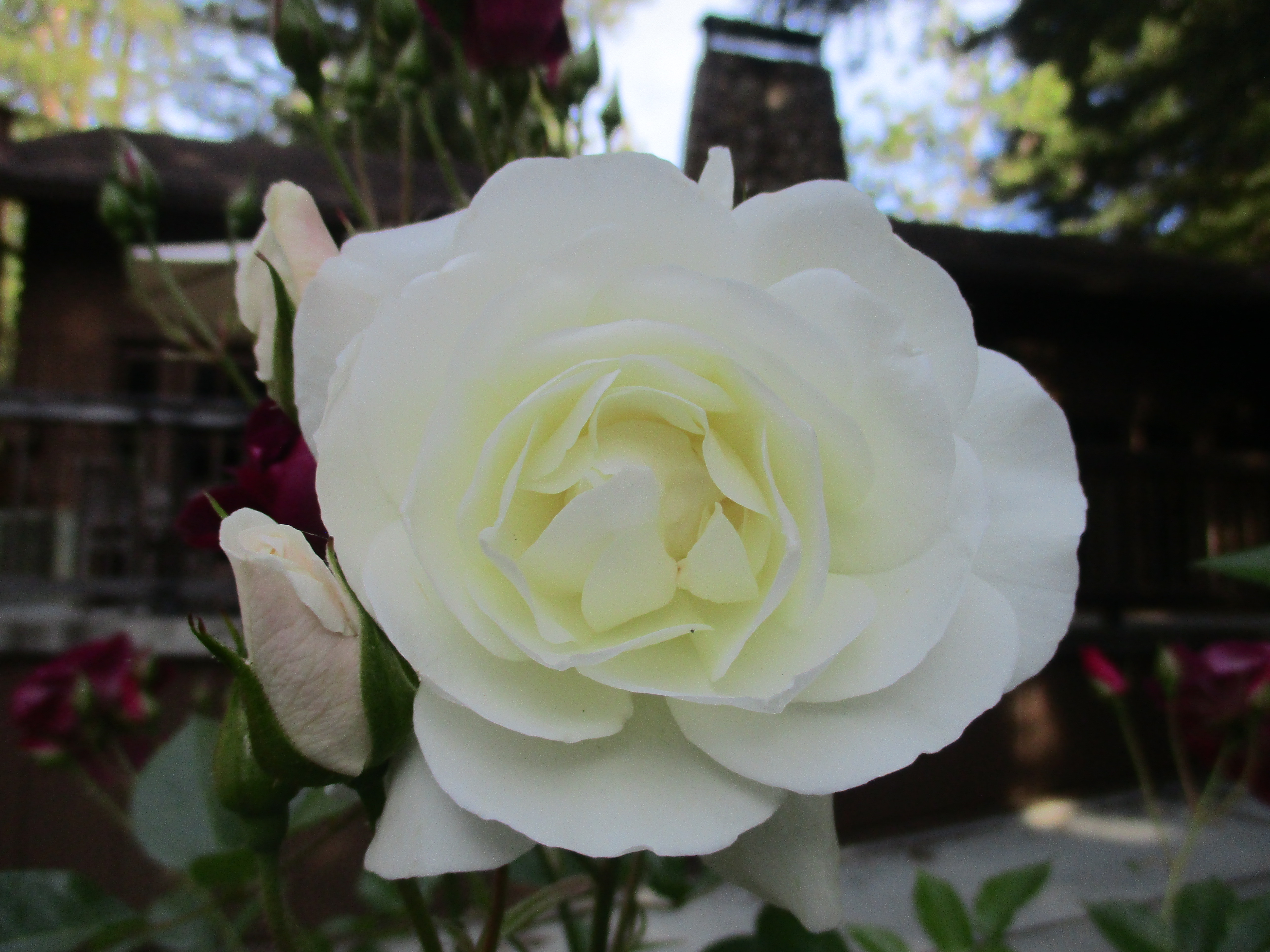
When an individual rose shrub blooms with two distinct types of flowers, it seems to be doing a little extra. It provides the big, bold and strongly stemmed roses that it is grown for, along with daintier dark red roses. Eventually though, the small red roses become more abundant, and can crowd out the more desirable roses.
Almost all of the older roses that are grown for cutting are grafted. This means that the stems that provide such excellent flowers above ground are attached to genetically different roots. When such plants were young, the graft union was more obvious, where the canes branched out from the single stem just above the roots.
The stems above the graft union are known as the ‘scion’. The roots below are known as the ‘understock’ or ‘rootstock’. The two are grafted together because the scion blooms so well, and the understock develops stronger and more efficient roots. Scions are not expected to grow roots any more than understock is expected to bloom.
Adventitious stems that develop from the understock below the graft union are known as ‘suckers’, probably because they suck resources that should go the scion. They should be removed as soon as they get noticed, before they can dominate the scion. They become more difficult to remove as they mature.
If possible, fresh new suckers should get broken off from their origin instead of simply pruned away. It sounds violent, but is actually more effective. Stubs left from pruning are much more likely to develop more suckers later. Suckers that get pruned back repeatedly can develop into significant burls.
Old rose shrubs that were planted with an abundance of organic soil amendments tend to sink into the ground as the soil amendments decompose. If a graft union gets buried, it can be difficult to distinguish between suckers and good canes that develop above the graft union.
‘Tree’ roses have two graft unions. The branched scion on top is grafted onto a straight stem of a different variety. The straight stem is grafted onto the understock at ground level. The trendy carpet roses and some other modern roses are not grafted, so will not develop suckers.
A five pound kumquat is a problem! It means something went seriously wrong. Anyone who grew one would concur. They are huge, lumpy, and very insipid, with ridiculously thick pale yellow rind around a small handful of uselessly fibrous pulp. They are protected by dangerously sharp and rigid thorns that can get longer than three inches. Even their irregularly wavy foliage is unappealing.
In reality though, there is no such thing as a five pound kumquat. These huge but useless fruits, as well as the associated thorns and foliage, are those of ‘shaddock’, which is the most common ‘understock’ for almost all grafted dwarf citrus trees. It is what keeps such trees compact, so that they do not get as big as orchard trees. It was there all along, whether we were aware of it or not.
Most citrus trees are composed of two genetically different parts. The understock are the lower parts that develop roots that are unseen underground. The desirable upper parts that produce the familiar citrus fruits grow from ‘scions’ that are grafted onto the understock. Graft unions are just above grade, where the texture of the bark above is slightly different from that of the bark below.
‘Suckers’ are stems that grow from the understock below the graft unions. Because they are genetically identical to the understock rather than the scions, they produce the same fruit and exhibit the same physical characteristics as the understock would if it were growing wild. Suckers can overwhelm desirable scion growth, which is how kumquat trees can produce huge five pound fruits.
Other grafted trees and shrubs, particularly fruit trees, get suckers too. New suckers appear as new spring growth develops. They should be peeled off of the main trunks rather than pruned off. As brutal as this seems, it is more efficient than pruning. Soft young shoots should snap off quite readily. This technique removes more of the callus growth at the bases of the suckers, which could develop more suckers later. Big older suckers should be pruned off as closely and neatly as possible.




 A five pound kumquat is a problem! It means something went seriously wrong. Anyone who grew one would concur. They are huge, lumpy, and very insipid, with ridiculously thick pale yellow rind around a small handful of uselessly fibrous pulp. They are protected by dangerously sharp and rigid thorns that can get longer than three inches. Even their irregularly wavy foliage is unappealing.
 Tony Tomeo