Seasons Are Constantly In Flux

80822thumbGardening requires planning. There is always planning. The vegetables that are getting harvested now are developing mostly on plants that were put out in the garden early last spring. Some of those plants were grown from seed sown even earlier, late last winter. Now that it is more than halfway through summer, it is time to plan for cool season vegetable and annuals for next autumn.

There is still no need to rush cool season vegetables and flowering annuals that will be purchased as small plants in six packs or four inch pots. They are only beginning to become available in nurseries, and get planted a bit later. Broccoli, cauliflower, cabbage and kale are popularly purchased as small plants because not very many are needed, and they are reasonably inexpensive.

However, if varieties of these vegetables that are not expected to be available in nurseries are desired, they must be purchased as seed. If space allows, they can be sown directly into the garden early in September. Otherwise, they can be sown now into flats, six packs or small pots to grow into small plants that will be ready when warm season plants relinquish their space later in autumn.

Root vegetables like beets, turnips and carrots should not be grown or purchased in flats or pots. They get disfigured by transplant. Therefore, they should be sown directly into the garden through September. Carrots should perhaps be delayed until halfway through September. Turnip greens and leafy lettuces should be sown directly as well just because they get distressed from transplant.

Almost all cool season vegetable plants can be grown in phases, or several small groups planted every two week or so, in order to prolong harvest. Those planted first develop and are ready for harvest first. By the time they are depleted, the next phase should be ready. However, because most cool season vegetables develop somewhat slowly, and individual plants within each group develop at variable rates, planting only one early phase, and one late phase, perhaps with another phase in between, might prolong harvest more than adequately.

Six on Saturday: Bits and Pieces

There were no major projects this week that were interesting enough to get six pictures of. The best that I could do was get six random pictures of random features of the landscapes. I do not actually do much to cultivate flowers, but they happen to be components of the landscapes. Most are perennials that bloom on their own. Of course, I do not mind taking credit for them.

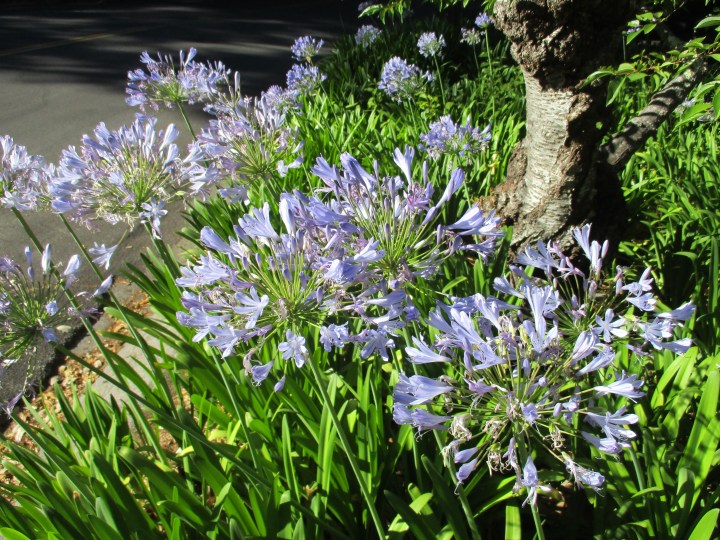
Some blooms started late while the weather was mild, but were then accelerated as the weather suddenly warmed. It seemed that several different types of flowers needed to be deadheaded at the same time. Zonal geraniums and lily-of-the-Nile are two of the most reliable perennials that bloom on schedule no matter what. Zonal geraniums bloom sporadically most of the time, and only bloom more while the weather is warm. Lily-of-the-Nile may start a bit early or a bit late, but is always in full bloom on the fourth of July. The blooms even look like exploding fireworks. More than two weeks later, their flowers are still in full color but will slowly start to fade. Phlox was a surprise for us.

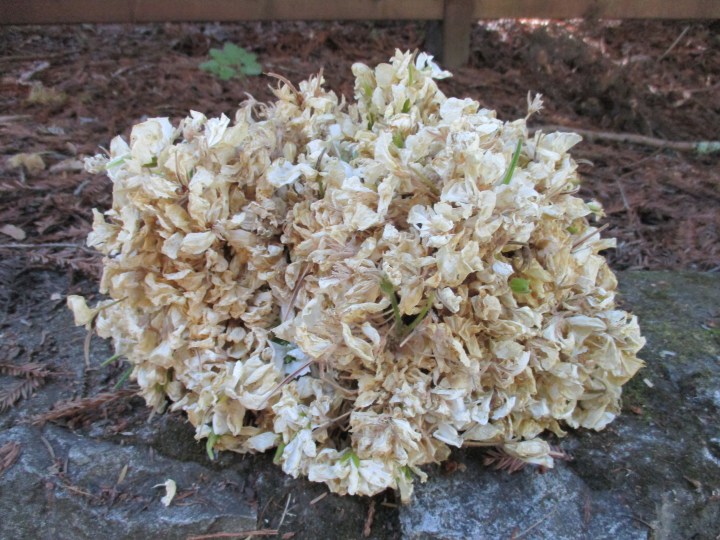
1. Can you guess what this bloom is?P80728
2. You can probably guess that this is phlox. It sure had my colleagues and I perplexed. We had never seen anything like it. Phlox is uncommon here. I would even say it is rare. No one knows why. It just is. I got a picture of it a few years ago only because I was intrigued by it in a neighboring landscape. It took a bit of effort to identify it, although I sort of suspected that it was phlox. It did not look quite like this phlox, and was lower to the ground. No one knows how this one got into the landscape. We suspect it arrived with the ‘fertilizer’ that the horses make for us.P80728+

3. Lily-of-the-Nile is still one of my all time favorite summer blooming perennials. I do not care how cheap and common it is. It is one of the first perennials I divided while I was in junior high school. I grew more than eighty new plants from a single old plant that needed to be removed. It was the old fashioned sort, with big blue flowers and big flabby leaves, perhaps bigger than these. I also like the white ones with the same big flowers and leaves, of course, because they are white. All the fancy modern cultivars are nice too, but not as excellent as the originals. I do like seeing the very pale blue ones in other gardens.P80728++
4. This zonal geranium has these small but cheery cherry red flowers, but it is really grown for the weirdly variegated foliage that is blurry in the background. I think that these flowers would look better against simple green foliage. There is another zonal geranium in another part of the landscape, with small peachy pink flowers and foliage that is variegated only with white. I am none too keen on the flower color, and I am not often too keen on variegation, but the foliage of that particular zonal geranium really looks sharp.P80728+++

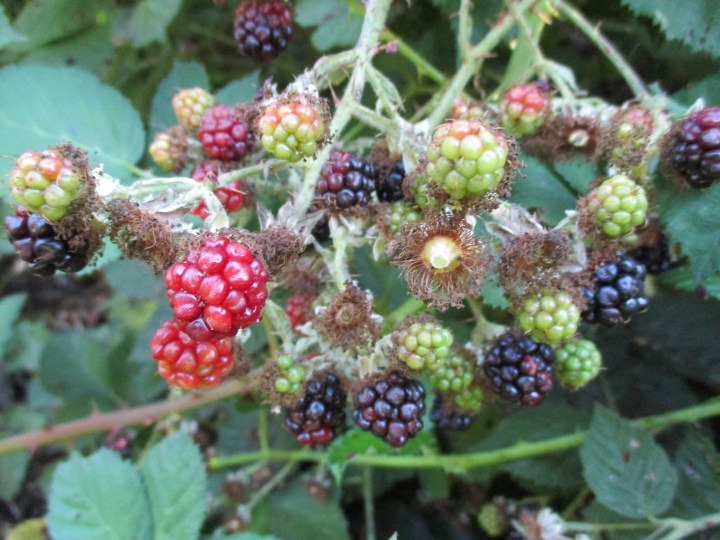
5. Himalayan blackberry is one of the worst and most invasive of the exotics weeds here. It develops huge canes that arch over and drop on top of other plants in the landscape. The wickedly sharp prickles (technical term for their thorns) are tortuous when trying to remove the canes. Even picking their berries is nasty business! There are a few berries ripening now, and they happen to be pretty good, but they are sooooooo not worth it.P80728++++
6. Chips needed to be dispersed into the newly landscaped areas that are partially visible in the background of this picture. These chips were free. They are made of recycled wood waste. For our purposes, they are sufficient. However, they include a few large chunks of wood and bits of metal. The chunk of metal in this picture is a short section of rebar. Some of the chips have paint on them. Some seem to be bits of old furniture. It makes one wonder where some of this material came from.P80728+++++

By the way, the bloom in the first picture #1 is merely a fist full of deadheaded white zonal geranium flowers all pressed together. White zonal geraniums do not readily drop their faded blooms like other zonal geraniums do, so they need to be deadheaded.

This is the link for Six on Saturday, for anyone else who would like to participate:

https://thepropagatorblog.wordpress.com/2017/09/18/six-on-saturday-a-participant-guide/

Six on Saturday: Finally Flowers


After posting so many inter pictures of soil, stone, road signs, plumbing, empty wine barrels and mockery of French culture, I suppose I should share some pictures of actual flowers for a change. I mean, this is about gardening after all. Unfortunately though, I do not work with many flowers. The landscapes are designed to be compatible with the surrounding forests, so flowers are minimal. I already shared pictures of most of the best. Some of these are from gardens that I do not work with. I just thought that they were pretty.

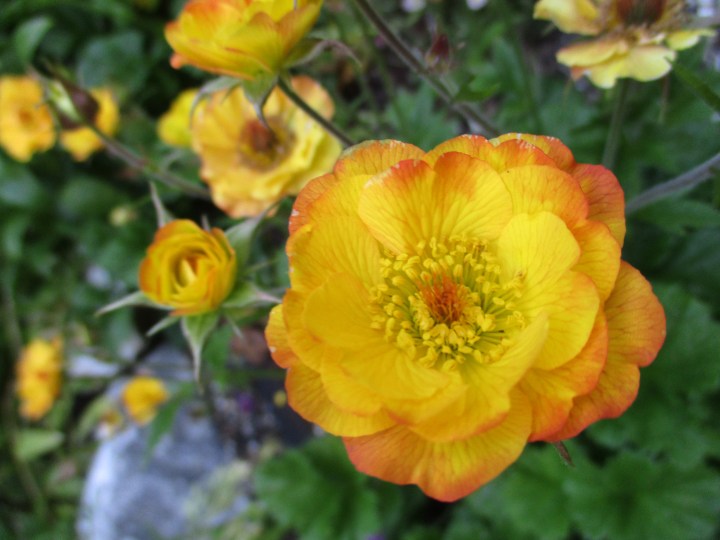
1. Avens finished blooming more than a week ago. I just really liked this picture because it is such a nice swirly orange color. Until I found these, I had not seen avens in many years, and did not expect to see it anytime soon. Since featuring it in the gardening column, I have found that others in other regions are quite familiar with it, and this it more popular than I would have guessed. http://www.canyon-news.com/ph-has-ups-and-downs/80473P80707
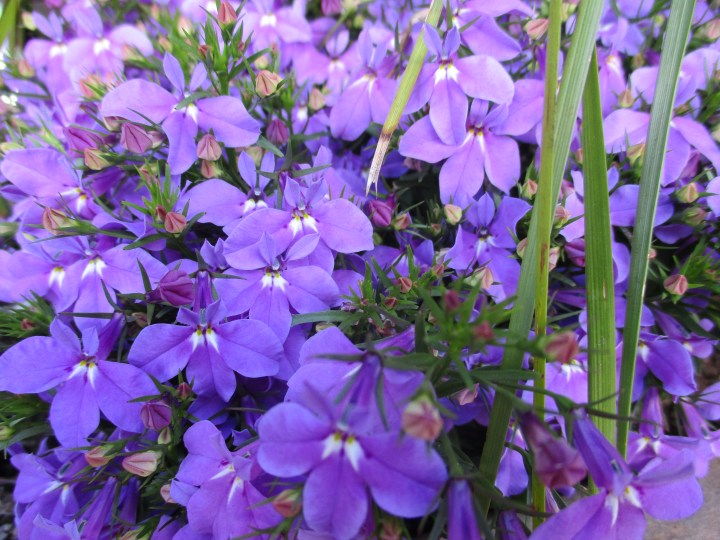
2. Lobelia is one of the more common warm season annuals. This is not from one of the landscapes that I work with, but looked good enough in a planter box in town for me to get a picture of it. I do not know what variety it is. There are many varieties nowadays that I am not familiar with anyway. Back in the 1980s, bright blue lobelia was popular alternated with white alyssum. I thought it looked rather silly at the time, but would not mind seeing it now. It was such an 80s look.P80707+
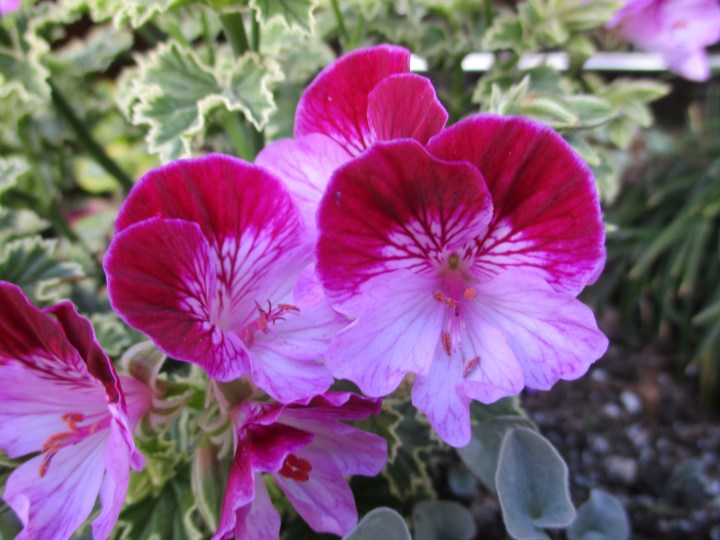
3. Pelargonium was in the same planter box as the lobelia. I know neither the species nor the cultivar. Again, it was just too pretty to pass up without getting a picture. It is more diminutive than the sorts of pelargoniums that I am familiar with. The plants are very compact. The variegated leaves and flowers are quite small.P80707++
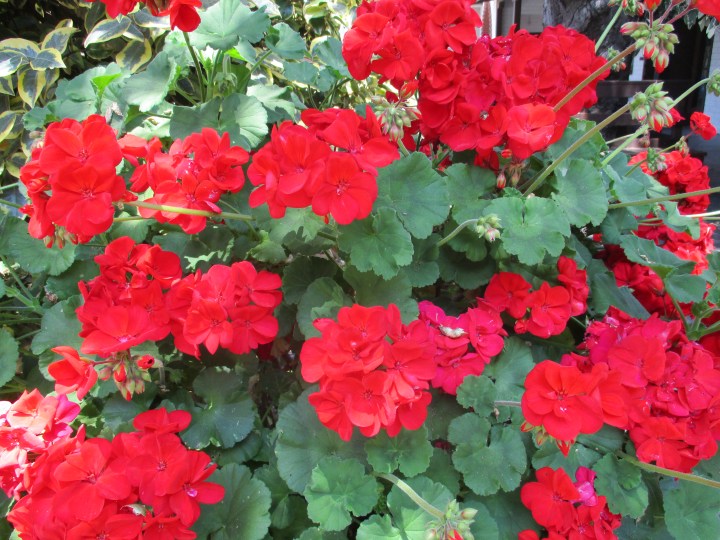
4. Zonal Geranium happens to be one of my favorite perennials because it was one of my first. Although I grew my first for only a short while when I was very young, I still grow one that I found in a trash pile when I was in junior high school, and another that I found naturalized in a creek near San Martin shortly after I graduated from college. I bring pieces of them everywhere I go. Both are the big and weedy types that are probably very closely related to the straight species. The first one is the very common bright pink with leaves that lack halos. The second is the very common bright orange red with only slight halos on the leaves. Getting back to this remarkably bright red zonal geranium; it is not one of mine. The leaves have only very light halos. The growth seems to be almost as vigorous and weedy as my bright orange red one, but not quite. It is more tame, and more prolific with bloom. The bright red color is prettier too.P80707+++
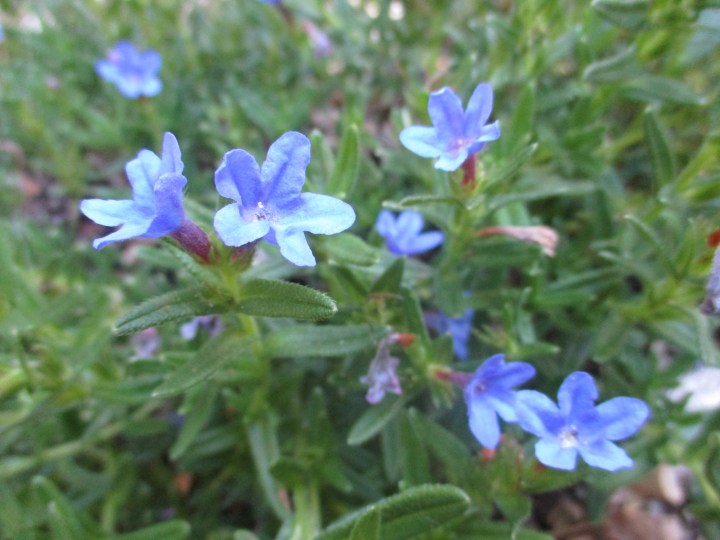
5. Lithodora looks prettier close up that it really looks in the landscape. It was planted into one of the newer small landscapes, but is not growing very well. I found the name to be amusing because it seems to mean that it smells like a rock. However, someone recently explained to me that the name means that it adores rocks, since it naturally grows in soil that is too rocky for other plants.P80707++++
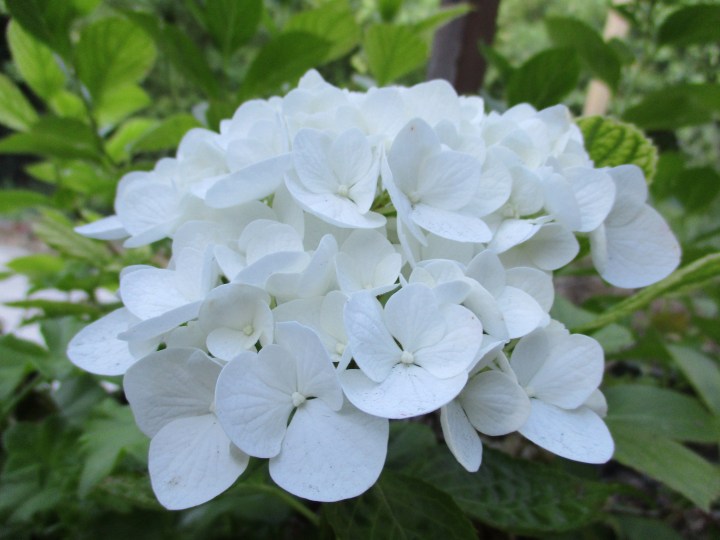
6. White Hydrangea is a nonconformist among all the hydrangeas that I fertilized to be either pink or blue. So far, the pink ones are still pink, and the blue ones are still blue. The few white ones are always white. http://www.canyon-news.com/ph-has-ups-and-downs/80473P80707+++++
This is the link for Six on Saturday, for anyone else who would like to participate:

https://thepropagatorblog.wordpress.com/2017/09/18/six-on-saturday-a-participant-guide/

Change of Format

P71019

This blog is now two months old; so it is about time that I start to recycle old articles instead of writing so many ‘elaborations’. The articles are probably more interesting and relevant anyway. They will be from the same time last year, or previous years. Like I have been doing with new articles, the old articles will be split into two separate postings. One will be the main topic. The other will be the ‘plant’ of the week. So, one new article and one old article split into two postings each week leaves only three days for ‘elaborations’. Redundant articles will be omitted. Eventually, I will refrain from daily postings. Also, I will try to keep my ‘elaborations’ brief. I know I tend to get carried away with this. Alternatively, I may recycle another article each week, leaving only one day for ‘elaborations’. I will figure this out as I go along.

While I am taking the time to post something that has nothing to do with gardening, I should also mention that one of my main objections to writing a blog is that so much of what I write about is specifically for the climate in which I live, and not necessarily applicable to other regions. My articles are written for newspapers between San Francisco and Beverly Hills (in Los Angeles County). However, since starting this blog, I have found that not only do the newspapers that I write for already share my articles with newspapers in other regions, but that people who read my articles in other regions are already as aware of regional differences as I am. People in Australia seem to be as interested in reading about autumn during their spring as I am interested in reading about their spring during autumn. People seem to know how much of the information that I present is actually useful to them, and can distinguish information that is not accurate for their respective applications. Now, I feel much better about posting my articles, as well as writing about whatever I want to write about.

If you are wondering how the picture of Rhody above is relevant to the posting, it has no relevance. He just had a way of getting you to read my blog earlier, so I tried it again, and it worked.

Why Autumn Is Also Fall

71011thumb.jpgThe calender says that it is now autumn. The weather does not necessarily agree. Some of the trees are dropping their leaves. However, the leaves are not falling because the weather is getting significantly cooler. The leaves got cooked during that weird heat wave a few weeks ago. If the weather can be this confusing here in our very mild climate, it must be really crazy everywhere else.

It is hard to make sense of what trees are dropping leaves in response to the earlier heat. Coast live oak, which normally tolerates heat quite well, was really annoyed by the heat in some areas. Cottonwood and other poplars are expressing their discomfort too, but that is to be expected from them. Sycamores, which are normally sensitive to weather anomalies, are not overly concerned.

All this means to us, the janitors of our trees, is that some of us might be raking leaves earlier than expected. These leaves will not be the nice colorful sort that we like to see in autumn. Those will come later. It is still too early to know how the weather will affect autumn color. All we know so far is that some trees will have less foliage for coloring. Sweetgums are hinting at a colorful autumn.

Leaves should be raked as they fall. However, because no one wants to clean the eave gutters any more than necessary, they can be cleaned only a few times, or maybe only once if trees shed efficiently. They are easiest to clean before the rain starts and the wet leaves start to decay. Unfortunately, most deciduous trees continue to drop their leaves well into the rainiest part of winter.

Lawns and shallow or dense groundcovers really do not like to be shaded by fallen leaves for too long. To perform through winter like we expect them to do here in our mild climate, they want as much sunlight as they can get while the days are shorter and the sun is lower on the horizon. Besides, fungal pathogens like mildew and rot, are more likely to proliferate under damp fallen foliage.

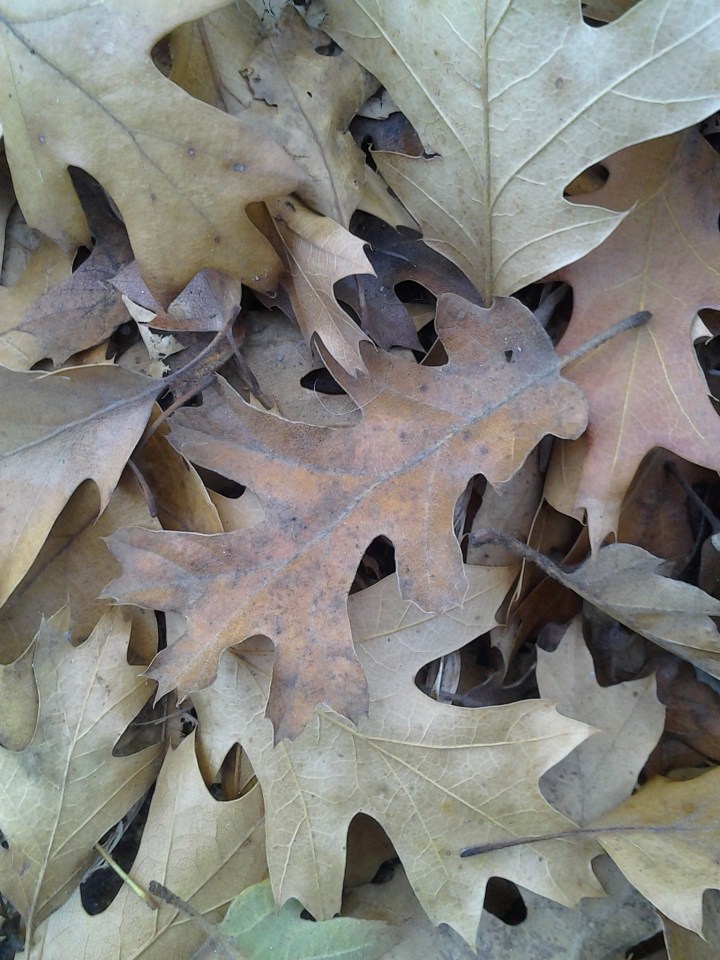
Finely textured leaves under low shrubbery and coarsely textured groundcover that ‘eats’ fallen leaves is a nice mulch, so does not need to be raked. If it can not be seen, and is not too abundant, it is probably not a problem. The exceptions are fallen leaves of roses, grapes, cane berries, deciduous fruit trees, and any plants that are susceptible to diseases that overwinter in fallen leaves.

Blue Ribbon

P71001Somewhere in the San Lorenzo Valley, there is a little old lady who is stitching a blue quilt. It is made of all the blue ribbons that she wins every year at the Jelly and Jam Contest of the Santa Cruz Mountains Harvest Festival. I do not know who she is, but I recognize her squiggly writing on the fancy labels. It is barely legible. Her hands are worn and tired from three quarters of a century off picking fruit, processing it into jelly and jam, and then stitching all her blue ribbons together. She probably giggles as she works, and thinks about everyone who wins only red or white ribbons.

Three years ago, I submitted my blue elderberry jelly and ‘Shiro’ white plum jam into the contest. They both won! Blue elderberry won second place. White plum won third. Two years ago, the blue elderberry jelly won second place again, although the white plum jam did not win anything.

Last year, I submitted the maximum of five jellies and jams. I was determined to get my blue ribbon! In conjunction to blue elderberry jelly and white plum jam, I also submitted peach jam, blackberry jelly and Santa Catalina Island cherry jelly. However, the Jelly and Jam Contest was not publicized like it should have been. Very few people were aware of it. Consequently, there was only ONE other entry! It was a sloppy and seedy strawberry and kiwi jam made from fruit that was not likely home grown. I knew I would finally win my blue ribbon, and probably red and white too! Technically, it was not cheating. It was just the way things worked out.

It was no surprise that the blackberry jelly won third place. It was a bit of surprise that the blue elderberry won second place, even though it had done so twice before. I was hoping that it would be the blue ribbon winner. That was not a problem. I was sure it won second place only because one of the other three had won first place. I stepped off the grandstand after claiming each of the two ribbons, but thought about just staying there for the third. I did the tactful thing and walked off stage.

Finally, the first place winner of the blue ribbon in the Jelly and Jam Contest was to be announced. I was halfway into my first step back to the grandstand when I heard “STRAWBERRY AND KIWI JAM”! What?! How was this possible? What was she putting in that jam?! The winner was not present to claim her ribbon, but she won nonetheless. I imagined her watching with a telescope from the window of her secret hideout in the mountains above town, and laughing maniacally.

Well, the Santa Cruz Mountains Harvest Festival was yesterday. For the Jelly and Jam Contest, I submitted only two entries; blue elderberry jelly and blackberry jelly. There were only four other entries; fig jam, peach jam, another blackberry jelly and the infamous strawberry and kiwi jam. I was pleased that my blackberry jelly won third place, and I still hoped for the blue elderberry jelly to win second or first. The peach jam won second. It was made by . . . WHO? MY MOTHER’S PEACH JAM WON SECOND PLACE?! This was intolerable! I ALWAYS win at least second place! What made it worse is that I lost to my MOTHER’S peach jam! Where did she learn how to make jam? . . . and from peaches from the tree that I grew? Before I could recover from this baffling revelation, the first place winner was announced; and it was again, the strawberry and kiwi jam.

Wow! I do not know what to think. I got to meet the lady who makes the strawberry and kiwi jam. She is not a little old lady who lives in a secret hideout. She is a pretty young lady, and she actually told me that she does not intend to compete next year, and told me that I should try her recipe. I thanked here but declined. I do not want to use store bought produce. Now the difficult part. I need to deliver the second place red ribbon to my mother who was not there to claim it.

Heat Lingers With Indian Summer

70920thumbIt is still too early to say if, or for how long, warm Indian Summer weather will linger into what should be autumn. This last spell of unseasonable heat (in California) was merely a heat wave. Of course, at the time, there was nothing ‘mere’ about it. It was downright hot! It was weirdly humid too. As uncomfortable as it was for us, the humidity made the unseasonable heat more tolerable for some plants.

Heat has a nasty habit of drying things out. Humidity does the opposite, although not quite as efficiently. Many plants might have been seriously desiccated if the weather had gotten so warm without the humidity. A cooling breeze might have made things more comfortable for us, but likewise would have been more uncomfortable for plants by enhancing the desiccating effect of heat.

So, again, we disagree with our plants. One thing we all agree on is that this last heat wave was unseasonable, and came at a time when summer should be on the downhill side toward autumn. Some evergreen plants are producing foliage designed for cooler weather. Worst of all, many of the gardening procedures that get done this time of year are in anticipation of cooling weather.

Not too long ago, pruning and shearing of hedges and other evergreens was an important topic. The objective was to get it done one last time before autumn. If done too late, new growth develops slowly through the cool winter weather, and is more susceptible to discoloration and frost damage. Now, the problem is that some of the fresh new foliage was scorched by the heat!

Also, fertilizer should have been applied one last time before autumn. Later application stimulates new growth so late in the season that it is sensitive to frost through winter. Just like pruning, the fertilizer stimulated new growth that might have been damaged by the heat. So, proper pruning and application of fertilizer to limit frost damage may have left plants more susceptible to scorch.

Just like with frost damage, scorched foliage should not necessarily be pruned away immediately. If not too unsightly, it might be best to leave it alone. Some evergreen plants will not replace it until next year anyway. Deciduous plants will shed it when convenient. Large leaves like those of philodendron and banana, may deteriorate so badly that pruning them away is the best option.

Timing Is Everything For Pruning

70906thumbThere are certain disadvantages to gardening in such a perfect climate. We can not grow things that require significant chilling in winter. Nor can we grow things that require prolonged heat in summer. Seasons change so gently that it is easy to get behind schedule. It is already late summer, whether it seems like it or not. What we do not do in the garden is as important as what we do.
Plants know what time it is. Almost all are slowing down significantly. Many natives do almost all of their growth in spring, and then spend the later half of summer just getting ready for autumn. By now, the buds of deciduous trees like sycamore, oak and willow are already getting plump, even though they will not do anything until the end of winter. Non native plants will not be too far behind.
Evergreen plants that get pruned or shorn a few times through summer might need to be pruned or shorn one last time. If not done now, it probably should not be done any later. They need a bit of time to recover and regenerate a little bit of new growth prior to autumn. Otherwise, the exposed inner growth will stay exposed, and get worn by the weather as summer progresses into autumn.
Some plants need a bit more time to for new growth to mature than others do. Privet hedges for example, are quite tough, and do not seem to mind getting shorn at any time. New growth of holly, pittosporum and photinia gets stunted and discolored if still trying to grow as the weather gets too cool for it to continue. With enough time, new growth starts, and then ‘hardens off’ before autumn.
Like pruning, fertilizer promotes new growth, so should likewise not be applied too late. One last application of fertilizer can improve the color of citrus foliage before winter. Greener lemon and lime foliage tends to be more resilient to frost. Iron is particularly helpful for foliage, and is less likely than complete fertilizers are to stimulate new growth that will be sensitive to frost later in winter.