Mild Summer

Weather has been somewhat atypical.

(This article is recycled from a few years ago.)

Now that it is half way through September, it is impossible to ignore that tomatoes did not have a good season. Most of us who grow tomatoes were embarrassed by their performance until we realized that everyone else who grows them was also experiencing similar disappointing results. It was not because we did not water them properly. Nor was it because they lacked particular nutrients. They simply wanted warmer weather.

Plants that were put out early before the warm weather last spring did much better at first, but then decelerated as the weather became milder instead of warmer. Cool nights certainly did not help. Mildew, which typically slows a bit as weather becomes drier (less humid) though summer, instead continued to proliferate so that new foliage became infected almost as soon as it developed.

Earlier predictions that the weather would eventually get warm were not accurate enough for many of us who are only now getting enough tomatoes for fresh use, but not an abundance for canning, drying or freezing. There is still some time for most of the tomatoes that are on the vines now to ripen; but many will probably remain green by autumn. Some but not all of the last green tomatoes can ripen off the vine. Perhaps the only good news about all this is that there should be plenty of green tomatoes for pickling.

Sadly, tomatoes were not the only warm season vegetables to be dissatisfied with the weather. Green bean vines and bushes were generally healthy and made good beans, but did not produce very abundantly. Corn was likewise of adequate quality, but on smaller ears and less abundant. Even zucchini, which typically produces too much, was a bit subdued. Marginal vegetables that really prefer warmth, like eggplant and bell pepper, were downright disappointing.

Even if the weather gets warmer in the last days of summer, languishing tomato plants can not ketchup on production. They can be left to make a few more tomatoes, but will eventually need to get out of the way of cool season vegetables. Cabbage, kale, turnip greens, beets, radishes and all the slower growing vegetables that take their time through autumn, winter and early spring will want their space back soon. They will hopefully have a better season.

If possible, cabbage, broccoli, cauliflower and some of the larger cool season vegetable plants can be plugged in amongst the finishing warm season vegetable plants. Then, by the time the finishing warm season vegetable plants need to be removed, the next phase of cool season vegetable plants is already somewhat rooted and has a head start. This process works well in small spaces with good quality soil.

The main problem with this procedure is that it prevents potentially depleted soil from getting amended and well mixed between planting. It can also be a bit awkward to get the spacing of rows, furrows or mounds of the next phase of vegetable plants to match up with the previous phase. Smaller vegetable plants that get sown directly from seed into rows, like turnip greens, carrots, beets and radishes, really prefer customized bed preparation, after the warm season vegetables have been removed.

Not All Pruning Happens In Winter

If necessary, Oregon grape can be pruned to the ground now.

Spring has sprung; and winter has wenter . . . or whatever winter does to get out of the way of spring. Plants are more active now than at any other time of year. Deciduous plants that were dormant and bare through winter have already started to bloom and produce new foliage. Evergreen plants are now making new foliage to replace their tired old foliage that lingered through cold, wet and windy winter weather. 

Frost is very unlikely this late. It is safe to sow seeds for all sorts of warm season vegetables and annual flowers, like beans, okra, zucchini, nasturtiums and sunflowers. It is likewise time to plant small plants for certain vegetables and flowers that are too slow to start from seed, like tomatoes, peppers, eggplants, petunias and impatiens.

Winter was the time to prune almost all deciduous plants (which defoliate) and many evergreen plants while they were dormant. However, pruning of plants that are susceptible to frost damage needed to be delayed until about now, even if they had been damaged earlier. Premature pruning would have stimulated new growth, which would have been even more sensitive to subsequent frost.

Any lavender starflower, bougainvillea, marguerite daisy or blue potato bush foliage that was damaged by earlier frost can now be pruned away. New foliage should already be appearing. Also, any mushy frost damaged leaves of giant-bird-of-Paradise and banana can be removed, and should be replaced by new foliage as the weather gets warmer.

The end of winter and beginning of spring is also the best time for any necessary severe restorative pruning of plants that can be damaged by frost, as well as many heartier evergreen plants. It is late enough to avoid frost, while early enough to take advantage of the first new growth phase of the season.

For example, lavender starflower that is both overgrown and damaged by frost can be pruned back to the main stems now, instead of merely shorn to remove damaged foliage. If pruned earlier, it would have not only been more sensitive to frost, but would have remained unsightly as long as weather remained too cool for it to regenerate new foliage.

It likewise can not be pruned much later without wasting most of the new spring growth that is presently developing, which would be very stressful and delay bloom. Pruning severely now will be unsightly for the least amount of time before new growth regenerates and blooms. It would also be less stressful, since it coincides with natural dormancy and regenerative cycles.

Privets, junipers, oleanders, photinias, bottlebrush and pittosporums that need restoration should also get it now, not because they are sensitive to frost, but so that they recover as efficiently as possible as weather gets warmer. Besides, bottlebrush, pittosporum and some other plants are susceptible to disease if pruned during winter, because pruning wounds are easily infected during rainy weather.

Six on Saturday: Fake Autumn

Daylight does not last quite as long as it had earlier in summer. Shadows stay noticeably longer. Summer actually ended about two weeks ago. For now it is early Indian summer.

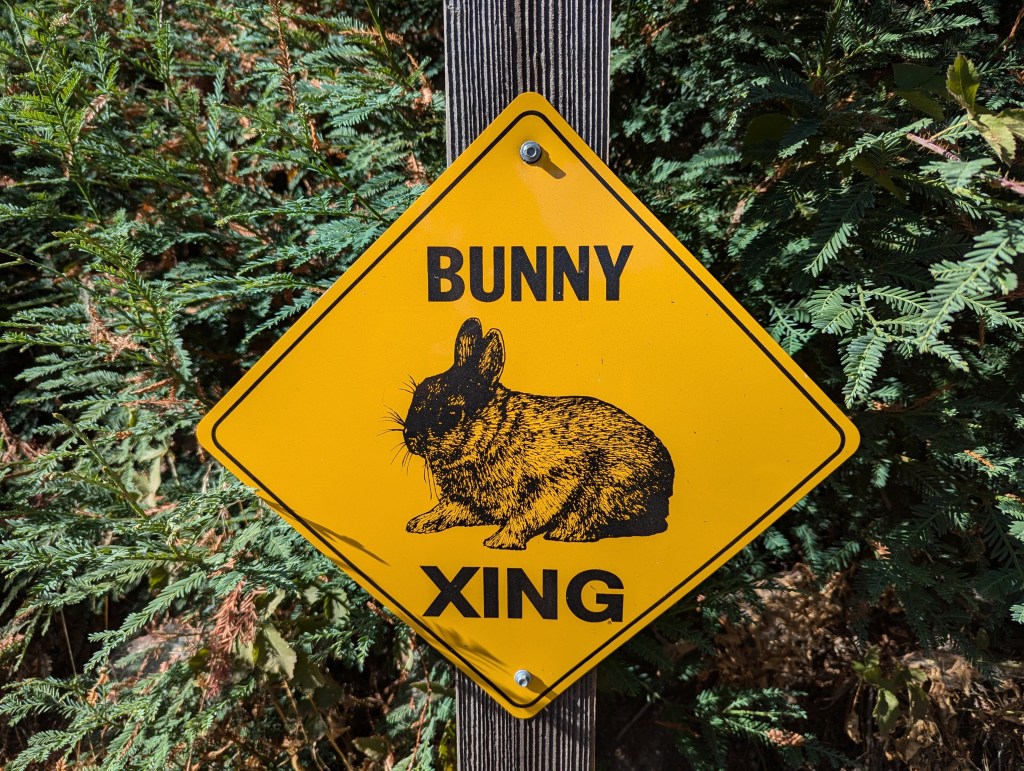
1. “Bunny Xing” is as irrelevant to autumn as it is to Charing Cross Road in Los Angeles. I just found it to be amusingly odd that a neighbor seems to be protective of wildlife that can be so detrimental to some gardens here. Bunnies fortunately do not bother us much.

2. Juglans nigra, Eastern black walnut or Juglans nigra X hindsii, royal walnut, yellows early, more likely because it is tired of summer heat than because it anticipates autumn. Both walnut tree types naturalized from understock that sustained old walnut orchards.

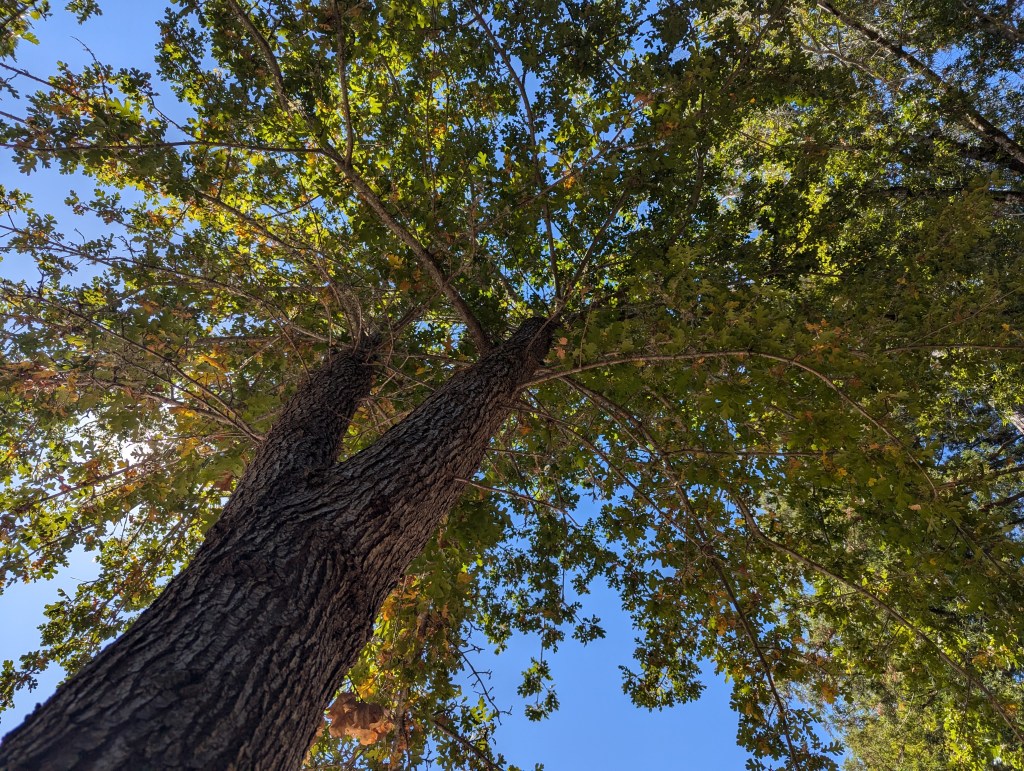
3. Quercus lobata, valley oak typically but not always begins to brown after walnut trees yellow. This yellowish color is likely a result of the weather cooling a bit before warming again. This species is native nearby, but may have naturalized here after getting planted.

4. Acer rubrum, red maple is likely only coloring because it is distressed by confinement of its roots within its big clay pot. Recent and suddenly warmer weather after seasonably cooler weather may have accelerated the process. I really want these trees in the ground!

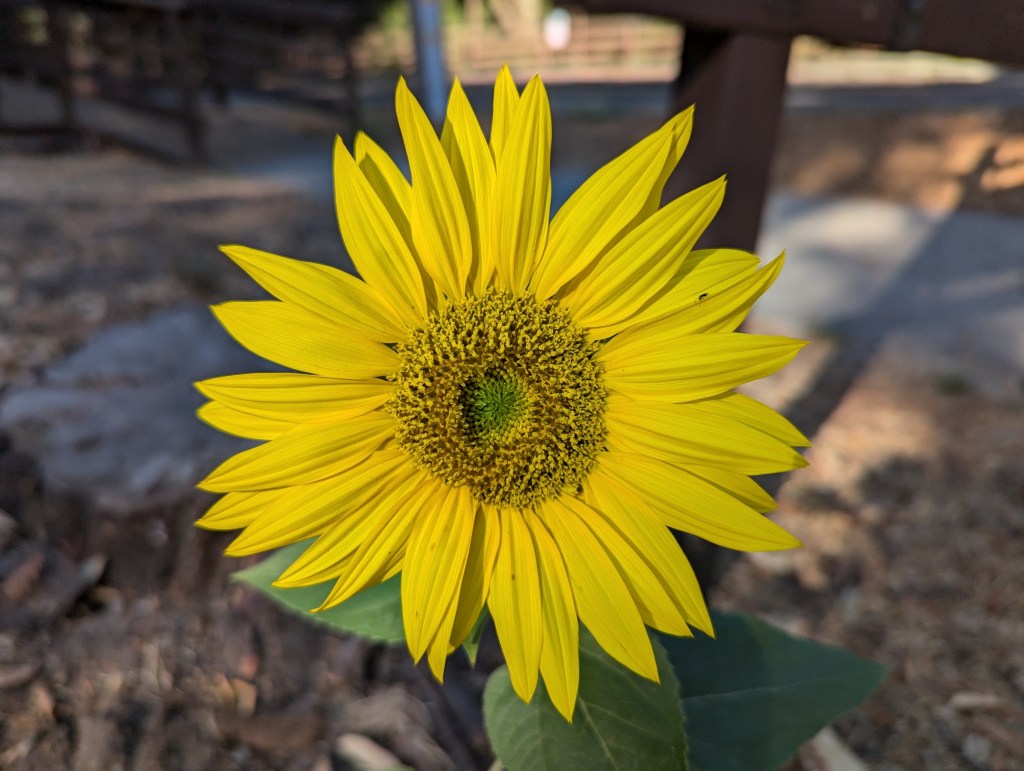
5. Helianthus annuus, sunflower mysteriously appeared precisely where we should have but neglected to grow sunflowers this year. This is the only one, but it is enough to show us what we are missing because of our lack of diligence. It is only a bit early for autumn.

6. Rhody is ready for autumn. More specifically, he is ready for cooler weather. Although it was scarcely more than ninety degrees yesterday, and only for a few hours after noon, it seemed to be unseasonably warm, after earlier weather was already beginning to cool.

This is the link for Six on Saturday, for anyone else who would like to participate: https://thepropagatorblog.wordpress.com/2017/09/18/six-on-saturday-a-participant-guide/

Late Summer Heat Confuses Some Vegetation

(This article is recycled from several years ago, so some of its information is irrelevant to current conditions. Also, it posted more than half a day late.)

Weather should but does not always get cooler at this time of year.

After the coolest July in a century, and one of the mildest summers in memory, the recent warm weather at the end of August seemed unseasonable, even though it is actually not unusual for this time of year. Predictions of an Indian summer for this year were made shortly after predictions for this past El Nino winter materialized. The ash blasted into the atmosphere by a volcano in Iceland may have changed all that. No one really knows. The weather continues to change like the weather.

For right now though, the damage caused by the sudden warmth is becoming evident. Fortunately, most of the damage is harmless and should be gone by winter. Some is a bit unsightly. The desiccation of small or potted plants may unfortunately be as serious as it looks. The most severely damaged plants may not recover.

The yellowing inner foliage that eventually turns reddish brown in redwood trees is actually a normal response to foliar desiccation that results from warm or dry weather. As long as the outer foliage remains healthy, this discoloration is harmless. Inner foliage that is more expendable is merely being shed to conserve moisture for the more important outer foliage. This shedding foliage will deteriorate and get cleaned out by wind and rain in autumn.

This older foliage typically sheds naturally throughout summer. However, because the summer was so mild, much of the foliage that should have been shed was not shed. As the weather only recently but suddenly became warm, all the foliage that should have been shed earlier became discolored and began to shed at the same time, which is why it is now so much more noticeable.

A few other trees are also shedding some of their foliage. Trees in areas that are not landscaped or watered may drop dried leaves in even slight breezes. Leaves of deciduous trees that would be colorful and pliable if they fell on schedule in autumn are instead crispy and brown. Maple, oak, ash, sycamore (including plane), willow, poplar, eucalyptus and madrone are among the most affected. Fortunately, this is a harmless response to the warm weather after such a mild summer.

Some Japanese maples are damaged more significantly, but should recover. Because they are naturally understory trees (which prefer to grow in the partial shade and ambient humidity of larger trees), they are not well adapted to warm and dry weather, particularly if it becomes warm as suddenly as it recently did. Some got roasted so quickly that the foliage stays attached to the stems as it shrivels and dries. Foliage that is still partially viable (and hopefully functional) should fall in autumn and winter. Foliage that is necrotic (dead) may linger until it is forced to fall by new foliage that emerges next spring.

Potted plants that were desiccated by the heat may not be so fortunate. Even though they can be unsightly, roasted plants that may be rooted into the ground through their drainage holes should not be moved right away, since the roots that are in the ground are the least damaged and the best hope for recovery. Similarly, roasted plants that hang over the edges of their pots should not be pruned back too severely until later, since exposing the pots to more sunlight will cause more heat to be absorbed if the weather gets warm again.

Summer Warmth Continues Into Autumn

Dog days of summer are over.

The locally mild climate might be rather boring. Winter weather is not very cold. Summer weather is only sometimes very hot. Then, warmth does not often last for very long. Such climate might seem to be deficient in seasons. Summer seems to be the primary season, with just a few cool weeks of winter. Spring and autumn seem to be only brief transitions.

According to the position of Sirius, the Dog Star, the dog days of summer are done. They are the hottest days of the year for several climates of the Northern Hemisphere. The last was the eleventh of August. The final day of summer is the twenty-second of September. Such dates are less relevant here than elsewhere, though. Warm weather may continue.

Indian summer is more typical here than not. In some other climates, it is unusually warm and dry weather that continues into autumn. In this particular climate, it is not so unusual. Another difference is that it does not occur after earlier frost, as it might elsewhere. Some climates here lack frost anyway. Locally, warm weather is more lingering than fluctuating.

Some vegetation knows how to exploit such weather. Indeterminate tomato varieties can continue to be productive until a first frost. If they started soon after a last frost, they could get sloppy with rampant growth. That should not be a problem if production is the priority. With phasing as late as August, determinate tomato varieties can also produce until frost.

Most popular canna cultivars are hybrids of tropical and montane species. Because they are tropical, they are not accustomed to distinctly cool winter seasons. Because they are montane, they survive mild frost. Therefore, they grow until frost, and then resume growth as soon as they can afterward. Dahlia is similar, but maintains dormancy through winter.

Photoperiod also influences growth. Days gradually shorten through summer regardless of the duration of warmth. Some species are more responsive to this than others. Later in summer, crape myrtle can slowly begin to develop autumn foliar color. It does not require much chill to become strikingly colorful for autumn. It can do so while cannas still bloom and tomato plants still produce fruit.

Planting Should Not Be Complicated

Soil amendment should not be excessive.

Autumn and winter are generally the best seasons for planting. Most vegetation is either less active than during other seasons, or dormant. It is therefore more complaisant to the distress of planting procedures. Weather is cooler and wetter than during other seasons. It is therefore less stressful to vulnerable vegetation recovering from planting procedures.

Nonetheless, planting continues throughout the year. Seasonal vegetables and annuals are seasonal at various times. Planting after any lingering chill or potential frost of winter is safer for several species. Also, planting commonly happens whenever it is convenient for whomever does it. Many species are most tempting whenever they happen to bloom.

Generally, this is no problem. Planting while vegetation is active during warm weather is riskier but feasible. It should preferably happen after the warmest time of day. Weather is likely cooler after three in the afternoon. Unusually hot weather justifies delay for another day. Once planted, thorough soaking settles comforting wet soil around vulnerable roots.

Realistically, most planting techniques and concerns are the same regardless of season. The processes only have more potential to be more stressful now than during dormancy. A few species are actually dormant during summer or even spring. Several spring bulbs, such as narcissi, are now ready for division or relocation. Bearded iris rhizomes are also.

Soil amendment helps new plants to feel more comfortable within their new situations. It encourages them to extend roots from their original media into surrounding soil. It should not be excessive though. Contrary to overly popular belief, it is unnecessary below roots. New plants can sink detrimentally below grade if amendment or loose soil below settles.

Stakes for trees that need them must extend past roots and into solid soil below. Binding nursery stakes should be loosened or removed if possible. Binding, which initially keeps trunks straight, can later interfere with trunk development. All new plants need systematic watering through dry seasons until they disperse roots. Most appreciate a layer of mulch, to retain moisture and insulate.

Out of Tune Trumpet

Brugmansia X cubensis ‘Charles Grimaldi’

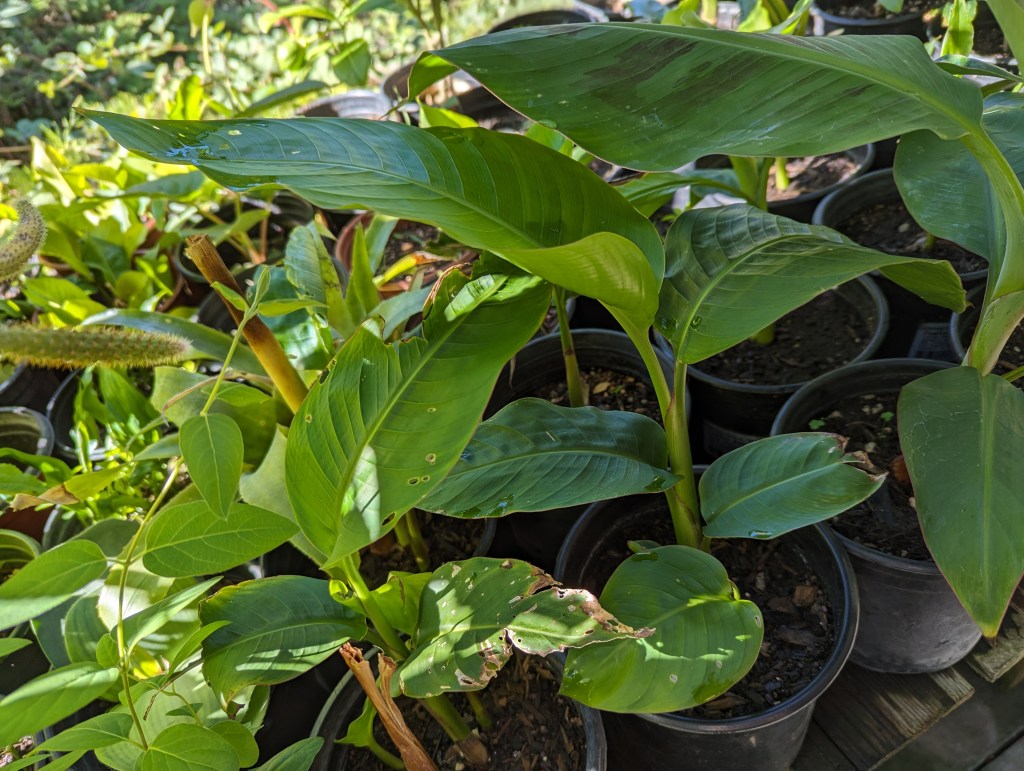
Summer was mild. Vegetation that enjoys warmth grew relatively slowly through much of it. Then, toward late summer, and without increased warmth, some vegetation seemed to accelerate growth unexpectedly. Banana and heliconia pups grew like they should have earlier in summer. Angel’s trumpet cuttings began to get somewhat weedy. Some that did not bloom earlier began to bloom now!

Brugmansia X cubensis ‘Charles Grimaldi’ is likely the most popular angel’s trumpet. It is the most vigorous, and may be the most fragrant. One cutting that survived the unusually cool frost last winter grew from its roots to more than six feet tall since then. Now that it is time for it to decelerate growth, it is blooming! Such performance is impressive, but not in tune with the seasons. It can not continue for long, before disruption by increasingly cool autumn weather. Unusually vigorous growth that continues to bloom unusually late could be unusually vulnerable to frost next winter.

This is not the only angel’s trumpet that is out of tune with its seasons. A similarly mature specimen of an unidentified cultivar with single white flowers is about to bloom also. Two older specimens of other unidentified cultivars are growing about as vigorously, although without bloom. One blooms with double white flowers. The other blooms with single pale orange flowers.

About nine copies of each of both cultivars that bloom with white flowers are growing like weeds in #1 cans, with more than a dozen more small cuttings of the cultivar that blooms with double flowers in cells. Only the original matured specimen that blooms with double white flowers actually inhabits a landscape, and is incidentally about to bloom, but is not here with these in the nursery. More will go to landscapes after winter, where their bloom can be enjoyed.

Firewood Season Begins Before Fireplace Season

Despite the pleasant warm weather, it will be autumn soon. This is the time to get ready for cooler weather through autumn and winter. The plants in the garden do that on their own without our help. They somehow seem to know what time it is. We only need to clean up the mess and empty the gutters when deciduous trees start to drop their leaves later. Most of our work involves features that are not plants.

Winters are so mild here that some of our work often gets delayed until it becomes necessary. If needed, we can paint, stain and seal decks, fences, patios and anything else outside anytime the weather allows right through winter. Many of us leave patio furniture outside all year both because the weather is not too harsh on it, and because patios are usable spaces even through winter.

Firewood is also commonly neglected or not even needed, but for different reasons. Many fireplaces were damaged or destroyed by the Loma Prieta Earthquake decades ago, and never repaired or replaced. Modern building codes outlawed the construction of new fireplaces even prior to that; so newer fireplaces are instead pellet stoves. Those of us who still use old fireplaces and stoves have more difficulty obtaining wood now that the orchards are gone and the outskirts of town are so much farther from home.

The advantage of pellet stoves is that fuel (which looks like stove food) is always available so does not need to be accumulated, stored and seasoned. The fuel also burns cleaner. Synthetic logs (made from compressed wood byproducts and fuel) are an expensive alternative for conventional fireplaces and stoves, but also burn cleaner than wood, and are always available. They are lightweight and clean, so can be picked up at the store and brought home in the trunk of a small car whenever a fire is wanted in the fireplace.

Good old fashioned firewood is both more work and stigmatized because of pollution. Those of us who do not have firewood available within our own gardens can purchase it from some tree service companies. It is most commonly obtained already split and seasoned directly from the wood yard where the tree service company stores it. It can be delivered for a price. Some people even like to pay a bit extra to get it  stacked.

Firewood obtained in this manner is typically a mix of random woods from trees found in local landscapes. There is often a preponderance of a particular type of wood. No one ever knows what to expect. The specific type of wood is designated only when a large tree or group of trees needs to be removed, and can be isolated from mixed wood.
Palms and yuccas, known as ‘herbaceous trees’, do not produce effective firewood! A few pieces in a load of firewood should not hurt anything, but palm or yucca ‘wood’ should not be purchased. Mixed wood often contains some resinous wood and eucalyptus, which burns just fine, but produces a bit more soot that needs to be cleaned from chimneys.

Firewood should be obtained annually in quantities that are likely to be used each winter. It is perishable, and can rot if stored several years outside. Even if it does not rot, it can become infested with rodents if it stays idle too long. Besides, excessive firewood simply takes up space that could be used for something else.

Late Summer

Such weather is early this year.

The change of seasons can be boring here. It might seem as if this climate experiences only two seasons. Summer is the primary season, which seems to extend through most of the year, with what seems to be merely a few days of another brief secondary season which is not summer. Perhaps this brief secondary season is autumn, winter and spring, but that is too many letters and big words for such a small season.

That is how those who are familiar with more distinct seasons might perceive seasons of this innately mild climate. Those of us who are familiar with this climate perceive it quite differently. We are aware of the four seasons, regardless of how mundane the transitions between them seem to be. In fact, some might contend that, if autumn seems to be minimal here, it is merely because this climate experiences a fifth season between summer and autumn, which is known as Indian summer.

Indian summer is an extension of summery weather into autumn, and sometimes occurs after summer seems to have begun to succumb to autumn. It does not happen annually, and does not seem to be happening this year, but certainly could. It is sneaky that way.

For now though, autumn seems to be sneaking into the last two weeks of summer, much like Indian summer sometimes sneaks into autumn. Nights have been interestingly cool. Low clouds have been lingering a bit longer after sunrise than they typically do.

However, vegetation that enjoys warmth does not seem to be decelerating for cooler weather. Perhaps such vegetation knows more than the rest of us do about what to expect. Perhaps it is merely more responsive to photoperiod than weather. Regardless, I get the impression that this is how late summer typically is within other climates.

Six on Saturday: Frosty Forecast

Frost is not a problem here. The several species here that are not resilient to frost are the problem. The first of my Six actually has no problem with frost, but does have a problem with starting too late to finish prior to frost next winter. The second also has no problem with frost, but does not want to bloom as weather cools into autumn. The other four are from a frostless region of Los Angeles. I neglected to protect them from the earliest frost last winter because I did not expect it. Their recovery was slow through mild spring and summer weather. They are now growing vigorously rather than decelerating for autumn. This increases their vulnerability to frost next winter.

1. Dahlia X pinnata, mixed dinnerplate dahlias are starting to grow, with only a third of their season left. I described the delay last week. Only three of two dozen survived so far.

2. Gardenia jasminoides, gardenia seems to be healthy, and generated a typical number of floral buds, but is now shedding such floral buds, likely in response to cooling nights.

3. Solandra maxima, cup of gold vine was new here when it got frosted last winter, then grew slowly through atypically cool weather last spring, and is now growing like a weed!

4. Platycerium bifurcatum, staghorn fern also waited a bit too long to start growing like this. It could eventually enjoy rain and humidity through winter, but not even mild frost.

5. Heliconia psittacorum, parakeet flower has done well since last winter. I brought nine rhizomes from Los Angeles. They are still a bit too small to survive average frost though.

6. Dichorisandra thyrsiflora, blue ginger is likely even more vulnerable to frost. Most of its cuttings did not survive last winter. I am impressed and pleased with the six that did.

This is the link for Six on Saturday, for anyone else who would like to participate: https://thepropagatorblog.wordpress.com/2017/09/18/six-on-saturday-a-participant-guide/