Which Mesquite?

Is this velvet mesquite, Prosopis velutina, or honey mesquite, Prosopis glandulosa? It is still too young to identify. I suspect that it is velvet mesquite because I found its seed in a landscape in Surprise, Arizona, and velvet mesquite is the most common species within landscapes there. Also, the foliage of the trees that provided the seed resembled that of velvet mesquite more than that of honey mesquite, with relatively smaller leaflets. The bark was medium brown, so was not quite as dark brown as I would expect for velvet mesquite, but more brown than tan, as I would expect for honey mesquite. This little seedling may not look like much now, but it is the only survivor of the many seed that I collected. Only a few germinated, and slugs ate them before they extended their first leave beyond their cotyledons. This seedling germinated last, and was promptly canned in a four inch pot that I brought inside at night for protection. I hope that, before the end of summer, it grows large enough to survive winter. It should. Regardless of its identity, I hope to eventually use its stems for smoking and, if it grows large enough, barbecuing.
Timeout

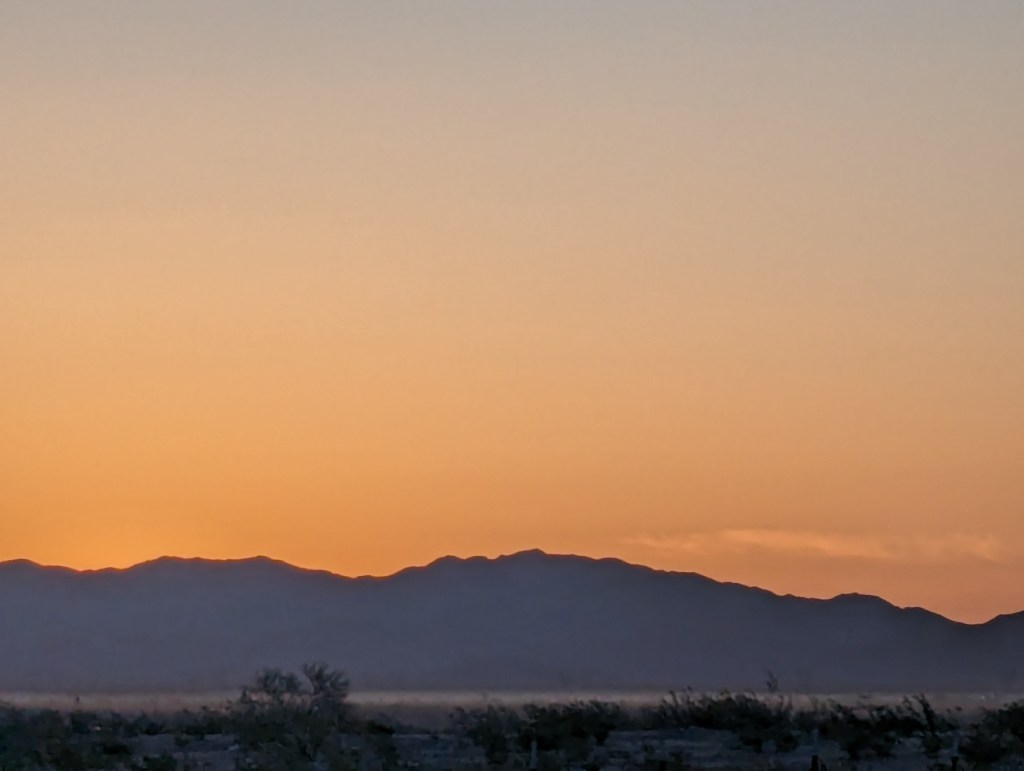
A moment before sunrise over Phoenix.

Apologies for my absence.

Perhaps no one noticed. Most of my posts were automated prior to my departure, and I managed to compose a few brief articles for what was not automated; so ultimately, there was no lapse of posting. I may have only been negligent with response to comments for the last two weeks.

Realistically though, I have been intending to discontinue blogging and recycling old articles, and to post only my weekly gardening column, in two parts, on Mondays and Tuesdays. I merely have not done so yet.

Anyway, my trip, although very different from how it was planned, was totally excellent! Just a short distance from the turnoff for the southbound San Diego Freeway towards my primary destination in Los Angeles, I was diverted to my secondary destination northwest of Phoenix. I missed the desert scenery as I drove all night to arrive shortly before four in the morning, and began my vacation exhausted. Although I missed out on some of my plans in Los Angeles, I got more time in Arizona. The weather was weirdly excellent, with a weirdly torrential thunderstorm right in the middle of it. It was too early in the year to collect the seed that I wanted, but I really was not expecting to find any anyway. I did happen to procure a hedgehog cactus of some sort. I decided that, since my return was already delayed by a day, that I may as well delay it for two days. (I had brought some of my work with me, so was able to tend to it prior to my return rather than after.) Therefore, I came to my original primary destination in Los Angeles secondarily, stayed to help Brent with the View Park Garden Tour on Sunday, and returned home on Monday.

Seed Collection For Another Season

Less hybridized canna produce more seed.

Deadheading conserves resources that would otherwise sustain production of seed. For species that bloom more than once, it promotes continued bloom. For others, it promotes healthier vegetative growth. Also, it inhibits proliferation of potentially invasive seed. It is neater anyway. However, several species might forego deadheading for seed collection.

Flowers that bloom only once for a brief season generate all their seed at the same time. Flowers that bloom for an extensive season generate seed for a more extensive season. Some seed is obtainable from ripe fruit. Some is obtainable from unharvested vegetable plants that go to seed. Seed collection involves various sources during various seasons.

Regardless of its season and source, most seed is too abundant for complete collection. A single fruiting vegetable, such as a true to type chile, provides more than enough seed. A few stalks of naked lady might provide more seed than one garden can accommodate. Wildflowers are an exception. Their seed collection is rarely too excessive to broadcast.

Many species do not reliably generate viable seed though. Some require pollination by a very specific pollinator that does not live here. Yuccas that are from Central America rely on moths that live only in Central America. Some bamboos generate seed only once in a century or so. Most hybrids are too genetically dysfunctional to produce any viable seed.

Hybrids that can generate viable seed are very unlikely true to type. In other words, their progeny will be very different from them. Such progeny tend to revert to a simpler or more primitive form. The same applies to progeny of cultivars of extensive breeding within one species. Genetic aberration, such as variegation, is likewise unlikely inheritable by seed.

To complicate seed collection, some species begin life with juvenile growth. Some might take several years to mature. Avocado seedlings initially grow very fast, and tall, without blooming. By the time they mature, bloom and produce fruit, such fruit can be too high to harvest. Trees from nurseries are fruitful lower only because of grafting with adult growth.