Four O’Clock

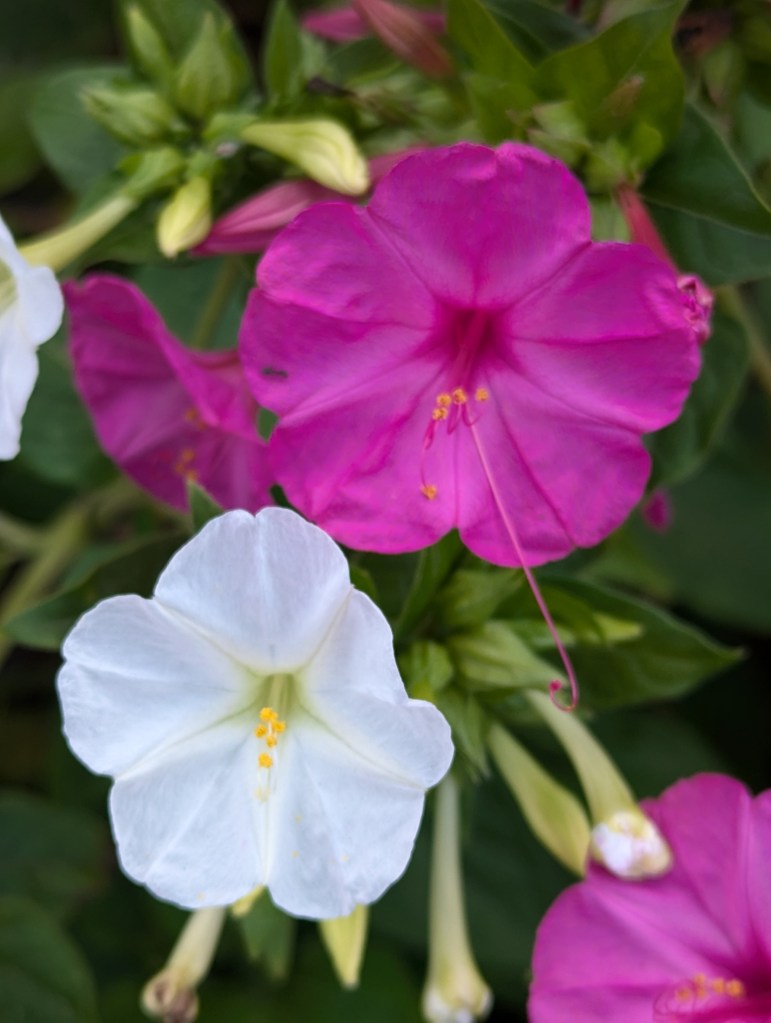
Two colors on one four o’clock.

Punctuality is not one of its primary attributes. Four o’clock, Mirabilis jalapa, is supposed to unfurl its flowers about four o’clock. It is more likely to do so a bit later here because of aridity. Flowers can remain open and mildly fragrant all night, but might close after about noon. Four o’clock grows vigorously with summer warmth, but also appreciates humidity.

Floral color ranges through various hues of pink, red, orange, yellow and white. Flowers commonly exhibit stripes, spots or patches of other color within this range. Flowers with completely different colors can bloom on the same stems. Simple bright pink flowers are typically the most fragrant. Other colors and mixed colors may lack fragrance completely.

Most four o’clock grow in their gardens without invitation. They sneak in as seed, but are too pretty to be weeds. They grow tuberous roots to overwinter as their foliage and stems later succumb to chill. Stems do not stand much more than three feet tall, but may sprawl twice as wide. Below their lush foliage, these lanky stems are vulnerable to disturbance and wind.

4:00

Mirabilis jalapa is known more commonly as four o’clock. It is spelled with letters rather than as 4:00 with numbers. This refers to the time in the afternoon when its bloom should be at its best. These pictures were taken prior to nine in the morning though. Apparently, it does not adhere to a strict schedule. I took these pictures because I was so impressed with the performance of these particular specimens. Those with yellow bloom above are so large that I came from across the road to confirm their identity. I do not expect this species to grow so large. They are about as big as small oleander! Those with white and pink bloom below are actually the same plant. The species commonly blooms with flowers of different colors, but such colors are typically not so divergent as clear bright pink and clear white. They are more typically blotched with colors of each other, such as white flowers with a few pink blotches in conjunction with pink flowers with a few white blotches. This species is somewhat naturalized here, but politely so. Although it generates copious seed, it is not migrating very far from where it is established.

Weed Abatement Beyond Refined Gardens

Dry weeds can be very combustible.

Gardening involves weeds. Gardening outside of refined gardens involves more weeds. A few of such weeds are native species which grow where they are undesirable. Most of the most aggressive are naturalized exotic species. Collectively, they are an unpleasant consequence of unmanageable external biodiversity. They necessitate weed abatement.

Weed abatement is a standard procedure within refined gardens. Most know it simply as weeding. Ideally, it is harmless to desirable vegetation. It may be a relatively simple task where desirable vegetation excludes weeds. Also, weeds are less abundant where they lack sources of seed to regenerate. Timely weeding should eliminate much of their seed.

Unfortunately, no garden is isolated from external influences. Weed seed sneaks in from uncultivated spaces, adjacent gardens or beyond. Suburban and rural gardens might be close to wildlands or forests. Many of such weed seed sources are beyond the control of their victims. Some are merely easy to ignore because they are out of view or not in use.

For some unused or unseen areas, weed whacking can be more practical than weeding. It entails cutting undesirable vegetation almost to grade with a motorized weed whacker. Manual weed whackers, although rare, are not extinct. Weed whackers are not selective. They can sever desirable annuals or perennials that mingle with undesirable vegetation.

The primary advantage of weed whacking is that it is fast and efficient. With good timing, it eliminates bloom or developing seed prior to dispersion of seed. Diminishment of seed inhibits subsequent proliferation, and is much safer for pets. Foxtail seed are notoriously hazardous. Besides, overgrown weed vegetation becomes a fire hazard as it desiccates.

Viable basal stems and roots that remain after weed whacking are not much of an asset. Many types of perennial and biennial weeds regenerate from such growth. However, to a very minor degree, such vegetation may contribute to healthy biodiversity. It may sustain some beneficial insects and soil microorganisms. Also, it can inhibit surface soil erosion.

Layering Can Copy Favored Flora

Ivy can grow roots almost anywhere.

Seed is the most familiar method of propagation. However, some popular plants produce no viable seed. Some produce seed that is genetically very different from its parents. For many plant varieties, only vegetative propagation reliably produces similar copies. Such copies can grow from division, cuttings or layering. They are genetically identical clones.

Layering is uncommon for nurseries because it is generally insufficiently productive. It is unpopular for home gardening because it seems complicated. It is actually more reliable for many species than cuttings are. Also, layering is quite practical if merely a few copies are sufficient for home gardening. Realistically, it is not as complicated as it seems to be.

Layering is simply the development of roots where stems lay on the soil. All sorts of flora does it naturally without intervention. For example, ivy vines notoriously develop roots as they extend over the ground. Tips of raspberry canes develop roots where they leap over to reach the ground. These rooted tips grow replacement canes that repeat this process.

With a bit of intervention, several species that do not commonly layer can do so also. For some, it can be as simple as pressing a lower stem into moist soil. Application of rooting hormone to exposed cambium accelerates layering for most. Gouging into the underside of the buried portion of stem exposes its cambium. Tip growth must remain above grade.

For most species, the buried portions of layering stems should be a few inches in length. Extra stem length is no problem. Actually, if stems are long enough, they can be situated into their permanent locations. Stems can layer right below grade, but they prefer to be a few inches deeper. While their roots develop, they require irrigation for evenly moist soil.

The few inches of foliated tip growth above grade sustains actively layering stems. Also, remaining intact cambium provides sustenance from the original plant. Only a few stems can layer simultaneously, but that is enough for most gardens. Hydrangeas, azaleas and camellias layer quite easily. Pines, oaks and eucalyptus do not. Layers should develop quite a few roots before separation.

Nasturtium

Feral nasturtium is yellow or orange.

Most consider nasturtium, Tropaeolum majus, to be a warm season annual. Some might consider it to be a cool season annual. A few press its tender stems into moist soil to root and continue growth as a perennial. Plants that bloom for summer can disperse seed for winter bloom. Plants that bloom for winter can likewise disperse seed for summer bloom.

Because they replace themselves so readily, they may seem to be perennial. In actuality, plants from one season, whether warm or cool, may not last long in the next. Seed might be sneaky about spreading. Trailing nasturtiums might naturalize in riparian ecosystems. Nasturtium seedlings are available in cell packs, but do not grow as vigorously as seed.

Nasturtium bloom is diverse shades and tints of yellow, orange and red. Varieties bloom with particular colors within that range, although few are true to type. Their feral progeny bloom only bright orange and bright yellow. Their tender growth does not get much more than one or two feet deep. Trailing varieties can climb as high as first floor eaves though. Nasturtium leaves are almost circular like those of water lilies.

Feral Vegetation Inherits Natural Advantages

Feral alyssum is limited to white.

Most vegetation within home gardens is better than it was naturally in the wild. For many, systematic selection isolated the best from average populations. Selective breeding and hybridization improved many others. Some are too genetically compromised by breeding to produce viable seed. Feral progeny of those that are not demonstrate the divergences.

Such feral progeny are generally not true to type. They are, to varying degrees, more like their ancestors than their direct parents. Some can revert directly to a natural state in the first generation. Some do so slower through a few generations. Feral progeny of hybrids are still hybrids but may be more primitive. Many hybrids produce no viable seed though.

‘Jewel Mix’ nasturtium, for example, blooms with many shades of yellow, orange and red. Several are pastels. Some are dark enough to be almost brown. A few are bicolors. Their progeny though, blooms with less light, dark and red colors. Bloom becomes exclusively bright yellow and orange as feral plants replace originals. It reverts to more natural color.

That is because nature is efficient. By human standards, innately unnatural breeding and selection improve plant life. They produce better fruits, vegetables, flowers and anything that grows on plants. However, they interfere with natural function such as reproduction. Seedless limes, which are preferable within home gardens, would go extinct in the wild.

Plants that revert to more natural feral states are merely trying to survive. Sterile pampas grass is only sterile because it is exclusively female. Naturalized Andean pampas grass can pollinate it from a distance, though. Their hybrid but nonsterile feral progeny may be as invasive as their Andean parent. They are detrimental to their ecosystem, but survive.

Not all feral flora grows from seed. Seedless and thornless honeylocust are grafted onto wild honeylocust understock. Seedy and thorny suckers can grow from such understock below its grafts. They commonly develop after removal of original grafted trees. By some standards, they become aggressively invasive. By other standards, they are sustainable.

Six on Saturday: &

Odds & ends. Bits & pieces. Rhythm & blues. That is all I got here. The latter might make sense with #4 below. It makes this no easier for me though. I have difficulty writing with characters such as “&”, and even “#”, although I do use “#” when necessary to describe a caption number or can size as for #6 below. Perhaps I should challenge my comfort zone a bit more, as I did when I tried using contractions a few months ago. Although I did not continue using them afterward, it was not nearly as awkward as I thought it would be. At least I now realize that I could do so if I choose to. I simply choose to not do so. In other simpler words, I could, but I don’t.

1. Carson, Rhody’s Roady, posed for this thumbnail illustration for a recent article about how similar binomial botanical nomenclature is to traditional automotive nomenclature.

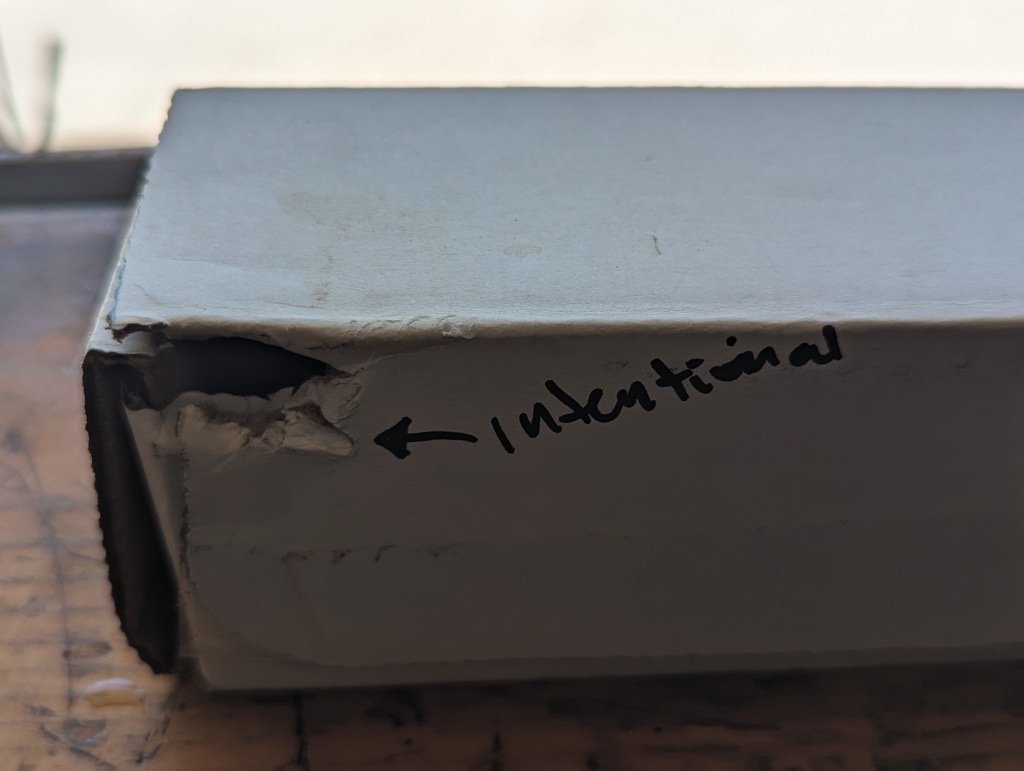
2. Purchases are almost against the rules in my garden. They can only involve items that I lack access to. This purchase that was delivered by mail apparently needed ventilation.

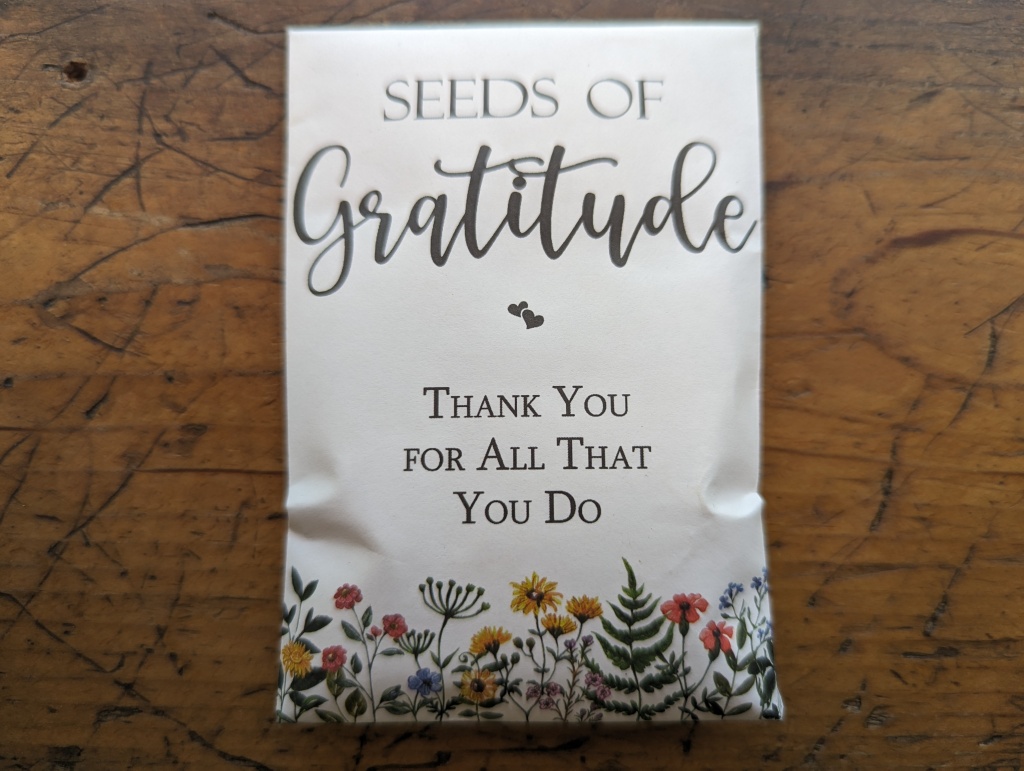
3. Someone who does not take compliments well diverted this one to me. No one knows what seed it contains, but I suppose that we will find out when it grows after next winter.

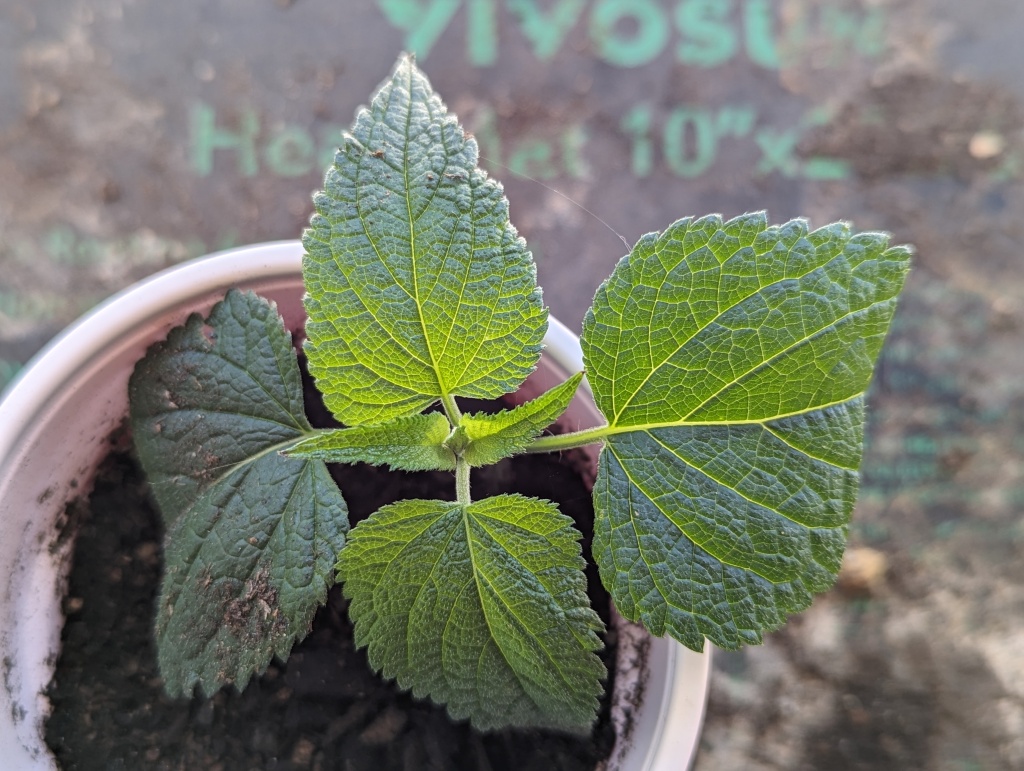
4. Salvia guaranitica ‘Rhythm & Blues’ came as a cutting in a red Solo cup with the pack of unidentified wildflower seed. This is why I abide by my rule that disallows purchases.

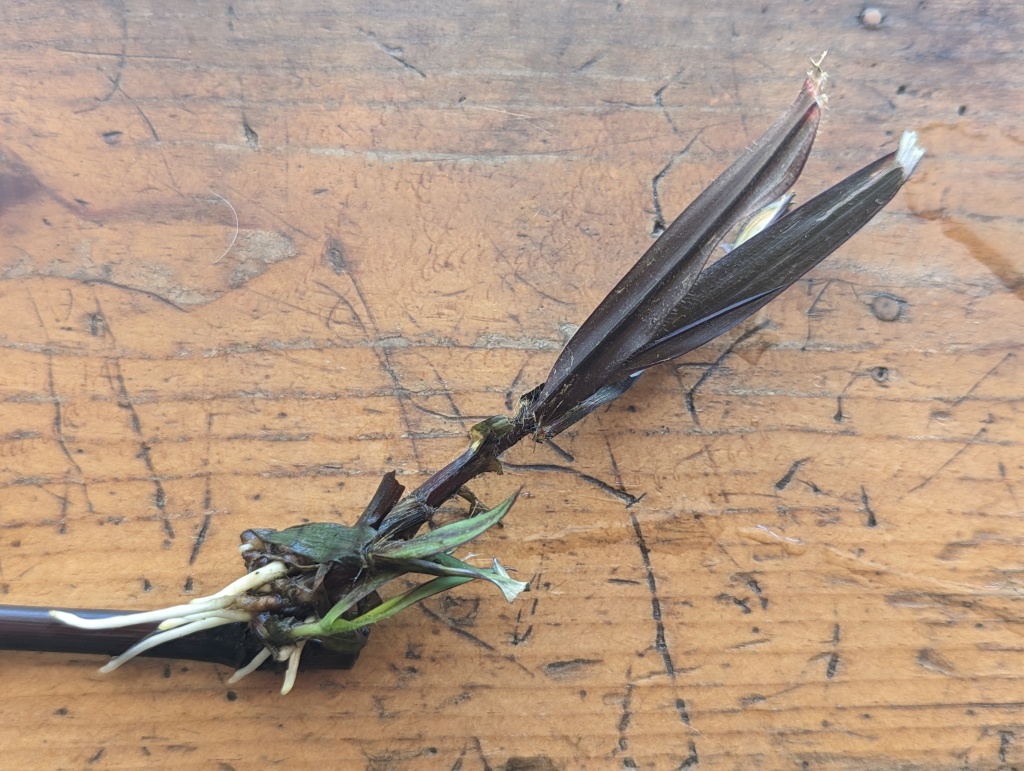
5. Saccharum officinarum ‘Pele’s Smoke’ sugarcane provided more cuttings than I knew what to do with. Fortunately, most succumbed to frost. I can accommodate these fifteen.

6. However, they are merely the fifteen best specimens that were big enough for #1 cans. At least as many smaller cuttings that got separated from them still need four inch pots.

This is the link for Six on Saturday, for anyone else who would like to participate: https://thepropagatorblog.wordpress.com/2017/09/18/six-on-saturday-a-participant-guide/

Cosmos

Cosmos has potential to almost naturalize.

For the past few years, I have really been overly indulgent with the seed catalogues from Renee’s Garden. I wanted to try more varieties of classic annual cosmos, Cosmos bipinnatus, than I could fit in my garden. I recently grew ‘White Seashells’ with tubular ray flowers, and colorful ‘Double Click’ with ruffled semi-double and double flowers, and even the ‘Dancing Petticoats’ mix, which includes several varieties! By now, I have probably grown all but a few of the many offerings.

After trying so many though, I still can not tell you which are my favorites. It would not matter much anyway, since I did not deadhead them to deprive them of their abundant seeds. Their self sown progeny are now mixed and beginning to bloom in random shades of pink ranging from pale pink to nearly red to nearly purple, with a few white.

Naturalized cosmos eventually reverts to bloom with more genetically basic single flowers in simpler shades of pink and white, on stems about three or four feet tall. They can even get taller than six feet and wider than two feet. Most of the popular garden varieties that I started out with though stay less than three feet tall. ‘Sonata’ is a popular strain that stays even shorter, so is among the most practical and proportionate for refined gardens.

Seed can be sown or new plants can be planted now to bloom through summer. Naturalized plants are already blooming only because they get an earlier start. Regardless of color or form, all cosmos flowers are about three inches wide, with yellow centers. Their finely textured pale green foliage is quite delicate and airy. 

Some Exotic Annuals Self Sow

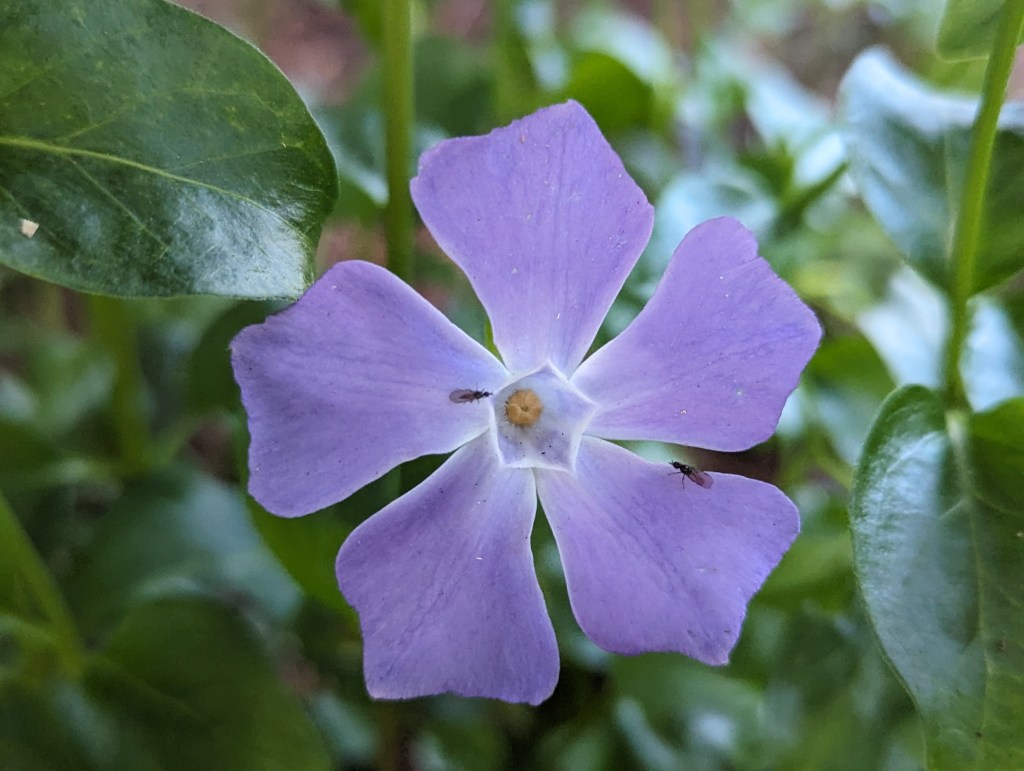
Periwinkle can naturalize a bit too aggressively.

It is impossible to say how long native wildflowers have adorned the natural landscape of California. Various lupines, California poppy and evening primrose had always been the most colorful wildflowers locally until they began to be displaced by exotic (non-native) plants only in the past two centuries or so. Although natives are remarkably resilient to dry summers and occasional wildfires, they are not very competitive with more aggressive and prolific invaders. What the natives and exotics have in common though is that they are so well adapted to local environmental conditions that they are able to perpetuate without much help.

Lupines, poppies and evening primrose, as well as native yarrow, godetia, and fleabane, may unfortunately need a bit of help if exotics want to move into their territory. In areas that are regularly or even only sometimes watered, weeding to remove more aggressive exotic plants helps the natives stay in control. They should otherwise do well on their own. Although without irrigation their growing season is much shorter, natives are slower to be displaced, since so many of the otherwise competitive exotics are not adapted to dry summers.

Many exotic flowering annuals are prolific enough to almost become naturalized, but are not quite aggressive or adaptable enough to get very far from cultivated landscapes. Cosmos, nasturtium, alyssum, catchfly (silene), four o’clock, gaura and foxglove self sow so readily that they are considered by some to be invasive. Some of us instead consider them to be ‘reliable’. They can be useful for unrefined parts of the garden that we do not mind watering, but otherwise do not want to put much effort into.

However, foxglove and even nasturtium can actually become noxious weeds in coastal areas not too far from here. I think that forget-me-not, feverfew, baby tears and English daisy can be problematic anywhere that they get enough water. Also, most annuals eventually revert to more genetically stable forms; which is why all varieties of dwarf nasturtium eventually bloom with the same yellow or orange single flowers. Yet, if we can distinguish between the plants that we can appreciate for their reliability and those that can be too invasive, native and exotic wildflowers and not so wild flowers can make gardening a bit easier.

Timeout

A moment before sunrise over Phoenix.

Apologies for my absence.

Perhaps no one noticed. Most of my posts were automated prior to my departure, and I managed to compose a few brief articles for what was not automated; so ultimately, there was no lapse of posting. I may have only been negligent with response to comments for the last two weeks.

Realistically though, I have been intending to discontinue blogging and recycling old articles, and to post only my weekly gardening column, in two parts, on Mondays and Tuesdays. I merely have not done so yet.

Anyway, my trip, although very different from how it was planned, was totally excellent! Just a short distance from the turnoff for the southbound San Diego Freeway towards my primary destination in Los Angeles, I was diverted to my secondary destination northwest of Phoenix. I missed the desert scenery as I drove all night to arrive shortly before four in the morning, and began my vacation exhausted. Although I missed out on some of my plans in Los Angeles, I got more time in Arizona. The weather was weirdly excellent, with a weirdly torrential thunderstorm right in the middle of it. It was too early in the year to collect the seed that I wanted, but I really was not expecting to find any anyway. I did happen to procure a hedgehog cactus of some sort. I decided that, since my return was already delayed by a day, that I may as well delay it for two days. (I had brought some of my work with me, so was able to tend to it prior to my return rather than after.) Therefore, I came to my original primary destination in Los Angeles secondarily, stayed to help Brent with the View Park Garden Tour on Sunday, and returned home on Monday.