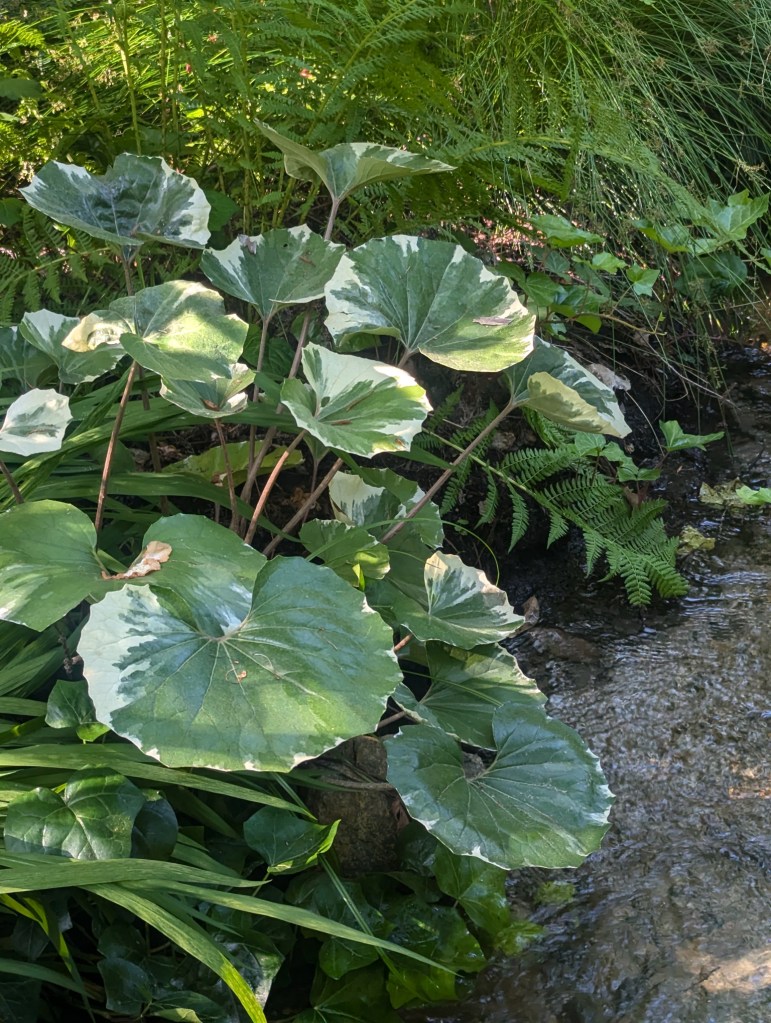
Not much can survive in the shade of broad eaves that extend over a northern exposure. With sufficient watering, that is where the leopard plant, Farfugium japonicum, can excel. It is naturally an understory species that prefers the shade of bigger vegetation. If it does not get too dry, it also performs well with full sun exposure. It enjoys organically rich soil.
Leopard plant is a striking foliar plant, but may also bloom for autumn or winter. Its bright yellow daisy flowers are about an inch wide, and bloom in loose trusses. The glossy and evergreen foliage might be foot and a half high. Some cultivars are more compact, while old cultivars may get slightly bigger. Individual leaves are about three to six inches wide.
Popular cultivars of leopard plant are notably diverse. Most are variegated with yellow or white spots, blotches, margins or irregular streaks. Some exhibit wavy, crinkly or convex foliar margins. Yet, the most popular is likely the old fashioned cultivar with simple, deep green foliage. Their subterranean rhizomes migrate, but rather slowly. Too much fertilizer can cause foliar burn or even inhibit bloom.
After the warm and arid summers here, ferns enjoy the beginning of the rainy season in late autumn or early winter, which is about now.
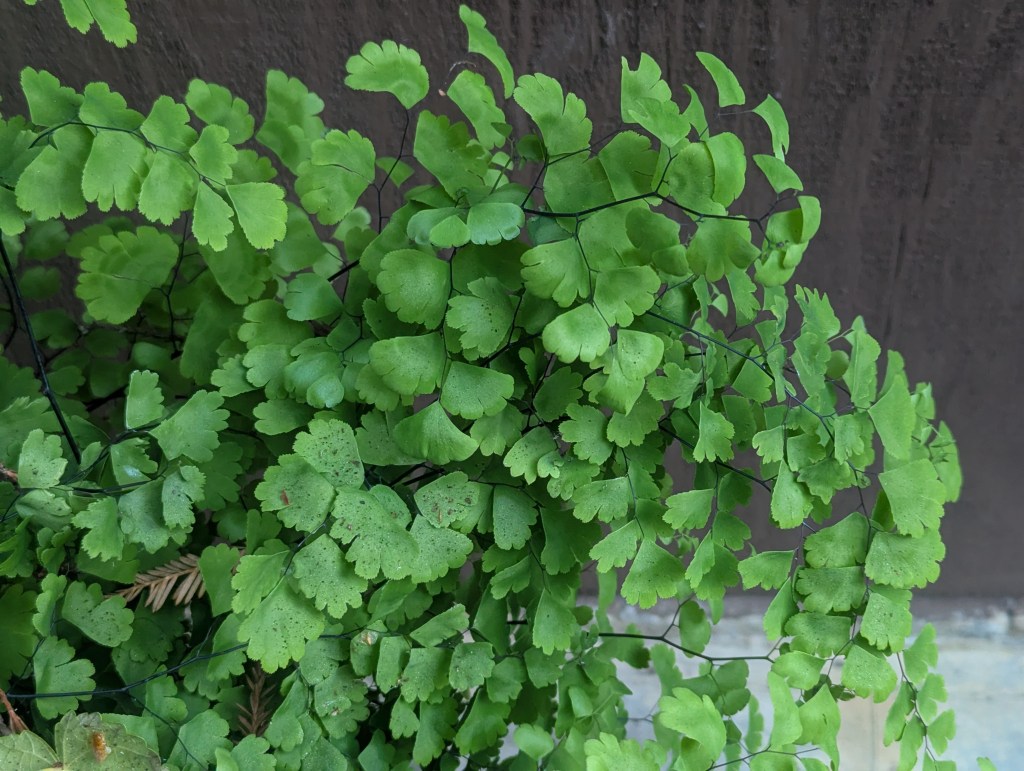
1. Adiantum capillus–veneris, Southern maidenhair fern replaces all its tired old foliage for autumn. It resembles native species of maidenhair fern, but with distinct foliar form.
2. Nephrolepis cordifolia, sword fern remains within a big pot because it can be invasive in the ground. It is directly related to Boston fern, but is not quite as soft and pendulous.
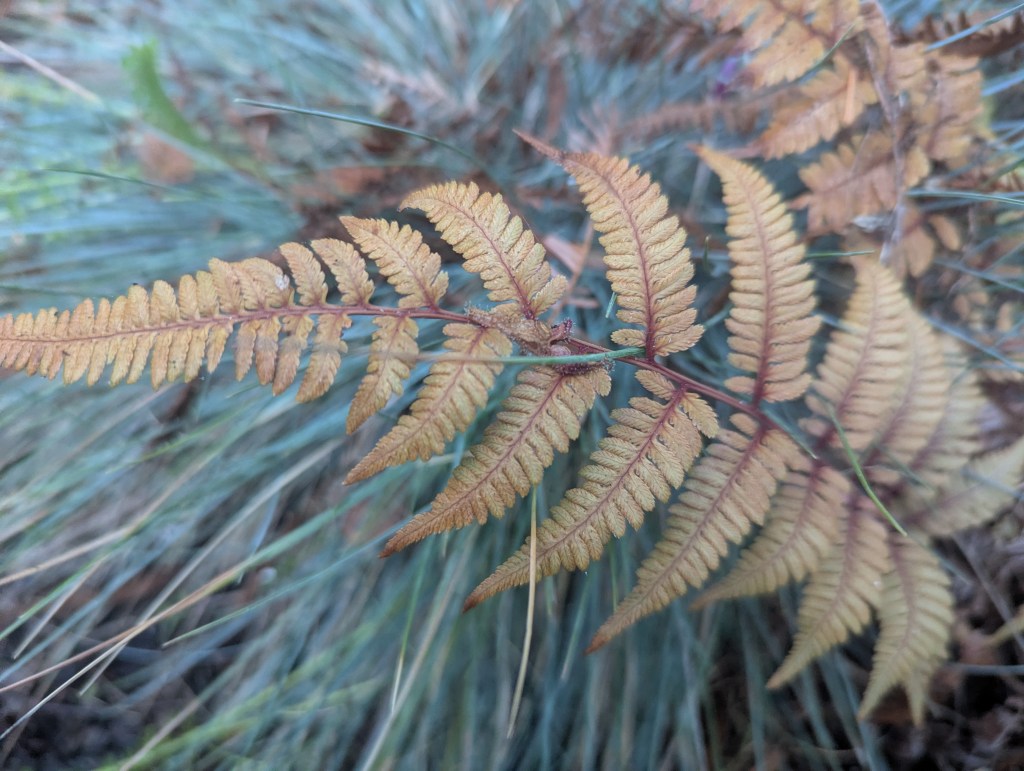
3. Dryopteris erythrosora, autumn fern is the only fern here that exhibits autumn foliar color. It is pretty, but quite diminutive. It is no bigger now than it was several years ago.
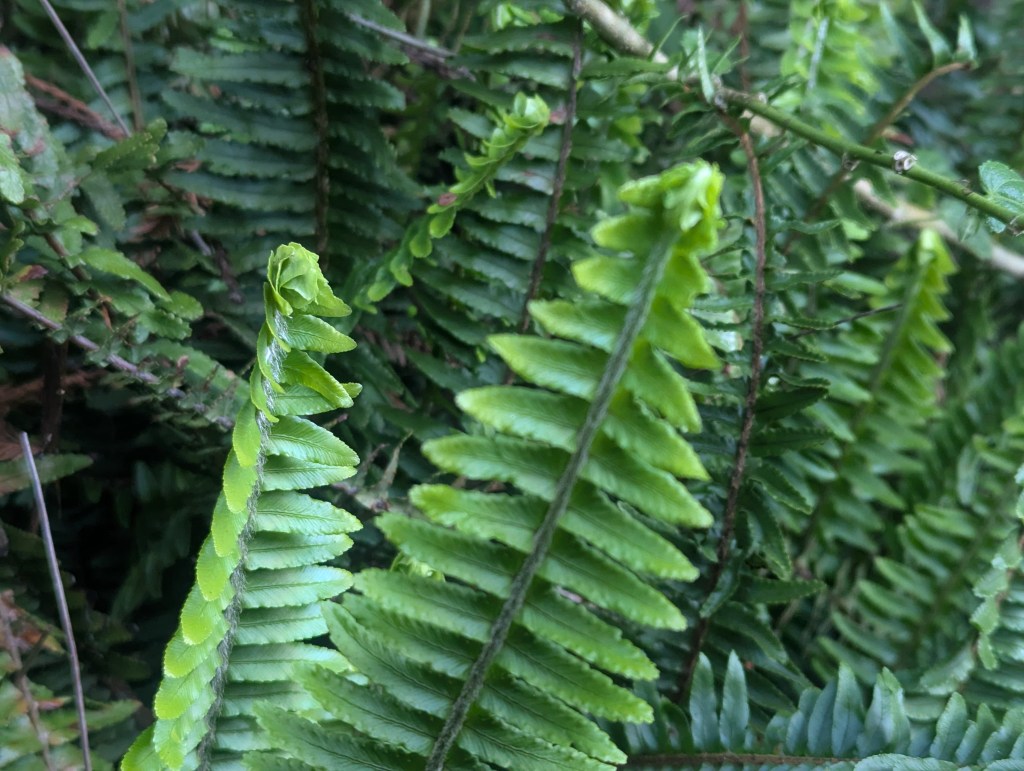
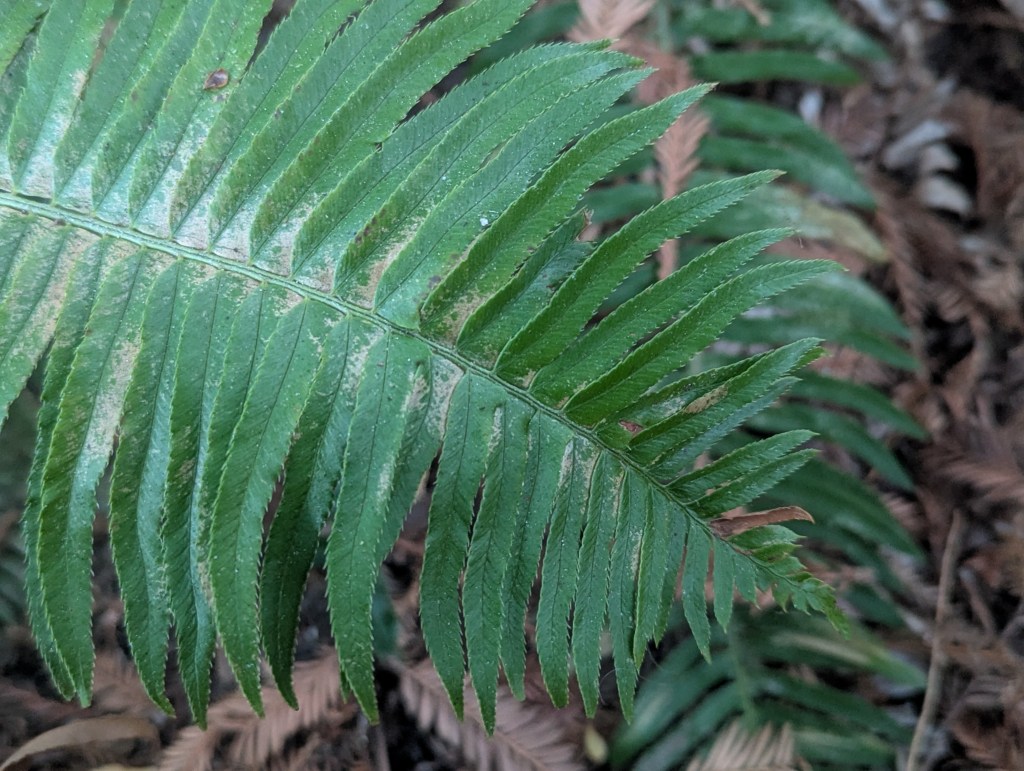
4. Polystichum munitum, Western sword fern and the next two ferns are native here. All three grow wild within some of our landscapes; and all are remarkably tolerant of shade.
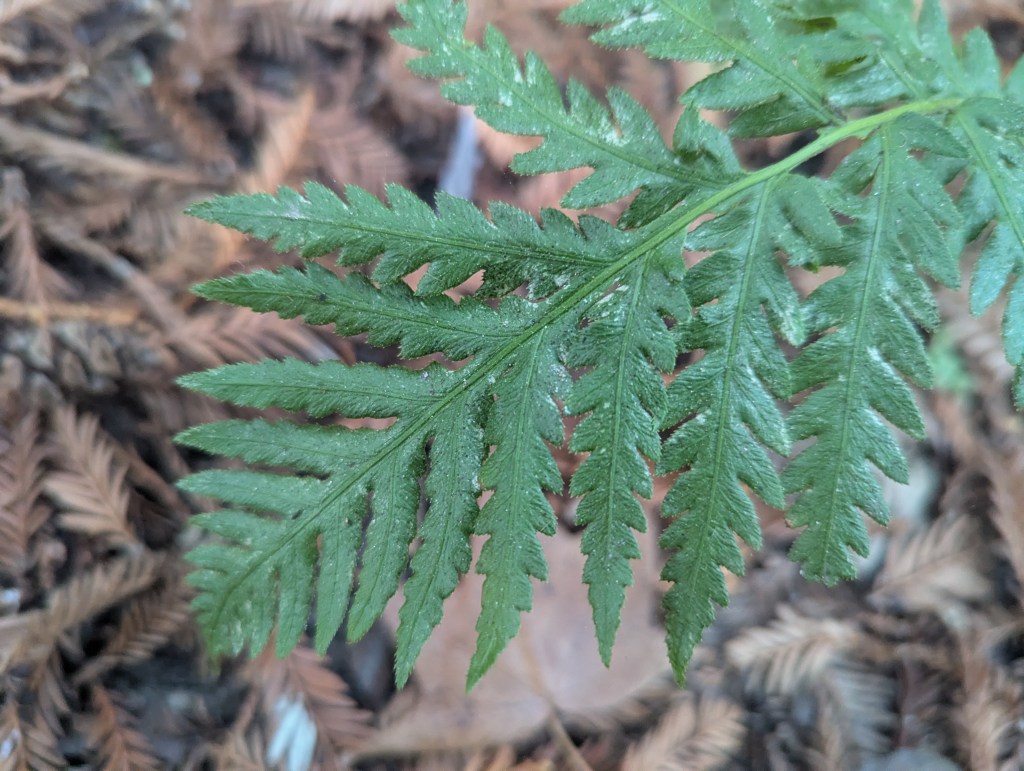
5. Athyrium filix–femina, lady fern is also known locally as ostrich plume fern, but is not related. It has tender leaves with almost succulent rachises that break easily if disturbed.
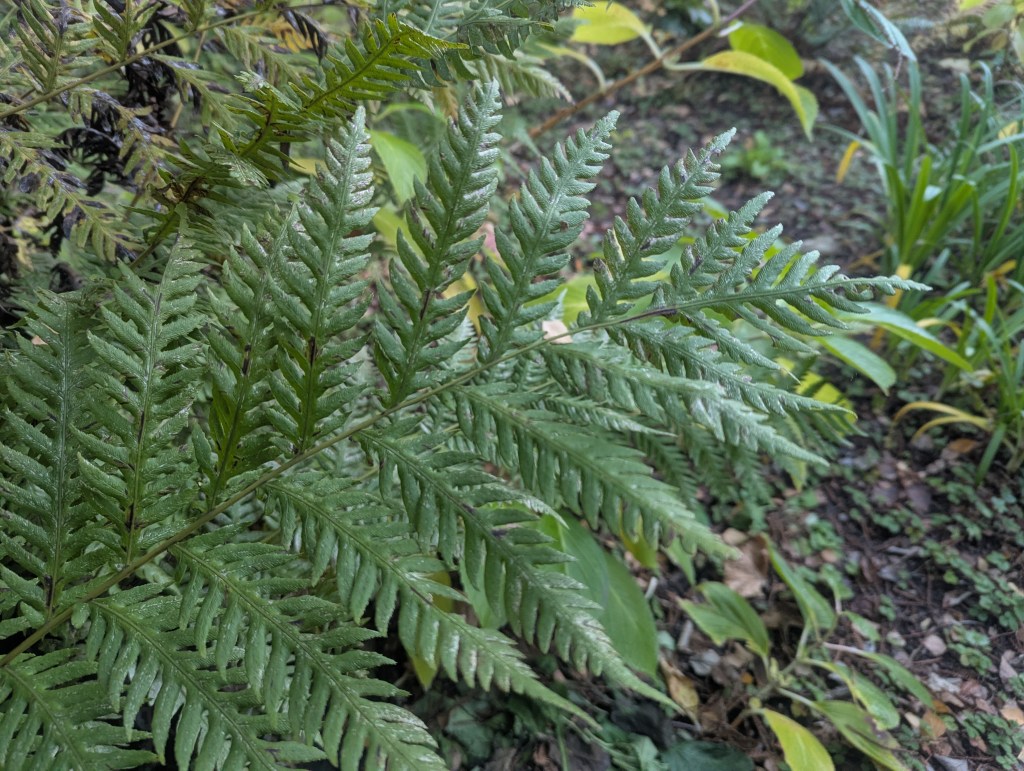
6. Woodwardia fimbriata, giant chain fern has a similar foliar texture, but is bigger and more resilient than lady fern. We sometimes need to remove big superfluous specimens.
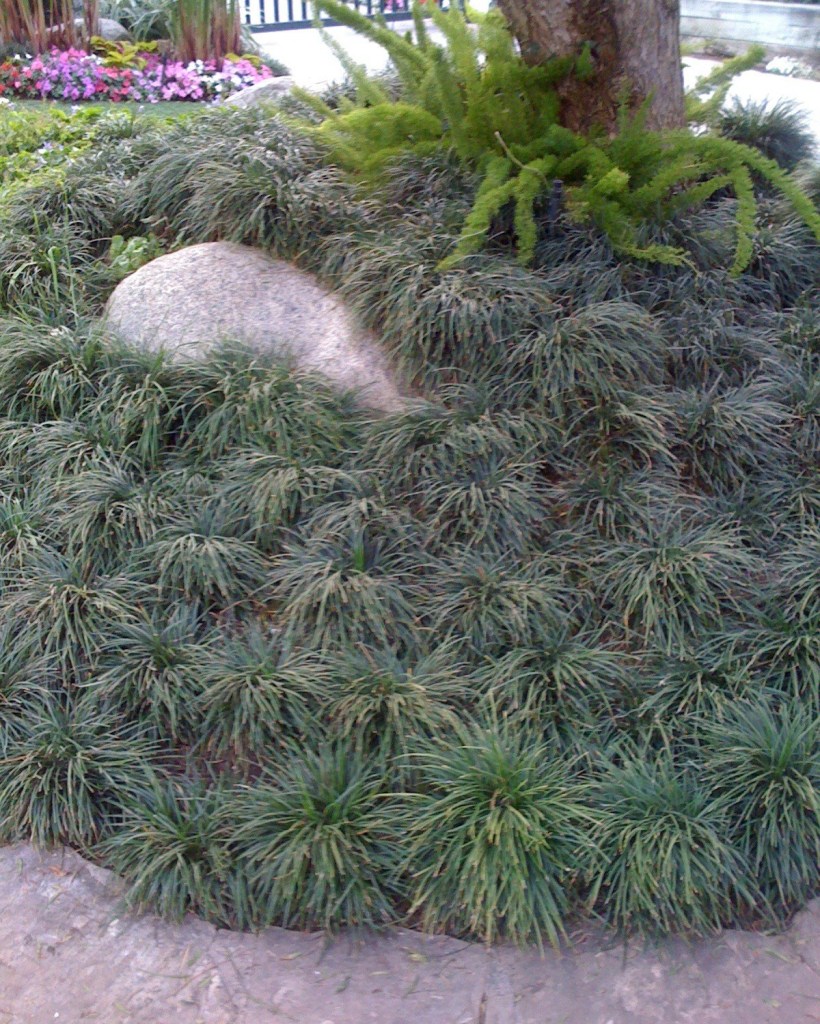
The thick clumps of evergreen grass-like foliage of mondo grass, Ophiopogon japonicas, make a nice lumpy ground cover for small spaces. Because it is rather tolerant of shade, and actually prefers partial shade to full sun, it works nicely under Japanese maples or highly branched overgrown rhododendrons. It gets only about half a foot deep. Narrow stems with small pale purplish blue flowers that bloom in summer are not too abundant, and are generally obscured below the foliage, but can actually get taller. ‘Silver Mist’ is variegated with white.
New plants are easily produced by division of large clumps. Overgrown or tired looking clumps can be shorn down at the end of winter, before new growth begins. Slugs and snails can be problematic.
Even for some understory species, shade can inhibit bloom. For Hosta, that would not be much of a problem. Its late summer bloom is merely an added bonus to its lushly colorful foliage. Actually, the foliage is more appealing without its tall floral spikes. Such bloom is prettier in a vase anyway. The hanging white or lavender flowers are an inch or two long.
Where summer weather is cooler, some Hosta can grow three feet tall and twice as wide. Locally, only a few of the largest cultivars can grow as wide as three feet during summer. Then, they defoliate by winter. Most have broadly rounded leaves, but a few have narrow or wavy leaves. Many have paler green, yellow or white variegation, or glaucous foliage.
Hosta is uncommon here, probably because it may be somewhat demanding. It requires very regular watering to avoid desiccation. It craves organically rich soil or potting media. Fertilizer can enhance lushness, but can burn foliage if just slightly excessive. Slugs and snails can ruin foliage. However, Hosta are understory plants that tolerate a bit of shade.
Its unappealing common name is less common than its more agreeable botanical name. Lungwort does not sound as pretty, or at least as official as Pulmonaria officinalis. It is an evergreen perennial, although its foliage likely desiccates through summer. New foliage replaces it during cooler autumn weather. Lungwort prefers cool and moist partial shade.
Mounds of foliar rosettes grow no deeper than a foot. They often stay only half a foot high as they spread as wide as two feet. Their lowest rhizomes produce adventitious roots so that they can sprawl even farther. Such growth is easy to divide. Foliage of most cultivars exhibits pretty lighter green or silver spots or blotches. Some is almost completely silver.
Lungwort blooms mostly for late winter and early spring. Trusses of daintily small flowers hover barely above their basal foliage. The most popular sort blooms with pinkish purple flowers that mature to blue. Others bloom with purple, pink, purplish red or white flowers. Although foliage is healthier within partial shade, sunshine promotes profusion of bloom.
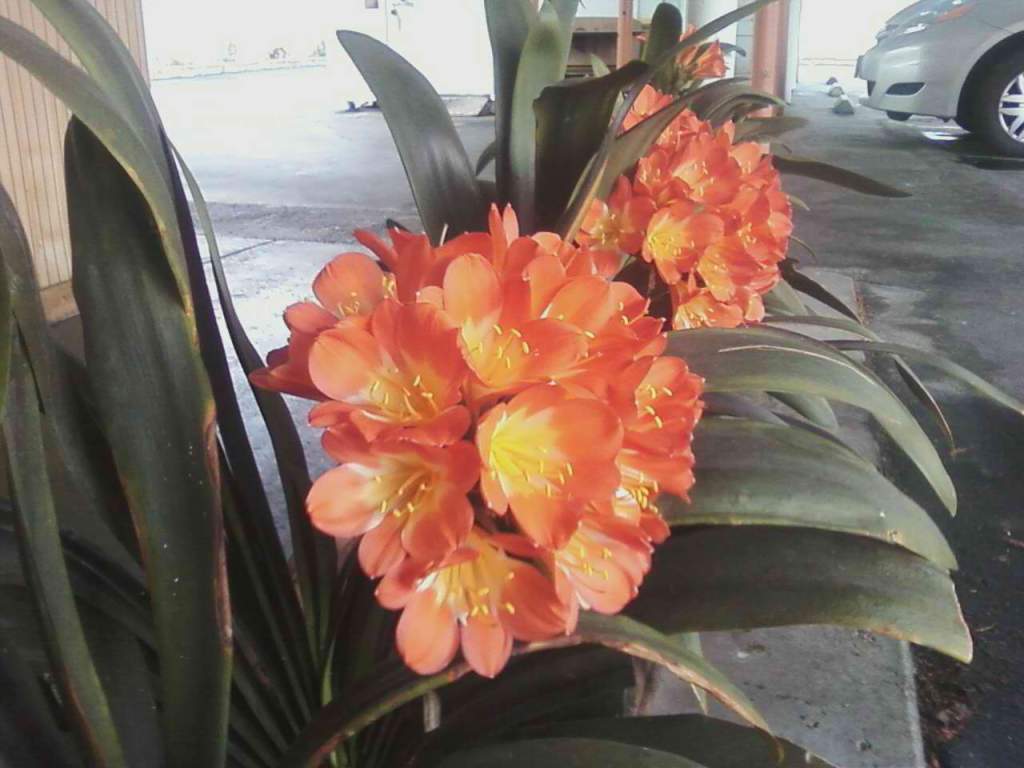
Kaffir lily may look like a bright orange lily of the Nile.
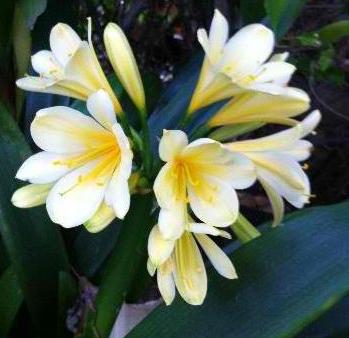
Not much more than a decade ago, Kaffir lily, Clivia miniata, was known almost exclusively for big rounded trusses of boldly bright orange flowers at the end of winter or beginning of spring. Relatively recent breeding has extended the color range to include some softer shades of orange as well as many shades of yellow and reddish orange. Solomone Hybrids are various shades of yellow. ‘Flame’ is brilliant reddish orange. Some varieties bloom earlier in winter. Others bloom later in spring.
Individual tubular flowers are actually rather small, but are clustered like hydrangea flowers on strong stalks that stand as tall as a foot and a half. Bright red berries sometimes appear after flowers fade. The rather rubbery foliage is deep green. The individual strap shaped leaves are rather wide and can be nearly a foot and a half long. Belgian and French hybrids have heftier flower stalks and wider leaves. Established plants do not like to be disturbed, but may get too crowded to bloom well if not dug and divided every few years or so.
Most gardens have some sort of shade. Those that are not shaded by substantial trees likely have shadows from houses or fences. Big eaves of ranch architecture make big shadows. So do tall Victorian houses. Yet, the disproportionately small gardens of bulky modern homes with high fences are shadiest.
There are not many trees that do well in shade. Most of those that do are rather small ‘understory’ trees that naturally prefer to be in the partial shade of taller trees. The many different Japanese maples are perhaps the most familiar. Vine maple is a similar maple from North America. Many dogwoods are likewise understory trees.
Eastern redbud, parrotia, strawberry tree, sweet bay and various podocarpus are not necessarily understory trees, but are quite tolerant of partial shade. However, stems that reach beyond the shade are likely to thrive at the expense of shaded parts if not pruned for confinement. For example, a fern pine (podocarpus) can be happy on the north side of a house, but can develop such a thick canopy where it gets good sun exposure on top, that lower growth gets shaded out. All palms tolerate significant shade while young, but most eventually grow beyond it.
There is more shade tolerant shrubbery to choose from, since shrubbery is naturally lower and more likely to be shaded by trees. Rhododendron, azalea, camellia, hydrangea, pieris, fuchsia, aucuba and Japanese aralia are about as familiar as Japanese maple is. Heavenly bamboo (Nandina spp.), Oregon grape, mountain laurel, flowering maple and various hollies are also worth investigating.
Because low growing perennials are naturally lower than both trees and shrubbery, many are naturally more tolerant to shade. Bear’s breech, cast iron plant, perwinkle, tradescantia, arum and forget-me-not can be so happy in shade that they can actually be invasive. Kaffir lily, bergenia, hosta, lily turf, ginger lily, coral bells and various ferns are much better behaved.
Foxglove, cyclamen and balsam (Impatiens spp.) are good annuals for shady spots. Cyclamen is actually a perennial that deteriorates during warm summer weather, but can regenerate as weather gets cool in autumn, to bloom through winter and early spring. Balsam does just the opposite, thriving through warm weather, but deteriorating with frost. Caladium and coleus can provide remarkably colorful foliage until frost. (Foxglove is actually biennial. Caladium grows from bulbs, but is rarely perennial.)
Despite their reputation as being aggressively invasive, both Algerian and English ivies can be resilient ground covers in significant shade. Baby’s tears likewise spreads as far as it gets water. Star jasmine is more complaisant, but only tolerant of moderate shade, and will not bloom as well as it does with better exposure.
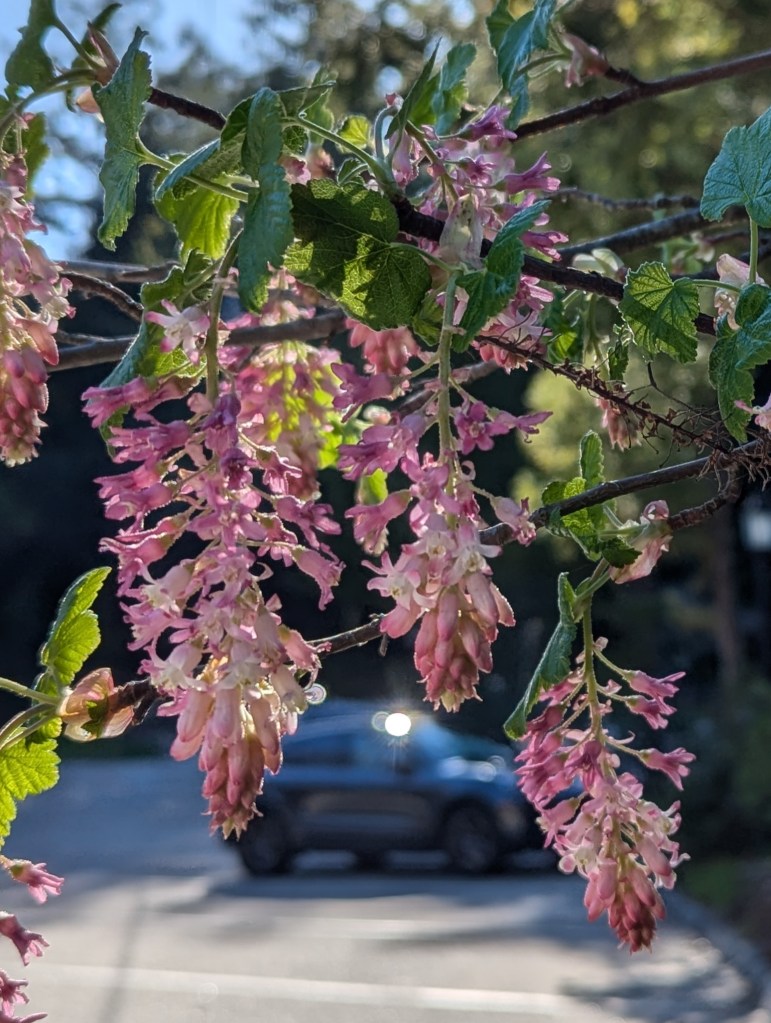
Its natural range extends from coastal Santa Barbara County to central British Columbia. Yet, red flowering currant, Ribes sanguineum, is elusive in the wild. It is more commonly observable within relaxed landscapes of native species. Individual specimens might not perform for more than a decade but can disperse seed. It behaves as if it is growing wild.
Mature specimens of red flowering currant can grow ten feet high and half as wide. Most stay lower. It is an understory species, so it tolerates a bit of shade. It may prefer shade to warm exposures. Young specimens may be wobbly enough to justify temporary staking. Removal of deteriorating old stems promotes more vigorous growth on fresh new stems.
Pendulous conical trusses of small pink flowers bloom by late winter or very early spring. Before anyone notices, birds are likely to take the few small currants that might develop. Small palmate leaves resemble those of scented geranium, and are somewhat aromatic. They turn yellow as they shed for autumn. Red flowering currant has a foresty character. It suits casual landscapes which border or merge into undeveloped areas.
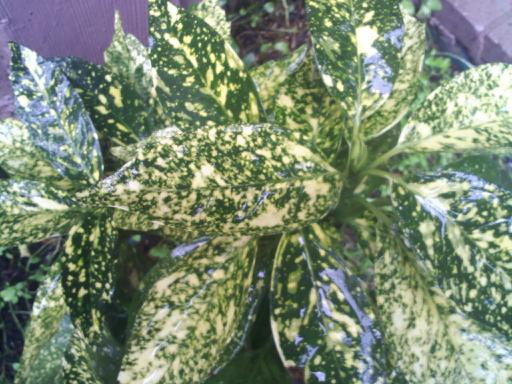
Gold dust plants actually prefers partial shade to full sun exposure.
Like so many hollies, the gold dust plant, Aucuba japonica ‘Variegata’, is grown more for its glossy foliage than for flowers or berries. The tiny dark red flowers that bloom in the beginning of spring are barely visible. Clusters of bright red half inch wide berries that ripen in autumn and winter are almost never seen without a male pollinator. Yet, the three inch wide and three to five inch long leaves are colorful enough with their splattering of light yellow spots. Gold dust plant grows rather slowly to about six to eight feet tall and wide, and does better in partial shade. Foliage can get roasted if too exposed to sunlight.
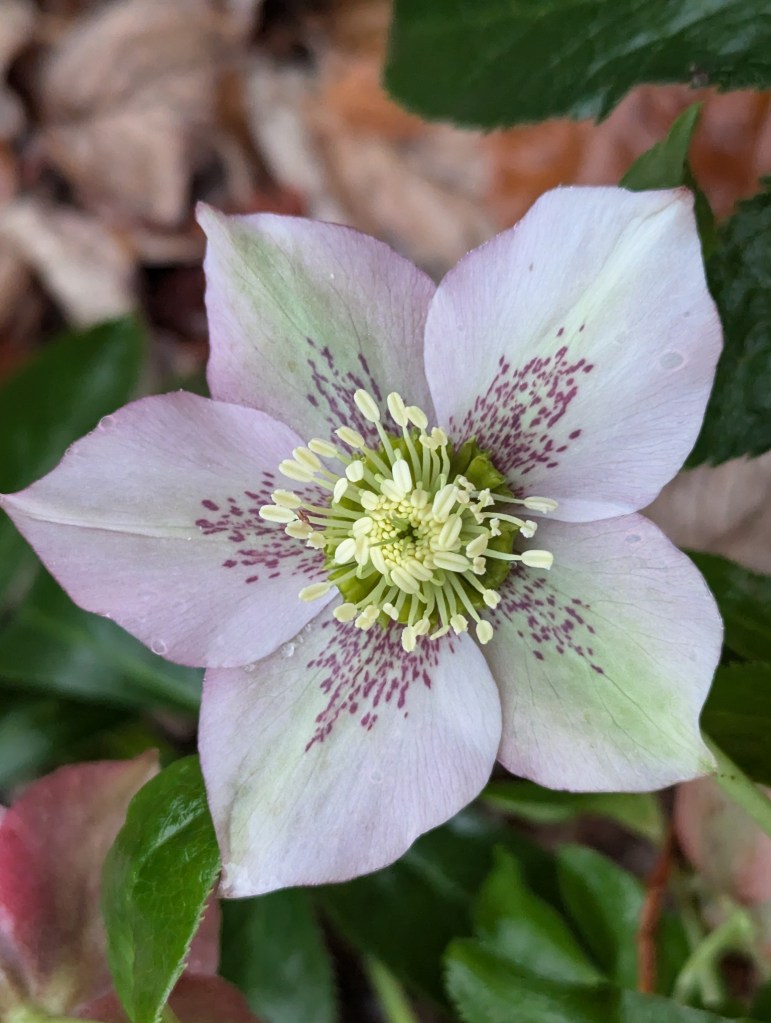
Where winters are too cool or damp for much else to bloom, hellebore are more popular. The most popular are Helleborus X hybridus, which are hybrids of a few similar species. Most are direct descendants of Helleborus orientalis. They are more resilient to frost than to arid warmth during summer. Actually, that is very likely why they are less popular here.
Locally, hellebore are useful for cool, damp or partly shady situations. However, they are not as substantial as ferns. Also, they can get a bit wimpy as the weather warms through summer. Although evergreen, they shed some of their older yellowing foliage. They grow most during late autumn, winter and perhaps early spring. They crave richly organic soil.
Floral color is typically subdued but interesting. Most common hellebore flowers are pale pink or almost grayish white with spots. Alternatively, they can be rusty red, maroon, pale green, yellow, gray or almost black. Some exhibit more or less spots, blotches, stripes or picotee edges. Double flowers are rufflier than single flowers are. All hellebore are toxic, and for some, can cause dermatitis.


 Tony Tomeo