
Shear Abuse

an . . . extreme example

Rosemary happens to be one of the many plants that is perhaps too versatile to be respected. Low ground cover forms and sculptural upright forms are probably at their best without much attention. Shrubby forms can instead be shorn strictly into neat formal hedges.

The problem is that most rosemary eventually gets shorn and deprived of natural shape and texture, whether it needs it or not. Those that should be upright and sculptural become rounded over like bean bag chairs. Ground cover forms without their naturally soft texture are like flattened hedges. Those that should be shorn are seldom shorn properly for confinement, so become distended and obtrusive.

The many different kinds of juniper are similarly disgraced. Instead of becoming sculptural small trees, Hollywood juniper and Eastern red cedar more commonly get shorn into nondescript shrubs. Shrubby types get shorn so often that their appealing textures are  never appreciated. Only a few of the densely foliated and compact junipers are conducive to formal shearing.

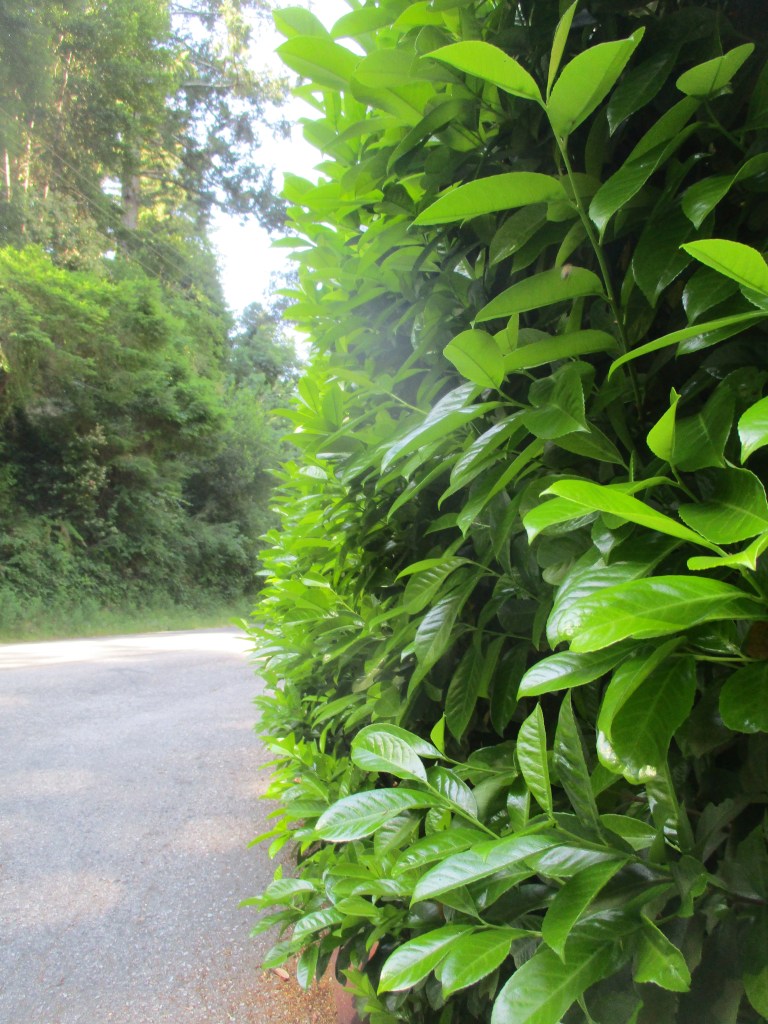
Shearing is certainly practical where formal hedges are desired, and for plants that have sufficiently dense and finely textured foliage. Yet, it is still important to shear such plants properly. Hedges should be slightly narrower at the top and wider at the bottom, so that lower foliage gets good sun exposure. Vertical surfaces are acceptable; but hedges should not be wider on top and narrower on the bottom.

Hedged or shorn plants should not be allowed to sneak out of their confinement to become obtrusive to usable space. For example, hedges along a driveway should not become so deep (from front to back) that they occupy usable space where cars could otherwise park. They function just as well if three feet deep as they would if they were eight feet deep!

Most hedged plants that should not have been hedged can be salvaged with a bit or work. Unfortunately, the process can be quite involved and makes the shorn plants unappealing while they recover. Overgrown privet hedges can simply get cut back to bare limbs (late in winter) and allowed to sprout back. They should be cut back farther than they need to so that new growth has room to expand.

Overgrown photinias are not so tolerant to severe pruning, so need to be cut back selectively to allow sunlight into the interior. The largest and most obtrusive growth can be cut out completely at first, as long as some lower growth remains to sustain recovery and shade interior stems. As new growth emerges from within, more of the overgrown outer growth can get removed until it is replaced.

Alternatively, overgrown photinias, as well as oleanders, osmanthus, large junipers and some pittosporums can be allowed to grow wild on top if their obtrusive lower growth gets pruned away. Such overgrown plants often have appealing trunks within. The only problem is that hedges pruned up into rows of small trees do not obstruct lower views as they may have been intended to do, unless they get pruned up only on one side.

Remember that shearing is not the only option. Properly pruned plant are allowed to grow into some spaces, but not where they will get in the way. Natural growth habits should be exploited instead of oppressed.
Shear Abuse

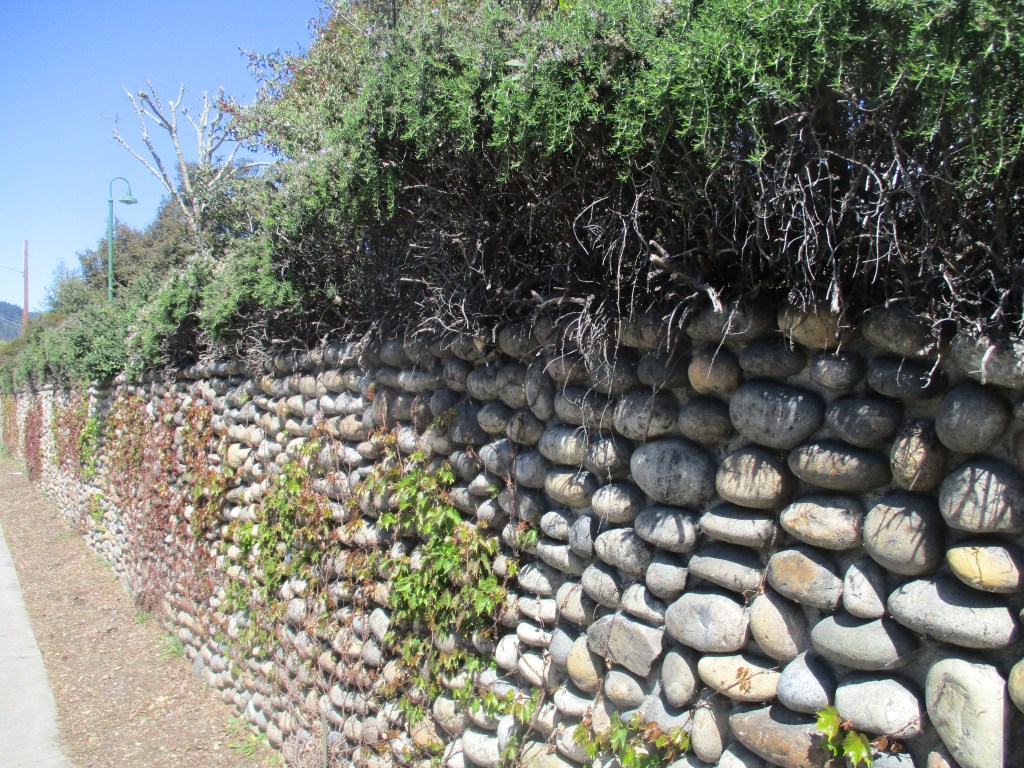
Cascading rosemary should actually cascade rather than get shorn into submission. (For this situation, it is subordinating to the climbing Boston ivy below.)

You can make fun of the decadent hair styles of the 1980s all you like; but you must admit that they were better than what came later. Back then, the assets of each particular type of hair were exploited instead of destroyed; sculpted instead of chopped into submission. Sadly, landscape maintenance evolved in a similar manner.

So many trees, shrubs and ground covers are either shorn too much to develop their naturally appealing forms, or not pruned severely enough to allow space for resulting new growth to mature and bloom like it should. Gardeners are notorious for shearing anything within reach. However, they are also notorious for allowing certain ground covers to get too deep and overgrown.

Trees that are short with multiple trunks when they first get planted are more likely than taller trees with single trunks to be shorn into nondescript shrubs. Olive, Japanese maple, tristania (laurina) and crape myrtle are commonly victims of this abuse. They are not only deprived of their form, but their grace and foliar appeal as well. Shorn crape myrtle may never be able to bloom.

Oleander, bottlebrush, arborvitae and various pittosporums that make nice informal screens in their natural forms are likewise very often shorn inappropriately and needlessly into all sorts of odd geometric shapes. Fortunately, pittosporums tend to make excellent formally shorn hedges as well as informal screens. Yet, when shorn without a plan, they more often develop into herds of noncontinuous geometric shapes. Oleander and bottlebrush, like crape myrtle, may never bloom if shorn too frequently.

Ground cover more often has the opposite problem. It does not get mown enough, or otherwise pruned down to stay shallow. This may not be a problem in most of the space covered by ground cover, but does make for hedge-like edges where the ground cover meets walkways, with all the problems of improperly shorn hedges. These edges can be softened if sloped inward and rounded off on top. However, lantana, star jasmine, acacia redolens and the ground cover forms of ceanothus do not bloom on these shorn edges unless the shearing procedure gets done at the right time to allow for enough new growth to mature in time for the blooming season.

There is certainly nothing wrong with properly planned and properly shorn formal hedges; but not everything needs to be shorn. Plants should be selected to be proportionate to their particular application without abusive shearing. Like the hair styles of the 1980s, the assets of each particular plant should be exploited instead of destroyed.

Shear Hedges Seasonably And Properly

Scheduling is important to hedging too.

There are rules to hedging. For example, hedges should be uniform and exclusive to just a single cultivar. A modern ‘Green Beauty’ boxwood will never conform within a hedge of more yellowish old fashioned boxwood. Hedges should also remain within confinement. It is important to shear them back from obtrusion into walkways and other usable spaces.

It is not as simple as it seems to be. That is why so few hedges get proper maintenance. Almost all occupy and therefore waste more space than they need. Most have wide tops that shade out narrower lower growth. Moreover, many plants that are not components of hedges all too commonly succumb to inappropriate shearing too. It is sheer shear abuse!

Even if done properly, only hedges and a few other plants are conducive to shearing and hedging. It is an aggressive procedure that compromises form, texture and bloom cycles of involved plants. For hedges, that is not a problem. They need not bloom, and adapt to a refined hedged form, which is more desirable than their natural shrubby form would be.

However, it is important to not unnecessarily shear plants that bloom, or provide intricate foliar texture or form. Shearing deprives rhododendron of young floral buds. It ruins foliar texture of Heavenly bamboo, and foliar form of Japanese maple. It is acceptable to shear boxwood only because it responds by generating such appealingly uniform foliar growth.

With proper scheduling, it is possible to shear only a few blooming plants without ruining all of their bloom. Aggressive shearing after the early bloom of oleander and bottlebrush leaves them with space to grow enough to bloom again during autumn. Without sufficient space to grow, they will require subsequent shearing, which will ruin subsequent bloom.

It is better to shear some of the simpler hedges, such as privet and boxwood, shortly after winter. They regenerate lush growth immediately afterward, and do not mind two or three annual shearings. The last shearing should be early enough to allow a bit of growth prior to autumn. Photinia generates appealingly bronzed new growth in response to shearing. Also, frequent shearing inhibits potentially undesirable bloom.